CPT code 48152: Whipple procedure without pancreatojejunostomy
CPT code 48152: Official description and procedure overview CPT code 48152 descr...

Last Updated: Nov 13, 2026
92314 is the CPT code for a corneal contact lens prescription for both eyes, with the fitting directed and performed by an independent technician. The prescribing physician or optometrist sets the lens characteristics and supervises the patient's adaptation.
Who fits the lenses separates 92314 from 92310, which covers the same service when the prescriber fits them personally. Neither code applies to aphakia, and Medicare lists both as non-covered.
Let Pabau's smart automation suggest the right codes, reduce claim denials, and keep your practice compliant—effortlessly.
Automate repetitive tasks and focus on what matters most—your patients.
Reduce coding errors and ensure compliance with the latest regulations.
Clean claims, fewer denials, and faster reimbursements.
Powerful insights and reporting to help your practice thrive.
HIPAA compliant SOC 2 certified GDPR-compliant Trusted by 4,000+ clinics worldwide

CPT Code 92314 covers a corneal contact lens prescription for both eyes, except for aphakia, with the fitting directed to an independent technician.
Who performs the fitting decides the code: 92310 applies when the prescriber fits the lenses personally, and 92314 when an independent technician does.
The 92310-92317 family splits by aphakia, number of eyes and lens type, then repeats as 92314-92317 for technician-directed fittings.
Medicare lists 92314 with status N, a non-covered service, so these claims usually go to vision plans or commercial payers.
Ophthalmologists and optometrists both bill 92314, and the chart must name the technician who performed the fitting.
CPT Code 92314 is the code for a corneal contact lens prescription for both eyes, with the fitting performed by an independent technician. Indiana Medicaid’s vision services code table reprints the full AMA descriptor, which reads as follows.
Prescription of optical and physical characteristics of contact lens, with medical supervision of adaptation and direction of fitting by independent technician; corneal lens, both eyes except for aphakia.
Three elements are embedded in that descriptor.
92314 is a both-eyes code for patients who still have their natural lens. A technician-directed fitting for aphakia goes to 92315 for one eye or 92316 for both, and a corneoscleral lens goes to 92317. The code sits in the Medicine section of the CPT codebook, under Ophthalmology, in the contact lens services range (92310-92326).
The descriptor carries no patient-status condition. New and established patients are billed with the same code, and no spectacle-substitution statement is part of it.
Scope drives two common billing mistakes: billing 92314 when the prescriber fitted the lenses personally, and expecting the code to cover lens materials.
Refraction is a separate service, reported with 92015 when it is performed and documented. A fitting to manage keratoconus is reported with 92072, not with 92314. Contact lens materials are billed with HCPCS V-codes (V2500-V2599) only where the payer covers them.
CPT Code 92314 and 92310 describe the same clinical scenario: corneal lenses for both eyes, except for aphakia. They differ on one criterion, which is who performs the fitting.
The lower work RVU on 92314 reflects the share of the service that moves to the technician. A practice that bills 92310 for technician-run fittings overstates the prescriber’s work on every line.
CPT Code 92314 belongs to an eight-code family. Three facts route a fitting to its row: the patient’s aphakic status, the number of eyes and the lens type. A fourth fact, who performs the fitting, picks the code within that row, as the grid below shows.
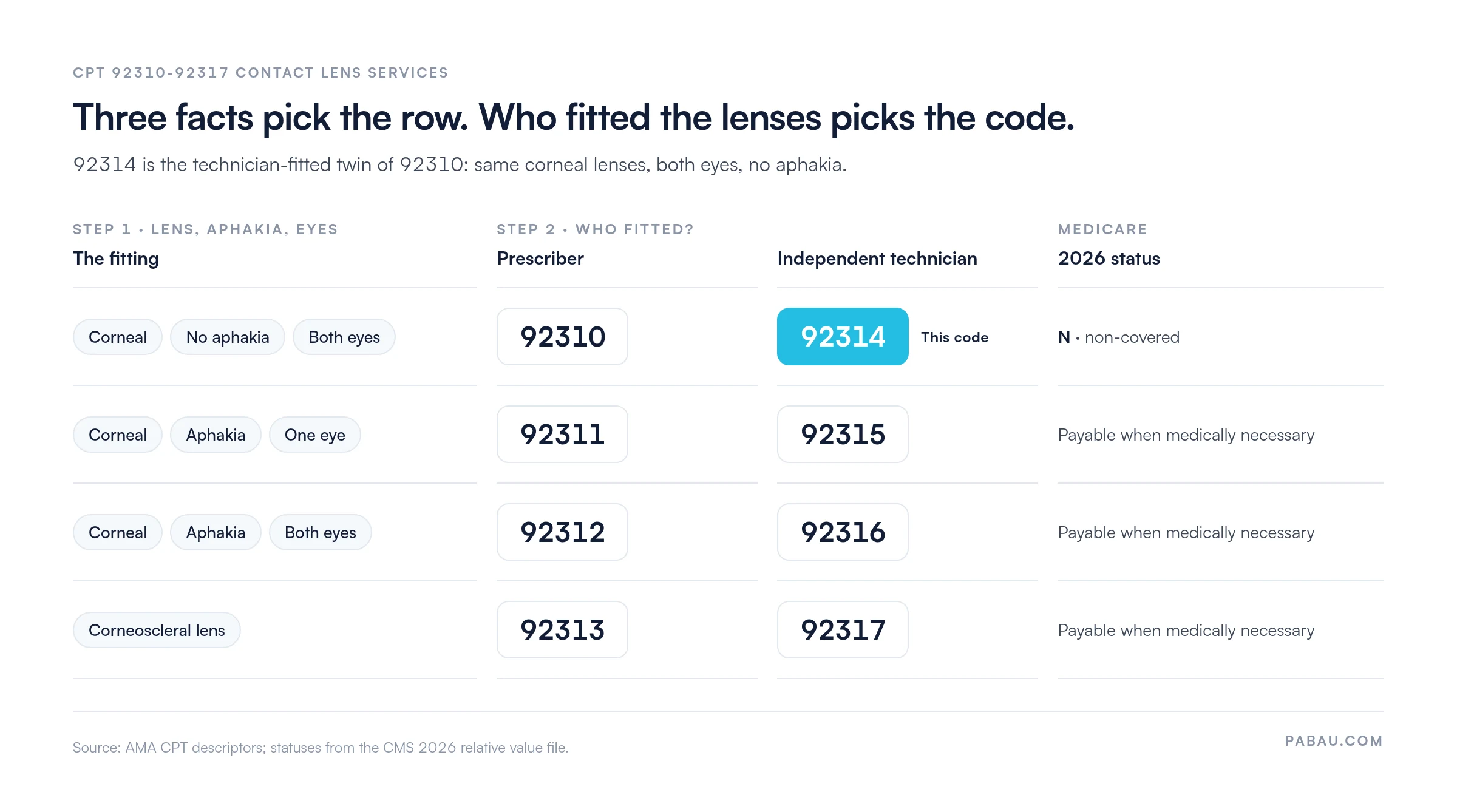
Each technician-directed code mirrors the prescriber-directed code in the same row. Medicare lists both codes in the first row as non-covered (status N). The aphakia and corneoscleral rows are active codes, payable when medically necessary. Descriptors come from the AMA CPT code set, and statuses from the CMS 2026 relative value file.
Ophthalmologists and optometrists can both bill CPT Code 92314 under their own NPI. The descriptor names no specialty, so the code is not limited to ophthalmologists.
Add a “fitting performed by” field to the contact lens encounter template, with prescriber and technician as the only choices. The answer selects 92310 or 92314, so the code follows the chart instead of the coder’s memory.
CPT Code 92314 is a refractive service for patients who still have their natural lens. The linked diagnosis should name the refractive error or corneal condition behind the fitting, with laterality.
Aphakia rule: If the chart records aphakia in either eye, 92314 is the wrong code. Its aphakic counterparts, 92315 and 92316, also carry a different Medicare status.
CPT Code 92314 already describes both eyes, so laterality modifiers do not apply. The fee schedule gives it a bilateral indicator of 9, which means the bilateral concept does not apply to the code.
Modifier 25 belongs on the E&M or eye exam code, such as 92012 or 92014, not on 92314. For a Medicare patient, an ABN is not required for a statutorily excluded service. A voluntary notice still helps the patient understand why the bill comes to them.
The chart note behind a CPT Code 92314 claim needs five documentation elements. Pabau, the practice management platform we build, pairs structured chart templates with its claims management software. The claim then draws on the same fitting record the payer audits.
Structured records with field-level capture make this documentation reproducible across prescribers and technicians. They also give the practice a complete file to hand over during a payer audit.
Medicare does not cover CPT Code 92314. The 2026 fee schedule lists it with status N, a non-covered service. Contact lenses for refractive error fall under the routine vision exclusion in Social Security Act Section 1862(a)(7).
Medicare’s contact lens benefit is tied to aphakia, which the 92314 descriptor excludes by definition. A technician-directed fitting for aphakia is billed with 92315 or 92316, and those codes are payable when medically necessary. When the prescriber fits a corneal lens to one aphakic eye personally, the claim takes CPT code 92311 instead.
Vision insurance: VSP, EyeMed and other vision benefit plans often handle contact lens fitting under a contact lens benefit, with their own fee schedules. Confirm the patient’s benefit before the visit, because plans differ on fitting allowances and lens types.
Medicaid: State Medicaid programs set their own vision rules, and adult coverage varies by state. Check the state’s provider manual before billing 92314.
The 2026 Medicare Physician Fee Schedule publishes RVUs for CPT Code 92314: 2.64 in an office and 0.86 in a facility. Medicare does not pay on them, because status N marks the code as non-covered. CMS publishes them for reference, and some commercial and vision fee schedules are built from them.
The RVUs come from the CMS relative value files for 2026 (October release), multiplied by the non-QP conversion factor. The dollar figures are reference values only. A commercial payer’s allowed amount depends on its own conversion factor and contract.
Most CPT Code 92314 denials trace back to one of six preventable errors. A systematic denial management workflow catches most of them before the claim leaves the practice. When a denial does arrive, the denial codes reference decodes the CARC and RARC on the remittance.
When appealing, include the chart note that names the technician, the prescriber’s fitting instructions and the lens prescription for each eye. Building a clean claim at submission avoids the appeal cycle entirely.
Run a quarterly report of contact lens lines by provider and date. Compare it with the days your technicians ran fitting clinics. Any 92310 billed on those days is worth a second look before an auditor finds it.
Many eye care practices still rekey the fitting record, the technician’s name and the diagnosis into a separate billing tool. Each rekeyed field is another chance for a technician fitting to go out as 92310.
In Pabau, US claims go out through Claim.MD, the clearinghouse integration for CMS-1500 and 837P claims. The claim is pre-filled from data already on the patient record, so the code and diagnosis match the chart note.
The integration also runs eligibility checks and posts 835 electronic remittance advice (ERA) when payers respond. That matters for 92314, where a vision plan or commercial payer usually pays instead of Medicare.

Pabau pulls the fitting record, the diagnosis and the code from the chart into a pre-filled claim, then sends it through Claim.MD. See how it works for eye care practices.

92314 turns on one fact the code number never shows: who fitted the lenses. Record the technician’s name and the prescriber’s lens prescription on every fitting, and choosing between 92310 and 92314 stops being a judgment call.
If your practice runs technician fitting clinics, audit last quarter’s contact lens lines for two patterns. Look for 92310 billed on clinic days, and for 92314 sent to Medicare as payable. Both are fixable with a resubmission, and both repeat until the charge template changes.
Book a demo to see how Pabau carries the fitting record, diagnosis and code from the chart into a clean claim.

Need to understand how clearinghouse submission works for CPT claims? Pabau’s guide to medical claims clearinghouses covers the full 837P submission workflow, payer enrollment, and ERA reconciliation.
Want to understand how electronic remittance advice connects to your claim status? Electronic remittance advice (ERA) explained breaks down 835 transaction files and CARC/RARC codes.
CPT code 92314 covers the prescription of corneal contact lenses for both eyes, except for aphakia, with the fitting directed to an independent technician. The prescriber sets the lens characteristics and supervises the patient’s adaptation. The lenses themselves and refraction (92015) are billed separately.
Who performs the fitting is the only difference. CPT 92310 applies when the prescribing physician or optometrist fits the lenses personally. CPT 92314 applies when an independent technician performs the fitting from the prescriber’s lens prescription. Both cover corneal lenses for both eyes, except for aphakia.
No. Medicare lists CPT 92314 with status N, a non-covered service, because contact lenses for refractive error fall under the routine vision exclusion. Append modifier GY when a secondary payer needs the Medicare denial. Technician-directed fittings for aphakia are billed with 92315 or 92316 instead.
Yes. Ophthalmologists and optometrists can both bill CPT 92314, because the descriptor names no specialty. The billing provider is the one who writes the prescription and supervises adaptation. Confirm vision plan credentialing for contact lens codes before the visit.
Yes, when the exam is a significant, separately identifiable service. Append modifier 25 to the evaluation and management or eye exam code, such as 92012 or 92014, not to 92314. Check the current NCCI edit table first, because CMS updates edit pairs quarterly.
The most common reasons are billing 92314 when the prescriber fitted the lenses personally, and using it for an aphakic patient. Other causes are sending it to Medicare as payable, splitting it into RT and LT lines, and putting modifier 25 on the fitting code.