CPT Code 25210: Excision of a single carpal bone
CPT Code 25210: Official descriptor and quick-reference data CPT Code 25210 is a...

Last Updated: Nov 26, 2026
V2799 is the HCPCS Level II code for vision item or service, miscellaneous. It covers a vision item or service that no other code in the V2020-V2799 vision services section describes.
Optometrists and ophthalmologists use it only after ruling out the item's own code family, since most families end in an "other type" code. V2799 has no fixed fee schedule amount, so payers price each claim from its narrative and invoice.
Let Pabau's smart automation suggest the right codes, reduce claim denials, and keep your practice compliant—effortlessly.
Automate repetitive tasks and focus on what matters most—your patients.
Reduce coding errors and ensure compliance with the latest regulations.
Clean claims, fewer denials, and faster reimbursements.
Powerful insights and reporting to help your practice thrive.
HIPAA compliant SOC 2 certified GDPR-compliant Trusted by 4,000+ clinics worldwide

HCPCS code V2799 is the miscellaneous vision code for an item that no other vision code, including its family’s own catch-all, describes.
Check the item’s own family first, because most vision code families end in an “other type” code such as V2199, V2599 or V2629.
Every V2799 claim needs a narrative naming the exact item, or the payer has no basis for pricing it.
V2799 has no fixed fee schedule amount, so the contractor prices each claim from the invoice and clinical notes.
In Pabau’s practice management software, the order, the notes and the Claim.MD claim sit on the same patient record.
HCPCS code V2799 is the Level II code for a “vision item or service, miscellaneous,” used only when no other vision code describes the item. The Centers for Medicare and Medicaid Services (CMS) maintains the HCPCS Level II code set, which covers supplies and equipment that CPT codes do not.
V2799 is the last code in the V2020-V2799 vision services section. That section holds the codes for frames, spectacle lenses, contact lenses, low vision aids, prosthetic eyes and intraocular lenses. V2799 closes its final block, V2700-V2799, which covers lens options and miscellaneous vision services such as tints, coatings, prisms and progressive lenses.
Like every miscellaneous code in HCPCS Level II, V2799 is a residual category meant for items that no existing vision descriptor fits. Payers expect billers to rule out every specific code first.
V2799 may be used for spectacles, contact lenses, intraocular lenses (IOLs), eye prostheses and other optical supplies. It applies only when no other vision code, including the item family’s own catch-all, describes the item. The operative word is “miscellaneous.” V2799 applies when you have a vision item in hand and no other vision descriptor fits.
Payers want specificity. Before billing V2799, review every code from V2020 through V2797 to confirm that no descriptor fits the item. Check V2797 as well, which covers a supply, accessory or service that is a component of another vision code. Carriers may down-code or deny a V2799 claim when a specific code exists.
V2799 does not cover any item or service that has a dedicated HCPCS code. Billing it when a specific code exists is a coding error, and payers deny it.
The V2020-V2799 vision services section is built in families, and most families end in their own catch-all code. An unlisted contact lens goes to V2599, and an unlisted prosthetic eye goes to V2629. A contact lens with a named design keeps its own code, so a gas permeable bifocal lens is code V2512. The chart below runs through each family in the order a coder should check it.
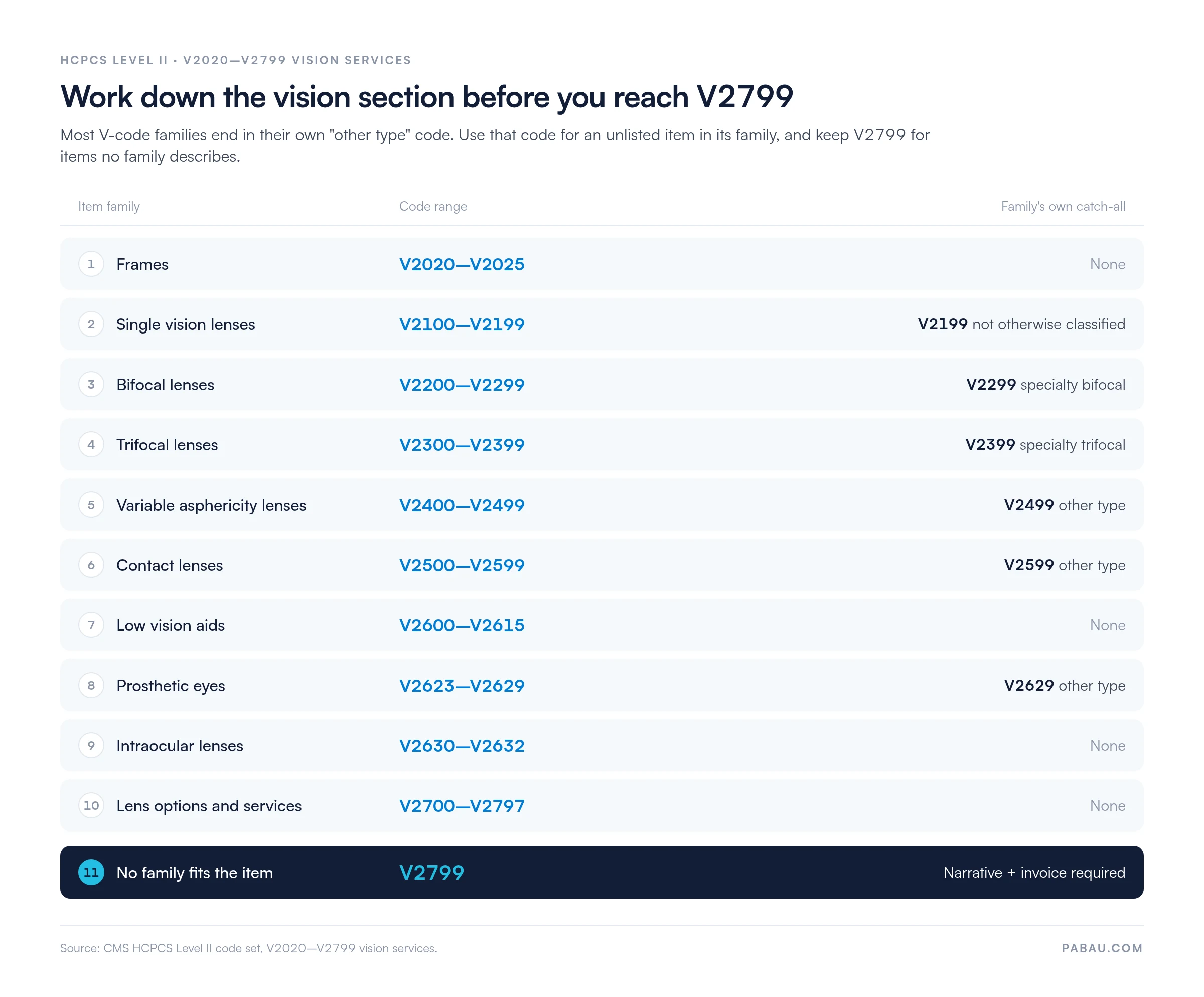
Single vision lenses (V2199), bifocals (V2299), trifocals (V2399) and variable asphericity lenses (V2499) follow the same pattern. V2799 is right only when the item belongs to none of these families.
Use the AAPC HCPCS Level II code lookup to verify whether a more specific code exists before assigning V2799. Pabau’s full HCPCS code library also has a billing guide for each vision code.
A V2799 claim goes out on the CMS-1500 or 837P once you have confirmed that no specific code fits. Payers read the narrative and modifier fields closely on a miscellaneous code.
Before submitting a V2799 claim, attach the supplier invoice to the claim file. DME MACs frequently request it as part of pricing determination for contractor-priced items, and having it ready saves a round of back-and-forth on pricing.
A miscellaneous code is priced and reviewed by hand. That gives the documents behind a V2799 claim more weight than they carry on a coded item. Every V2799 claim should be accompanied by the following:
Good medical billing compliance means keeping these documents for at least seven years. Keep them longer where state law or the payer contract requires.
No modifier is mandatory on every V2799 claim. Which ones you add depends on the item, the eye it is fitted to and the payer’s policy.
Requirements vary by region, so check the DME MAC Local Coverage Determination (LCD) for your jurisdiction before each submission.
Traditional Medicare Part B covers few vision items. The main exception is post-cataract spectacles or contact lenses after cataract surgery with IOL implantation. That is a defined benefit under Chapter 15 of the Medicare Benefit Policy Manual. Almost all other vision items fall outside Medicare’s standard benefit.
V2799 is not automatically covered. Coverage depends on the specific item, the payer, and whether the item meets medical necessity criteria. For 2026, V2799 carries no fixed amount on the CMS DMEPOS fee schedule because it is contractor-priced. The DME MAC reviews the submitted invoice and clinical documentation, then determines an allowable amount on a case-by-case basis.
When a high-cost item’s coverage or price is uncertain, contact the DME MAC before delivery. Have the invoice and clinical notes ready for its pricing review, and get a signed ABN where coverage is in doubt.
Payers review V2799 claims by hand, which gives them more grounds to deny one. The table maps each common reason to its typical claim adjustment reason code (CARC) and the fix.
Structured denial management processes route each denial reason to the right staff action. That keeps V2799 claims moving before they age past timely filing limits.
Run a quarterly audit of the V2799 claims from the previous 90 days and compare their denial rate with your specific V-code claims. A higher rate usually points to thin narratives or missing modifiers, and both can be fixed without changing how you select codes.
Medicare provides five levels of appeal for denied claims. Each level has a strict filing deadline. It is counted from the date you receive the notice, which Medicare presumes is 5 days after the date on it.
A V2799 item follows the same route whoever supplies it. Optometrists and ophthalmologists both bill a supplied item to the DME MAC as enrolled DMEPOS suppliers. Part B enrollment covers only the professional service, such as the exam or the procedure.
What differs by provider type is the professional service billed alongside the item. A practice that dispenses optical items without DMEPOS supplier enrollment cannot bill them under the physician’s Part B enrollment instead.
A V2799 claim usually means retyping the item narrative from the order, chasing the supplier invoice, and checking a payer portal for a pricing decision. When each step sits in a different place, a missing document only shows up once the denial arrives.
Pabau keeps the order, the clinical notes and the claim on the same patient record, with end-to-end claims management built in. The practice runs an eligibility check before the item is dispensed, then submits the CMS-1500 or 837P claim through Claim.MD.
ERA remittances post back to the claim, so the biller can see which contractor-priced V2799 claims are still open. When a supplemental plan picks up the balance, the secondary claim goes out from the same record. Keeping the narrative, invoice and notes together is how a claim meets the clean claim standards payers expect.

Pabau’s insurance billing sends CMS-1500 and 837P claims through Claim.MD. ERA remittances post back to the patient record, so contractor-priced claims stay visible until they are paid.

V2799 is a last resort, and payers treat it as one. Before you assign it, rule out the item’s own family code, because an unlisted contact lens or prosthetic eye already has one. A scleral cover shell worn over an eye still in the orbit has its own code too, V2627.
When V2799 is the right code, the claim stands or falls on its paperwork. Send the narrative, the invoice and the order together, and plan for a longer wait while the contractor sets a price.
To keep those claims on one record from order to remittance, book a demo and see how Pabau handles insurance billing for vision care practices.

Need a denial resolution framework? Denial management in healthcare covers the full workflow from remittance analysis to appeal submission.
Looking for clean claim standards? What is a clean claim explains the data elements payers require to process a claim without development.
Billing an unlisted spectacle lens? HCPCS code V2199 covers single vision lenses that no other V21xx code describes.
Billing an unlisted contact lens? HCPCS code V2599 covers contact lens types that no other V25xx code describes.
Is the item part of another vision service? HCPCS code V2797 explains when a supply or accessory is billed as a component of another vision code.
HCPCS code V2799 is the Level II code with the official descriptor “vision item or service, miscellaneous.” It bills ophthalmic supplies and services that no more specific code in the V2020-V2799 vision section describes. It is a catch-all code intended only when every other applicable vision code has been ruled out.
Use V2799 only after reviewing every code from V2020 through V2797, including the item family’s own catch-all, and confirming that none describes the item. Document this review in the billing record. Billing V2799 when a specific code exists is a coding error, and payers deny it.
Medicare Part B covers only medically necessary vision items, and most routine vision care is excluded. V2799 may be covered when the specific item meets medical necessity criteria, but it is never automatically covered. Post-cataract spectacles after IOL implantation are one of the few vision benefits Part B covers explicitly. Medicare Advantage plans may offer broader coverage. Even so, they often require prior authorization for a miscellaneous code.
Modifiers depend on the item and the payer. KX applies only where an LCD requires it. RT/LT mark the side, and RA/RB flag a replacement. GA, GY and GZ convey ABN or exclusion status.
V2799 has no fixed fee schedule amount for 2026. It is contractor-priced, meaning the DME MAC reviews the submitted invoice and determines an allowable amount on a case-by-case basis. Submit the supplier invoice with every V2799 claim to support the pricing determination.
Every V2799 claim requires a signed physician order and a narrative in Box 19 or the NTE segment naming the exact item. It also needs a supplier invoice for DME MAC pricing and clinical notes that establish medical necessity. Add an Advance Beneficiary Notice (ABN) when coverage is uncertain. Missing any of these elements is a primary denial trigger for miscellaneous codes.