CCSD code H4430: Examination of rectum under anaesthetic
CCSD code H4430 pays for the examination alone CCSD code H4430 is the UK private...

Last Updated: Oct 20, 2026
T2041 is the HCPCS Level II code for supports brokerage, self-directed, waiver; per 15 minutes.
Federal guidance sets the framework. Your state Medicaid agency sets the rules that decide whether a claim pays.
Let Pabau's smart automation suggest the right codes, reduce claim denials, and keep your practice compliant—effortlessly.
Automate repetitive tasks and focus on what matters most—your patients.
Reduce coding errors and ensure compliance with the latest regulations.
Clean claims, fewer denials, and faster reimbursements.
Powerful insights and reporting to help your practice thrive.
HIPAA compliant SOC 2 certified GDPR-compliant Trusted by 4,000+ clinics worldwide

HCPCS code T2041 covers supports brokerage, self-directed, waiver, billed per 15 minutes. It sits at the end of the T2012 to T2041 waiver services range.
Only providers enrolled in a state’s self-directed Medicaid waiver program may submit T2041 claims.
Medicare does not cover T2041, so every reimbursement rate is set by a state Medicaid agency and varies by location.
Each 15-minute unit needs a service note recording the start time, the end time, and the activity performed.
Practice management software like Pabau supports time-based unit billing and Medicaid waiver documentation workflows.
HCPCS code T2041 is a Level II Healthcare Common Procedure Coding System code maintained by the Centers for Medicare and Medicaid Services (CMS). It describes a specific service type within self-directed Medicaid waiver programs.
The T-code range that runs from T2012 to T2041 is reserved exclusively for Medicaid waiver services. No crossover to Medicare applies. Billers working across both payer types should flag T2041 claims for Medicaid-only submission to avoid unnecessary rejections.
A supports broker is a trained professional who helps individuals enrolled in a self-directed Medicaid waiver program manage their own care services. The broker does not deliver clinical treatment. Instead, they help the participant identify, access, hire, and manage the personal support workers who make up the care plan.
The role sits at the intersection of care coordination and administrative support. Key functions that fall under T2041 brokerage services include:
The scope of supports brokerage varies by state. Some Medicaid programs define it narrowly. Others fold financial management assistance into the role, which moves the line between T2040 and T2041. Read your state’s waiver manual before you code brokerage time under T2041.
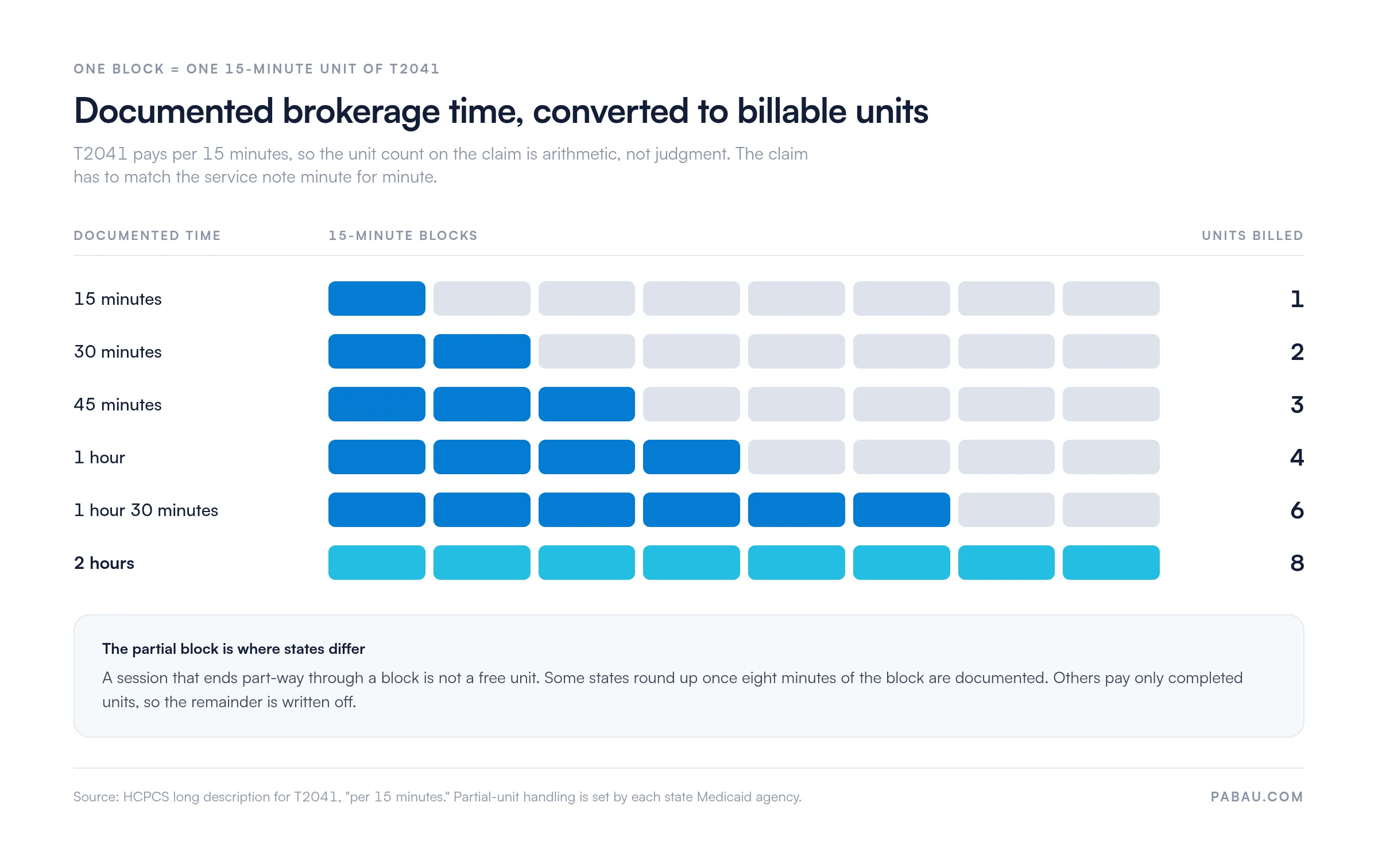
T2041 is billed in 15-minute increments. Each unit of service represents one 15-minute block of documented supports brokerage activity. A two-hour session equals eight billable units, and the conversion works the same way at every session length.
Provider eligibility to bill T2041 is state-defined. The general requirements across most programs include:
Partial units are handled differently depending on state policy. Some states pay the unit once eight minutes of the block are documented. Others require providers to bill only completed units. A working denial management process catches these discrepancies before claims go out.
T2041 claims are submitted on a CMS-1500 claim form or the equivalent 837P electronic transaction. Practices submitting electronically route waiver claims through a clearinghouse, which is what our Claim.MD integration does.
Place of service codes vary. Brokerage delivered in the participant’s home typically uses POS 12. Phone-based brokerage may use POS 02 where state guidance allows it. Capture the service date, the duration, and the POS code before the claim goes out.
Check your state Medicaid billing manual before submitting T2041 claims. States differ on rounding rules, prior authorization triggers, and whether phone-based supports brokerage qualifies for a telehealth place of service. A one-time manual review saves repeated denials.
Modifiers adjust how a code is interpreted by the payer. For HCPCS code T2041, the applicable modifiers depend on state Medicaid policy. The table below outlines common modifiers that programs may require or accept.
Modifier requirements are not universal. A modifier that triggers payment in one state may cause a rejection in another. Verify required modifiers against your state Medicaid billing manual before submission. The AAPC HCPCS code lookup is a quick way to cross-reference modifier applicability for T-codes.
There is no federally set Medicare rate for HCPCS code T2041, because Medicare does not cover T-codes at all. Reimbursement comes entirely from state Medicaid programs, and each state sets its own allowable amount per 15-minute unit. The CMS Physician Fee Schedule lookup returns no values for T2041 for this reason.
State Medicaid rates for supports brokerage reflect the administrative nature of the role. They tend to run lower per unit than direct care service codes. Your state Medicaid agency’s fee schedule is the authoritative source. Third-party fee schedule aggregators lag behind state rate-setting cycles, which makes them a poor substitute.
Factors that affect the allowable amount in a given state include:
Update the T2041 rate in your billing system every time your state issues a new fee schedule. Billing at an expired rate is a common cause of underpayment on waiver service codes. It rarely shows up until the remittance arrives.
Documentation is where most T2041 claims fail audit. Because the code is billed in 15-minute units, every claim must trace to a written service record that accounts for exactly the time billed. A log written days after the fact does not meet Medicaid documentation standards in most states.
Required documentation elements for T2041 claims typically include:
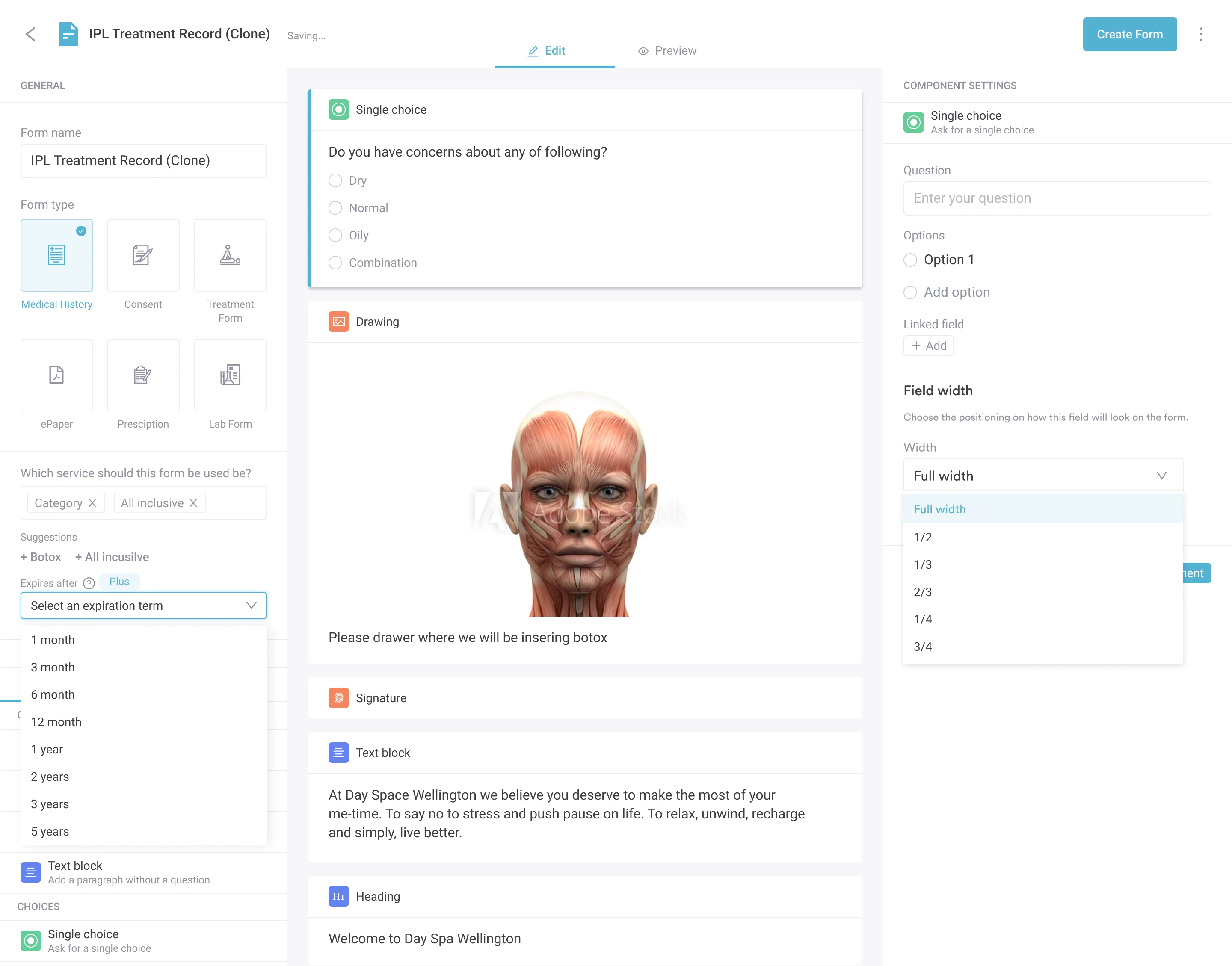
Good medical billing compliance means contemporaneous notes. The service note is finished at the time of service, or on the same day at the latest. Digital forms capture structured service data with timestamps, which makes audit defense far less painful.
Run insurance eligibility verification before the session, not after the rejection. That check confirms the participant’s waiver enrollment is still active before a minute of brokerage time gets logged against it.
A clean claim for T2041 is one where the authorization number, service dates, unit count, and provider NPI all match the state’s records. A mismatch on any field triggers an automated rejection before a human reviewer sees the claim.
T2041 is the final code in the HCPCS waiver services range. The adjacent codes cover other Medicaid waiver service types. Read each code’s official description carefully before you choose between them, since the service distinctions matter to payers. The PGM Billing HCPCS lookup tool gives free access to full descriptions for the T-code range.
T2040 and T2041 are commonly confused. T2040 covers financial management services under self-directed waivers, while T2041 covers supports brokerage coordination. Some participants receive both from different providers, and both codes then appear on separate claims.
Never bill T2040 and T2041 for the same activity, on the same day, from the same provider. When the waiver service matches no specific T-code at all, T2025 is the code to reach for.
T2039 sits in the same range and pays per service for vehicle modifications, not per 15-minute unit. Earlier in the range, T2031 covers assisted living billed as a waiver per diem.
No. Medicare does not cover HCPCS code T2041 or any code in the T-code range. T-codes are a Medicaid-only code set that CMS maintains for use in state Medicaid programs. Medicare fee schedules return no allowable for T2041, because the code was never intended for Medicare billing.
Providers who submit T2041 to Medicare receive an automatic rejection. The correct payer for every T2041 claim is the state Medicaid agency. In some states that is the managed care organization contracted to run the waiver program.
Time-based codes like T2041 create a documentation burden that grows with caseload. A supports broker serving 20 participants needs a system that tracks time per participant and captures each service note with timestamps. Spreadsheet tracking stops holding up somewhere around the second caseload.
Waiver agencies rarely bill brokerage on its own. The same provider may also run occupational therapy and behavioral health caseloads under the same waiver. Several unit rules and note formats then have to coexist in one record.
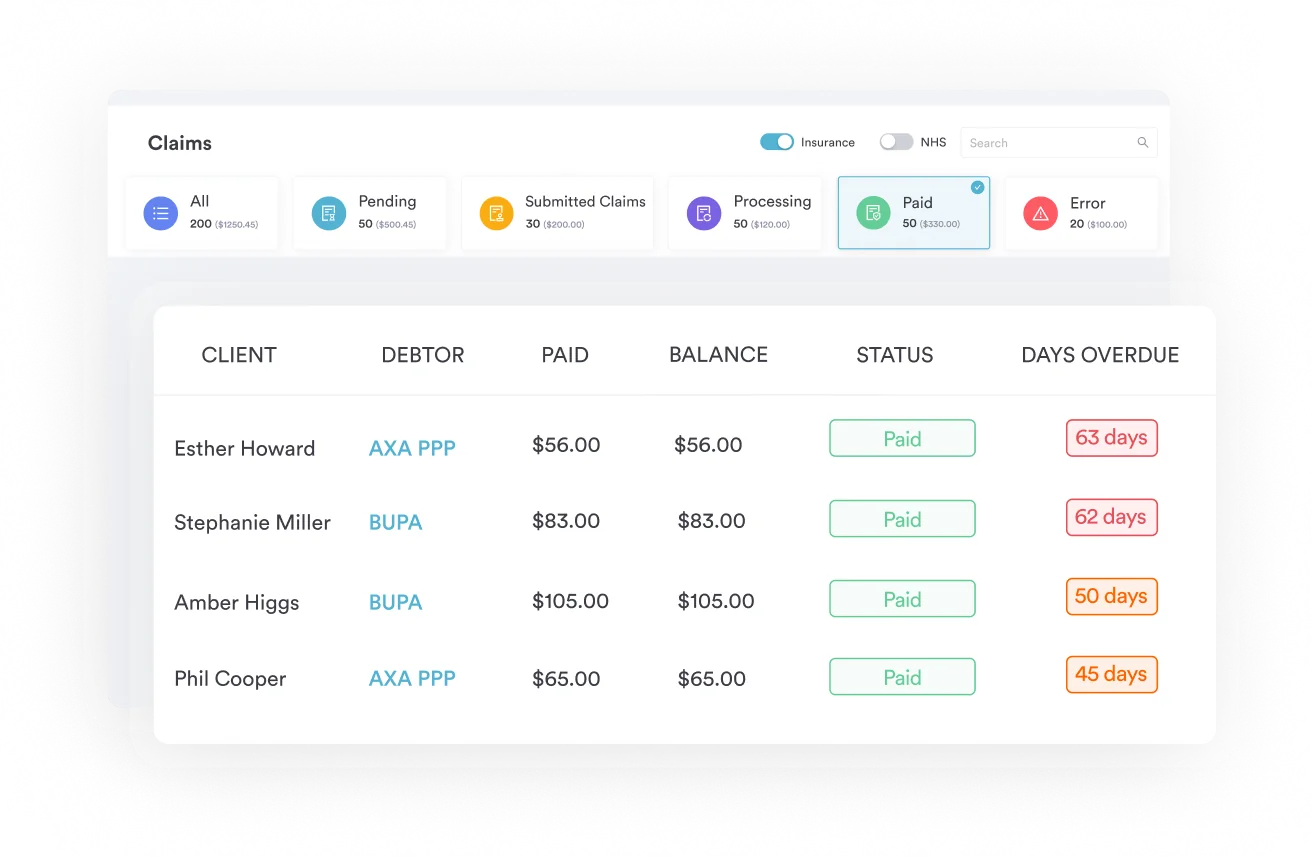
Practice management software like Pabau handles those workflows in one place. Pabau’s claims management software supports structured claim preparation, where service time, documentation, and claim data all flow from a single record. That removes the manual reconciliation step most Medicaid waiver billers run before submission.
Key capabilities that reduce T2041 billing friction include:
State fee schedules update on annual cycles, so medical billing software that carries current rates is worth more to a waiver program than it looks. It is what stops a year of quiet underpayment at an expired rate.
Reconcile your submitted T2041 units against your state Medicaid remittance advice every month. A consistent pattern of partial payments usually signals a unit rounding rule or a rate change your billing system has not picked up.

Pabau’s claims management tools support per-unit billing workflows, documentation capture, and claim submission for Medicaid waiver programs, including T-code services.

The homework on T2041 is state-level, not federal. Two agencies can read the same HCPCS description and pay differently on rounding, prior authorization, and which modifier belongs on the claim. Do that homework once for your state, write it down, and the code stops generating denials.
The 15-minute unit is the part worth protecting. Every unit you bill has to trace back to a note showing the time and the activity. That habit decides whether a claim survives an audit two years from now.
Pabau supports time-based billing workflows, structured documentation capture, and clean claim preparation for Medicaid waiver programs. Book a demo to see how it handles T-code billing across a full brokerage caseload.

Billing another time-based waiver service? H2025 runs on the same 15-minute unit structure and the same documentation demands.
Coding behavioral health under a waiver? H2035 covers alcohol and drug program services, with its own unit rules and state variations.
Working with a per diem waiver code? H2021 covers wrap-around services and shows how a daily rate changes the documentation you keep.
Building out a rehabilitation program? H2018 covers psychosocial rehabilitation, a service waiver participants often receive alongside brokerage.
Collecting balances outside the waiver? Patient payment plans explains how to set up, automate, and collect on scheduled payments.
HCPCS code T2041 is a Medicaid waiver billing code covering supports brokerage, self-directed, waiver, billed per 15-minute increment. Providers enrolled in state self-directed Medicaid waiver programs use it to report time spent helping participants identify, access, and manage their own support services.
Only providers enrolled as approved supports brokerage agencies or individuals in a state’s self-directed Medicaid waiver program may bill T2041. Eligibility is state-defined, so confirm enrollment requirements with your state Medicaid agency before submitting claims.
There is no federally set rate for T2041. Each state Medicaid program sets its own allowable amount per 15-minute unit, and rates vary by state, waiver program type, and provider model. Contact your state Medicaid agency or check the current state fee schedule for your location.
Applicable modifiers depend on state Medicaid policy. Commonly used ones include the state-assigned Medicaid modifiers U1 through U9 and the telehealth modifier GT for synchronous video. UD applies where the state requires a level-of-care indicator. Always verify required modifiers against your state’s billing manual before submission.
No. Medicare does not cover T2041 or any HCPCS T-code. T-codes are Medicaid-only, so submitting T2041 to Medicare results in automatic rejection. For dual-eligible participants, T2041 is a Medicaid waiver benefit and must be billed exclusively to Medicaid.
T2041 is billed per 15-minute unit, not per visit. Each unit represents one 15-minute block of documented supports brokerage activity, so a two-hour session equals eight billable units. Every unit needs contemporaneous documentation recording the date, the start and end time, and the activities performed.
Required documentation includes the participant’s name and Medicaid ID, plus the date of service with start and end time. You also need a description of the brokerage activities, the service location or delivery method, and the provider’s name and credentials. Add the prior authorization number where the state requires one.