CCSD code F5010: Parotid duct transposition billing guide
CCSD code F5010 covers parotid duct transposition, one side or both CCSD code F5...

Last Updated: Oct 9, 2026
T2012 is the HCPCS Level II code for habilitation, educational; waiver, per diem.
One unit means one calendar day of qualifying service, which is where most T2012 errors start. Waiver claims run on authorized service dates rather than encounter counts, so medical billing here works differently from a standard outpatient claim.
Because T2012 sits in the state Medicaid section of HCPCS Level II, it carries no Medicare coverage and no national fee schedule. State Medicaid programs that administer HCBS waivers set their own rates and coverage policies. Checking current code status against the AAPC HCPCS code directory is a standard precaution for any T-series code.
Let Pabau's smart automation suggest the right codes, reduce claim denials, and keep your practice compliant—effortlessly.
Automate repetitive tasks and focus on what matters most—your patients.
Reduce coding errors and ensure compliance with the latest regulations.
Clean claims, fewer denials, and faster reimbursements.
Powerful insights and reporting to help your practice thrive.
HIPAA compliant SOC 2 certified GDPR-compliant Trusted by 4,000+ clinics worldwide

HCPCS code T2012 describes habilitation, educational; waiver, per diem services billed under Medicaid Home and Community-Based Services (HCBS) waiver programs.
T2012 is a per diem code. One unit equals one full calendar day of qualifying educational habilitation, not an hourly or per-visit rate.
Reimbursement rates are set at the state level, and there is no national Medicare fee schedule for T2012. Verify every rate against your state Medicaid fee schedule.
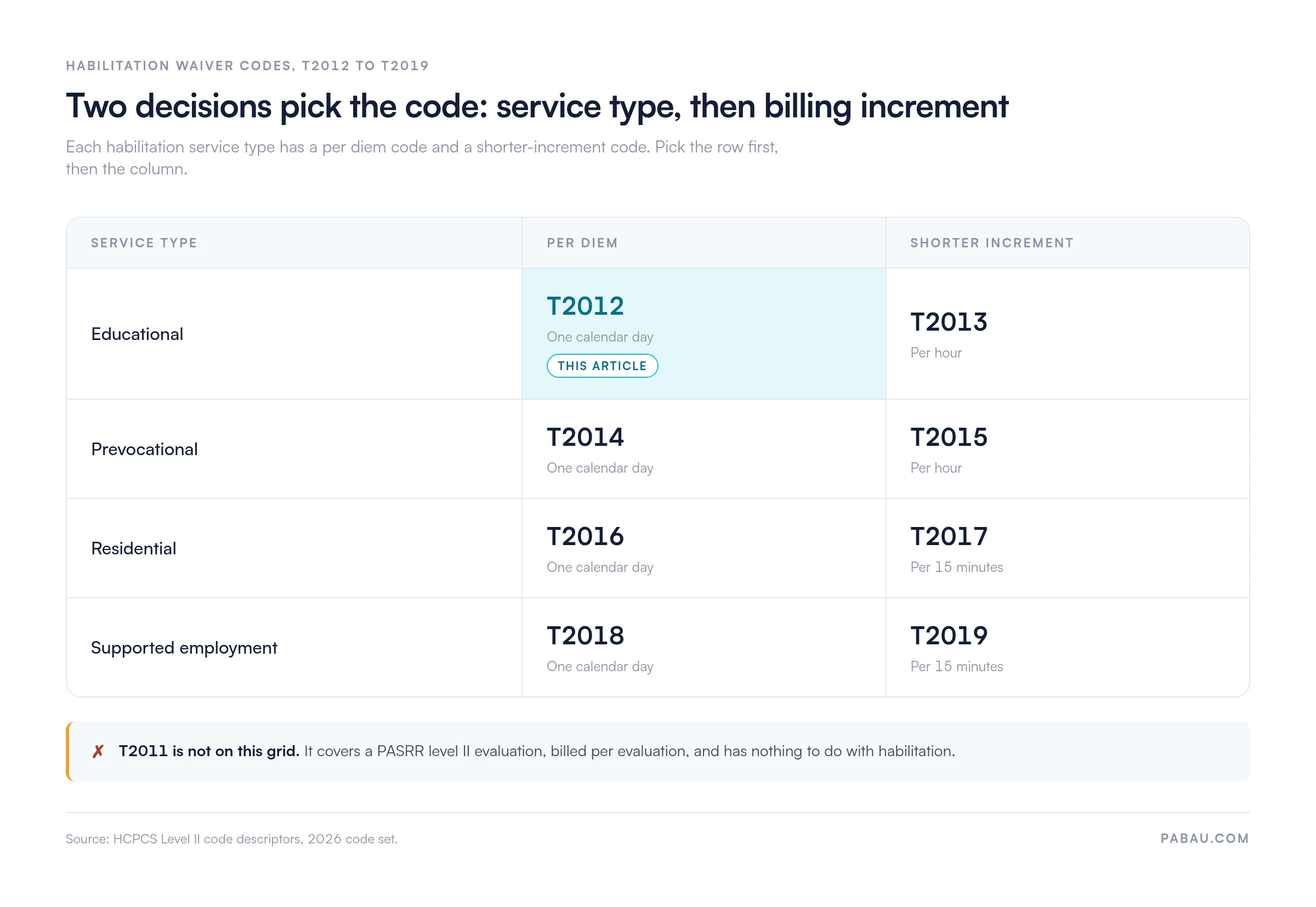
T2011 is not a habilitation code at all. It covers a PASRR level II evaluation, so the prevocational per diem code you want is T2014.
Practice management software like Pabau supports HCPCS Level II code entry alongside dated service notes, so T2012 claims go out with their documentation behind them.
Habilitation services help individuals with disabilities acquire, retain, or improve functional skills they have never fully developed. Educational habilitation under T2012 covers skill-building in educational or learning contexts, delivered through a Medicaid HCBS waiver program. That separates it from residential habilitation and from school-based services billed through different payer mechanisms.
Eligible services support the developmental and functional learning goals written into an individual’s person-centered plan. The key qualifier is the waiver itself. Service delivered as a standalone Medicaid state plan benefit does not belong on a T2012 claim.
Providers working in behavioral and mental health settings should read their state’s waiver service definitions closely. Many states separate educational habilitation from prevocational and supported employment services, and each one carries its own HCPCS code.
Per diem means one unit equals one calendar day. Providers report one unit of T2012 for each day a qualifying educational habilitation service was delivered under the waiver. Time-based codes work differently, counting 15-minute increments, and per-visit codes count encounters regardless of duration.
Three per diem billing mistakes drive T2012 denials and recoupments:
Structured documentation is what turns a billed day into a defensible one. Pabau’s claims management software holds HCPCS Level II code entry and service documentation in one workflow. Billing teams see the clinical record and the claim data together before submission.
Before billing T2012, run a date-of-service reconciliation against the member’s HCBS waiver authorization dates. Any service date falling outside the authorization window will be denied on submission. Build this check into your pre-billing workflow, not your denial management process.
There is no national Medicare fee schedule for HCPCS code T2012. Rates are set entirely at the state Medicaid level, under each state’s HCBS waiver program rules. A provider in North Carolina bills the same code as a provider in California, but the two per diem rates can differ substantially.
To find current T2012 reimbursement rates for your state:
Third-party fee schedule aggregators are a starting point, not a source. Verify any figure against the official state Medicaid publication before you use it for contracting or budget planning. Rates update annually, and sometimes mid-year when a state renegotiates a waiver amendment.
HCPCS code T2012 is used within Home and Community-Based Services waiver programs authorized under Section 1915(c) of the Social Security Act. These waivers let states fund Medicaid services in home and community settings instead of institutional care. Not every state waiver includes educational habilitation, so coverage varies widely.
Ask your state’s waiver program coordinator to confirm that T2012 is covered under the waiver your client is enrolled in. CMS publishes approved waiver applications at Medicaid.gov, and each one lists covered services with their codes. Members on an I/DD or TBI waiver often have equipment claims running alongside, and a code like K0843 carries its own prior authorization rules.
Modifier requirements for T2012 are payer- and state-specific, and no single list applies across every Medicaid program. Several modifiers do appear regularly in HCBS waiver billing, and they are worth knowing before you build a T2012 claim.
Always check your state Medicaid billing manual before you append a modifier to a T2012 claim. A modifier the state system does not recognize can trigger an automatic denial, even when the service itself is documented correctly. Good denial management for waiver claims starts with the modifier rules, before submission rather than after rejection.
HCPCS code T2012 sits inside the T2012-T2041 range of waiver services codes. Coders working with HCBS waiver populations have to separate it from the codes immediately around it. Picking the wrong T-code is one of the most common waiver billing errors, especially when a care plan carries several habilitation service types at once.
The habilitation codes run in pairs, so two decisions pick the code. Service type comes first, then the billing increment. T2012 and T2013 cover educational habilitation, T2014 and T2015 cover prevocational, T2016 and T2017 cover residential, and T2018 and T2019 cover supported employment.
Billing T2012 for a prevocational or residential service is a misrepresentation that auditors flag during waiver compliance reviews. T2011 is not part of this group. It covers a PASRR level II evaluation, billed once per evaluation, which is a different job entirely.
The waiver services range does not stop at T2019. Codes further up it cover residential and community living, including HCPCS code T2031 for assisted living under a waiver.
Agencies billing habilitation often bill behavioral health services for the same member, under codes such as H2018 and H2021. Keeping those categories separate in the billing workflow is what stops one service line borrowing another one’s code.
T2012 claims need a supporting ICD-10-CM diagnosis code that reflects the member’s primary condition or disability. The crosswalk below lists commonly paired diagnoses, and it is indicative rather than exhaustive. States often restrict accepted diagnosis codes to a narrower list tied to the waiver’s target population.
Diagnosis restrictions are where states differ most. Some accept any diagnosis that fits the waiver’s target population, while others publish a short list inside the waiver application. Read that list before the first claim goes out, not after the first denial comes back.
Most T2012 references stop at a list of documentation requirements. The sequence below runs in the order the work happens, from the authorization check through to the remittance review, following standard HCBS waiver billing practice.
Teams handling several waiver codes need the documentation standard visible at the point of claim preparation. The superbill structure used in outpatient settings adapts well here, with per diem date-of-service entries in place of per-visit encounter summaries.
Flag T2012 claims for internal audit quarterly. Pull a sample of billed dates, match them against service notes, and confirm each note records a delivered service. State Medicaid auditors can recoup payment on any claim the documentation does not support. That holds even when the service was genuinely delivered.
HCBS waiver billing answers to two rulebooks at once: Federal Medicaid regulations at the CMS level, and state waiver operational protocols. Providers billing T2012 have to satisfy both. The medical billing compliance requirements that apply to waiver services include:
Habilitation billing usually breaks in the handoff. Service notes sit in one system, authorization dates sit in a spreadsheet, and the biller assembles the claim from whatever they can find. By the time a denial lands, nobody can say which billed day is missing its note.
Practice management software like Pabau keeps those records in one place. Each session is logged against the member’s record on the date it happened. A per diem claim then gets built from dated notes instead of reconstructed from memory. Digital forms capture the same fields every time, which is what an auditor sampling billed days months later wants to see.
Few agencies bill habilitation alone. The same provider often carries an occupational therapy caseload and a behavioral health program, each with its own codes and documentation rules. Running them in one system means the billing team can see every service line before submission, and every subscription includes the full platform.

Pabau helps habilitation providers manage HCPCS code entry, dated service notes, and claim preparation in one platform. Per diem Medicaid billing stops eating your admin week.

T2012 rewards one dull habit. Keep a dated note for every billed day, and check each date against the authorization window before the claim goes out. Practices that run that check before billing stop losing money to recoupments they have no grounds to appeal.
The harder call is code selection. Educational habilitation is one service type among four, and the descriptors sit close enough that a busy coder picks by habit. Read the descriptor instead. Book a demo to see how Pabau ties each T2012 service note to the claim that bills it.

Need help managing Medicaid billing documentation? Medical forms at your healthcare practice covers how digital form workflows keep documentation consistent across billing-heavy service types.
Writing service notes that survive an audit? PIE note template shows a problem, intervention, and evaluation structure that fits per diem habilitation notes.
Want to understand denial patterns for Medicaid claims? Denial codes in medical billing explains the most common CARC denial codes and how to action each one during appeals.
Exploring billing software for HCBS waiver providers? Best medical billing software in the US compares platforms by feature set, payer integration depth, and HCPCS Level II support.
HCPCS code T2012 is a Level II non-physician Medicaid billing code for habilitation, educational; waiver, per diem services. It bills one full calendar day of educational habilitation delivered under a state Medicaid Home and Community-Based Services (HCBS) waiver program. The code sits in the National Codes Established for State Medicaid Agencies section and is active for 2026.
Per diem means one billing unit equals one full calendar day. Providers submit one unit of T2012 for each day a qualifying educational habilitation service was delivered and documented. Billing several units for a single day, or billing days with no service documentation, are the two most common T2012 errors.
Each billed unit needs a dated service note confirming the service happened, plus an active HCBS waiver authorization covering that date. You also need the member’s current person-centered plan naming educational habilitation as an approved service. A supporting ICD-10-CM diagnosis code the state Medicaid program accepts is required too. Missing any one of these is grounds for denial or recoupment.
Use T2012 when the waiver service is educational habilitation, meaning skill-building in an educational or learning context. Use T2014 when the service is prevocational habilitation, meaning work readiness skills. Both are per diem codes, so the service descriptor is the only thing separating them. T2011 does not enter this decision, because it covers a PASRR level II evaluation rather than habilitation.
There is no national Medicare fee schedule for T2012. Each state Medicaid program sets its own rate, and those rates vary widely across states and waiver types. To find the current figure, contact your state Medicaid agency or read your state’s published HCBS waiver fee schedule. Rates update annually, and sometimes sooner when a state amends a waiver agreement.
Modifier requirements for T2012 are state-specific. Common modifiers in HCBS waiver billing include state-assigned modifiers (U1-U9) and HE for a mental health program. TF marks an intermediate level of care, and HO marks a master’s-level provider. Always check your state Medicaid billing manual first. A modifier the state system does not recognize can trigger an automatic denial, even on a well-documented service.
T2012 is used in Section 1915(c) HCBS waivers, most often those serving individuals with intellectual or developmental disabilities (I/DD). State-specific I/DD waivers, TBI waivers, and children’s complex needs waivers may include educational habilitation as a covered service. Coverage varies by state, so confirm with your waiver program coordinator that T2012 applies to your client’s waiver.
T2012 is a Medicaid-only code. It has no Medicare coverage and no Medicare fee schedule. It belongs to the National Codes Established for State Medicaid Agencies section of HCPCS Level II. Only state Medicaid programs that cover educational habilitation under an approved HCBS waiver will pay it.