HCPCS Code E0272: Foam rubber mattress billing guide
HCPCS Code E0272: official descriptor and code overview HCPCS Code E0272 is the ...

Last Updated: Nov 6, 2026
Q4195 is the HCPCS Level II code for PuraPly, per square centimeter. It is an add-on code, billed with a skin substitute application code for PuraPly, a porcine collagen wound matrix from Organogenesis.
PuraPly AM has its own code, Q4196. Both replaced Q4172, which CMS deleted on December 31, 2018. In 2026 Medicare pays PuraPly as an incident-to supply at a flat national rate of $127.14 per square centimeter.
Let Pabau's smart automation suggest the right codes, reduce claim denials, and keep your practice compliant—effortlessly.
Automate repetitive tasks and focus on what matters most—your patients.
Reduce coding errors and ensure compliance with the latest regulations.
Clean claims, fewer denials, and faster reimbursements.
Powerful insights and reporting to help your practice thrive.
HIPAA compliant SOC 2 certified GDPR-compliant Trusted by 4,000+ clinics worldwide

HCPCS Code Q4195 bills PuraPly, an Organogenesis collagen wound matrix, per square centimeter as an add-on to a skin substitute application code.
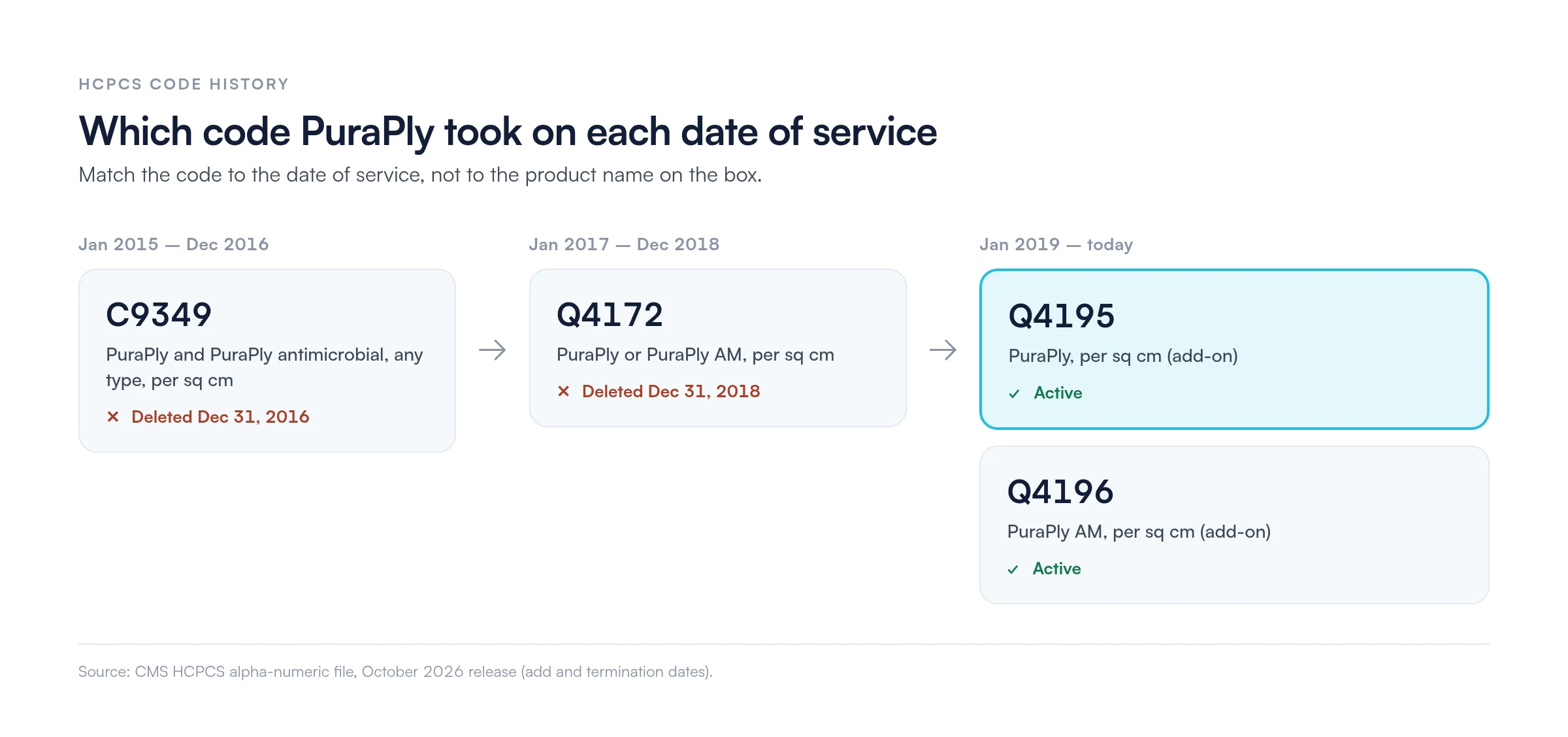
Q4172 is deleted. It covered PuraPly and PuraPly AM in 2017 and 2018, and from January 1, 2019 PuraPly takes Q4195 while PuraPly AM takes Q4196.
In 2026 Medicare pays PuraPly as an incident-to supply at a flat national rate of $127.14 per square centimeter, with no payment for discarded product.
Wound site and total wound area pick the application code from 15271 to 15278, and only the square centimeters applied are billed.
Coverage turns on your contractor, because only Novitas, CGS and First Coast still run a skin substitute LCD.
HCPCS Code Q4195 is the Level II code for PuraPly, per square centimeter.
It is an add-on code, so it is always listed in addition to a primary skin substitute application procedure.
PuraPly is a porcine collagen wound matrix made by Organogenesis and cleared by the FDA as a 510(k) medical device. Q4195 identifies the product applied, while a separate CPT code reports the application itself.
| Field | Detail |
|---|---|
| HCPCS code | Q4195 |
| Official descriptor | Puraply, per square centimeter (add-on, list separately in addition to primary procedure) |
| Short descriptor | Puraply 1 sq cm |
| Code level | HCPCS Level II, Q-code series (temporary codes) |
| Product | PuraPly, Organogenesis. PuraPly AM bills under Q4196 |
| Unit of service | 1 unit = 1 square centimeter applied |
| Code added | January 1, 2019 |
| Status | Active in the CMS HCPCS file, October 2026 release |
| Replaced | Q4172, deleted December 31, 2018 |
| 2026 Medicare payment | Incident-to supply, flat national rate of $127.14 per cm² |
The descriptor names one product only. Using Q4195 for PuraPly AM, PuraPly XT or another collagen matrix is a coding error, even when the products sit on the same shelf.
Q4172 is no longer a valid HCPCS code. Its descriptor read “Puraply or puraply am, per square centimeter,” and it covered both products under one code from January 1, 2017.
CMS terminated Q4172 on December 31, 2018. On January 1, 2019 it split the code in two, giving PuraPly Q4195 and PuraPly AM its own code, Q4196.
Q4172 had a predecessor of its own. C9349, a hospital outpatient code for PuraPly and PuraPly antimicrobial, ran from 2015 until CMS deleted it at the end of 2016.
| Code | Descriptor | Active dates | Use it for |
|---|---|---|---|
| C9349 | Puraply, and puraply antimicrobial, any type, per square centimeter | Jan 1, 2015 to Dec 31, 2016 | Historic outpatient claims only |
| Q4172 | Puraply or puraply am, per square centimeter | Jan 1, 2017 to Dec 31, 2018 | Corrections and appeals for 2017–2018 dates of service only |
| Q4195 | Puraply, per square centimeter (add-on) | Jan 1, 2019 onward (add-on wording current from Jan 1, 2026) | PuraPly applied today |
| Q4196 | Puraply am, per square centimeter (add-on) | Jan 1, 2019 onward (add-on wording current from Jan 1, 2026) | PuraPly AM applied today |
| Q4197 | Puraply xt, per square centimeter (add-on) | Jan 1, 2019 onward | PuraPly XT, a separate product |
A claim that still carries Q4172 for a current date of service is rejected as an invalid code. Search your charge master, superbill templates and saved claim templates for Q4172, then replace it with Q4195 or Q4196.
Medicare pays Q4195 at a flat national rate of $127.14 per square centimeter in 2026. The rate comes from the CY2026 Physician Fee Schedule final rule, CMS-1832-F, effective January 1, 2026.
That rule moved skin substitutes that are not licensed as biologics out of drug pricing. They are now paid as incident-to supplies when used with a covered application procedure.
PuraPly is a 510(k)-cleared device, not a biologic, so it falls under the flat rate. Products licensed under a biologics license application (BLA) are excluded from it.
| Payment element | Through 2025 | From January 1, 2026 |
|---|---|---|
| Payment basis | Average sales price, as a biological | Flat rate of $127.14 per cm², as an incident-to supply |
| Discarded product | Billable with modifier JW | Not paid by Medicare |
| JW and JZ modifiers | Required on single-use packages | Do not apply to Q4195 |
| Outpatient application codes | C5271–C5278 for low-cost products | C5271–C5278 deleted Dec 31, 2025 |
| Rate updates | Quarterly ASP files | Annual rule cycle |
A 9 cm² application of PuraPly bills 9 units of Q4195. At the national rate that is $1,144.26 for the product, before your locality adjustment.
The application CPT code is paid on its own line. Check your locality in the CMS Physician Fee Schedule lookup before you quote a figure.
The place of service decides who reports the product. In a physician office the practice bills both lines, but in a facility the physician bills only the application.
| Place of service | POS code | Who bills Q4195 | How the product is paid |
|---|---|---|---|
| Physician office | 11 | The practice, with the application CPT code | Physician Fee Schedule, at the flat supply rate |
| Off-campus outpatient hospital | 19 | The hospital, on its facility claim | Outpatient Prospective Payment System (OPPS) |
| On-campus outpatient hospital | 22 | The hospital, on its facility claim | OPPS |
| Ambulatory surgical center | 24 | The ASC, on its facility claim | ASC payment system |
In POS 19, 22 and 24 the physician’s claim carries the application CPT code alone. Adding Q4195 to the professional claim in a facility duplicates the product charge and can be denied.
POS 23 is a hospital emergency room, not an outpatient wound care department. A skin substitute claim sent with POS 23 by mistake can come back with CARC 5.
Bill Q4195 on its own line under a primary CPT application code from the 15271–15278 family. Two facts pick that code, which are the wound’s location and its total surface area.
| CPT code | Wound location | What it reports |
|---|---|---|
| 15271 | Trunk, arms, legs. Total wound area up to 100 cm² | First 25 cm² or less |
| 15272 | Trunk, arms, legs. Total wound area up to 100 cm² | Each additional 25 cm² (add-on to 15271) |
| 15273 | Trunk, arms, legs. Total wound area 100 cm² or more | First 100 cm² |
| 15274 | Trunk, arms, legs. Total wound area 100 cm² or more | Each additional 100 cm² (add-on to 15273) |
| 15275 | Face, scalp, eyelids, mouth, neck, ears, orbits, genitalia, hands, feet, digits. Up to 100 cm² | First 25 cm² or less |
| 15276 | Same sites as 15275. Up to 100 cm² | Each additional 25 cm² (add-on to 15275) |
| 15277 | Same sites as 15275. Total wound area 100 cm² or more | First 100 cm² |
| 15278 | Same sites as 15275. Total wound area 100 cm² or more | Each additional 100 cm² (add-on to 15277) |
A foot ulcer takes 15275 rather than 15271, because the foot sits in the second site group. A 30 cm² foot ulcer bills 15275 once and 15276 once, plus 30 units of Q4195.
Our guide to CPT code 15271 covers the full descriptor and bundling notes for the trunk, arm and leg family.
One unit of Q4195 equals one square centimeter of PuraPly applied to the wound. Record the area in the note, then bill that number of units.
Organogenesis supplies PuraPly in several sheet sizes for single use. Its coding guide says the code counts product size, but Medicare stopped paying for discarded supply on January 1, 2026.
For Medicare, bill only what was placed on the wound. If a 16 cm² sheet is opened and 11 cm² is applied, the claim carries 11 units, and the practice absorbs the rest.
That makes sheet selection a cost decision. Choose the smallest size that covers the measured wound, and record the size opened next to the area applied.
| Modifier | When it applies | Common error |
|---|---|---|
| JW and JZ | Not on Q4195 from 2026. They apply to drugs and biologicals, and PuraPly is paid as a supply | Carrying a 2025 wastage habit forward |
| GA | An advance beneficiary notice (ABN) is on file before service | Sending GZ when an ABN was signed |
| GZ | Service expected to be denied and no ABN on file | Using GZ in place of GA |
| 59 or XS | A separate wound or site is treated on the same date as another procedure | Appending it where no NCCI edit applies |
| RT and LT | Follow your payer’s policy. Medicare does not require laterality modifiers for Q4195 | Laterality that contradicts the ICD-10 code |
A modifier that does not fit the code returns CARC 4, which means the procedure code is inconsistent with the modifier used.
Medicare covers Q4195 when the record shows a chronic wound that failed standard care and meets the reasonable-and-necessary standard. Which written policy applies depends on your Medicare contractor.
Only three A/B MACs still enforce a legacy skin substitute LCD. They are Novitas Solutions (L35041), CGS Administrators (L36690) and First Coast Service Options.
The new unified skin substitute LCDs, due on January 1, 2026, were withdrawn on December 24, 2025. Every other MAC now reviews PuraPly claims case by case, without a published LCD.
| Contractor or program | What applies to Q4195 |
|---|---|
| Novitas (JH, JL) | Legacy LCD L35041 and its billing article |
| CGS (J15) | Legacy LCD L36690 and its billing article |
| First Coast (JN) | Legacy skin substitute LCD |
| Palmetto, NGS, WPS, Noridian | No skin substitute LCD. Reasonable-and-necessary review case by case |
| WISeR prior authorization model | Skin substitutes need prior authorization in New Jersey, Ohio, Oklahoma and Texas |
| Medicare Advantage and commercial plans | Plan-specific rules. Some require prior authorization |
The WISeR model also runs in Arizona and Washington. Skin substitutes are not on its list there, because those states have no active skin substitute LCD.
Build a medical billing compliance check that confirms your contractor’s current position before the date of service, not after the denial.
Write every PuraPly chart to the strictest retained LCD, such as Novitas L35041, even if your contractor publishes none. Case-by-case reviewers ask for the same wound history, measurements and failed standard care.
The diagnosis has to show a chronic ulcer and its cause. Code the underlying condition first, then the ulcer code that gives the site and depth. A diabetic foot ulcer in a type 2 patient, for example, starts with E11.621 and adds an L97.4- or L97.5- code.
| ICD-10-CM | Description | Typical PuraPly scenario |
|---|---|---|
| E11.621 | Type 2 diabetes mellitus with foot ulcer | Diabetic foot ulcer, paired with an L97.4- or L97.5- code |
| E10.621 | Type 1 diabetes mellitus with foot ulcer | The same scenario in a type 1 patient |
| L97.4- | Non-pressure chronic ulcer of heel and midfoot | Gives the ulcer’s side and depth |
| L97.5- | Non-pressure chronic ulcer of other part of foot | Gives the ulcer’s side and depth |
| L97.32- | Non-pressure chronic ulcer of left ankle | Ankle ulcer. L97.329 means severity unspecified, so code the recorded depth instead |
| I83.0- | Varicose veins of lower extremity with ulcer | Venous leg ulcer after compression has failed |
| I87.31- | Chronic venous hypertension (idiopathic) with ulcer | Venous ulcer where hypertension is the documented cause |
Avoid unspecified codes when the chart records site and depth. I87.009, postthrombotic syndrome without complications, does not describe an ulcer and does not support a skin substitute.
In a Novitas, CGS or First Coast area, check the code against that LCD’s billing article before the claim leaves.
Every billed unit of Q4195 must trace back to a measurement in the chart. Reviewers check these elements first.
A chart that names PuraPly AM while the claim says Q4195 fails review. The product named in the note decides the code.
Most Q4195 denials come from four places, which are the code, the claim form, the site of service and the record.
| CARC | What it means | Typical Q4195 cause | Prevention |
|---|---|---|---|
| 4 | Procedure code inconsistent with the modifier used | JW or JZ appended, or GA and GZ confused | Drop wastage modifiers and match GA or GZ to the ABN |
| 5 | Procedure code inconsistent with the place of service | Q4195 on a professional claim in POS 19, 22 or 24, or POS 23 by mistake | Let the facility bill the product |
| 16 | Claim lacks information or has billing errors | Q4172 billed after 2018, or units missing | Replace Q4172 in every template |
| 50 | Not deemed a medical necessity | Wound history or failed standard care missing | Chart to the strictest retained LCD |
| 97 | Benefit included in another service | The payer bundles the product into the facility or application payment | Check the payer’s bundling edits before billing the product as a separate line |
| 107 | The related or qualifying claim or service was not identified on this claim | Q4195 billed without its primary application code | Always pair Q4195 with 15271–15278 on the same claim |
Track these by CARC, not just by claim. Our guide to denial codes in medical billing explains each group code and how to work the appeal.
PuraPly claims fail when the chart and the claim are built in separate places. The measurement sits in one system, the product details in another, and someone retypes both into the claim.
Pabau, the practice management platform we build, keeps the wound record and the billing on one patient file. Your wound care form records the measurement, sheet size and lot number on that patient record at the visit.
The invoice then drives the claim. Before it goes out, staff check the units on the invoice against the area charted in the wound care form.
Pabau’s claims management raises the claim from the invoice and tracks it from Pending to Paid.
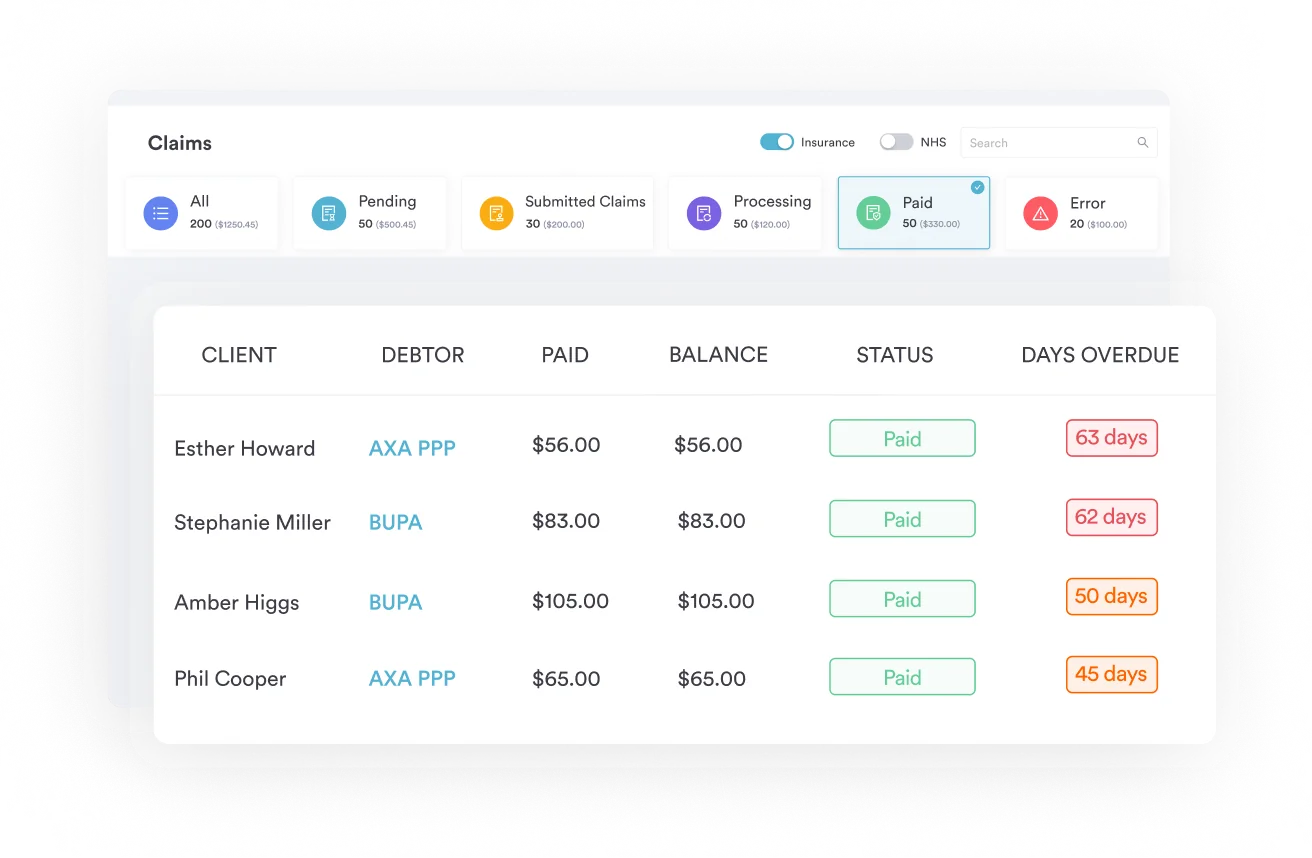

Pabau keeps wound records, invoices and insurance claims in one system, so your team can check billed units against the chart.

If your templates still list Q4172, the fix is quick but it cannot wait. Every current PuraPly claim needs Q4195, and every PuraPly AM claim needs Q4196.
The harder work is the 2026 rules. A flat supply rate with no wastage payment rewards practices that size the sheet to the wound and chart the area at the visit.
Coverage now depends on your contractor more than on the code, so check it before the first application. Book a demo to see how Pabau keeps wound records, invoices and insurance claims in one system. Your team can then check billed units against the chart.

Billing a trunk, arm or leg wound? CPT code 15271 explains the application code that most often sits above a skin substitute line.
Comparing another collagen product? HCPCS Code Q4150 walks through Allowrap DS billing under the same 2026 rules.
Want fewer rejected wound care claims? Clean claim submission lists the pre-submission checks that keep claims out of the denial queue.
Reading remittances for skin substitute claims? Electronic remittance advice shows how to read the CARC codes on an 835 file.
HCPCS Code Q4195 is the Level II code for PuraPly, per square centimeter. It is an add-on code billed with a skin substitute application code from 15271 to 15278.
No. CMS deleted Q4172 on December 31, 2018. Since January 1, 2019, PuraPly bills under Q4195 and PuraPly AM bills under Q4196.
Use Q4196. Q4195 covers PuraPly only, and PuraPly XT has its own code, Q4197.
Medicare pays a flat national rate of $127.14 per square centimeter, adjusted for locality. PuraPly is paid as an incident-to supply, and discarded product is not paid.
No. From January 1, 2026, JW and JZ do not apply to skin substitutes paid as incident-to supplies. Bill only the square centimeters applied.
The hospital bills it on its facility claim under OPPS. The physician bills only the application CPT code on the professional claim.