HCPCS Code Q4175: Billing, coverage, and documentation guide
HCPCS Code Q4175: Code Description and Product Identity HCPCS Code Q4175 is the ...

Last Updated: Nov 20, 2026
Q4147 is the HCPCS Level II code for Architect, Architect Px and Architect Fx extracellular matrix, billed per square centimeter. Architect is a decellularized collagen matrix made from equine pericardium, cleared by the FDA as a 510(k) wound device rather than a placental graft.
Since January 1, 2026, Medicare pays Q4147 as an incident-to supply at a flat national rate per square centimeter. The application itself is billed separately with CPT codes 15271 to 15278.
Let Pabau's smart automation suggest the right codes, reduce claim denials, and keep your practice compliant—effortlessly.
Automate repetitive tasks and focus on what matters most—your patients.
Reduce coding errors and ensure compliance with the latest regulations.
Clean claims, fewer denials, and faster reimbursements.
Powerful insights and reporting to help your practice thrive.
HIPAA compliant SOC 2 certified GDPR-compliant Trusted by 4,000+ clinics worldwide

HCPCS code Q4147 bills Architect, Architect Px or Architect Fx, an equine pericardium-derived collagen matrix, at one unit per square centimeter.
Architect is an FDA 510(k) wound device, not a placental or amniotic allograft, so 361 HCT/P rules don’t describe it.
Since January 1, 2026, Medicare pays Q4147 as an incident-to supply at a flat $127.14 per square centimeter, replacing ASP-based pricing.
The application is billed separately with CPT codes 15271 to 15278, chosen by wound location and size.
Coverage still turns on your MAC’s wound policy and your notes on wound size, duration and failed standard care.
HCPCS code Q4147 is the Level II code for Architect, Architect Px and Architect Fx extracellular matrix, billed per square centimeter. CMS lists it in its quarterly HCPCS Level II files as an add-on code, reported alongside the procedure that applies it.
Architect is a decellularized collagen matrix made from equine pericardium by Harbor MedTech. The FDA cleared it as a wound dressing through the 510(k) pathway (K140367 for Architect Px), under device product code KGN.
That origin matters on a claim. Plenty of Q4xxx neighbors are placental tissue regulated as 361 HCT/Ps, and coders who assume Q4147 is one of them pick the wrong policy. Q4147 is active for 2026, but recheck it in each quarterly update before a new quarter starts, as you would any Q code.
Each Q4xxx code names specific brands, so the code follows the box on the shelf, not the wound. If your team applied Architect Px, the claim says Q4147.
Billing a neighboring code for the same wound is a product mismatch, and payers deny it however good the clinical notes are. HCPCS Q4163, for example, names Woundex and Bioskin, so it fits only those two products.
Architect’s 510(k) clearance lists a broad range of wounds. Medicare coverage is narrower, and it comes from your Medicare Administrative Contractor (MAC).
The national-scope skin substitute LCDs planned for 2026 were withdrawn in late December 2025, before they took effect. So each MAC’s existing policy still governs, and those policies differ.
In practice, the claims that pay are chronic diabetic and venous ulcers that haven’t healed after standard care, usually about four weeks of it. The table sets the FDA’s cleared uses against where Medicare policies tend to land.
Most Q4147 problems start days before anyone opens the claim form. The flow below maps the path a clean office claim takes, ending in the two claim lines a small foot ulcer produces.
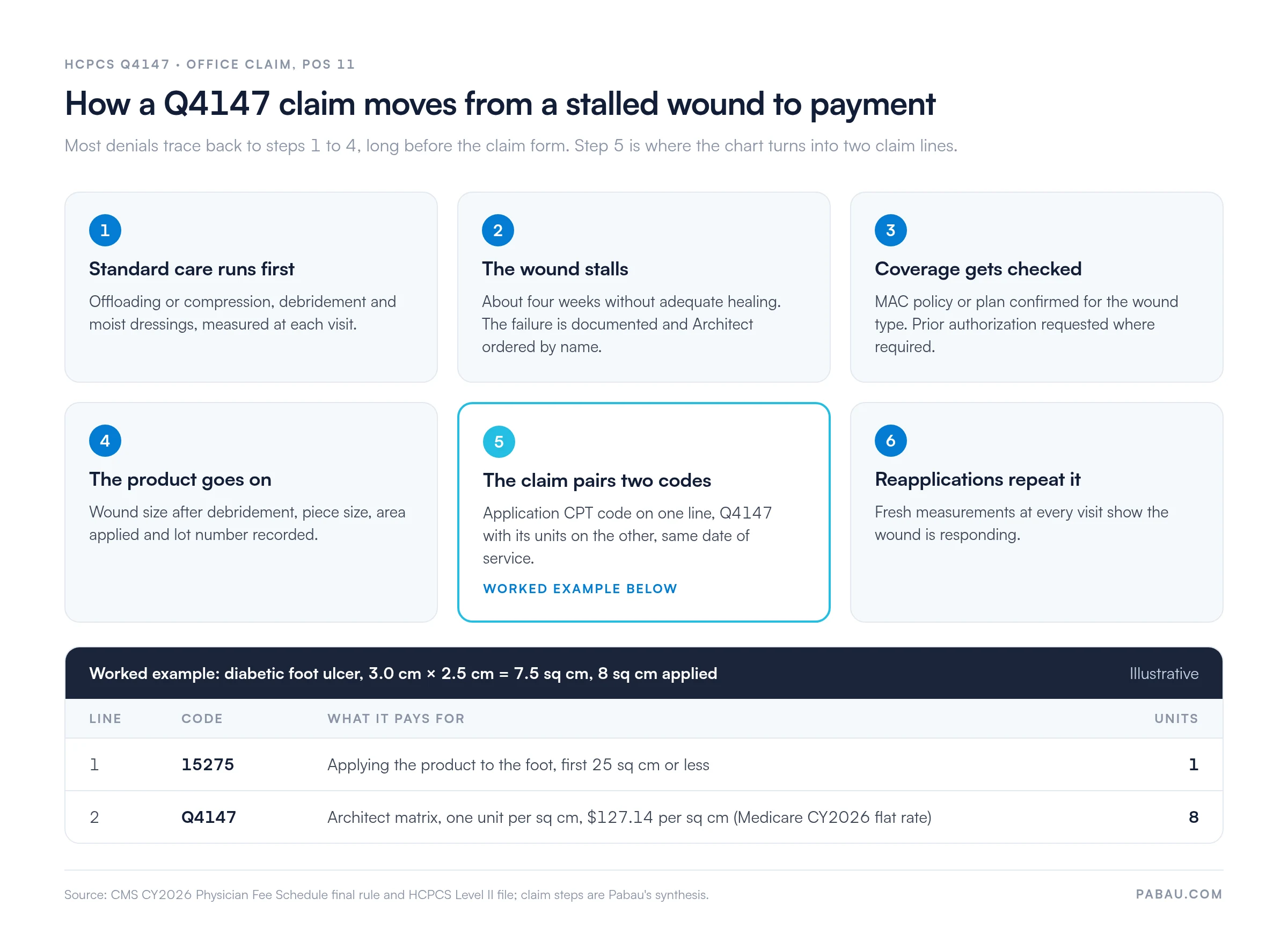
When a MAC asks for records, a reviewer reads the chart from the first visit forward. They want a wound that was measured, treated conventionally, and failed before Architect appeared. Standardized wound forms make that history easier to capture the same way at every visit.
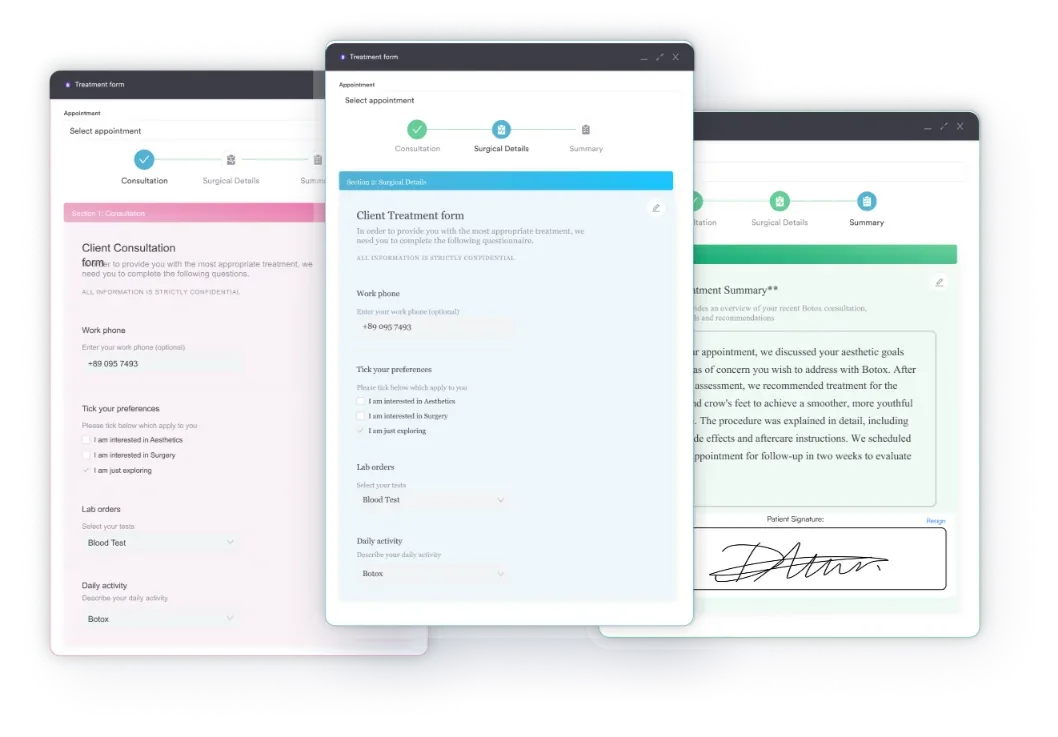
One unit of Q4147 equals one square centimeter of Architect. Say a diabetic foot ulcer measures 3.0 cm by 2.5 cm after debridement, a 7.5 sq cm wound. The clinician trims a piece to cover it with a small margin and applies 8 sq cm. That visit bills 8 units of Q4147, plus one unit of 15275 for applying it to a foot wound of 25 sq cm or less.
The claim takes whole units, so the note has to show how you got to the number billed. Record the wound area, the piece size opened and the area applied. MACs differ on how they handle product opened but not applied, so check that rule before your first claim.
Measure at every visit, not just the first application. Reviewers compare the units on each claim with the measurement in that day’s note, and a single week-one measurement can’t support later applications.
Skin substitute payment changed on January 1, 2026. Under the CY2026 Physician Fee Schedule final rule, as corrected in November 2025, Medicare pays these products as incident-to supplies. The rate is a flat $127.14 per square centimeter. It replaced the old ASP plus 6% pricing, where each product carried its own rate.
The flat rate covers skin substitutes that aren’t biologics licensed under section 351 of the Public Health Service Act. As a 510(k) device, Architect falls inside it. Look up your local allowable with the CMS Physician Fee Schedule search tool, and remember the application CPT code is paid on its own line.
Traditional Medicare has no blanket prior authorization rule for Q4147. One exception is CMS’s WISeR model, which began in January 2026 in six states.
It lists skin substitutes for lower-extremity chronic wounds, though CMS has since dropped that category in some participating states. Check the current operational guide if you practice in Arizona, New Jersey, Ohio, Oklahoma, Texas or Washington.
Medicare Advantage and commercial plans are a different story. Many require prior authorization for skin substitutes, and the clinical package they want looks a lot like the documentation list above. A quick routine keeps it under control:
State Medicaid programs vary too. Some mirror Medicare policy, others add their own approval step or limit the wound types, so confirm coverage with the state plan before the visit.
Q4147 often goes out with no modifier at all in the office. The ones below appear when the setting, the coverage picture or the payer’s own rules call for them.
Most codes confused with Q4147 are human tissue products, a different category entirely. Q4148 covers Neox and Clarix Cord products made from amniotic umbilical cord. HCPCS Q4168 covers particulate AmnioBand, an amniotic tissue product billed per 1 mg. Q4147 covers an animal-derived collagen device.
Check descriptors in the CMS HCPCS quarterly files when a new product arrives.
Q4147 pays for the product only. The work of applying it goes on a separate line, using CPT codes 15271 to 15278. Codes 15271 to 15274 cover the trunk, arms and legs. Codes 15275 to 15278 cover the face, scalp, neck, hands, feet and similar sites. Within each group, the code depends on wound size, with add-on codes for each extra increment.
Q4147 rejections tend to fall into a short list of patterns. Match each denial’s reason code to the cause below, then fix the step that produced it. Our denial code reference explains the reason codes themselves.
Running this list takes a couple of minutes, and it catches most errors before a payer does. It also mirrors what a clean claim needs on any payer, so the habit carries over to your other wound care billing.
Wound care billing usually breaks where the chart and the claim live in different systems. The measurement sits in one place, the lot number in another, and the biller rebuilds the visit from memory.
Pabau, a practice management and EHR platform, keeps those pieces on one patient record. Wound forms capture measurements and photos at each visit. Stock carries a lot number and expiry date, recorded against the patient and the appointment.
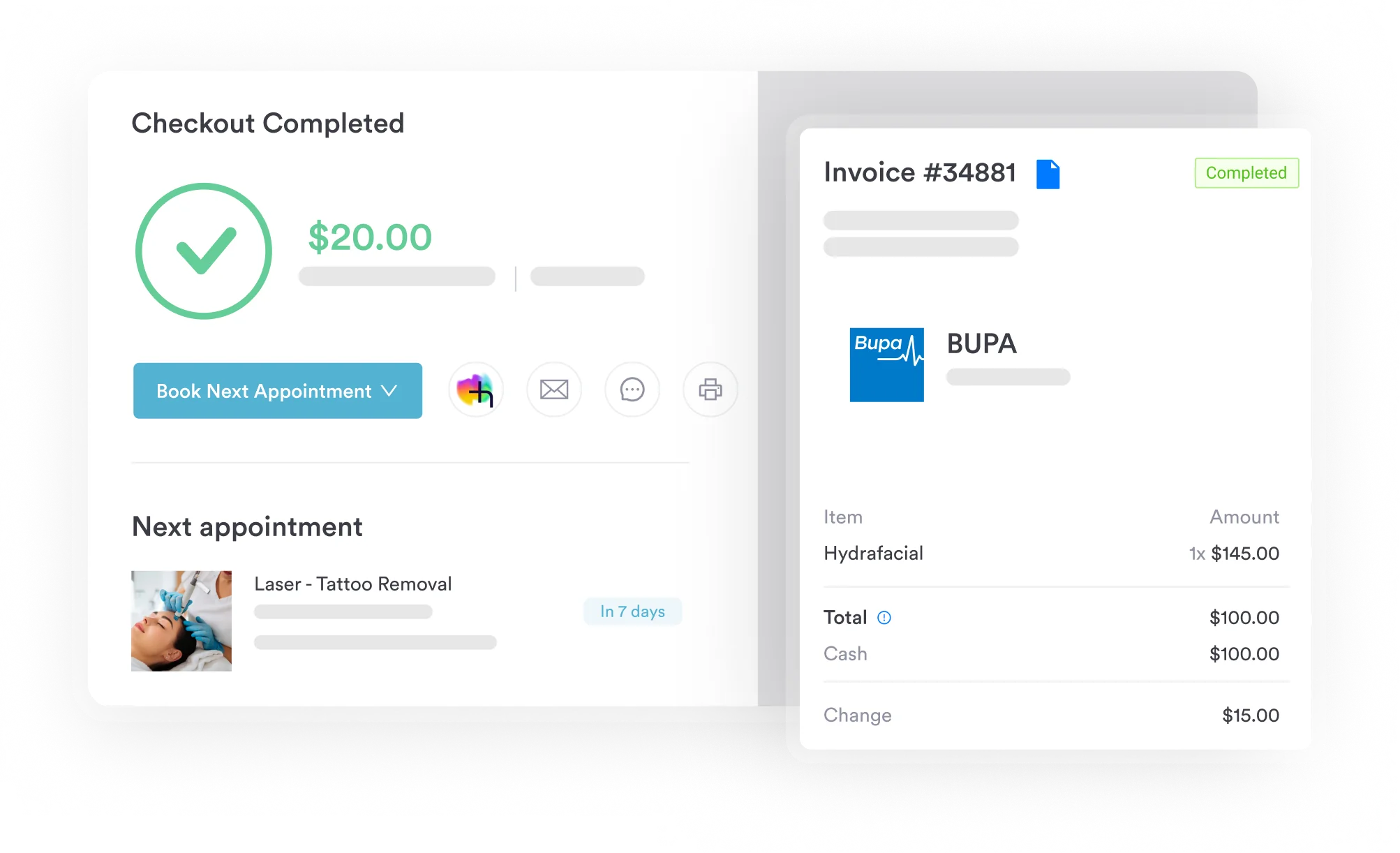
When it’s time to bill, Pabau’s claims software for specialty practices pre-fills the CMS-1500 from the record. In the US, claims go out through Claim.MD, with eligibility checks and remittance posting. Pair that with sound medical billing compliance habits, and records requests stop being a scramble.

Pabau keeps wound measurements, photos and product lot numbers on the patient record. It then pre-fills the claim and flags a missing authorization number before it goes out.

Q4147 is simpler to bill in 2026 than it used to be. One flat Medicare rate replaced product-by-product pricing, and the code describes one brand family. What still decides payment is whether the chart proves a stalled wound and the units match the note.
Start by checking two settings in your own system this week. Architect should be set up as a collagen device, not a placental graft, and your fee schedule should carry the 2026 rate. Then hold every claim to the checklist above.
Book a demo to see how Pabau keeps wound documentation and skin substitute claims on the same patient record.

Need a denial resolution framework? Denial management in healthcare covers the end-to-end workflow for identifying, appealing, and preventing recurring claim rejections.
Unfamiliar with common CARC codes on denied claims? Denial codes in medical billing provides a reference guide to the most frequently returned adjustment reason codes.
Looking to improve claim submission accuracy? What is revenue cycle management explains how the full RCM workflow connects documentation to payment.
Billing another matrix under the 2026 flat rate? HCPCS code Q4127 covers Talymed, a skin substitute billed per square centimeter.
Coding the application on the trunk, arms or legs? CPT code 15271 covers the first 25 sq cm or less of a skin substitute graft at those sites.
Yes. Q4147 is active for 2026 and still describes Architect, Architect Px and Architect Fx. Q codes are temporary, though, so check each CMS quarterly HCPCS update before you bill in a new quarter.
Harbor MedTech makes Architect. It’s a decellularized, stabilized collagen matrix made from equine pericardium, the membrane that surrounds a horse’s heart.
No. Architect is an animal-derived device cleared through the FDA’s 510(k) pathway. The amniotic products billed under nearby Q codes are human tissue, usually regulated as 361 HCT/Ps, a separate FDA category.
Pair the underlying condition with a code for the ulcer’s site and depth. A diabetic foot ulcer often takes E11.621 plus an L97.4- or L97.5- code. A venous ulcer takes I83.0- or I87.31-, plus an L97 code. Your MAC’s covered list has the final word.
The product code doesn’t change by site, and the application uses 15271 to 15274 for the arm. Coverage is the hurdle. Most MAC policies center on lower-extremity diabetic and venous ulcers, so read yours or issue an ABN first.