HCPCS Code Q4177: Skin substitute graft billing guide
HCPCS code Q4177: Official descriptor and product details HCPCS Code Q4177 is th...

Last Updated: Nov 20, 2026
HCPCS Code Q4175 is the Level II code for Miroderm, a skin substitute cleared through the FDA 510(k) pathway. It is billed per square centimeter applied, as an add-on to a CPT application code from 15271 to 15278.
The code is active in the 2026 CMS HCPCS file. The old not-otherwise-specified code, Q4100, was deleted on December 31, 2025, and Miroderm never bills under the new unlisted codes. Since January 1, 2026, Medicare pays Q4175 as an incident-to supply at one national rate per square centimeter, in place of product-specific pricing.
Let Pabau's smart automation suggest the right codes, reduce claim denials, and keep your practice compliant—effortlessly.
Automate repetitive tasks and focus on what matters most—your patients.
Reduce coding errors and ensure compliance with the latest regulations.
Clean claims, fewer denials, and faster reimbursements.
Powerful insights and reporting to help your practice thrive.
HIPAA compliant SOC 2 certified GDPR-compliant Trusted by 4,000+ clinics worldwide

HCPCS Code Q4175 bills Miroderm per square centimeter. The old not-otherwise-specified code Q4100 was deleted on December 31, 2025, and Miroderm never bills under an unlisted code.
Always pair Q4175 with a CPT application code from 15271 to 15278, chosen by wound location and total wound area.
Since January 1, 2026, Medicare pays Q4175 as an incident-to supply at one national rate of about $127.14 per sq cm, replacing product-specific pricing.
Coverage still follows your MAC’s LCD. Medicare Advantage and commercial plans may also require prior authorization.
Documentation must include wound size in sq cm, wound location, wound bed description, the physician order, and the product lot and application note.
Pabau keeps wound measurements, photos and product lot numbers on the patient record, then pre-fills the claim and sends it through Claim.MD.
HCPCS Code Q4175 is the billing identifier for Miroderm, a skin substitute in the Q4101 to Q4440 range of product-specific codes. CMS’s January 2026 ASC update lists it as “Miroderm, per square centimeter”, paid at the single 2026 skin substitute rate. CMS gives each product in this range its own Q-code. The old generic code, Q4100, was deleted on December 31, 2025. The table below summarizes the key reference data for Q4175.
CMS publishes the product identity in the official annual HCPCS Alpha-Numeric file. Coders should always verify the linked product name against the current-year file at CMS’s HCPCS overview page. Product-to-code assignments occasionally shift when a manufacturer reformulates or rebrands. Codes are also deleted, as Q4100 was at the end of 2025, so a stale code-to-product mapping is an audit risk.
Q4175 covers the specific skin substitute product it identifies when applied to a qualifying wound in an eligible care setting. The application procedure itself is billed with the accompanying CPT code, not with Q4175. The code also never covers another product, however clinically similar.
Covered uses: Application to chronic wounds (diabetic foot ulcers, venous leg ulcers, pressure injuries) and acute wounds where the product is clinically indicated. The application must happen in a qualifying place of service, backed by a physician order and wound measurement documentation.
Not covered:
The distinction between covered and non-covered is LCD-jurisdiction-specific. Novitas, CGS, Palmetto GBA, Wellpoint Federal (formerly National Government Services), WPS, First Coast, and Noridian each publish their own skin substitute LCD. The covered-diagnosis list and application-frequency limits in your MAC’s LCD govern. A wound that qualifies under one MAC’s policy may not qualify under another’s.
Thin wound documentation is a leading reason Q4175 claims fail on audit. Medical billing compliance for skin substitutes demands more specificity than most other HCPCS product codes. Payment is calculated per square centimeter, and LCD criteria require documented treatment failure before a CTP is applied.
Every claim for HCPCS Code Q4175 requires these elements in the medical record:
Units billed equal the wound area in sq cm at the time of application. If the wound measures 8 cm × 5 cm, the area is 40 sq cm and 40 units of Q4175 are billed. Some LCDs impose a maximum number of units per application or a maximum wound size for coverage. Check the applicable LCD before billing.
Q4175 identifies the product; a CPT code from the 15271-15278 series identifies the application procedure. Both codes must appear on the same claim. A missing or mismatched CPT application code is among the most common denial triggers for skin substitute claims.
The correct CPT selection depends on anatomical location and total wound surface area, not on the product or the patient’s age. A diabetic foot ulcer on the plantar surface uses 15275, plus 15276 for each additional 25 sq cm up to 100 sq cm total. A venous leg ulcer on the calf uses 15271, plus 15272 add-ons on the same basis. Once the total wound area reaches 100 sq cm, the claim moves to 15273 and 15274. For the face, hands, and feet group, it moves to 15277 and 15278. The grid below lays out all four pairs, with the 40 sq cm calf ulcer from above as a worked claim.
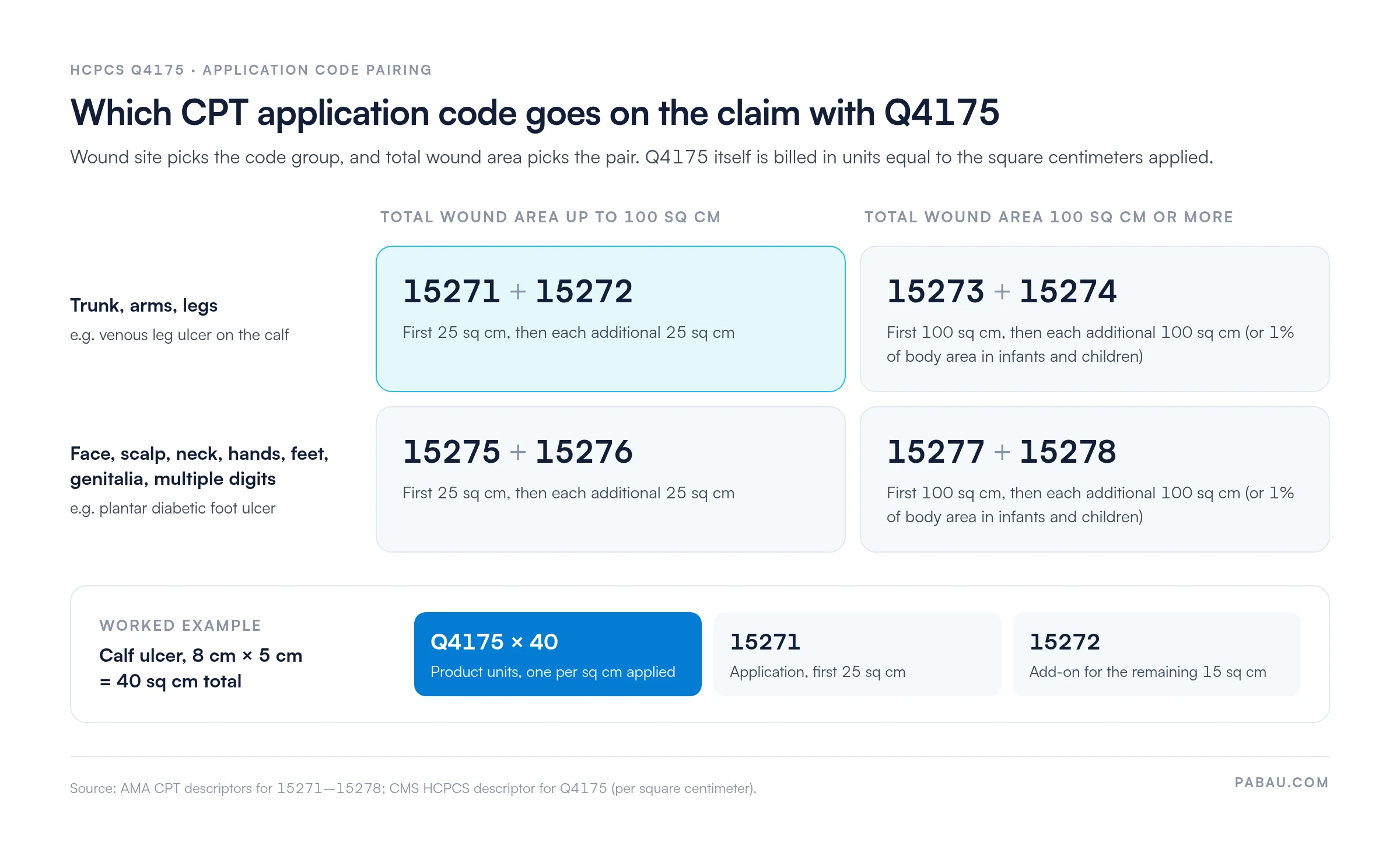
The “1% of body area” measure applies to infants and children. It is an alternative unit inside those four codes, not a separate pediatric code. Verify any bundling edits for Q4175 with your CPT pair in the National Correct Coding Initiative (NCCI) edits before submitting.
Q4100 was the “not otherwise specified” code for skin substitutes that had no product-specific Q-code. CMS deleted it on December 31, 2025, and listed it with action code D in the January 2026 HCPCS file. It has not been reinstated. HCPCS Level II is the HIPAA standard code set, so Q4100 is invalid on a claim to any payer, not only Medicare.
Q4100 was replaced by three unlisted codes, effective January 1, 2026. Q4431 covers PMA products, Q4432 covers 510(k) products, and Q4433 covers 361 HCT/P products. They apply only to an FDA-authorized product that has no code of its own yet. Miroderm has one, so it always bills under Q4175. Confirm each stocked product’s current-year code before every billing period, and ask your Medicare Administrative Contractor (MAC) before the first application of an uncoded product.
The Q4101 to Q4440 range contains well over 100 product-specific codes. Knowing the nearest neighbors to Q4175 reduces cross-coding errors when multiple skin substitute products are stocked and applied in the same facility.
Run a product-to-code reconciliation at the start of each calendar year. CMS updates HCPCS codes on January 1 and sometimes mid-year. A product that maps to Q4175 today may receive a new code or have its descriptor revised. Before the first Q4175 claim of the year, check the current-year CMS HCPCS file against your charge description master.
Medicare FFS covers Q4175 skin substitute claims when the claim satisfies the applicable MAC Local Coverage Determination. Medicare FFS has no formal prior authorization process here. The LCD serves as the coverage policy, and compliance with its criteria determines coverage. Understanding revenue cycle management for products like Q4175 means knowing your MAC’s specific LCD before billing, not after a denial.
Key coverage criteria common across most MAC skin substitute LCDs include:
Payment changed on January 1, 2026. Under the CY2026 Physician Fee Schedule final rule (CMS-1832-F) and the OPPS/ASC final rule (CMS-1834-FC), Medicare pays non-BLA skin substitutes as incident-to supplies. They are paid when used with a covered application procedure, in the physician office, the hospital outpatient department, and the ASC alike.
Miroderm is a 510(k) device, assigned to APC 6001, so Q4175 falls under this policy. One national rate applies across the HCT/P, PMA, and 510(k) categories. CMS finalized it at about $127.28 per sq cm and later corrected it to about $127.14. It replaces the old product-specific ASP and APC pricing; only BLA-licensed products stay on ASP-based payment. A legal challenge from the CAMPs Initiative was dismissed on August 26, 2026, so the policy is in force. Look up your local allowable in the CMS Physician Fee Schedule search tool, and remember the CPT application code is paid on its own line.
Medicare FFS has no blanket prior authorization rule for HCPCS Code Q4175; coverage is established by LCD compliance, not by an advance approval step. One exception is CMS’s WISeR model, which began in January 2026 in Arizona, New Jersey, Ohio, Oklahoma, Texas, and Washington. If you practice there, check its current operational guide. Medicare Advantage plans operate differently. Many require prior authorization for CTPs, and their policies vary by plan and plan year. Commercial insurers vary too. Some follow the Medicare LCD framework, while others apply their own medical policies, frequency limits, and PA requirements.
Before submitting a Q4175 claim for a Medicare Advantage or commercial patient, verify the plan’s specific policy. A PA submission typically needs what the LCD requires for Medicare FFS. That means wound measurements, the diagnosis, standard care failure documentation, and the physician order.
Where Q4175 is applied determines who bills the product code and how the claim is processed. Since 2026 the per-sq-cm rate is the same across settings, but the claim form is not. A physician applying a CTP in a hospital outpatient department does not bill the product code on their professional claim. The facility bills it on the institutional claim.
A physician who applies Q4175 in a hospital-owned outpatient wound clinic bills only the CPT application code on their professional claim. The hospital facility bills Q4175 on its outpatient institutional claim. Billing the product code on a professional claim for a POS 22 encounter is a placement error that results in a denial or recoupment.
Skin substitute claims need precise documentation, correct code pairing, and LCD compliance all at once, so each one can fail in several ways. Good denial management in healthcare starts with knowing which failure mode drove the denial before it happens.
Understanding denial codes in medical billing helps revenue cycle staff route each denial to the right remediation pathway. A CO-50 (not medically necessary) denial needs a different response than a CO-4 denial. CO-4 means the procedure code is inconsistent with the modifier used, or a required modifier is missing.
Medicare FFS appeals follow a five-level process. Most Q4175 denials are resolved at levels one or two.
For non-documentation denials (wrong CPT pairing, units mismatch), correct and resubmit rather than appeal. Appeals are for coverage disputes and medical necessity disagreements, not for correctable coding errors. Check what a clean claim submission requires before resubmitting. Fixing the original error is faster than appealing a preventable denial.
Build a Q4175 pre-submission checklist. Check that the wound area in sq cm is documented and the CPT code matches the location and total area. Confirm the ICD-10 code is on the covered-diagnosis list and standard-care failure is in the note. Then check that units match the measurement and the place of service is right. Confirm the code is current in this year’s CMS HCPCS file, too. Running this checklist before each submission catches the top eight denial triggers before they reach the payer.
Skin substitute billing usually breaks where the chart and the claim live in different systems. The wound measurement sits in one place and the lot number in another, so the biller rebuilds the visit from memory. With a flat per-sq-cm rate, every unit that does not match the note is money a reviewer can take back.
Pabau, a practice management and EHR platform, keeps those pieces on one patient record. Wound forms capture measurements and photos at each visit. Stock carries a lot number and expiry date, recorded against the patient and the appointment.
When it’s time to bill, Pabau’s claims management software pre-fills the CMS-1500 from that record. Claims go out through Claim.MD, with eligibility checks and remittance posting against the same patient. A biller checking units against the wound note finds both on the same record.

Pabau keeps wound measurements, photos and product lot numbers on the patient record. It then pre-fills the claim and routes it through Claim.MD with eligibility checks and remittance posting.

Q4175 got simpler to code and stricter to defend in 2026. Q4100 is gone, and Miroderm has its own code, so it bills under Q4175 and never under an unlisted code. Payment no longer depends on the product, so the number of square centimeters is the whole claim. That puts the weight on the wound note. It needs an exact measurement, a CPT code chosen by location and total area, and proof that standard care failed first.
Practices that treat the note as the claim will see fewer denials and far fewer recoupments. Book a demo to see how Pabau keeps wound documentation and claim submission in one workflow.

Need to track denial patterns across HCPCS codes? Denial management in healthcare covers how to categorize, track, and reduce denial rates across your billing operation.
Confused about which denial code you received? Denial codes in medical billing explains CARC and RARC codes so you can route each denial to the right fix.
Want to understand the full revenue cycle behind wound care billing? What is revenue cycle management walks through the end-to-end process from eligibility through payment posting.
HCPCS Code Q4175 is a Level II Q-code for Miroderm, per square centimeter (add-on, list separately in addition to primary procedure). Miroderm is a skin substitute cleared through the FDA 510(k) pathway. The code sits in the Q4101 to Q4440 range of product-specific skin substitute codes maintained by CMS.
Yes, Medicare FFS covers Q4175 when the claim meets the criteria in the applicable MAC Local Coverage Determination. Since January 1, 2026, Medicare pays it as an incident-to supply at one national rate of about $127.14 per sq cm. Medicare Advantage plans may require prior authorization separately.
Q4175 pairs with a CPT code from the 15271-15278 skin substitute application series. The choice depends on anatomical location and total wound surface area, not on the patient’s age. Codes 15271 to 15274 cover the trunk, arms, and legs, and 15275 to 15278 cover the face, scalp, neck, hands, feet, genitalia, and multiple digits. In each group, the first pair covers a total wound area up to 100 sq cm. The second pair covers 100 sq cm or more.
Q4175 is the active, product-specific code for Miroderm. Q4100, the not-otherwise-specified skin substitute code, was deleted on December 31, 2025, and is invalid on any claim. Since January 1, 2026, a product with no code of its own bills under unlisted code Q4431, Q4432 or Q4433, chosen by its FDA pathway. Miroderm has its own code, so it always bills as Q4175.
Q4175 can be billed in a physician office (POS 11), hospital outpatient department (POS 22), and ambulatory surgical center (POS 24). In physician office settings, the physician bills the product code. In facility settings (HOPD or ASC), the facility bills Q4175 on the institutional claim. The physician bills only the CPT application code on their professional claim.
Record wound measurements in sq cm (length, width, depth) at each application, plus the wound bed description and anatomical location. Add evidence that standard wound care failed before the CTP was applied, typically over four or more weeks. The record also needs a signed physician order, the product lot number, and an ICD-10-CM code on the MAC’s covered-diagnosis list. Missing any element is the leading cause of Q4175 claim denials.