HCPCS Code L0472: Hyperextension TLSO billing guide
HCPCS code L0472: Official descriptor and device definition HCPCS code L0472 des...

Last Updated: Nov 5, 2026
15277 is the CPT code for a skin substitute graft to the face, scalp, eyelids, mouth, neck, ears, orbits, genitalia, hands, feet and/or multiple digits. It reports the first 100 sq cm of a wound whose total surface area is 100 sq cm or greater. In infants and children, it can report the first 1% of body area instead.
Wound size decides the code at every application, first or repeat. Smaller wounds on the same sites use 15275 and add-on 15276. Each additional 100 sq cm above the first, or part of it, is billed with add-on 15278. Trunk, arm and leg wounds use 15271–15274.
Let Pabau's smart automation suggest the right codes, reduce claim denials, and keep your practice compliant—effortlessly.
Automate repetitive tasks and focus on what matters most—your patients.
Reduce coding errors and ensure compliance with the latest regulations.
Clean claims, fewer denials, and faster reimbursements.
Powerful insights and reporting to help your practice thrive.
HIPAA compliant SOC 2 certified GDPR-compliant Trusted by 4,000+ clinics worldwide

CPT Code 15277 reports the first 100 sq cm of a skin substitute graft when the total wound is 100 sq cm or more. It covers the face, scalp, neck, hands, feet and other listed sites.
Wound size decides between 15275 and 15277 at every application, first or repeat. Wounds under 100 sq cm on the same sites use 15275 and add-on 15276.
Add-on CPT 15278 covers each additional 100 sq cm or part of it. A 250 sq cm wound bills as 15277 x1 plus 15278 x2.
For infants and children, 15277 can cover the first 1% of body area, with 15278 for each additional 1%.
Since January 1, 2026, Medicare pays most skin substitute products as incident-to supplies at one flat rate per sq cm. The product is billed on its own Q-code line.
Pabau, the practice management platform we build, sends US insurance claims through Claim.MD and flags each rejection with its reason for correction.
CPT Code 15277 is defined by the American Medical Association (AMA) as the application of a skin substitute graft to specific high-visibility and high-function sites. Those are the face, scalp, eyelids, mouth, neck, ears, orbits, genitalia, hands, feet, and/or multiple digits. It applies when the total wound surface area is 100 sq cm or greater, and it reports the first 100 sq cm.
For infants and children, the same code can instead report the first 1% of body area. The code sits in the skin substitute grafts subsection of CPT’s skin replacement surgery codes, and this structure has been in current CPT since 2012.
The term “skin substitute graft” here refers to cellular and tissue-based products (CTPs), not autografts harvested from the patient’s own skin. Products such as Apligraf (a bilayered cell therapy from Organogenesis) and Dermagraft (a bioengineered dermal substitute) fall within this category. Each product carries its own HCPCS Q-code, such as Q4101 for Apligraf.
The eight skin substitute codes split two ways: by body site and by total wound size. Each primary code has its own add-on, and the add-on unit changes with the size tier.
CPT 15277 covers CTP application to wounds on the face, scalp, eyelids, mouth, neck, ears, orbits, genitalia, hands, feet, and/or multiple digits. The deciding fact is size: the total wound surface area treated at the encounter must be 100 sq cm or greater.
The code does not depend on whether the patient is having an initial or a repeat graft. A 140 sq cm scalp wound is 15277 at the first visit, and at the fourth. A 40 sq cm hand wound is 15275 at every visit, however many applications came before.
Body site is the second check. Wounds on the trunk, arms or legs use 15271–15274, even when the wound is large or complex. A 140 sq cm thigh wound, for example, bills as 15273 plus one unit of 15274. Billing 15277 for a calf ulcer creates a mismatch between the code and the diagnosis, which payers deny. The grid below puts both checks side by side.
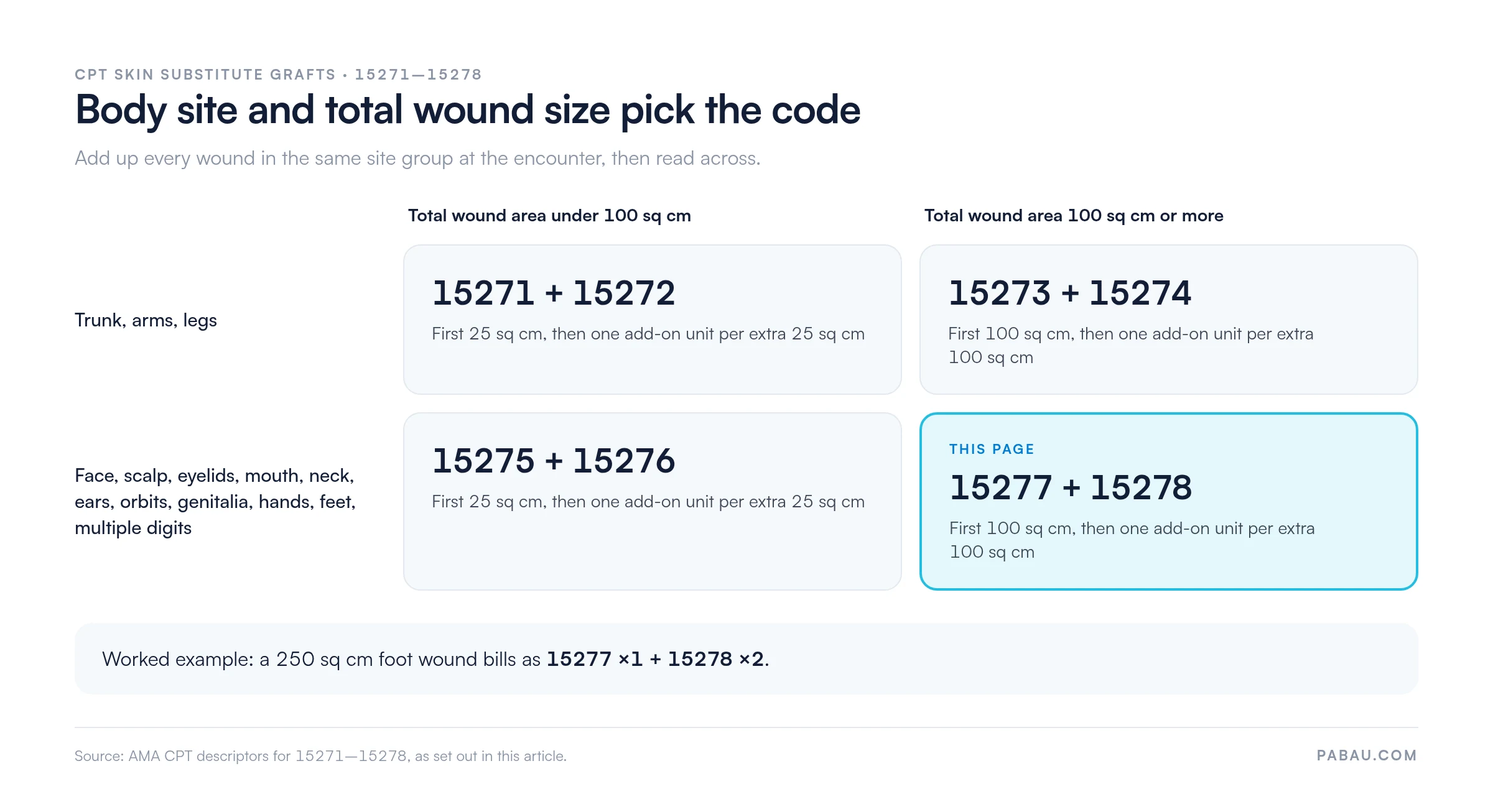
Included under CPT 15277:
Excluded from CPT 15277:
The clinical record must demonstrate medical necessity for every CPT 15277 claim. Wound measurements in square centimeters come first, because they prove the wound reached the 100 sq cm threshold. Missing or non-metric wound dimensions are a leading documentation denial trigger for skin substitute claims.
Capture each element below before the encounter closes, because a missing one is hard to add once the claim has gone out. The minimum record for CPT Code 15277 includes:
When an LCD applies in the jurisdiction, the documentation must also meet its specific criteria. Examples include confirming adequate vascular supply to the wound bed or documenting that the treating clinician reviewed the wound before CTP application.
The diagnosis has to match the wound too. A diabetic foot ulcer in type 2 diabetes, for example, is coded E11.621, with an L97 code for the ulcer’s site and depth. A standardized wound-care checklist tied to your MAC’s criteria is the surest route to clean claim submission on the first pass.
CPT 15278 is the add-on code for each additional 100 sq cm, or part thereof, beyond the first 100 sq cm reported with CPT 15277. For infants and children, it can instead report each additional 1% of body area. It cannot be reported without 15277 on the same claim.
The unit calculation starts with the total wound area. If it is under 100 sq cm, 15277 does not apply at all. At 100 sq cm or more, report 15277 once for the first 100 sq cm. Then divide the remaining area by 100 and round any fraction up to get the 15278 units.
When several wounds in the same anatomic group are treated at one encounter, add their surface areas together before choosing the code. A 70 sq cm foot wound and a 40 sq cm hand wound total 110 sq cm. Together they bill as 15277 x1 plus 15278 x1. Wounds on the trunk, arms or legs are totaled separately under 15271–15274.
Document each wound’s length-by-width dimensions separately in the clinical note, then sum the total area in the billing summary. Payers that audit 15277 and 15278 claims check whether the total reached 100 sq cm. Itemized measurements per wound site protect the claim during review.
Modifier selection for CPT Code 15277 depends on the clinical scenario, the payer, and whether other procedures were performed at the same encounter. Using the wrong modifier, or omitting a required one, is a top denial trigger for skin substitute graft claims.
Modifier 59 warrants special attention. National Correct Coding Initiative (NCCI) edits bundle wound debridement, such as 11042, into the skin substitute graft code. That applies when both are performed on the same wound at the same encounter. Modifier 59 or XS overrides that bundling only when the debridement was on a separate wound or served a distinct clinical purpose.
Applying either modifier without supporting documentation exposes the claim to audit and recoupment. Verify current NCCI edits via the AAPC code lookup before billing debridement alongside CPT 15277.
Medicare covers CPT Code 15277 under Part B when the claim meets medical necessity rules. It must also satisfy any Local Coverage Determination (LCD) from your Medicare Administrative Contractor (MAC). Coverage criteria are not uniform nationwide, so always check your MAC’s active policy before billing.
Coverage policy shifted at the end of 2025. CMS withdrew the multi-MAC skin substitute LCDs for diabetic foot and venous leg ulcers on December 24, 2025, days before their January 1, 2026 start. Claims are still reviewed case by case, and several MACs, including Novitas, CGS and First Coast, keep their own skin substitute policies.
Across current MAC policies, these criteria come up most often:
The setting changes the payment rate. In a freestanding office (Place of Service 11), the physician fee schedule pays the non-facility rate, which is higher because the practice carries the overhead.
In a hospital outpatient department, POS 22 (on campus) or POS 19 (off campus), the professional service pays at the lower facility rate. The hospital bills its own facility claim separately. The CMS Physician Fee Schedule lookup tool shows both rates for CPT 15277 by year and locality.
Traditional Medicare has not historically required prior authorization for CPT 15277. That changed in part on January 1, 2026, when CMS’s WISeR model started testing prior authorization for skin and tissue substitutes. It runs in selected MAC jurisdictions in Arizona, New Jersey, Ohio, Oklahoma, Texas and Washington, so confirm with your MAC whether it applies to you.
Commercial payers are a different matter. Most major commercial insurers, and many Medicaid managed care plans, require prior authorization for skin substitute graft procedures. Requirements and timelines vary by payer and change often. Always verify them with the specific payer for each patient before the first CTP application.
A prior authorization submission for CPT 15277 typically requires:
Billing CPT Code 15277 without a required authorization usually results in a CO-197 denial (precertification absent). Some payers deny it as CO-50 (not medically necessary) instead. Neither is fixed by correcting the claim, so you need an approved authorization before you rebill.
CPT Code 15277 rates under the Medicare Physician Fee Schedule (MPFS) differ between facility and non-facility settings and are updated each year by CMS. Rates also vary by region through the Geographic Practice Cost Index (GPCI) adjustment.
The professional fee for 15277 covers applying the CTP product, preparing the wound and managing the encounter. The product itself goes on its own claim line under its HCPCS Level II Q-code, with units in square centimeters. The 15277 fee does not include it.
Product payment changed on January 1, 2026. Under the CY 2026 fee schedule, Medicare pays most skin substitute products as incident-to supplies at one national rate. A November 2025 correction set it at $127.14 per sq cm before geographic adjustment. Products licensed as biologics are paid differently, so check the current rate for the exact product you used.
Use the CMS fee schedule lookup or a tool such as CrossCoder to confirm the right Q-code and its current rate. Key reimbursement variables for CPT 15277 claims include setting, MAC region and the product’s payment category.
Most CPT Code 15277 denials are preventable. They trace to four root causes: the wrong body site, the wrong size tier, missing medical necessity documentation and incorrect modifier usage. Effective denial management workflows catch these before submission rather than after the payer rejects the claim.
Understanding denial codes at the team level helps front-end staff and coders spot patterns before claims leave the practice. Tracking 15277 denials by category each month shows whether the cause is documentation, size tier, modifiers or product coverage. That points the fix at the right workflow.
Wound care billing for CPT Code 15277 has more moving parts than most code families. Body site, summed wound area, size tier, prior authorization, modifiers, 15278 units and the product Q-code all have to line up. Each one is a point where a manual process can fail.
Pabau keeps the clinical record and the claim in one system, so wound measurements and photos sit next to the bill they support. Its claims management software handles US insurance billing for wound care practices through:
A claim fixed before submission costs far less than one fixed through an appeal. With notes and claims in one system, the body-site and size-tier errors behind most 15277 rejections surface while the patient’s record is still open.

Pabau keeps wound notes, photos and prior authorizations next to your claims, submits them through Claim.MD, and flags rejected claims with the reason. Fewer denials, less rework.

CPT Code 15277 turns on one number: a total wound area of 100 sq cm or more. The body site then decides between this family and 15273/15274. Get that measurement right, and the choice between 15275 and 15277, and the 15278 units, follows from it.
Most failed 15277 claims trace back to process, such as a missing measurement or an unchecked authorization. Measure every wound in centimeters, sum by anatomic group, check your MAC’s policy and confirm prior authorization before the graft goes on. To see how Pabau keeps wound documentation and claims together, book a demo and walk through a 15277 billing scenario with the team.

Choosing a clearinghouse for wound care claims? Claim.MD clearinghouse review explains how a US clearinghouse sends your claims to payers and brings back remittances and eligibility answers.
Auditing your billing process? Medical billing compliance covers the laws behind billing violations, with a downloadable checklist for small practices.
Grafting a smaller trunk or limb wound? CPT code 15271 covers the first 25 sq cm on the trunk, arms and legs when the total wound is under 100 sq cm.
CPT Code 15277 reports a skin substitute graft to the face, scalp, eyelids, mouth, neck, ears, orbits, genitalia, hands, feet, and/or multiple digits. It applies when the total wound surface area is 100 sq cm or greater. It covers the first 100 sq cm, or the first 1% of body area of infants and children. It covers cellular and tissue-based products (CTPs) only, not autografts or non-CTP dressings.
Both codes cover the same body sites, and the difference is wound size. CPT 15275 applies when the total wound surface area is under 100 sq cm and reports the first 25 sq cm. CPT 15277 applies at 100 sq cm or greater and reports the first 100 sq cm. Neither code depends on whether the graft is the patient’s initial or a repeat one.
CPT 15278 is the add-on code for each additional 100 sq cm, or part thereof, beyond the first 100 sq cm reported with 15277. For infants and children, it can report each additional 1% of body area. A 250 sq cm foot wound bills as 15277 x1 and 15278 x2. CPT 15278 cannot be billed without 15277 on the same claim.
Bill CPT 15277 x1. The descriptor covers a total wound surface area of 100 sq cm or greater. A wound of exactly 100 sq cm sits in the 15277 tier with no 15278 units. A total of 101 to 200 sq cm adds one unit of 15278.
Yes, Medicare Part B covers CPT Code 15277 when the claim meets medical necessity rules and your MAC’s coverage policy. That means documented failure of standard wound care and a CTP product covered in your jurisdiction. CMS withdrew the planned multi-MAC skin substitute LCDs in December 2025, so check your MAC’s active policy before billing.
Yes, in certain circumstances. NCCI edits typically bundle wound debridement (CPT 11042/11043) into the skin substitute graft code when performed on the same wound at the same encounter. Modifier 59 or XS allows separate billing only when the debridement was on a separate wound or served a distinct purpose, supported by documentation. Using either modifier without that support exposes the claim to audit and recoupment.
A freestanding wound care practice owned by the physician group bills CPT 15277 under Place of Service 11 (office), which pays the higher non-facility rate. A hospital-based wound care clinic bills under POS 22 (on-campus outpatient hospital) or POS 19 (off-campus outpatient hospital). There, the professional service pays at the lower facility rate and the hospital bills its own facility claim. Use the CMS Physician Fee Schedule lookup to confirm the rates for your locality.
The medical record must include wound measurements in centimeters (length x width) and the total area that reaches 100 sq cm. It also needs the wound etiology and diagnosis code, documented failure of prior wound care, and the CTP product name and lot number. Add wound photographs where your MAC requires them, plus physician attestation. MAC policies may add criteria such as a vascular assessment or a minimum treatment period before CTP starts.