CPT code 51797: Intra-abdominal voiding pressure add-on
What CPT code 51797 covers CPT code 51797 is the add-on code for intra-abdominal...

Last Updated: Oct 19, 2026

CPT 15271 covers skin substitute graft application to the trunk, arms, or legs, first 25 sq cm or less.
The 15271-15278 family is divided by anatomical zone and by total wound surface area, not by patient age.
For trunk, arms, or legs, use 15271 with add-on 15272 below 100 sq cm. At 100 sq cm or more, use 15273 with add-on 15274.
Within the 15273 and 15277 pairs only, age 10 decides the unit of measurement, sq cm or percent of body surface area.
Documentation must record the wound measurement, wound type, product name and lot number, and a medical necessity narrative.
Practice management software like Pabau supports wound care billing, submitting 15271 claims through its Claim.MD clearinghouse integration.
CPT Code 15271 bills the application of a skin substitute graft to the trunk, arms, or legs. Specifically, one unit covers the first 25 sq cm or less. In turn, the total wound surface area treated must stay under 100 sq cm.
The eight codes in the 15271-15278 family are divided by anatomical zone and by total wound surface area, never by the patient’s age. In addition, add-on code 15272 covers each additional 25 sq cm in the same zone.
This guide sets out the AMA descriptor, the add-on arithmetic with 15272, and how the rest of the family fits around it. Beyond that, it also covers Medicare reimbursement, documentation, ICD-10 pairings, modifiers, prior authorization, and the most common denial reasons.
The American Medical Association (AMA) descriptor for CPT Code 15271 splits at a semicolon, the convention that marks a shared code family. Specifically, the common portion reads: application of skin substitute graft to trunk, arms, legs, total wound surface area up to 100 sq cm. In turn, the specific portion reads: first 25 sq cm or less wound surface area.
It is a standalone base code, used when a cellular or tissue-based product is applied to a wound on the trunk, arms, or legs. Notably, the 100 sq cm ceiling in that descriptor is what separates it from 15273.
The code does not describe debridement, wound bed preparation, or the graft product itself. Instead, those are separate billable services with separate HCPCS codes, such as Q4101.
CPT 15271 covers only the act of applying the substitute to a prepared wound surface. Accordingly, wound care centers, plastic surgery practices, and hospital outpatient departments all bill it on those terms.
CPT 15272 is the add-on code paired exclusively with 15271. Specifically, it covers each additional 25 sq cm of skin substitute application to the same anatomical zone beyond the first 25 sq cm captured by 15271. In practice, you bill one unit of 15271, then one unit of 15272 for every additional 25 sq cm increment.
The arithmetic matters. For example, take a wound measuring 60 sq cm on the lower leg. First, one unit of 15271 covers the first 25 sq cm. Next, one unit of 15272 covers 26 to 50 sq cm. Finally, a second unit of 15272 covers the remaining 10 sq cm.
Partial increments round up to the next full 25 sq cm under AMA guidelines, so the claim reads 15271 x1 and 15272 x2.
Incorrect add-on stacking is a top OIG audit trigger for this code family. Therefore, always verify that the number of 15272 units reflects the measured wound area documented in the operative or procedure note. In practice, auditors compare the billed units against the wound measurement in the record, not against an estimate.
CPT Code 15271 is the first code in an eight-code family organized by two variables: anatomical zone and total wound surface area. Specifically, each zone has a pair of codes for wounds under 100 sq cm and a second pair for wounds of 100 sq cm or more.
The grid below maps all eight codes onto those two questions, so you can place a wound before you count units. The AAPC Codify CPT lookup, in turn, carries the full descriptors.
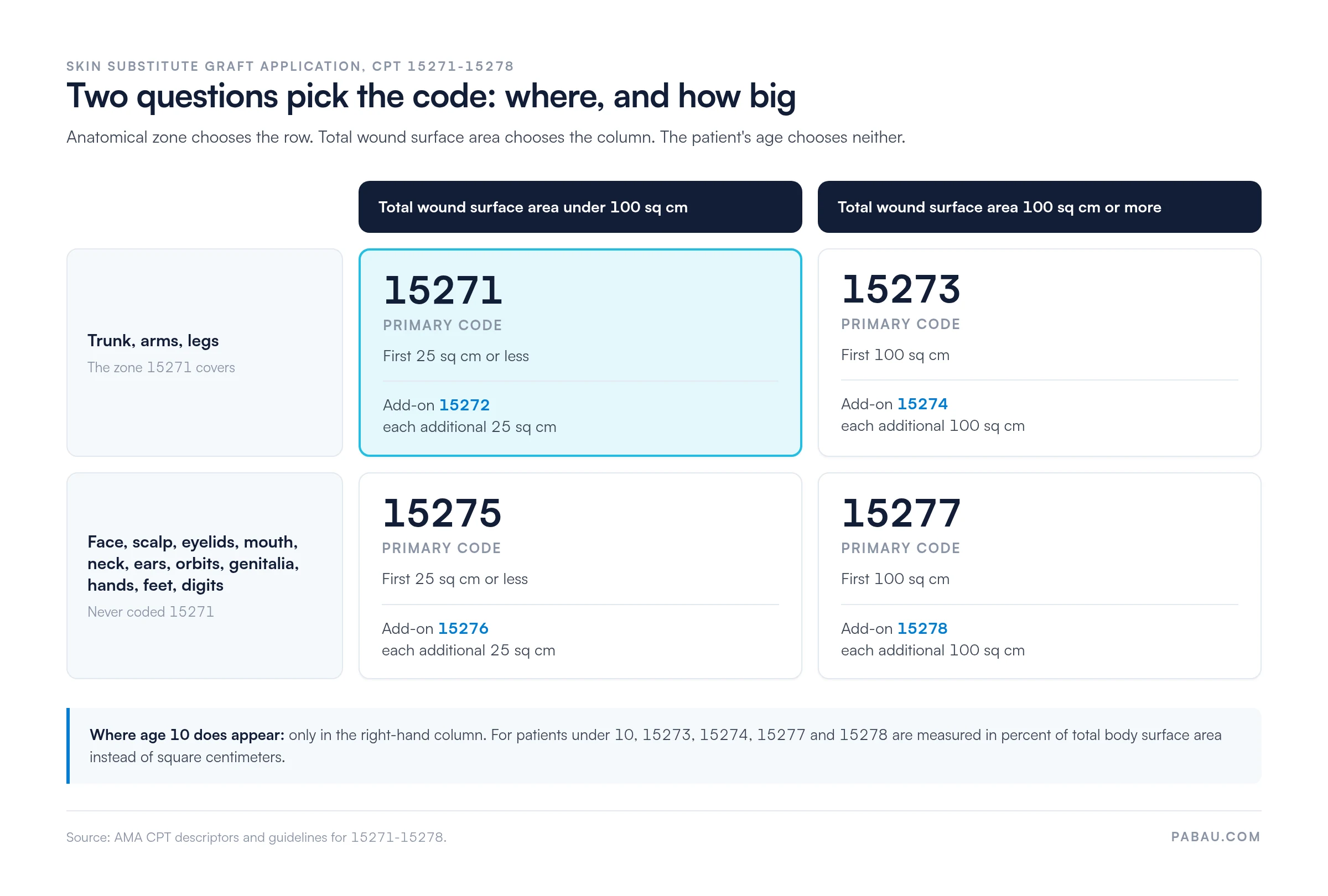
Two misassignments account for most denials in this family. The first is billing 15271 for a hand or foot wound, when those zones belong to 15275 and 15276. The second is stacking 15272 units on a wound of 100 sq cm or more, which should be coded 15273 with 15274 add-ons.
Both fail on claim edits, because the code selected contradicts the site or the measurement in the record.
Age 10 never decides which pair of codes you bill. Rather, it appears in only one place in the CPT guideline, and only inside the two large-wound pairs, 15273 with 15274 and 15277 with 15278.
There, age sets the unit of measurement. Specifically, report square centimeters for patients aged 10 and older, and percent of total body surface area for infants and children younger than 10.
Age has no bearing at all on 15271, 15272, 15275, or 15276. For instance, a five-year-old with a 20 sq cm leg wound is still coded 15271, because the total area sits well under 100 sq cm.
By comparison, a 40-year-old with a 260 sq cm leg wound is coded 15273 with two units of 15274, since that total area crosses the 100 sq cm line.
Treat 15273 as a primary code, not a pediatric version of 15271. It stands on its own for wounds of 100 sq cm or more, and 15274 is its add-on. Billing 15271 and 15273 together for the same wound will not survive a claim edit.
Medicare reimburses CPT Code 15271 under the Physician Fee Schedule (MPFS) at rates that differ between facility and non-facility settings. Accordingly, the CMS MPFS look-up tool publishes current-year rates by locality. Dollar amounts change with each annual update, so query the tool directly rather than relying on figures published in articles or newsletters.
Three factors move the payment amount. First, the geographic practice cost index (GPCI) applied by your locality. Second, the place of service code on the claim. Third, whether multiple procedure payment reduction rules apply that day.
Pabau integrates with Claim.MD to streamline electronic claims for wound care and surgical practices. In addition, the Claim.MD integration reaches thousands of US payers and supports real-time eligibility checks. Electronic remittance advice comes back as an 835 file, so practices reconcile payments without manual lookups.
Query the CMS MPFS look-up tool at the start of each calendar year with your specific locality code to capture updated 15271 rates. Non-facility rates typically exceed facility rates, so confirm your place of service code matches the actual setting of service before submitting.
Incomplete documentation is the top reason CPT Code 15271 claims are denied or recouped on audit. The operative or procedure note must support each element of the code descriptor. The record must also demonstrate medical necessity independently of the billing. Beyond that, using claims management software with built-in documentation checklists helps practices catch omissions before submission.
Generating a superbill that captures all these elements at the point of care reduces denial rates. By contrast, reconstructing the same documentation weeks later rarely produces the same detail. As a result, practices on paper-based or disconnected workflows often discover the omission only after a payer audit has already begun.
For submitting a clean claim, assemble the documentation package before submission rather than retrieving it when a payer requests records. Indeed, many MACs require supporting documentation to accompany certain high-value skin substitute claims at initial submission.
Selecting the correct ICD-10-CM diagnosis code is critical for establishing medical necessity under MAC LCDs. The diagnosis must describe the wound condition that makes a skin substitute graft clinically appropriate. The CrossCoder CPT-to-ICD-10 crosswalk tool, in practice, helps you check which diagnoses payers commonly accept with 15271. Beforehand, confirm current-year codes against the CDC/NCHS ICD-10-CM web tool before submission.
The E11.621 row above shows how a diagnosis can pull a coder toward the wrong CPT code. For example, a foot wound bills under CPT 15275, not 15271, whatever the diabetes diagnosis says. The anatomical zone governs CPT selection, and the diagnosis only supports medical necessity. Therefore, check the documented wound site before you match the diagnosis to a graft application code.
Modifiers signal to payers why a service is being billed in a particular way. Using the wrong modifier, or omitting a required one, results in a denial or a reduced payment that requires an appeal. Specifically, CMS guidance in the Claims Processing Manual (Publication 100-04) governs modifier use for skin substitute grafts.
Prior authorization requirements for CPT Code 15271 vary significantly by payer and by MAC jurisdiction. Medicare does not require prior authorization for 15271 under the Physician Fee Schedule, but many commercial payers do. Likewise, Medicaid programs set their own state-level requirements, so never assume a universal rule applies.
The most important coverage documents to review before billing are the MAC-issued Local Coverage Determinations (LCDs). Specifically, each MAC issues its own LCD governing when skin substitute grafts are medically necessary for Medicare beneficiaries.
These LCDs specify wound chronicity requirements, wound type restrictions, and required documentation elements. Typically, most set a minimum period of failed standard treatment, commonly 30 days. Therefore, reviewing your own MAC’s LCD at least annually keeps you inside the current criteria.
For commercial payers requiring prior authorization, submit the wound measurement, wound photographs, and a medical necessity letter before the procedure date. Otherwise, late authorization requests are almost always denied. Consequently, confirming the plan’s prior authorization process before the appointment is booked avoids that outcome.
Check your MAC’s LCD for CPT 15271 each January. Coverage criteria for skin substitute grafts change more often than most practitioners expect. Billing under superseded criteria is a leading cause of post-payment recoupment demands.
Skin substitute graft billing under CPT Code 15271 generates a disproportionate share of claim denials relative to other wound care codes. The OIG has cited this family as a persistent overpayment risk, and payers apply heightened scrutiny to claims in this range. As a result, building a denial management strategy specific to this code family pays off quickly in recovered revenue.
Reviewing common denial codes returned on 835 remittance files helps practices identify patterns. For example, a run of CO-151 denials on 15271 claims points at add-on units the documentation does not support. Meanwhile, CO-97 denials usually mean the payer treats the graft application as bundled into another service.
Most 15271 denials trace back to the clinical note rather than the billing office. Often, the wound area is recorded in free text, or measured at one visit and estimated at the next. By then nobody can say from the record whether the wound sat under 100 sq cm.
Pabau keeps the measurement and the claim in one system. Wound details captured in the treatment note stay attached to the visit, so the coder reads the documented area rather than reconstructing it. Claims then go out through the Claim.MD clearinghouse, with eligibility checked before the appointment.
The outcome is fewer avoidable denials on this code family, and a shorter path from graft application to payment. Likewise, Regenerative medicine practices applying the same cellular products work from the same record.
When a denial does arrive, the note, the units billed, and the remittance sit together in one record. Assembling the appeal then takes minutes rather than an afternoon of retrieval.

Pabau keeps wound measurements, skin substitute product details, and claim submission in one record. Wound care practices bill 15271 from documented figures, track denials, and reconcile payments in one place.

The code you bill follows the tape measure. Confirm the anatomical zone first, then total the wound surface area. Only then choose between the under-100 pair and the 100-or-more pair, and count add-on units from the documented figure.
Practices that fix the measurement step fix most of their denials, because every other LCD requirement hangs off it. As a result, repeated errors here attract audit attention from both MACs and the OIG. Recoupment then arrives long after the money has been spent.
The one habit worth building is recording the measured area in the note before anyone opens the claim. In short, everything else on this page follows from that single number. Book a demo to see how Pabau keeps it with the visit record.

Coding excess skin removal instead? CPT code 15837 covers excision of excessive skin and subcutaneous tissue on the forearm or hand.
Working on the thigh? CPT code 15832 sets out the documentation payers expect for excision of excessive thigh skin.
Standard wound care not working? HCPCS code G0281 covers unattended electrical stimulation for chronic ulcers that stall after conventional treatment.
CPT Code 15271 bills the application of a skin substitute graft to a wound on the trunk, arms, or legs. Specifically, it applies when the total wound surface area is less than 100 sq cm, and one unit covers the first 25 sq cm. For example, it is used most often for chronic wounds such as non-healing surgical wounds, venous ulcers, or diabetic wounds that have not responded to conventional therapy.
The AMA descriptor splits at a semicolon. The common portion reads: application of skin substitute graft to trunk, arms, legs, total wound surface area up to 100 sq cm. In turn, the specific portion reads: first 25 sq cm or less wound surface area. The code covers the application act only. Instead, it does not cover wound debridement, wound bed preparation, or the skin substitute product itself, which is billed separately with a HCPCS Level II code.
Medicare reimbursement for CPT 15271 is set annually by the Physician Fee Schedule. Specifically, it varies by geographic locality and by place of service, facility or non-facility. Check current-year rates with the CMS MPFS look-up tool at cms.gov, because dollar amounts change each January 1.
The difference is total wound surface area, not patient age. CPT 15271 applies when the total wound surface area is less than 100 sq cm, and covers the first 25 sq cm or less. By contrast, CPT 15273 applies when the total area is 100 sq cm or more, and covers the first 100 sq cm. Both are standalone primary codes for the trunk, arms, and legs, with 15272 and 15274 as their respective add-ons.
CPT 15271 covers graft application to the trunk, arms, and legs. By contrast, CPT 15275 covers the face, scalp, eyelids, mouth, neck, ears, orbits, genitalia, hands, feet, and multiple digits. Both are primary codes for wounds under 100 sq cm, so the anatomical zone decides which one is correct. For example, applying 15271 to a hand or foot wound is a common coding error.
Required documentation includes the wound location confirming the trunk, arm, or leg zone, the wound type, and the wound measurement in sq cm. You also need the total wound surface area treated, plus the skin substitute product name and lot number. Finally, a medical necessity narrative meeting LCD criteria and the supporting ICD-10-CM diagnosis code complete the file. Missing any element is grounds for denial or post-payment recoupment.
No. CPT 15271 is a standalone base code. Its companion add-on code is CPT 15272. Specifically, that code is billed for each additional 25 sq cm of graft application to the trunk, arms, or legs beyond the first 25 sq cm. Therefore, 15272 cannot be billed without 15271 as the primary code.
No. Age never selects the code pair, which is set by anatomical zone and total wound surface area. However, age 10 matters only inside 15273, 15274, 15277, and 15278, where it fixes the unit of measurement. Specifically, report square centimeters for patients aged 10 and older, and percent of total body surface area for infants and children younger than 10.