







ICD-10 code Z56.2: Threat of job loss
ICD-10 code Z56.2 is the billable ICD-10-CM diagnosis code for “Threat of ...

Last Updated: Sep 15, 2026

ICD-10 code X74.01XS is the billable ICD-10-CM diagnosis code for intentional self-harm by airgun, sequela. It reports a late-effect encounter for a condition caused by an earlier airgun self-harm injury. The code sits in category X74 of Chapter 20, External causes of morbidity (V00-Y99), and the 7th character S marks the encounter as a sequela.
X74.01XS is never the principal diagnosis. The condition being treated at the visit is coded first, and X74.01XS follows it as the external cause. This reference covers the hierarchy, 7th character selection, sibling codes, billing rules, and the behavioral health documentation payers look for.

ICD-10 code X74.01XS is a billable ICD-10-CM code for intentional self-harm by airgun, sequela.
The code has been effective since October 1, 2015, and it carries forward unchanged into the FY2026 code set.
The 7th character S covers late-effect visits, not healing-phase follow-ups, which take X74.01XD instead.
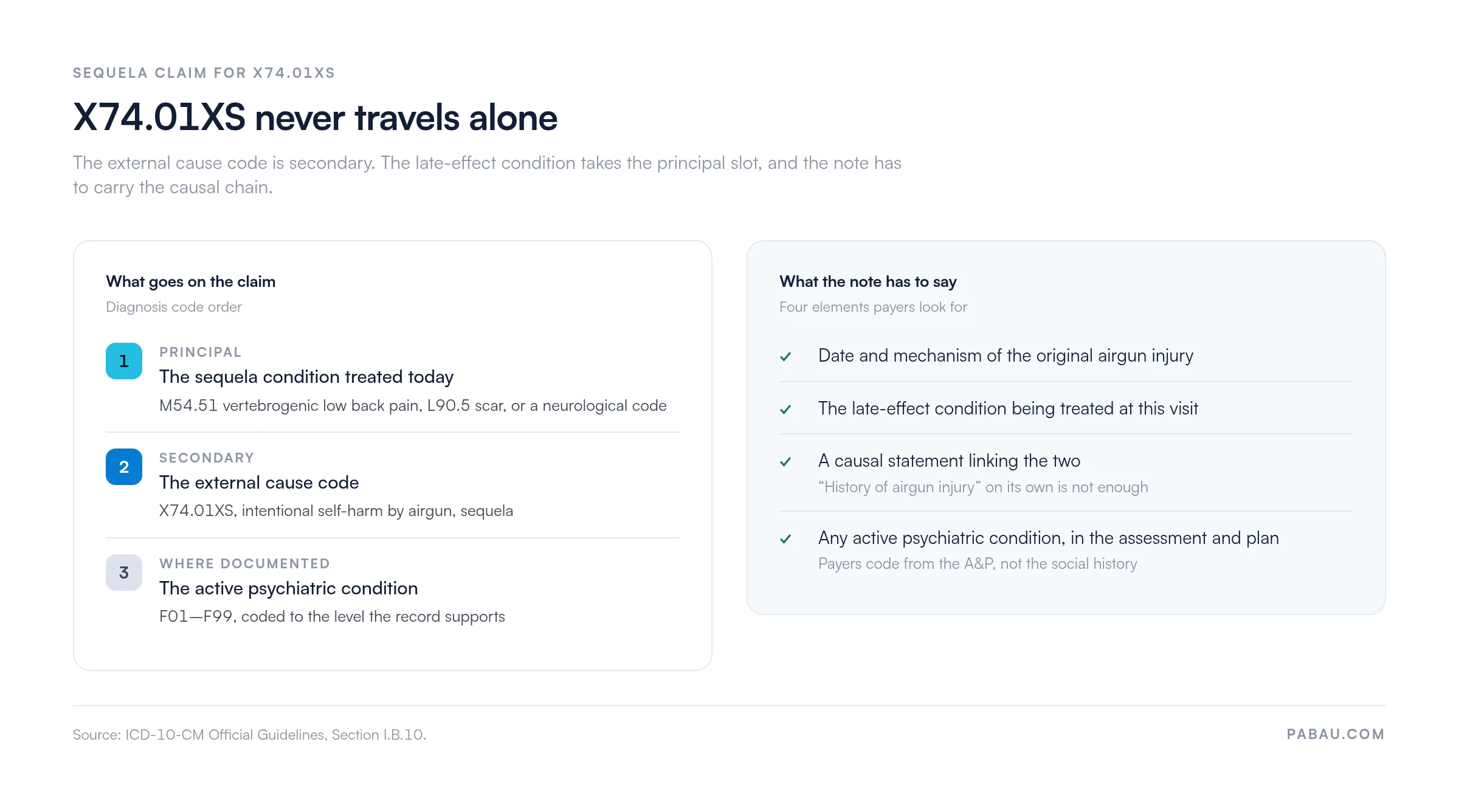
A sequela condition code always accompanies X74.01XS and takes the principal slot on the claim.
Sequela visits for self-harm often need a concurrent mental health code to support medical necessity.
ICD-10 code X74.01XS is the specific, billable diagnosis code for intentional self-harm by airgun, sequela. It applies to a late-effect encounter for a condition that arose from a prior airgun self-harm injury. Airguns here include BB guns, pellet guns, and other gas-, air-, or spring-operated weapons.
The code is not new. Per the CDC/NCHS ICD-10-CM web tool, X74.01XS has been effective since October 1, 2015 and has not changed since. FY2026 runs from October 1, 2025 to September 30, 2026, and it is simply the code’s current annual cycle.
The code is valid for submission to both public and private payers. It carries no age or sex edit restrictions under the standard ICD-10-CM Tabular List. Individual payer policies on self-harm diagnosis billing still apply, so confirm coverage rules before submitting.
X74.01XS belongs to the V00-Y99 block of ICD-10-CM Chapter 20, which covers external causes of morbidity rather than the conditions themselves. External cause codes are supplementary. They describe the mechanism and intent of an injury, not the injury itself.
Assign X74.01XS alongside the injury or sequela condition code, never as the principal diagnosis. The condition being treated at the sequela visit takes the principal slot. Keeping that order prevents the most common error on these claims, which is billing X74.01XS on its own.
The 7th character in X74.01X_ sets the encounter type, and the wrong suffix is one of the most common reasons these claims are denied. The three options are A for initial encounter, D for subsequent encounter, and S for sequela. Each describes a distinct phase of care with its own documentation requirements.
The critical distinction: Subsequent encounters (D) address the healing of the injury itself. Sequela encounters (S) address a new condition that developed because of the original injury. A patient returning for wound care after an airgun injury gets the D suffix. A patient seen two years later for chronic neuropathic pain from that injury gets S, and the neuropathic pain becomes the principal diagnosis.
ICD-10 code X74.01XS shares its parent structure with two sibling codes that differ only in the 7th character. Choosing between them means knowing which phase of care the current visit represents. All three are billable, specific codes in the FY2026 ICD-10-CM code set, per the CMS ICD-10 codes reference.
There is no time limit on when a sequela code may be applied after the original injury. Per ICD-10-CM Official Guidelines Section I.B.10, a sequela encounter can occur whenever the patient is treated for a late effect. Six weeks or six years after the original event, the rule reads the same.
When documenting a sequela visit, the clinical note must clearly link the late-effect condition to the original injury. Phrases like ‘chronic neuropathic pain secondary to prior airgun injury in 2023’ give payers the causal chain they need to approve the claim. Vague notes that omit the original injury mechanism are a leading cause of sequela code denials.
Official sequela coding rules for ICD-10 code X74.01XS come from ICD-10-CM Official Guidelines Section I.B.10, published annually by CMS and NCHS. Payers audit sequela claims closely, because late-effect visits are denied more often than initial or subsequent encounter claims.
The order of those codes, and the four things the note has to say, are what separate a paid sequela claim from a returned one.
Sequela documentation is one of the most audited areas in external cause coding, and it produces a recognizable set of rejections. The denial codes practices see most often are worth reviewing before a sequela claim goes out. A charting prompt built into the EHR workflow captures the causal language automatically.
X74.01XS is a billable code, but sequela claims carry submission requirements that differ from standard injury billing. Verify the following before a claim with this code is transmitted.
Practice management software like Pabau submits electronic claims through Claim.MD, our US clearinghouse partner. The integration validates ICD-10-CM code combinations and payer eligibility before submission, so a sequela pair missing its condition code gets caught early.
Practices handling self-harm sequela claims lean on the validation layer inside claims management software, which flags incomplete diagnosis code pairs before anything reaches the payer.
The X74 category covers intentional self-harm by other and unspecified firearm and gun discharge, per the WHO ICD-10 classification. Coders in emergency medicine, trauma surgery, and behavioral health meet several X74 subcodes. The table lists the billable codes in X74.01 and X74.9 most often researched alongside X74.01XS.
Use X74.9XXS when the record does not document the type of firearm and it cannot be determined. X74.01XS is the more specific choice where airgun involvement is confirmed. Auditors reward specificity, so use the most detailed code the clinical record supports.
Self-harm by poisoning is coded from the T chapter instead of X74. T38.802D shows how the same encounter-type rules play out on the poisoning side of the classification.
Intentional self-harm injuries carry a mental or behavioral health component by definition. A sequela visit years after an airgun injury often runs alongside psychiatric or psychological treatment. When the claim leaves that out, payers have grounds to question medical necessity, and the review lands on the documentation rather than the code.
If the treating clinician documents an active psychiatric condition at the sequela visit, that condition is coded alongside X74.01XS and the sequela condition code. Depression, PTSD, a personality disorder, and suicidal ideation all qualify. Coding it is not optional where the condition affects care decisions at the current encounter.
Psychiatry and behavioral health practices meet X74.01XS most often in longitudinal patient records, not at the initial injury presentation. Their EHR has to support multi-code diagnosis documentation and attach the external cause code to every encounter where it applies.
Practices working under value-based care arrangements should also confirm whether X74.01XS affects risk-adjustment scoring in their contracts. Not all external cause codes carry HCC weight, and the revenue cycle impact varies by payer.
Build a sequela visit template in your EHR for intentional self-harm cases. Include mandatory fields for the original injury date and mechanism. Add the late-effect condition being treated today, any active psychiatric condition, and the causal statement linking the two. A template built once prevents the denials that otherwise repeat on every sequela claim.
Today a missing secondary code usually surfaces after the payer returns the claim. A coder reopens the encounter, hunts for the original injury date in an older note, and resubmits weeks later. The visit was documented correctly; the claim just left without the second half of the story.
Pabau runs that check before the claim leaves. Diagnosis pairs are validated at submission, and claims route through Claim.MD for payer eligibility checks. A sequela code sent without its condition code is flagged while the encounter is still open.
Clinical templates carry the sequela fields with them. The injury date, the late-effect condition, and the causal statement land in the note as it is written. Coders then work from a record that already answers the payer’s questions, and the practice stops funding rework on claims it could have sent clean.

Pabau validates diagnosis code pairs and checks payer eligibility in real time. Clean claims go out through Claim.MD, so sequela coding errors get caught before the payer ever sees them.

ICD-10 code X74.01XS covers a narrow scenario. The patient’s current condition is the direct late effect of a prior intentional airgun injury. The code has been billable for that purpose since 2015.
A sequela condition code has to lead the claim, the note has to establish causation, and any active behavioral health diagnosis belongs on the submission. Get those three right and the claim stops coming back. Miss one and the denial arrives weeks later, when the encounter is cold and the rework costs more than the charge.
Validation before submission is what keeps that work from repeating. Book a demo to see how Pabau catches an incomplete diagnosis pair before the payer does.

Need guidance on denial prevention for injury codes? Denial management in healthcare covers the most common reasons injury and external cause code claims are returned and how to respond.
Looking for a clearinghouse integration that validates ICD-10 combinations? How the Claim.MD clearinghouse works explains how Pabau routes claims through automated validation before they reach the payer.
Want to tighten documentation before an audit? Medical billing compliance sets out the record-keeping standards that sequela and external cause claims are judged against.
ICD-10 code X74.01XS is the billable diagnosis code for intentional self-harm by airgun, sequela. The patient is being treated for a late-effect condition that arose from a prior airgun self-harm injury. The code belongs to Chapter 20 (External causes of morbidity) of ICD-10-CM and is valid for FY2026 claim submission.
Yes. X74.01XS is a billable, specific ICD-10-CM code valid for reimbursement reporting, and it has been effective since October 1, 2015. It cannot be used as a standalone principal diagnosis. Submit it alongside the code identifying the specific sequela condition being treated.
X74.01XA applies to initial encounters, meaning active treatment of the airgun injury. X74.01XD applies to subsequent encounters during the healing phase. X74.01XS applies to sequela encounters, which are visits for late-effect conditions that developed because of the original injury. The 7th character is the only difference between the three codes.
Use the S 7th character once the injury itself has healed and the patient is treated for a condition it caused. Chronic pain, scarring, and a neurological deficit are typical examples. Per ICD-10-CM Official Guidelines Section I.B.10, there is no time limit on when a sequela code may be used.
Code the sequela condition as the principal code, then add X74.01XS as a secondary external cause code. The clinical note must state that the current condition is a direct result of the prior airgun self-harm injury. If an active psychiatric condition is present at the visit, add the appropriate F-chapter diagnosis code as well.
Yes. X74.01XS is valid throughout FY2026, which runs from October 1, 2025 to September 30, 2026. The code itself has been effective since October 1, 2015 and has not changed since, per the CDC/NCHS ICD-10-CM tabular list.