







ICD-10 code Z56.2: Threat of job loss
ICD-10 code Z56.2 is the billable ICD-10-CM diagnosis code for “Threat of ...

Last Updated: Sep 15, 2026

ICD-10 code T87.54 is the billable ICD-10-CM diagnosis code for necrosis of amputation stump, left lower extremity. It has been valid for claim submission since October 1, 2025, and it takes no seventh character.
The fifth character carries both the extremity and the side, so T87.54 only holds up when the chart names a left lower limb. This reference covers billable status, the code hierarchy, the T87.5x siblings, documentation requirements, and what the CMS crosswalk does with the old ICD-9 stump codes.

ICD-10 code T87.54 covers necrosis of the amputation stump on the left lower extremity only.
The code is billable and specific, and it has been valid for FY2026 submission since October 1, 2025.
Coding T87.50 when the record already names a side is a preventable denial trigger.
No ICD-9 code crosswalks into the T87.5x family, so legacy records need clinical review before assignment.
Pabau validates diagnosis codes before a claim leaves the practice, which catches laterality mismatches early.
T87.54 is billable as written. Three details decide whether the claim survives: the fiscal year, the documented side, and whether the necrosis is active or a late effect. The table below carries the core code facts for FY2026.
Per the CMS ICD-10-CM code files, T87.54 is confirmed billable for FY2026. Verify the code against the current CMS tabular release at each October 1 update, because billable status can change between fiscal years.
Necrosis of amputation stump is the death of soft tissue at the residual limb after a surgical amputation. It develops when blood supply to the stump falls short of what the healing tissue needs. Peripheral arterial disease, infection, wound dehiscence, and excessive tension on the closure are the usual reasons.
For T87.54, the necrosis involves the left lower extremity. That covers the residual limb left after amputation below the knee, above the knee, or at any level of the left leg. Presentation usually includes wound breakdown, dark discoloration, and sloughing tissue that needs debridement or revision surgery.
This is an active post-amputation complication rather than a late effect, and the section on sequela coding below works through that distinction. ICD-10-CM files post-procedural complications under injury codes, which is why T87.54 sits in the S00-T88 injury chapter instead of a disease chapter.
The classification tree runs from a broad chapter down to the specific billable code. T87.54 sits in the injury, poisoning, and consequences of external causes chapter, under the block for complications of surgical and medical care.
The T87 category covers reattachment complications and amputation complications together. T87.5x addresses necrosis of the stump specifically, separated from neuroma (T87.3x) and infection (T87.4x). Picking the right T87 subcategory is what routes the claim through the payer’s complication logic correctly.
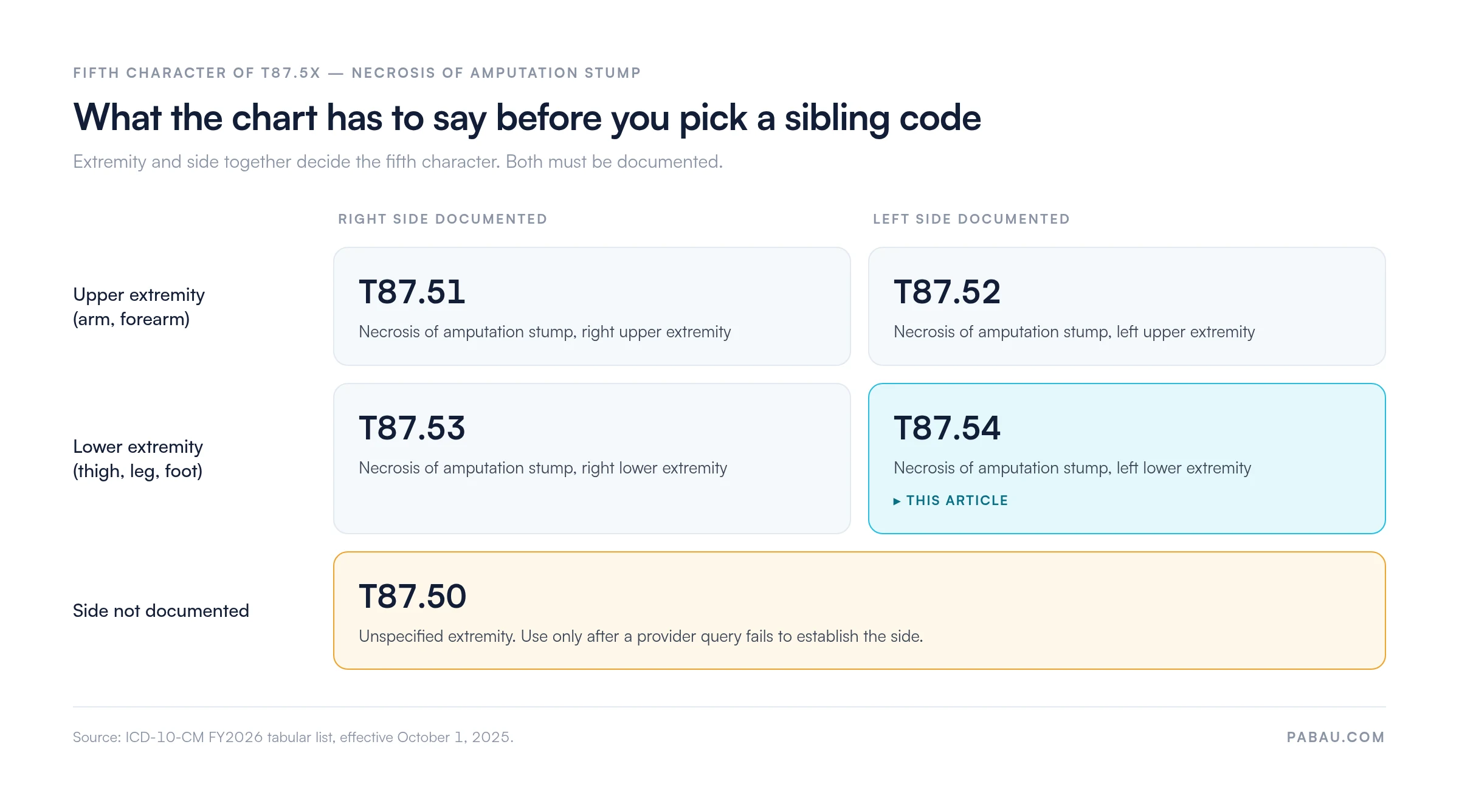
The T87.5x subcategory contains five billable codes, differentiated entirely by extremity and laterality. The wrong sibling is usually T87.50, chosen where the documentation supports a specific side. That claim can be denied outright or flagged for medical necessity review. The AAPC ICD-10-CM code lookup lists every T87.5x sibling with its full description.
Choosing between T87.50, T87.53, and T87.54 is a two-step read of the record: extremity first, then side. Work through it in that order and the fifth character falls out on its own.
Laid out as a grid, the whole subcategory is two questions wide. The matrix below shows which sibling each combination of extremity and side produces.
Practices with structured denial management workflows catch laterality mismatches at pre-submission review rather than after a rejection. A laterality check in the pre-bill edit logic saves the rework cost of a resubmission.
Run a monthly audit of T87.5x claims billed as T87.50, and cross-reference the operative notes behind them. Where the clinical record names a limb, T87.50 was a preventable default. Query the provider, correct the code, and resubmit. An hour of audit time usually exposes a pattern worth fixing at the front end.
Practices converting legacy records or answering a retrospective audit often want the ICD-9-CM predecessor of T87.54. There isn’t one. The CMS General Equivalence Mappings are the authoritative crosswalk, as the ResDAC reference on ICD codes in Medicare files explains. Neither ICD-9 stump-complication code converts into T87.5x at all.
That is the part worth carrying into an audit response. A GEM conversion of an old stump-complication claim produces T87.9 or T87.89, never T87.54, so nobody can reach this code by machine translation alone. Assigning T87.54 to a historical encounter means reading the original note for two things: documented necrosis, and a documented left lower limb.
Supporting T87.54 on a claim takes specific language in the clinical record. Payers follow CMS documentation guidelines, and a vague note carries the same denial risk as the wrong laterality. The checklist below is what to verify in the provider note before assigning the code.
Incomplete documentation causes more T87.54 denials than any other single factor. Provider query programs ask clinicians to clarify laterality and tissue status at the time of the encounter. They cut denial rates further than post-submission appeals do. The ICD-10-CM Official Guidelines for Coding and Reporting remain the authoritative reference for complication coding.
T87.54 is a complication code, not a sequela code. The Official Guidelines define a complication as an active condition arising from a procedure, one the patient still has and the team is still managing. A sequela is the late effect of an injury or condition that has already resolved. It needs a sequela code plus a code for the late effect itself.
For amputation stump necrosis, the practical distinction works like this:
Most stump necrosis presentations sit in the active complication category. Where the record is ambiguous about timing, a provider query is the correct path. Coders should not infer complication status without explicit documentation.
Beyond the documentation checklist, several rules govern how T87.54 interacts with the other codes on the same claim. The CMS ICD-10-CM Official Guidelines for Coding and Reporting carry the authoritative sequencing and combination rules.
Practices handling post-amputation wound care benefit from encounter templates that prompt for laterality, tissue status, and infection at the point of care. The same sequencing logic governs the neighboring complication families, and the ICD-10 diagnosis code library is where to check them against a specific encounter.
Build a T87.5x laterality rule into charge capture or pre-bill edits. When T87.50 appears on a claim for a patient whose chart records a left or right lower extremity amputation, flag it automatically for coder review. Most practice management systems can apply this as a simple diagnosis-code edit.
In most wound care practices the diagnosis code is chosen twice. A clinician writes the note, then a coder or biller reads it back and keys a code into a separate billing screen. Each re-entry is a chance for T87.54 to arrive as T87.50, or as the mirror code T87.53.
Pabau is practice management software that keeps the note, the diagnosis, and the claim in one record. Our claims software for coders validates ICD-10 codes and checks required fields before submission, and it routes claims electronically through Claim.MD. A code that does not match the encounter is caught while the chart is still open.
For a vascular surgery or wound care practice, that means fewer T87.5x rejections to rework and a shorter path from encounter to payment. Every Pabau subscription includes every feature, so the validation runs on the plan you already have.

Pabau’s claims management software validates ICD-10 codes, confirms laterality fields, and flags thin documentation before claims leave the practice. Your T87.54 submissions reach the payer clean the first time.

T87.54 rewards a practice that reads the chart before it reads the code list. The extremity and the side are two separate questions, and T87.50 answers neither of them. Treat unspecified as a last resort after a failed query, not as the safe option when the note is thin.
The crosswalk is worth remembering for the same reason. No ICD-9 code converts into T87.5x, so a legacy record reaches T87.54 only through clinical review. Anything that arrives at this code automatically deserves a second look before it goes out.
Two changes carry most of the benefit: a standing laterality query protocol, and a pre-bill edit on the T87.5x family. Book a demo to see how Pabau catches a laterality mismatch before the claim reaches the payer.

List Item #1
List Item #2
ICD-10 code T87.54 is the billable ICD-10-CM diagnosis code for necrosis of amputation stump, left lower extremity. It sits in subcategory T87.5 (Necrosis of amputation stump), inside the T87 category for complications peculiar to reattachment and amputation. The code has been valid for FY2026 submissions since October 1, 2025.
Yes, T87.54 is a billable and specific ICD-10-CM code valid for diagnosis submission. It goes on a claim directly, without a more specific code beneath it. The FY2026 CMS ICD-10-CM tabular list confirms it as billable, effective October 1, 2025.
T87.53 describes necrosis of amputation stump of the right lower extremity. T87.54 describes the same condition on the left. The codes are mirror images: same clinical condition, opposite laterality. Assigning T87.53 when the chart documents a left-sided amputation, or T87.54 for a right-sided one, is a laterality error that payers can deny.
There isn’t one. Under the CMS General Equivalence Mappings, ICD-9-CM 997.60 (amputation stump complication, unspecified) converts to T87.9, and 997.69 (other amputation stump complication) converts to T87.89. Neither maps into the T87.5x necrosis family. Assigning T87.54 from a legacy record therefore means reading the original documentation for both necrosis and the left lower extremity.
Use T87.50 (unspecified extremity) only when the record does not name the affected limb and a provider query cannot clarify it. If the chart documents a left lower extremity amputation and the necrosis is at that site, T87.54 is the correct code. Query for clarification rather than defaulting to unspecified.
Amputation stump complications sit under category T87. The subcategory follows the type of complication: necrosis is T87.5x, infection is T87.4x, and neuroma is T87.3x. Within T87.5x, the fifth character captures the extremity type and the laterality together. Document the complication type and the specific limb in the clinical note to support the most precise code.