







ICD-10 code Z56.2: Threat of job loss
ICD-10 code Z56.2 is the billable ICD-10-CM diagnosis code for “Threat of ...

Last Updated: Sep 15, 2026

ICD-10 code V86.59XA is the billable FY2026 diagnosis code for a go cart or golf cart driver injured in a nontraffic accident, initial encounter. Its official descriptor reads: Driver of other special all-terrain or other off-road motor vehicle injured in nontraffic accident, initial encounter. The code sits in Chapter XX of ICD-10-CM (External causes of morbidity, V00-Y99) and took effect on October 1, 2025.
The tabular list names only two vehicles under this code: Go cart and golf cart. A dune buggy driver is coded V86.53XA instead, and a military vehicle driver is coded V86.54XA. Both are separate billable codes, and neither belongs under V86.59XA.
Coders reach for V86.59XA when the patient was driving rather than riding, and the crash happened away from a traffic route. Documenting the role and the setting before submission prevents the most common denials on this code.

V86.59XA covers drivers of go carts and golf carts injured in nontraffic accidents only. Passengers and traffic-setting injuries use different V86 subcategory codes.
Dune buggy drivers belong under V86.53XA and military vehicle drivers under V86.54XA. Neither scenario is coded with V86.59XA.
The 7th character A marks an initial encounter, D a subsequent encounter, and S a sequela.
V86.59XA is billable and POA exempt for FY2026, which runs October 1, 2025 through September 30, 2026.
Pabau’s claims management software supports accurate external cause code submission to US payers, reducing denials on V86.59XA and related injury codes.
ICD-10 code V86.59XA describes one narrow scenario. The patient drove a go cart or a golf cart, sustained an injury, and the accident happened off a public road or traffic route. The “initial encounter” designation means the patient is receiving active treatment for that injury now.
Read the word “other” in the descriptor as a restriction. V86.59 is the catch-all child of the V86.5 subcategory, so it only takes vehicles that have no code of their own. Six sibling codes claim the named vehicles first.
According to CMS ICD-10 coding guidance, all external cause codes in the V00-Y99 chapter are supplementary codes. They are appended to a primary injury diagnosis code, such as a fracture or laceration, to explain how the injury happened. V86.59XA never stands alone on a claim. It always accompanies the code describing the nature of the injury itself. Practices routing US claims through a clearinghouse should confirm that both codes are present before submission.
V86.59XA is a billable, specific ICD-10-CM code valid for fiscal year 2026 claims. “Billable” means the code is specific enough to submit without further subdivision. “Specific” separates it from the non-billable parent codes above it, which always require a more detailed child code. The CDC/NCHS ICD-10-CM coding tool confirms it as a valid FY2026 code, effective October 1, 2025 through September 30, 2026.
Accurate billing depends on submitting the correct code edition. A claim carrying a code that was valid in FY2025 but has since been revised or deleted will be rejected. V86.59XA carries over from prior fiscal years without modification, so it remains safe to use for FY2026 encounters.
Understanding the parent chain helps coders locate sibling codes quickly when the documented scenario does not match V86.59XA. The full hierarchy from chapter to specific code is shown below.
Note the wording change between the two subcategory rows. V86.5 covers every driver of a special all-terrain or off-road vehicle in a nontraffic accident. V86.59 adds “other” to that title, which narrows it to the vehicles its siblings do not already name.
The “X” placeholder in position 6 is a structural filler required by ICD-10-CM conventions. It appears when a code needs a 7th character but has no subdivision at the 6th position. Coders sometimes omit it and submit “V86.59A”, which causes a rejection. The full string V86.59XA is required. Other chapters of the ICD-10-CM code index use the same X placeholder. It is worth checking before you code a second injury on the same claim.
The ICD-10-CM tabular list carries two inclusion terms under V86.59, and only two. Every other off-road vehicle in the V86.5 subcategory has a code of its own.
Lookup pages and older billing cheat sheets often list dune buggies and military vehicles here too. Both have carried their own codes for years. The table below routes each documented vehicle to the correct driver code for a nontraffic accident at the initial encounter.
Each sibling in that table takes the same three 7th characters as V86.59XA. Swap the A for a D on a subsequent encounter, or an S on a sequela. When the chart records no vehicle at all, query the provider. Assigning V86.59XA to an undocumented vehicle type leaves the claim unsupportable on audit.
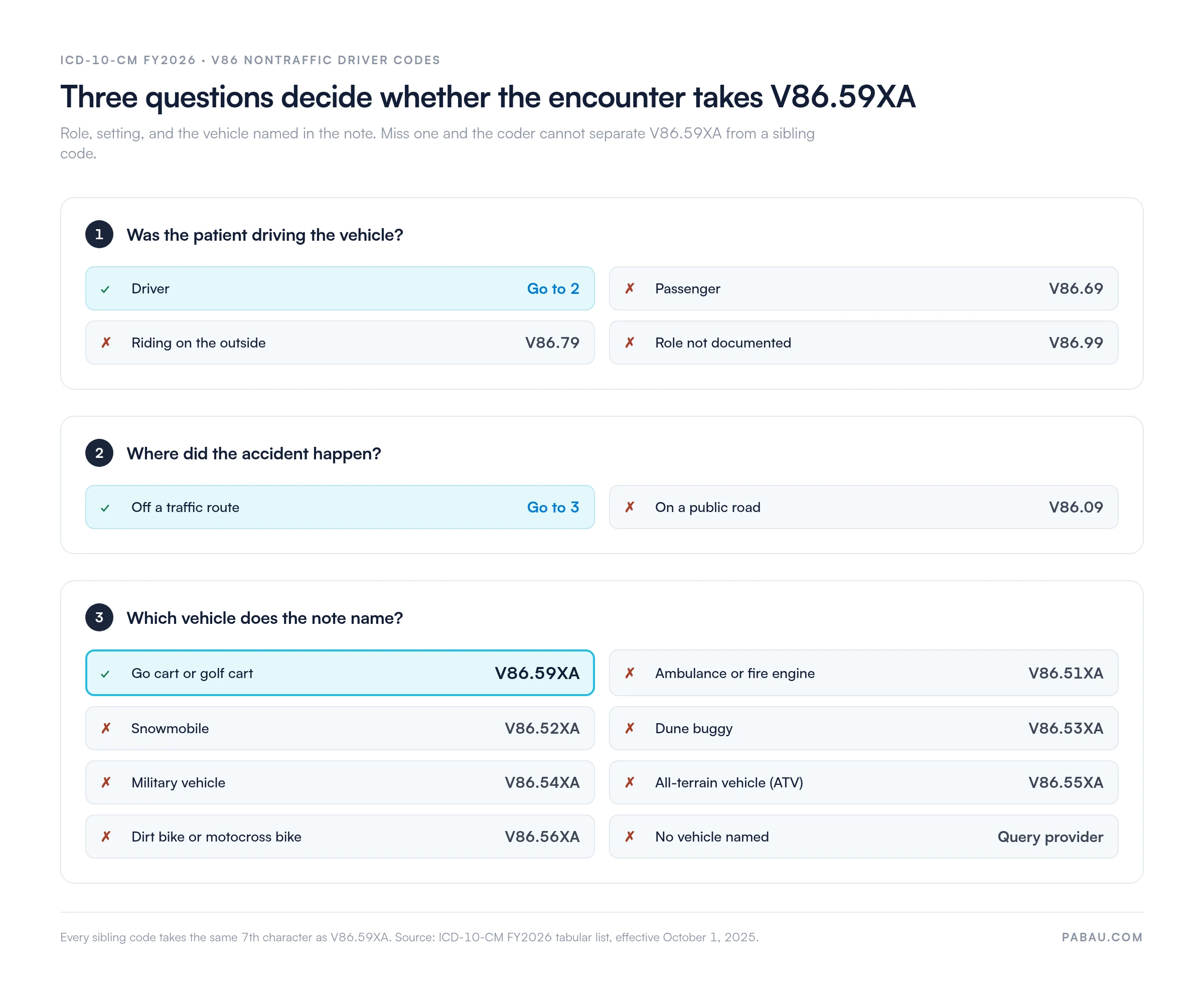
The vehicle word in the chart picks the code, and the generic phrase “off-road vehicle” never does. A note that says golf cart or go cart supports V86.59XA. A note that says dune buggy sends you to V86.53XA, and military vehicle sends you to V86.54XA. If the note names no vehicle at all, query the provider before you submit.
The 7th character in V86.59XA, the letter “A”, specifies the phase of care. All three V86.59X variants cover the same injury scenario, and only the care phase differs. A wrong 7th character is among the most common causes of denial on external cause codes. It signals a mismatch between the billed encounter type and the treatment phase in the record.
A practical note on the 7th character: “Initial encounter” refers to the phase of treatment, not literally the first visit for the injury. A patient who attends a different facility for a second surgery on the same injury is still in the initial encounter phase. Active treatment is continuing. The encounter turns “subsequent” once the injury is healing and the provider is monitoring recovery.
ICD-10-CM uses two types of excludes notes, and they carry different coding implications. Confusing Excludes1 with Excludes2 produces unbillable code combinations or missed diagnosis capture.
Excludes1 means the excluded code can never be reported with V86.59XA. These are mutually exclusive conditions, where reporting both at once would describe a clinical contradiction. At the V86 category level, Excludes1 notes point to recreational and sports vehicle scenarios that belong to separate, more specific categories.
Excludes2 means the excluded code is not part of V86.59XA but may be reported alongside it. Both conditions have to be genuinely present and documented. An occupant injury code from a different vehicle class could sit on the same claim if the patient was involved in two separate incidents.
Misapplying an Excludes1 combination is a common trigger for claim edits and denial management workflows. Review the full tabular notes in the AAPC Codify ICD-10-CM lookup before finalizing the combination. The notes sit at both the V86 category level and the V86.59 subcategory level.
The V86 category covers every occupant type and accident type for special all-terrain and other off-road motor vehicles. V86.59XA is one node in a grid organized first by occupant role, then by accident type. The table below maps each occupant role to the matching nontraffic subcategory, so coders can move sideways when the patient was not the driver.
The digit before the 7th character identifies the vehicle within each subcategory. The “9” in V86.59 stands for “other” off-road vehicle, which the tabular list limits to go carts and golf carts. It is not the ATV code. An ATV driver hurt in a nontraffic accident is coded V86.55XA.
V86.09 is a separate branch and a frequent mix-up. It is the “other” off-road vehicle driver code for a traffic accident, not a nontraffic one. Reading the first digit after the decimal point tells you which half of the category you are in. The chart below runs all three checks in the order a coder makes them.
Crosswalk mappings between ICD-9-CM and ICD-10-CM are approximate. The 2015 transition to ICD-10-CM introduced far greater specificity, so one ICD-9 code may map to several ICD-10 codes. Use crosswalk data for historical records and legacy reporting only. Never use an ICD-9 crosswalk to select a code for an active FY2026 claim.
E821.0 is the closest approximate match. Its official ICD-9-CM title is “Nontraffic accident involving other off-road motor vehicle injuring driver of motor vehicle other than motorcycle”. ICD-9 never separated off-road vehicle types the way ICD-10-CM does, so the mapping runs many-to-one toward ICD-10. The WHO ICD-10 browser holds the international reference classification, while the US ICD-10-CM version adds clinical modifications the base system does not carry.
V86.59XA needs four documented facts before a coder can assign it. Miss one, and the coder cannot choose between this code and a sibling. Most documentation disputes on this code start there.
The four elements the medical record must confirm:
Practices that capture structured encounter data find the missing elements before the coder receives the chart. Querying providers after the fact slows the billing cycle. A pre-coding checklist mirroring these four elements reduces both query volume and subsequent-encounter mismatch denials.
V86.59XA is exempt from the present-on-admission (POA) reporting requirement. That exemption means inpatient facilities do not assign a POA indicator of Y, N, U, or W to this code on UB-04 claim forms. The Centers for Medicare and Medicaid Services exempt the whole V00-Y99 chapter. These codes record how an injury happened, not whether a condition existed at admission.
Understanding this exemption matters in inpatient settings. Assigning a POA indicator to V86.59XA when none is required will not always reject the claim. It does signal to payers that the coding team may be applying external cause rules loosely. That perception raises audit scrutiny on the whole claim.
POA reporting does not apply at all to outpatient and professional fee claims, since the concept belongs to inpatient facility billing. When V86.59XA appears on an outpatient or ambulatory surgery center claim, the POA field is left blank.
External cause codes require specific positioning on the CMS-1500 and 837P claim formats. V86.59XA is never the primary diagnosis. It sits in a secondary or additional diagnosis field, after the injury code. That code records what happened to the patient, such as a fracture, a laceration, or a contusion. Payers read the primary injury code to judge medical necessity, while the external cause code supplies context for injury surveillance and population health reporting.
Practice management software like Pabau submits V86.59XA through Claim.MD, our US clearinghouse partner. Claim.MD checks the code combination against real-time payer edits before the claim reaches the payer. It processes claims across thousands of US payers and flags external cause codes submitted without a matching primary injury code.
The built-in ICD-10-CM catalogue in the clearinghouse also confirms that V86.59XA is valid for the date of service on the claim. For practices handling multiple injury encounters, the external cause workflow pairs well with clearinghouse validation. That combination catches positioning errors before they turn into denials.
At many practices, the vehicle, the role, and the setting sit in free-text consultation notes. A coder reads the note, guesses at the missing detail, and emails the provider days later. The injury code goes out on time and the external cause code follows on a corrected claim, or never goes out at all.
Pabau captures those details as structured fields on the encounter. The answer to “which vehicle” gets recorded at the point of care, rather than reconstructed days later. Coders open the chart and see the vehicle, the role, the setting, and the treatment phase together. That is enough to separate V86.59XA from V86.53XA or V86.54XA without a provider query.
From there, claims go to Claim.MD from inside Pabau, with the injury code and the external cause code attached to the same submission. You get fewer corrected claims, shorter query queues, and a cleaner audit trail on injury encounters. Every Pabau subscription includes the full claims workflow, so no part of it sits behind a higher tier.

Pabau’s claims management workflow supports accurate ICD-10-CM code submission, including external cause codes like V86.59XA, through the Claim.MD clearinghouse. See how it fits your billing process.

V86.59XA is a billable, specific ICD-10-CM code for FY2026 with a deliberately narrow scope. It applies to a go cart or golf cart driver injured in a nontraffic accident, at the initial encounter.
Two vehicles that often get filed here belong elsewhere. A dune buggy driver is coded V86.53XA, and a military vehicle driver is coded V86.54XA. An ATV driver is V86.55XA.
Getting the code right depends on four documented facts: Vehicle type, driver role, nontraffic setting, and encounter phase.
Pabau’s claims management software integrates with the Claim.MD clearinghouse to validate ICD-10-CM code combinations before they reach the payer. To see how the workflow handles external cause code positioning and real-time payer edits, book a demo.

Need to understand how external cause codes flow through your billing system? Revenue cycle management fundamentals explains how injury codes and supplementary codes interact across the claim lifecycle.
Working through a denial on an injury code combination? Managing healthcare claim denials covers the most common external cause code denial patterns and how to appeal them.
Looking for a clearinghouse that validates ICD-10-CM code combinations before submission? Claim.MD vs Office Ally compares two US clearinghouse options for practices handling injury and external cause claims.
Chasing fewer corrected claims on injury encounters? What makes a clean claim sets out the checks that get an injury claim paid on the first pass.
ICD-10 code V86.59XA is the billable US diagnosis code for a go cart or golf cart driver injured in a nontraffic accident, initial encounter. Its full descriptor reads: Driver of other special all-terrain or other off-road motor vehicle injured in nontraffic accident, initial encounter. It sits in Chapter XX (External causes of morbidity) and is valid for FY2026 claims from October 1, 2025.
Yes, V86.59XA is a billable, specific ICD-10-CM code valid for submission on FY2026 claims. It is specific enough to use directly on a claim without further subdivision and does not require a more detailed child code.
V86.59XA covers go cart drivers and golf cart drivers injured in nontraffic accidents. Those are the only two inclusion terms listed under the code in the ICD-10-CM tabular list. Dune buggy drivers are coded V86.53XA, military vehicle drivers V86.54XA, and ATV drivers V86.55XA.
A dune buggy driver injured in a nontraffic accident is coded V86.53XA at the initial encounter. Use V86.53XD for a subsequent encounter and V86.53XS for a sequela. V86.59XA does not cover dune buggies, despite what some lookup pages still show.
V86.59XA (7th character A) is used during the initial encounter, while active treatment is being provided. V86.59XD (7th character D) applies to subsequent encounters, during healing and recovery after active treatment is complete. The clinical scenario is identical, and only the care phase differs.
Yes, V86.59XA is POA exempt. CMS exempts all external cause codes in the V00-Y99 chapter from POA indicator requirements. External cause codes describe how an injury occurred, not whether a condition was present at admission.
Use V86.59XA when the patient drove a go cart or a golf cart. The accident also has to have happened away from a traffic route, such as a golf course or private land. A passenger in the same vehicle is coded V86.69XA. An accident on a public road moves the case to the V86 traffic subcategories instead.