







ICD-10 code V86.59XA: Off-road vehicle driver, nontraffic accident
ICD-10 code V86.59XA is the billable FY2026 diagnosis code for a go cart or golf...

Last Updated: Sep 15, 2026

ICD-10 code Z56.2 is the billable ICD-10-CM diagnosis code for “Threat of job loss,” effective October 1, 2025 for fiscal year 2026. It records a patient’s reported risk of losing a job they still hold, as a social factor affecting their health.
The code sits in the Z56 category, which covers problems related to employment and unemployment. Timing is what decides whether it fits. Use Z56.2 while the job still exists and termination is threatened. Once employment has ended, Z56.0 applies instead.
Coders report it most often as an additional diagnosis next to a primary clinical condition. Sequencing rules allow it in the principal position in narrow circumstances. This reference covers the code details, documentation, sequencing, payer treatment, and the codes it pairs with in behavioral health.

ICD-10 code Z56.2 is a billable, HIPAA-valid diagnosis code for Threat of job loss, effective FY2026 (October 1, 2025).
Z56.2 belongs to the Z56 parent category covering problems related to employment and unemployment, one of 10 subcodes in that group.
Documentation must include a patient-reported employment concern acknowledged by the provider and linked to the care plan before submitting Z56.2.
Practice management software like Pabau submits Z codes alongside the primary diagnosis, which cuts rework on rejected claims.
Z56.2 is the ICD-10-CM code for “Threat of job loss.” It is specific and billable, so it is valid on HIPAA-covered electronic transactions. According to the CDC/NCHS ICD-10-CM official code tool, Z56.2 took effect on October 1, 2025. It stays valid through September 30, 2026.
The code captures a social determinant of health, namely the patient’s awareness that their job may end soon. That awareness shapes mental health, treatment adherence, and whether the patient seeks care at all. Documenting it accurately matters clinically and administratively.
Z56.2 is one subcategory within the broader Z56 parent code, which covers problems related to employment and unemployment. The full group is worth knowing, because payers, auditors, and clinical reviewers scrutinize the choice between sibling codes.
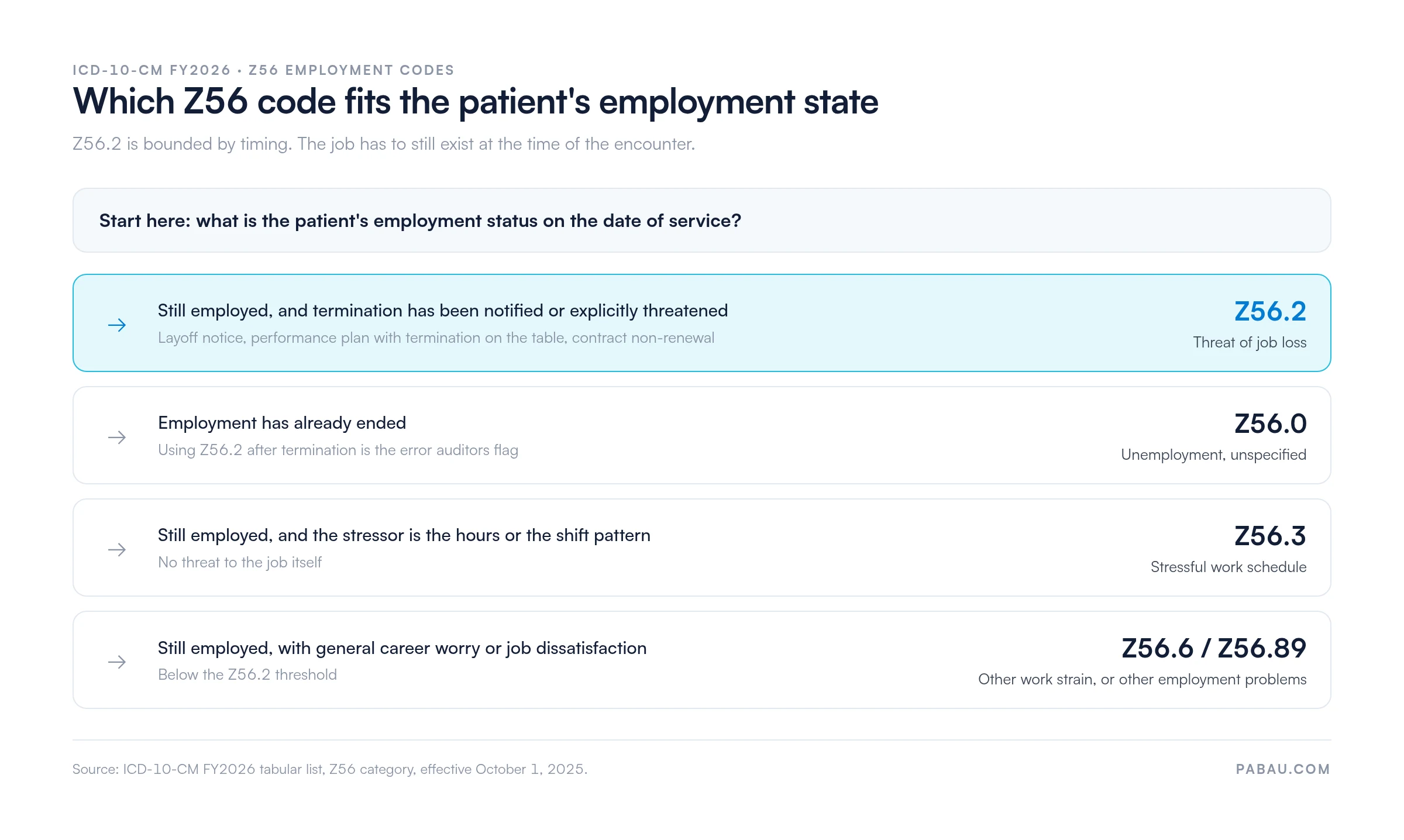
Coders have one distinction to make here. Z56.2 applies while a job still exists and termination is anticipated. Once employment has ended, Z56.0 (Unemployment, unspecified) becomes the appropriate code, and using Z56.2 after termination is an error auditors flag. The AAPC ICD-10-CM code browser shows the parent category covering both current employment problems and unemployment states. Subcode selection therefore has to be precise.
Z56.2 sits in the Z55-Z65 block, “Persons with potential health hazards related to socioeconomic and psychosocial circumstances.” Coders and payers know these as social determinants of health (SDOH) codes. The World Health Organization’s international classification groups employment problems under social circumstances as well, as the WHO ICD-10 browser shows.
If you report SDOH factors regularly, the rest of the block is worth reading through, and our ICD-10-CM code index lists each family in turn. The codes share one reporting logic across housing, education, and employment circumstances.
SDOH codes like Z56.2 serve two purposes at once. Clinically, they build a fuller picture of what drives a patient’s symptoms or blocks their treatment. Administratively, they support population health reporting, value-based care benchmarks, and quality metric tracking.
Z56.2 is a patient-reported code. In most payer contexts it works as an additional diagnosis rather than one that generates payment by itself. It still needs the provider’s acknowledgment in the record before it goes on a claim.
Providers treating anxiety, depression, or adjustment disorders should weigh Z56.2 whenever employment comes up during the encounter. F43.23, adjustment disorder with mixed anxiety and depressed mood, is one of the primary diagnoses it most often accompanies in behavioral health.
Z56.2 is appropriate when a patient reports an active, impending threat to their current employment. General fear of unemployment or dissatisfaction with working conditions does not reach that bar. Three clinical scenarios consistently warrant the code:
Z56.2 does not apply to generalized career anxiety, worry about the job market, or routine job dissatisfaction. Z56.6 (Other physical and mental strain related to work) or Z56.89 (Other problems related to employment) fit those presentations better. The boundary reads more clearly laid out by employment state than described in prose.
Document the patient’s exact words about their employment situation. A note reading ‘Patient reports a verbal warning that their role may be eliminated in the restructuring’ supports Z56.2. A note reading ‘patient anxious about work’ does not. Specificity in the subjective section is what survives an audit.
The official ICD-10-CM guidelines published by CMS allow SDOH Z codes to be assigned from several sources. Clinicians, nurses, social workers, and other allied health professionals involved in the encounter all count. Four elements must appear in the record to support Z56.2:
Some practices screen for SDOH factors at intake with a structured questionnaire covering employment status and job security. When that screener sits inside the clinical workflow, the answers land in the visit note automatically. The coder then has the wording they need, without chasing a chart amendment weeks later.
The ICD-10-CM Official Guidelines allow Z codes, Z56.2 included, to serve as either a principal or an additional diagnosis depending on the circumstances. In most outpatient encounters, Z56.2 functions as an additional diagnosis coded alongside the primary clinical condition.
The guidelines identify two outpatient pathways for Z56.2 as principal diagnosis:
In the vast majority of encounters, particularly in primary care and behavioral health, Z56.2 follows the primary diagnosis. A psychologist treating generalized anxiety disorder (F41.1) who documents a threatened layoff as a contributing stressor sequences F41.1 first, with Z56.2 as a secondary code.
SDOH codes are among the most undercoded in the set. Payers rarely reject them outright. Coders leave them off when the documentation is thin, or when they are unsure whether the code qualifies as an additional diagnosis.
Z56.2 does not independently trigger reimbursement. Like the other SDOH Z codes in the Z55-Z65 block, it is not typically a payable primary diagnosis in fee-for-service billing. Its value lies in supporting medical necessity for the primary clinical diagnosis, and in the SDOH data that value-based contracts and CMS quality programs require.
Payer-specific policies vary considerably. Some commercial payers accept Z56.2 without a secondary attachment when the encounter is clearly social work or care coordination. Medicare and Medicaid generally require a clinical diagnosis in the principal position. Verify coverage rules through your own payer contracts rather than general guidance, because SDOH policy has been moving since CMS began emphasizing this data.
Submitting through a clearinghouse that validates SDOH codes before transmission lowers the risk of rejection. Practice management software like Pabau connects to Claim.MD, a US clearinghouse supporting the CMS-1500 and 837P formats. Z codes then travel with the primary diagnosis on a claim that was checked before it left.
For practices under value-based contracts with managed care organizations, reporting Z56.2 consistently feeds SDOH risk stratification scores. Those scores influence care management program eligibility and population health incentive payments. A clearinghouse that passes SDOH codes through untouched is the practical prerequisite for capturing that value.
Behavioral health providers hear about threatened job loss more often than most specialties. The disclosure usually arrives in a therapy session rather than a physical exam, which puts the coding decision in the therapist’s note.
In behavioral health, Z56.2 most often appears alongside:
The adjustment disorder family runs from F43.20 through F43.29, and choosing the subtype is a documentation decision before it is a coding one. The clinician’s description of the predominant symptoms picks the digit.
Structured SDOH screening at intake gives coders the wording they need to apply Z56.2 consistently. Practices using claims management software that validates SDOH codes at submission cut the risk of those codes being stripped or rejected in clearinghouse processing.
Coders working with Z56.2 meet two groups of codes. Sibling Z56 codes describe related employment problems, and a handful of clinical codes turn up on the same claim. The table covers both, with descriptions as they read in the ICD-10-CM tabular list.
In many practices the employment question gets asked at intake, written into the note, and then dropped at the billing step. The coder works from a chart summary that never carried the screening answer forward, so Z56.2 never reaches the claim.
Pabau holds the intake form, the clinical note, and the claim in one patient record. An answer captured at check-in stays attached to the encounter the coder bills from. Pabau’s claims management tools then submit Z56.2 next to the primary diagnosis, and validate the claim before it goes to the clearinghouse.
Behavioral health practices get the same benefit from the clinical side. A therapist documenting a threatened layoff in a session note leaves the coder a record that already meets the acknowledgment requirement. Fewer charts get reopened weeks later to add a line the clinician had already written.

Pabau keeps SDOH answers from intake attached to the encounter the coder bills. Z codes go out with the primary diagnosis, on a claim that was validated first.

Z56.2 is a small code with a narrow window. It applies while the job is threatened, and it stops applying the day that job ends. The supporting documentation is short, usually the patient’s own words plus the provider’s acknowledgment of them.
Practices that report it consistently tend to ask the employment question the same way every time, at intake. The answer then travels into the note by itself. That is a workflow decision more than a coding one, and it is the part worth fixing first.
The trade-off is worth naming. Z56.2 pays nothing on its own, so the return comes later, through medical necessity support and SDOH reporting under value-based contracts. Book a demo to see how Pabau carries SDOH answers from intake through to a submitted claim.

Need the adjustment disorder code that pairs with this one? ICD-10 code F43.20: Adjustment disorder, unspecified covers the diagnosis Z56.2 most often supports in behavioral health.
Coding stress reactions rather than the job threat itself? ICD-10-CM stress codes: F43.0, F43.9 and Z73.3 sets out how the acute stress and burnout codes differ.
Looking to reduce SDOH claim denials? Denial management in healthcare walks through why SDOH codes get undercoded and which workflows fix it.
Want to read the rejection reason before you resubmit? Denial codes in medical billing explains the top CARC codes and the fix for each one.
ICD-10 code Z56.2 is the billable ICD-10-CM diagnosis code for “Threat of job loss.” It documents a patient’s reported risk of losing a job they still hold. The code took effect on October 1, 2025 and is valid on HIPAA-covered transactions.
Yes. Z56.2 is a specific, billable ICD-10-CM code, not a header or a nonspecific one. It usually appears as an additional diagnosis rather than a code that pays on its own. It is valid on the CMS-1500 and 837P claim formats.
Z56.0 applies once unemployment has happened. Z56.2 applies while the patient still holds the job and faces a specific threat of losing it. The distinction is timing. Reporting Z56.2 after termination is a coding error that auditors identify.
In most outpatient and behavioral health encounters, Z56.2 sequences after the primary clinical code. It can be listed first in two narrow cases. The first is a visit whose purpose is the social factor itself, such as care coordination. The second is an encounter where no clinical diagnosis can be established.
The record needs the patient’s disclosure of the threatened job loss. It also needs the provider’s acknowledgment of that social factor, plus a line linking it to the presenting concern or treatment plan. Results from a structured SDOH screener support the code once a clinician signs off.
SDOH Z codes rarely generate payment on their own in fee-for-service billing. Their value is supporting medical necessity for the primary diagnosis. They also feed the SDOH data sets used in value-based contracts and CMS quality reporting. Payer policies vary, so confirm coverage in your own agreements.