CPT code 93503: Swan-Ganz catheter billing and modifiers
CPT code 93503: Official descriptor and procedure overview In the AMA CPT code s...

Last Updated: Oct 23, 2026
L2397 is the HCPCS Level II code for addition to lower extremity orthosis, suspension sleeve.
Most claim denials for suspension sleeve billing don't come from wrong codes. They come from missing documentation and incorrect modifier usage. HCPCS code L2397, covering the addition to lower extremity orthosis, suspension sleeve, has clear Medicare coverage criteria, yet errors in PDAC verification, modifier selection, and medical necessity documentation generate avoidable rejections for DME suppliers and orthotics practices every year.
Let Pabau's smart automation suggest the right codes, reduce claim denials, and keep your practice compliant—effortlessly.
Automate repetitive tasks and focus on what matters most—your patients.
Reduce coding errors and ensure compliance with the latest regulations.
Clean claims, fewer denials, and faster reimbursements.
Powerful insights and reporting to help your practice thrive.
HIPAA compliant SOC 2 certified GDPR-compliant Trusted by 4,000+ clinics worldwide

HCPCS code L2397 describes an addition to lower extremity orthosis, suspension sleeve, used in lump-sum DME billing under Medicare Part B
Only PDAC-verified suspension sleeve products may be billed under L2397 for Medicare; suppliers must hold a current product classification decision
Modifier KX is required when billing L2397 to Medicare and confirms documented medical necessity is on file; missing KX is a top denial cause
Pabau’s claims management software helps DME suppliers and orthotics practices track L2397 documentation requirements and reduce claim errors
HCPCS code L2397 is described as “Addition to lower extremity orthosis, suspension sleeve.” Its short descriptor is “Suspension sleeve lower ext.” The code falls within the HCPCS Level II range L2200-L2397, maintained by the Centers for Medicare and Medicaid Services (CMS) under Additions, Lower Extremity Orthotics.
A suspension sleeve is a stretchable fabric sleeve worn over or under a knee or lower extremity brace. Clinically, it improves brace suspension, reduces pistoning (the vertical slipping of a prosthesis or orthosis), provides compression, and protects the skin beneath the orthotic device.
As a result, L2397 is billed as a lump-sum purchase under the DME, prosthetics, and orthotics (DMEPOS) benefit category.
The code entered use on January 1, 1994, per AAPC Codify’s HCPCS Level II reference, and remains a valid 2025/2026 code with no scheduled deletion as of this writing.
Medicare Part B covers suspension sleeves billed under HCPCS code L2397 as DME when the following conditions are met. Coverage is subject to the Knee Orthoses Local Coverage Determination (LCD L33318) and its related Policy Article (A52465), both published in the CMS Medicare Coverage Database.
Suppliers should always check the applicable LCD before billing.
Clinicians often confirm the ligament laxity that drives a suspension sleeve prescription with a physical exam such as the anterior drawer test. This kind of instability is common after sports-related knee injuries.
In addition, suppliers must retain the prescribing practitioner’s written order and supporting clinical documentation in the patient’s file before billing. Therefore, L2397 is not billable as a standalone item when no covered primary orthosis is present.
Coverage for L2397 also depends on the base HCPCS code’s compatibility under Policy Article A52465. Some base-and-addition combinations are not separately payable even when the base orthosis is covered, and certain fitting or fabrication services are already bundled into the base orthosis allowance.
Suppliers should check the A52465 compatibility list for the specific base code before billing L2397 as a separate line item.
For Medicare billing under HCPCS code L2397, the specific suspension sleeve product must have a PDAC (Pricing, Data Analysis and Coding) product classification decision assigning L2397. The PDAC contractor, currently Noridian Healthcare Solutions, reviews product applications and issues decisions confirming whether a product qualifies for a given HCPCS code.
Examples of products with verified PDAC decisions for L2397 include the Thuasne Cotton Undersleeve (PDAC letter issued after November 2015), the DR Medical Suspension Sleeve, and the ISO Preferred Knee Suspension Sleeve.
Consequently, billing a product without a current PDAC classification decision for L2397 is a compliance risk and can result in Medicare overpayment recoupment. Suppliers can verify product PDAC decisions through the CMS PDAC product classification database before dispensing.
Before ordering suspension sleeve inventory for Medicare patients, verify each product’s PDAC classification decision for L2397 on the CMS PDAC database. PDAC decisions are product-specific and do not transfer between manufacturers or model variants. Document the PDAC decision date in the patient’s DME file alongside the prescribing order.
Modifier selection is where many L2397 claims go wrong. Several modifiers apply, and each carries a specific documentation requirement.
Of these, modifier KX is the most consequential. When a supplier appends KX to HCPCS code L2397, they are attesting that the documentation in the patient’s file fully supports medical necessity under the applicable LCD. Billing KX without the supporting documentation in place exposes the supplier to False Claims Act liability during a post-payment audit.
Similarly, modifier GA is used when the supplier has reason to believe Medicare will deny coverage but has issued and obtained a signed Advance Beneficiary Notice of Noncoverage (ABN) from the beneficiary. Without GA on a likely-denied claim, the supplier cannot bill the patient for the item.
When a supplier expects a denial but has not obtained a signed ABN, modifier GZ applies instead of GA. Per Policy Article A52465, every knee-orthosis addition line, including L2397, must carry one of KX, GA, or GZ. Medicare automatically denies GZ-modified claims, and the supplier cannot bill the beneficiary for the denied amount.
For a beneficiary who needs a suspension sleeve on both knees on the same date of service, suppliers can append the combined LTRT/RTLT modifier to a single line, or submit two claim lines, each for one unit, with RT on one line and LT on the other.
DME suppliers billing L2397 through claims management software can set modifier rules and documentation checklists that flag incomplete records before submission, reducing preventable denials.
Complete documentation is the single most important factor in L2397 claim approval. The DME MAC audits DMEPOS suppliers at higher rates than most other Medicare provider types, and missing or non-compliant documentation is the leading reason for recoupment demands.
Furthermore, documentation must be retained for a minimum of seven years for Medicare beneficiaries. Suppliers using digital intake forms can capture prescribing orders, consent documents, and delivery confirmations electronically, creating an audit-ready file from the point of service.
The same discipline applies to related knee orthosis claims like L1833, which require matching written orders and PDAC verification before submission.
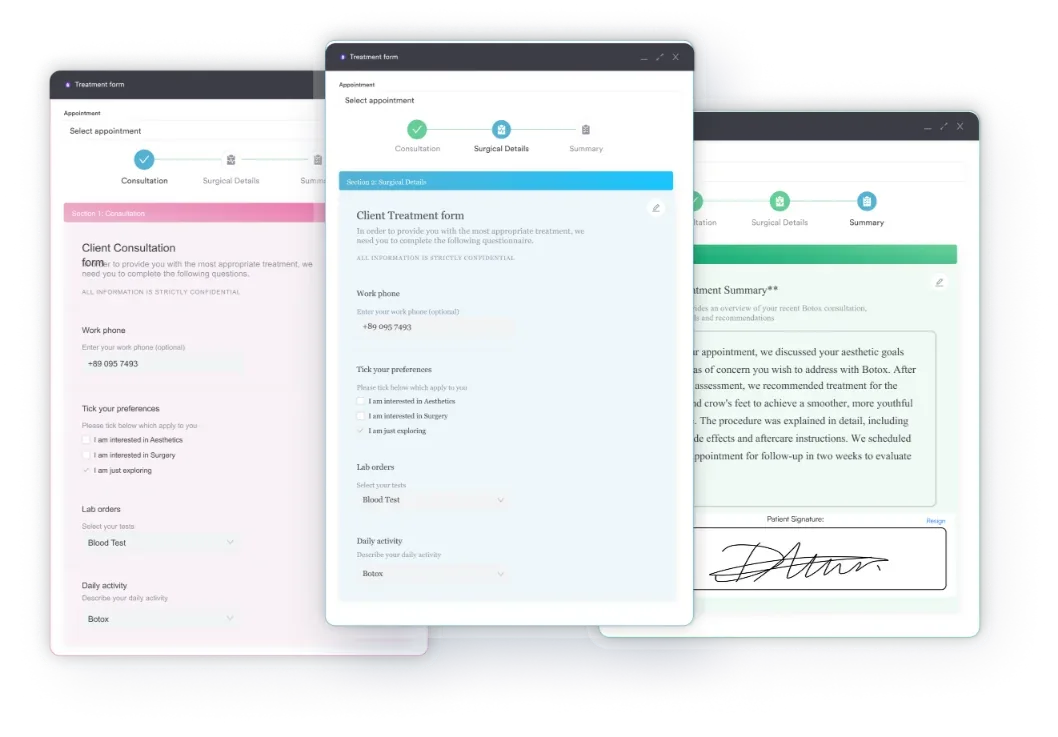

Pabau helps DME suppliers and orthotics practices build complete, audit-ready patient files before claims go out. Track prescription orders, PDAC verification notes, and proof of delivery in one place.

Understanding the code landscape around L2397 prevents upcoding errors and helps suppliers identify when a different code applies. The following codes are commonly referenced alongside L2397 in lower extremity orthosis billing.
The most common misapplication involves L2397 versus L5666. L5666 covers a cuff suspension mechanism for below-knee prostheses, not a fabric suspension sleeve for orthotic additions. Suppliers billing a fabric sleeve on a knee brace should use L2397. Billing L5666 for that product would be a miscoding error.
Reviewing M17.9 paired with L2397 is also important for demonstrating medical necessity at claim level.
L2397 does not have a mandated ICD-10 code crosswalk, but the pairing diagnosis must support the medical necessity for a lower extremity orthosis with suspension addition.
Common ICD-10 codes used on claims with L2397 include conditions affecting joint stability, ligament laxity, post-surgical rehabilitation, and neuromuscular weakness affecting the lower extremity. For example.
Suppliers should use the most specific ICD-10 code reflecting the patient’s documented condition rather than defaulting to unspecified codes, which attract higher audit scrutiny.
Submitting a clean L2397 claim requires completing several steps in the correct order. Skipping any one of them is the fastest route to a denial.
Practices that manage physical therapy practice management alongside DME billing often find that a unified documentation system reduces errors that occur when prescription data and delivery records are stored separately. The same documentation discipline applies to L1810 claims, which require the same written order and PDAC verification steps.
The DME MAC review process for HCPCS code L2397 generates a predictable set of denial reasons. Knowing them in advance turns avoidable denials into clean first-pass approvals.
Post-denial appeals for L2397 require submitting the missing documentation within the timeframe set by the DME MAC. Specifically, redetermination requests must include the written order, clinical notes, PDAC decision, and proof of delivery. Suppliers with a structured HIPAA compliance documentation process already have the file management discipline needed to build audit-ready DME records.
Run a pre-submission audit on every L2397 claim before it reaches the DME MAC. Check five items: written order present and signed, PDAC decision for the product on file, modifier KX selected with documentation ready, proof of delivery obtained, and ICD-10 diagnosis cross-referenced against the LCD. A five-item checklist reviewed in two minutes catches 90% of denial-causing errors before they leave your practice.
Medicare reimbursement for HCPCS code L2397 is determined by the annual CMS DMEPOS Fee Schedule, not the Physician Fee Schedule used for CPT-coded services. CMS updates rates annually, and they vary by DME MAC jurisdiction and geographic pricing locality.
Suppliers should not rely on historical rates for billing decisions; check the current year’s DMEPOS fee schedule on CMS.gov or through the DME MAC (Noridian or CGS) for your jurisdiction before billing. Practices billing in Australia check the current MBS descriptor before submitting, because descriptors are revised on a schedule.
Specifically, L2397 is billed as a lump-sum purchase, not a rental code. There is no capped rental or rental-to-purchase conversion applicable. The allowed amount is the lesser of the supplier’s submitted charge or the applicable fee schedule amount.
Competitive bidding does not currently apply to suspension sleeves under L2397 in most jurisdictions, but suppliers should confirm current competitive bidding status with their DME MAC.
Practices managing both DME billing and clinical documentation benefit from centralized record systems.
Good billing practice also requires verifying that diagnosis coding, such as M17.12, aligns with the patient’s current clinical status at the time of billing, not the status at an earlier encounter.
Clean billing for HCPCS code L2397 comes down to three things done correctly every time: PDAC-approved products, complete pre-dispensing documentation, and the right modifiers on the claim. Skipping any step generates a denial that takes more time to resolve than it would have taken to get it right the first time.
Pabau’s claims management software gives DME suppliers and orthotics practices a structured way to manage documentation checklists, track prescription orders, and flag incomplete records before submission. See how Pabau handles DME documentation workflows by booking a demo.

Billing a heroin metabolite test instead? CCSD code 0416H billing guide covers the 6-MAM test that confirms heroin use, since no other substance produces the metabolite.
Billing the base orthosis a suspension sleeve attaches to? L1845 covers the double-upright knee brace L2397 sleeves are frequently added to.
Handling a broader DME mix? E0143, the folding wheeled walker code, carries its own documentation and pricing rules worth knowing.
HCPCS code L2397 is used to bill for a suspension sleeve added to a covered lower extremity orthosis under Medicare Part B DME benefits. The suspension sleeve improves brace retention, reduces slipping (pistoning), and protects the skin beneath a knee or lower extremity orthotic device. It is billed as a lump-sum purchase, not a rental item.
Yes. For Medicare billing, the specific suspension sleeve product billed under L2397 must have a current PDAC (Pricing, Data Analysis and Coding) product classification decision. The decision is product-specific and issued by Noridian Healthcare Solutions (the PDAC contractor). Billing a product without a valid PDAC decision for L2397 is a compliance risk and can trigger recoupment.
The modifiers used with L2397 are KX (medical necessity documented), GA (signed ABN on file), GZ (expected denial as not reasonable and necessary, no ABN on file), and RT or LT (right or left extremity). Per Policy Article A52465, every knee-orthosis addition line needs one of KX, GA, or GZ. For bilateral use on the same date of service, append the combined LTRT/RTLT modifier, or bill two lines, each with one unit under RT and LT.
L2397 covers a suspension sleeve added to a lower extremity orthosis (such as a knee brace), while L5666 covers a cuff suspension addition to a below-knee prosthesis. They describe different anatomical applications and different suspension mechanisms. Billing L5666 for a fabric sleeve on a knee brace is a miscoding error; L2397 is the correct code for that product.
L2397 is a HCPCS Level II code, not a CPT code. It is often searched as an L2397 CPT code, but CPT codes are the American Medical Association procedure codes, whereas L-codes are HCPCS Level II codes used to bill durable medical equipment and orthotics such as a suspension sleeve.