Despina Petrushevska
Nutrition intake form
A nutrition intake form is a structured questionnaire that records a patientR...

4
Last Updated: Oct 22, 2026
Free PDF 4 pages, print-ready Clinician-reviewed
Download your free diabetic foot exam template Use the free diabetic foot exam template below to standardize every screening. Download it as a printable PDF, then adapt the fields to your practice and rebuild it as a digital form inside your patient records. Diabetic foot exam A comprehensive clinical assessment form covering systematic neurological, vascular, […]
A comprehensive clinical assessment form covering systematic neurological, vascular, dermatological, and musculoskeletal evaluation. Includes monofilament testing, pulse assessment, skin inspection, foot structure evaluation, risk stratification tier assignment, and documentation fields aligned with ADA guidelines.
Upload this PDF, or any form you already use, and Pabau's AI Form rebuilds it with tick boxes, text fields and a signature. Attach it to the treatment once, and every patient gets it on time.
AI Form rebuilds the consent, history and aftercare forms you already use. You review each one, then publish.
Patients complete forms on their phone before they arrive, so the front desk stops retyping paper.
Every signed form is versioned and attached to the treatment record, ready when you need it.
Set how long a consent stays valid. Returning patients skip forms they have already signed.
Supports HIPAA and GDPR compliance AES-256 encryption 4.8 on G2 4.7 on Capterra Trusted by 4,000+ practices worldwide

A diabetic foot exam is a systematic clinical assessment that identifies early signs of neuropathy, vascular disease, and skin breakdown to prevent serious complications like ulcers and amputation.
The exam includes five core assessments: monofilament testing for loss of protective sensation (LOPS), vascular pulse and ankle-brachial index checks, visual skin and nail inspection, foot structure evaluation, and risk stratification into low/moderate/high tiers.
Annual comprehensive foot exams aligned with ADA standards can reduce amputation risk by enabling early detection and timely specialist referral before complications develop.
Practice management software like Pabau helps clinicians structure and store diabetic foot exam findings, automate risk-based recall reminders, and support accurate billing and coding for routine and problem-focused exams.
Use the free diabetic foot exam template below to standardize every screening. Download it as a printable PDF, then adapt the fields to your practice and rebuild it as a digital form inside your patient records.
A diabetic foot exam is a structured screening that checks sensation, circulation, and skin integrity to catch problems before they progress to ulcers or amputation. This guide covers what the exam involves, how to perform each assessment step, how to translate findings into a risk tier, and how to document and code the visit correctly.
Undetected diabetic foot complications account for significant morbidity and preventable amputations. About 20% of diabetic foot ulcers ultimately lead to a lower-extremity amputation, many of which could have been prevented through early detection during routine exams.
A structured diabetic foot exam template makes sure clinicians assess every patient’s foot health the same way each time, covering sensation, circulation, and skin and structural integrity rather than a quick visual check.
Many primary care practices, diabetes care teams, and podiatry groups run foot exams without a standardized workflow. The result is inconsistent findings from one visit to the next and coding that is hard to defend at audit.
Whether you call it a diabetic foot examination template or a diabetic foot examination form, the goal is the same: a repeatable checklist every clinician follows.
A diabetic foot exam is a systematic clinical assessment designed to identify early signs of foot complications in patients with diabetes. Foot exams for diabetics, sometimes abbreviated to a DM foot exam, evaluate three primary domains: neurological status (sensation), vascular function (blood flow), and structural or dermatological integrity (skin, nails, deformities).
Because diabetes affects multiple organ systems through shared microvascular and neuropathic pathways, care teams often coordinate this exam alongside other systemic screenings, such as retinal evaluations coded under H35.89. Foot pain in a patient with diabetes is not always neuropathic. Gout flares most often at the first metatarsophalangeal joint, and a uric acid foods chart gives the patient something concrete to take home.
The American Diabetes Association (ADA) Foot Examination Risk Assessment established evidence-based standards for this assessment. According to CDC clinical guidance, annual foot exams assess pulses, sensation, foot structure and function, and nails-and document findings using a consistent format to support clinical decision-making and accurate billing.
From a compliance perspective, a documented foot exam also demonstrates that your practice meets standards of care for diabetes management. It creates a defensible record should questions arise about whether appropriate screening occurred.
A well-designed template guides clinicians through the five core assessment steps. Here is how to implement the exam in practice:
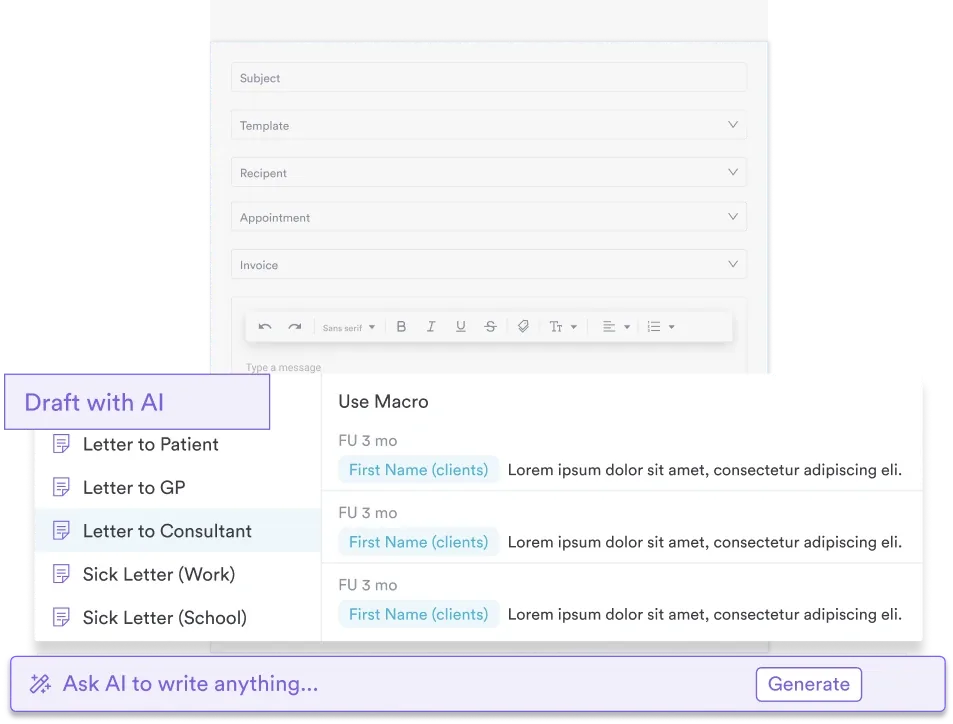
With an AI scribe like Pabau Scribe, our AI medical scribe, you can dictate findings during or right after the exam, and it transcribes and structures them into a note without manual typing.
With a tool that tracks clinical measurements, baseline and follow-up scores sit side by side in the patient record.
A diabetic foot exam template is essential for primary care physicians, family medicine practitioners, and internal medicine doctors managing diabetic patient panels.
Podiatrists and diabetes educators use it as a clinical standard, and nurse practitioners and physician assistants working in diabetes or wound care settings also benefit from the structured approach. Educators covering nutrition at the same visit can pair it with a vegetarian diet plan for patients eating plant-based.
Even in busy urgent care or occupational health settings, a quick-reference template ensures core assessments are completed.
Compliance and risk reduction: A documented foot exam demonstrates adherence to standards of care. It protects your practice in audits and reduces liability exposure by creating a clear record of what was assessed and what was communicated to the patient.
Early detection: Systematic assessment catches neuropathy and vascular disease before they progress to ulcers. Early detection enables timely specialist referral and preventive interventions.
Workflow consistency: A template ensures every clinician performs the same core assessment steps, reducing variability and missed findings. It also streamlines recall scheduling. Systems can flag annual recall dates automatically.
Accurate billing and coding: Structured documentation supports correct billing code and ICD-10 code assignment, reducing claim denials and coding errors.
Document findings in real time during the exam, not from memory afterward. Real-time charting improves accuracy and allows you to share results with the patient immediately, increasing engagement and compliance with follow-up care.
The diabetic foot exam’s primary goal is to assign patients to risk tiers that guide clinical action. Risk stratification drives referral decisions and determines exam frequency.
A well-designed template auto-calculates risk tier based on exam findings, removing guesswork and supporting consistent triage.
Most template libraries hand you a blank form and stop there. Here is a completed low-risk note you can copy, adapt, and save as a reusable dot phrase or autotext:
Type 2 diabetes, 6-year duration. No prior foot ulcer or amputation. No current pain, numbness, or difficulty walking. Skin intact bilaterally with no calluses, fissures, blisters, or ulcers; nails trimmed; no deformity noted. 10-gram monofilament sensation intact at all five plantar test sites on both feet. Dorsalis pedis and posterior tibial pulses 2+ and symmetric. Foot structure normal. Risk tier: low. Plan: annual comprehensive exam, daily self-inspection reviewed with patient, footwear appropriate.
For an abnormal exam, swap the relevant fields: record the site of any callus or ulcer, the plantar sites where the patient could not feel the monofilament, and any diminished or absent pulse. Then update the risk tier and referral plan to match. Saving the note as a dot phrase keeps every clinician charting the same fields in the same order, which is what makes findings comparable year to year. A weight loss practice reviewing progress needs the earlier measurements in the same view as the current one.
Routine or preventive foot exams are typically billed under standard evaluation and management (E&M) codes as part of the visit. HCPCS Level II codes G0245, G0246, and G0247 apply to a narrower Medicare scenario: a patient already diagnosed with diabetic sensory neuropathy resulting in loss of protective sensation (LOPS).
G0245 covers the initial evaluation of that patient, and G0246 the follow-up evaluation. G0247 covers routine foot care and is billable only alongside G0245 or G0246 on the same date of service. These are not preventive or screening codes.
Medicare coverage also extends to qualified nurse practitioners and physician assistants, not just physicians, but that’s a coverage rule rather than part of the code definitions themselves.
Accurate documentation supports correct coding regardless of which pathway applies. Building the template into your EHR as a diabetic foot exam dot phrase, or SmartText autotext, speeds charting and keeps the billing code and supporting detail consistent across clinicians.
Common ICD-10 codes for a documented foot exam include:
Diabetes care rarely stops at the foot exam. On the same visit day.
Storing exam templates in HIPAA-compliant digital systems ensures that findings are secure, searchable, and easily retrieved for audits or follow-up care.
A standardized diabetic foot exam template transforms foot assessment from an ad-hoc screening into a systematic, replicable clinical process. It reduces amputation risk by catching complications early.
Download the template above, implement it in your practice workflow, and schedule a demo to see how Pabau’s digital forms integrate diabetic foot exams into your patient record system.

Counseling a diabetic patient on diet changes too? carnivore diet plan template structures patient counselling, risk assessment, and documentation for animal-based eating protocols.
Also caring for a patient in DKA? diabetic ketoacidosis care plan covers nursing diagnoses, SMART goals, and insulin and fluid protocols for acute care.
Need a broader diet plan for a male patient? diet plan for men offers structured nutrition and meal planning tailored to men’s metabolic needs and goals.
A diabetic foot exam is a systematic clinical assessment that checks for signs of neuropathy (loss of sensation), vascular disease (poor blood flow), and skin breakdown in patients with diabetes. It helps identify foot complications early before they progress to ulcers or amputation.
At minimum, annually for low-risk patients with no prior complications. High-risk patients (those with loss of protective sensation or vascular disease) require exams every 3 to 6 months. Patients with a history of ulcers or amputations may need quarterly or more frequent evaluation.
The 10-gram Semmes-Weinstein monofilament test detects loss of protective sensation (LOPS). The clinician applies a thin, standardized filament at five sites on the plantar surface of each foot. If the patient cannot feel the monofilament at one or more sites, they have lost protective sensation and are at increased risk for foot ulcers.
A routine or preventive foot exam is coded to the patient’s diabetes diagnosis itself, not a separate screening code. For a diagnosed diabetic with no active complication, use E11.9 (type 2 diabetes mellitus without complications), or a neuropathy subcode such as E11.42 (type 2 diabetes mellitus with diabetic polyneuropathy) when that finding is documented. If the patient has diabetes and an active foot ulcer, use E11.621 (type 2 diabetes with foot ulcer) alongside a companion L97.4- or L97.5- code specifying the ulcer’s site and laterality. Without it, the claim will deny.
Low-risk feet have intact sensation, normal pulses, and no history of ulcers or deformities. High-risk feet have either loss of protective sensation (LOPS) or signs of vascular disease (diminished pulses, cool skin). Patients with high-risk feet need more frequent exams and closer specialist follow-up to prevent complications.
The American Diabetes Association recommends a comprehensive foot exam at least once a year for all adults with diabetes, covering sensation, pulses, skin, and foot structure. Patients considered higher risk (those with loss of protective sensation, poor circulation, or a prior ulcer or amputation) should also have a visual foot check at every routine visit, plus more frequent comprehensive exams.
Yes. You can download the template at the top of this page as a PDF at no cost, print it for point-of-care use, then rebuild it as a digital form in your patient records so findings stay searchable and easy to recall each year.
Record the patient’s diabetes history and risk factors, the skin and nail inspection, the 10-gram monofilament result at five plantar sites per foot, the dorsalis pedis and posterior tibial pulses, foot structure, an assigned risk tier, and a follow-up plan. Charting these fields in a fixed order, ideally as a saved dot phrase, keeps notes consistent and supports accurate coding. See the completed example above.