CCSD Code J5520: Total pancreatectomy billing guide
CCSD Code J5520: Definition and procedure scope CCSD Code J5520 describes a tota...

Last Updated: Oct 20, 2026
L1300 is the HCPCS Level II code for other scoliosis procedure, body jacket molded to patient model.
The jacket is custom fabricated over a model taken from a cast or scan of the patient's trunk. The code is all-inclusive, so no addition codes bill with it. A post-operative body jacket bills under L1310 instead.
Let Pabau's smart automation suggest the right codes, reduce claim denials, and keep your practice compliant—effortlessly.
Automate repetitive tasks and focus on what matters most—your patients.
Reduce coding errors and ensure compliance with the latest regulations.
Clean claims, fewer denials, and faster reimbursements.
Powerful insights and reporting to help your practice thrive.
HIPAA compliant SOC 2 certified GDPR-compliant Trusted by 4,000+ clinics worldwide

HCPCS code L1300 describes a custom scoliosis body jacket molded to a model of the patient’s trunk.
L1300 and L1310 are both scoliosis body jackets: L1300 is molded to a patient model, and L1310 is the post-operative jacket.
L1300 is all-inclusive, so billing addition codes, L0999 or L1499 alongside it is unbundling.
CMS lists L1300 as a custom-fabricated orthotic, so a qualified practitioner or supplier has to furnish it.
Pabau, the practice management platform we build, keeps the order and delivery record on the patient’s file and scrubs each claim before it goes out.
HCPCS code L1300 is the billing code for a scoliosis body jacket that is molded to a model of the patient. It sits in the HCPCS Level II L-code set, which the Centers for Medicare and Medicaid Services (CMS) maintains for orthotics, prosthetics and other supplies.
The official long descriptor is: Other scoliosis procedure, body jacket molded to patient model. The CMS short descriptor reads “Body jacket mold to patient.” In practice, the orthotist casts or scans the patient’s trunk, builds a positive model, and forms a rigid plastic jacket over it.
L1300 belongs to the L1300 to L1499 range, “Other Scoliosis and Spinal Orthotics and Procedures,” listed in the AAPC HCPCS range for L1300-L1499. Medicare prices it as a lump-sum orthotic purchase under the DMEPOS fee schedule, with coverage left to contractor judgment.
Most L1300 coding errors come from treating it as a generic back brace code. The table separates the device L1300 describes from the devices that bill elsewhere.
Some billing references describe L1300 as a rigid prefabricated lumbar orthosis. That description belongs to the lumbar-sacral orthosis (LSO) family, not to L1300.
A prefabricated LSO with rigid anterior and posterior panels bills as L0627, or L0642 when it is supplied off the shelf. L0631 is a prefabricated LSO with sagittal control that is customized to fit, and L0632 is its custom-fabricated version. Thoracic-lumbar-sacral orthoses for general spinal support start at the L0450 series.
If the device on the delivery slip is a back brace for low back pain or stenosis, L1300 is the wrong code. Check the order against the official descriptor before the claim is built. The three questions below sort any spinal orthosis order into the right code family.
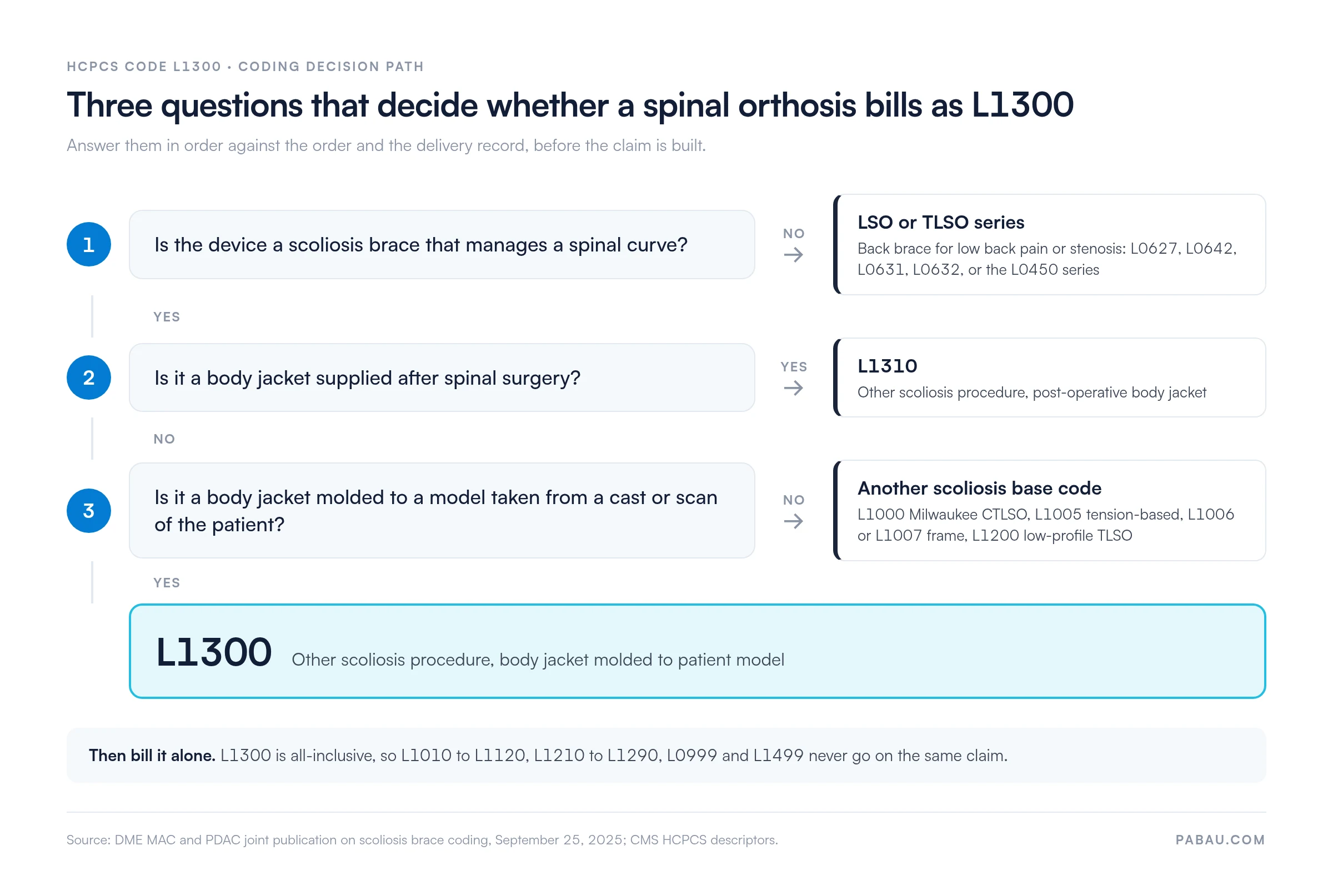
L1300 and L1310 are both “other scoliosis procedure” body jackets, and both are all-inclusive. The difference is clinical timing and fabrication. L1300 is molded to a patient model, while L1310 is the body jacket worn after spinal surgery.
The descriptors above follow the DME MAC and PDAC joint publication on scoliosis brace coding, posted September 25, 2025. It lists seven base codes for scoliosis braces, and L1300 is one of them.
The DME MACs and the Pricing, Data Analysis and Coding (PDAC) contractor treat L1005, L1006, L1007, L1300 and L1310 as all-inclusive. The pads, liners and closures inside an L1300 jacket are part of its allowance.
Two code families are built to take additions. L1010 to L1120 attach only to the L1000 Milwaukee brace, and L1210 to L1290 attach only to the L1200 TLSO. Billing any of them with L1300 is incorrect coding.
The same rule applies to the not-otherwise-specified codes. L0999 and L1499 may not describe a feature already included in L1300, and they may not replace a specific L-code. The joint publication calls both uses unbundling.
Before an L1300 claim goes out, scan the claim lines for L1010 to L1120, L1210 to L1290, L0999 and L1499. Any of them on the same date of service as L1300 invites an unbundling denial. Remove the extra line or fix the base code.
Every L1300 claim needs an ICD-10-CM code that names the scoliosis being treated. Code to the type and the spinal region, because an unspecified code gives the reviewer the least to work with.
M41.9, scoliosis unspecified, is a billable code, but it weakens the claim. If the record states the curve type and region, a specific M41 code should replace it.
Medicare covers L1300 under the orthotics and braces benefit when the jacket is reasonable and necessary for the patient’s spinal condition. Claims go to the DME MAC for the patient’s jurisdiction. The DME MAC spinal orthoses policy is written for TLSO and LSO codes, so for L1300 the medical record carries the case.
Four rules shape an L1300 claim to Medicare:
Many patients fitted with a molded scoliosis jacket are children or adolescents, so Medicaid and commercial plans pay a large share of these claims. Many of those payers ask for prior authorization on custom spinal orthoses. Run insurance eligibility verification before casting, so the authorization is in hand before fabrication starts.
A custom jacket is built before it is paid for, so incomplete records are expensive. A structured superbill documentation workflow captures the order, fabrication and delivery details as they happen.
CMS discontinued certificates of medical necessity (CMNs) and DME information forms for DMEPOS claims with dates of service on or after January 1, 2023. No CMN is needed for L1300.
Keep these records for at least seven years from the date of service. Medicare reviews can reach back several years, and a missing casting record is hard to rebuild later.
L1300 needs fewer modifiers than most orthotic codes. A body jacket covers the trunk, so it takes no RT or LT side modifier, and no scoliosis policy calls for KX.
Commercial and Medicaid payers set their own modifier rules. Check the plan’s orthotics policy when you set up the claim template.
Medicare pays L1300 as a purchase under the DMEPOS fee schedule. Its pricing indicator places it with orthotics and prosthetics, priced by state with national floors and ceilings. Custom jackets fall outside the off-the-shelf brace categories used in competitive bidding.
Look up the current allowable on the CMS DMEPOS fee schedule page for the patient’s state. CMS publishes a new file each January and posts quarterly updates, so a prior-year figure can be wrong.
Commercial payers usually pay a contracted rate or a percentage of the Medicare fee. Medicaid programs publish their own orthotic fee schedules by state.
L1300 denials follow a short, predictable list. Structured denial management workflows catch most of them before the claim leaves the practice.
Replacement claims need extra care. When a growing patient outgrows a jacket, the record has to show the change in physical condition that makes the new jacket necessary.
An L1300 claim depends on records created weeks apart. The order arrives first, then the cast or scan, then fitting and delivery. When those records live in different places, the claim waits while someone hunts for the missing one.
Pabau, the practice management platform we build, keeps the order, clinical notes, fabrication record and signed delivery form on the patient’s record. Its claims management software scrubs each claim for missing or invalid details before it leaves, so more of them go out as a clean claim.
Where a Medicaid or commercial plan requires prior authorization, Pabau stores it as a case. The authorization code then follows the appointment through to the claim. Claims then go to the payer through a clearinghouse, with each status visible on one screen.
The result is fewer resubmissions and a shorter wait between delivering the jacket and getting paid. Your team spends less time chasing paperwork and more time with patients.

Pabau’s claims management software checks every claim for missing or invalid details and tracks prior authorizations as cases. Claims go out through a clearinghouse, so fewer come back for correction.

The expensive L1300 mistakes happen before the jacket is cast. A wrong base code, a missing authorization or an unsigned order only surfaces after fabrication, when the cost of the build is already spent.
So settle the code with the three questions above when the order arrives, and confirm payer authorization before casting starts. After that, the claim needs L1300 on its own line and the delivery proof behind it.
To see how Pabau keeps the order, authorization and delivery record ready for each orthotic claim, book a demo.

Want to understand how the 837P claim file works? 837 file guide explains the EDI transaction format and the fields a payer checks on submission.
Need to trace a rejection back to the claim line? Electronic remittance advice explains how ERA files map denial reason codes to specific lines, so you can correct L1300 rejections faster.
Billing a dynamic scoliosis brace instead? HCPCS code L1005 covers the tension-based scoliosis orthosis, another all-inclusive base code.
Supplying a low-profile TLSO with pad additions? HCPCS code L1200 explains the base code and the L1210 to L1290 additions it takes.
HCPCS code L1300 covers a scoliosis body jacket molded to a model of the patient. The orthotist casts or scans the trunk and forms the jacket over that model. The code is all-inclusive, so its pads and components are not billed separately.
Both codes describe “other scoliosis procedure” body jackets. L1300 is a body jacket molded to a patient model. L1310 is the post-operative body jacket worn after spinal surgery. Neither code may be billed with addition codes.
No. L1300 is a scoliosis body jacket code in the L1300 to L1499 range. A prefabricated lumbar-sacral orthosis with rigid panels bills under the LSO series, such as L0627 or L0642.
No. The DME MACs and PDAC treat L1300 as all-inclusive. Billing L1010 to L1120, L1210 to L1290, L0999 or L1499 with it counts as unbundling.
Medicare covers L1300 under the orthotics and braces benefit when the jacket is reasonable and necessary. The claim goes to the DME MAC, and a qualified practitioner must furnish the jacket. A standard written order and proof of delivery must be on file.
As of October 2026, L1300 is not on the Medicare DMEPOS prior authorization lists. CMS also stopped requiring CMNs for dates of service on or after January 1, 2023. Medicaid and commercial plans may still require prior authorization.
Specific scoliosis codes support the claim best. Common choices are M41.124, M41.125 and M41.126 for adolescent idiopathic scoliosis, M41.45 or M41.46 for neuromuscular scoliosis, and Q76.3 for congenital scoliosis.