CPT Code 62284: Injection procedure for myelography
CPT Code 62284: official descriptor and procedure overview The American Medical ...

Last Updated: Oct 19, 2026
L1310 is the HCPCS Level II code for other scoliosis procedure, post-operative body jacket. It covers a rigid or semi-rigid body jacket furnished after scoliosis surgery, when no more specific scoliosis orthosis code describes the device.
Denials on this code repeat. They trace back to a missing or late physician order, or to thin medical necessity documentation. Picking L1310 where L1300 fits the device better is the other recurring cause.
Let Pabau's smart automation suggest the right codes, reduce claim denials, and keep your practice compliant—effortlessly.
Automate repetitive tasks and focus on what matters most—your patients.
Reduce coding errors and ensure compliance with the latest regulations.
Clean claims, fewer denials, and faster reimbursements.
Powerful insights and reporting to help your practice thrive.
HIPAA compliant SOC 2 certified GDPR-compliant Trusted by 4,000+ clinics worldwide

HCPCS code L1310 covers a post-operative body jacket for scoliosis, inside the Level II orthotic L-code range.
Medicare pays L1310 under the Part B DMEPOS benefit when a signed physician order precedes delivery.
L1300 is the closest neighboring code, and the surgery date in the chart is what separates the two.
L1290 adds a lateral trochanteric pad to a TLSO, and L1320 treats pectus carinatum instead.
CMS prices L1310 as a lump-sum purchase on the DMEPOS fee schedule, outside competitive bidding.
HCPCS code L1310 is the Level II code for a post-operative body jacket furnished to a scoliosis surgery patient. The Centers for Medicare and Medicaid Services (CMS) maintains it as a permanent national code in the orthotic L-code range.
Its official descriptor reads “Other scoliosis procedure, post-operative body jacket.” CMS added the code on January 1, 1986, and it is still active in the 2026 HCPCS set.
L-codes cover orthotic devices and the procedures around them. Spinal orthoses run from L1000 to L1499, but the scoliosis devices inside that block are not grouped tidily. Codes for unrelated conditions sit between them, which is where most of the confusion around L1310 starts.
L1310 is also a residual code. It applies only after you have confirmed that no more specific scoliosis orthosis code describes the device you furnished.
The last three rows carry more weight than their labels suggest. Coverage code C means CMS has published no national coverage decision for L1310, so the DME MAC judges each claim on its own documentation.
Pricing indicator 38 puts payment on the DMEPOS fee schedule, with regional floors and ceilings applied. Type of service P marks the jacket as a lump-sum purchase rather than a rental, so the beneficiary owns it once Medicare pays.
The surgery does, not the shape of the device. The jacket described by L1310 is a rigid or semi-rigid thoracolumbosacral orthosis (TLSO). It stabilizes the fusion, protects instrumentation, and limits motion while the surgical site heals.
A brace worn to slow a curve before surgery is a different device for billing purposes, however similar it looks on the patient. What pushes a device into L1310 is the absence of a standard, named design.
The jacket usually wraps the torso from the pelvis to below the axilla, and it is often custom-fabricated to the patient’s post-operative shape.
Only CMS-enrolled durable medical equipment (DME) suppliers and licensed orthotists may bill L1310 to Medicare. Hospitals billing a facility claim and physicians billing Part B professional claims do not use L-codes for outpatient orthotic devices.
The claim routes to a DME Medicare Administrative Contractor (DME MAC) rather than the Part B MAC that handles physician services. Jurisdiction follows the beneficiary’s permanent address, not the supplier’s. Ship a jacket from Ohio to a patient who lives in Texas and the claim belongs to Jurisdiction C.
Orthotics practices that also treat rehabilitation patients should check their DMEPOS enrollment separately. A physical therapy provider number does not carry DME billing rights with it. Place-of-service codes are not used on DME MAC claims either, since the claim type and supplier NPI decide the routing.
Medicare covers L1310 under the Part B DMEPOS benefit, but only where the record proves medical necessity before delivery. Three things have to line up before the jacket goes out.
Payment itself comes from the DMEPOS fee schedule, which CMS updates annually. Allowed amounts vary by jurisdiction and by rural or non-rural status. Rates change every January 1, so check the current figure against the CMS DMEPOS fee schedule before you quote anything to a patient.
Competitive bidding does not reach this code. The DMEPOS Competitive Bidding Program targets off-the-shelf back and knee braces, not custom-fabricated devices like a post-operative body jacket. No round has been active since the previous one expired on December 31, 2023.
Commercial and Medicaid payers write their own policies. Some managed care plans ask for prior authorization on any custom orthosis. Others pay a percentage of the Medicare allowed amount. Either way, confirm eligibility and authorization rules for that payer before fabrication starts.
A signed physician order and clinical notes supporting medical necessity have to be on file before the claim goes out.
CGS Medicare’s guidance on scoliosis orthoses is blunt about this, and DME MAC review findings repeat it year after year. Incomplete documentation remains the leading reason L1310 claims are denied.
The charge line itself is short. It carries the HCPCS code, the KX modifier where the medical necessity criteria are met, the beneficiary’s Medicare number, and the date of service.
If the file does not show that the jacket followed scoliosis surgery, expect an additional documentation request (ADR) or a flat denial.
Ask for the signed order before you book the fitting appointment. An order dated later than the delivery date is one of the fastest ADR triggers on DMEPOS claims. Build the rule into the workflow: no orthotist starts custom fabrication until the signed order is scanned into the patient file.
Only L1300 is a genuine alternative, and the surgery date in the chart is what separates the two. Coders pick the wrong scoliosis code more often than they pick the wrong modifier. Two questions settle it, and the diagram below walks through both.
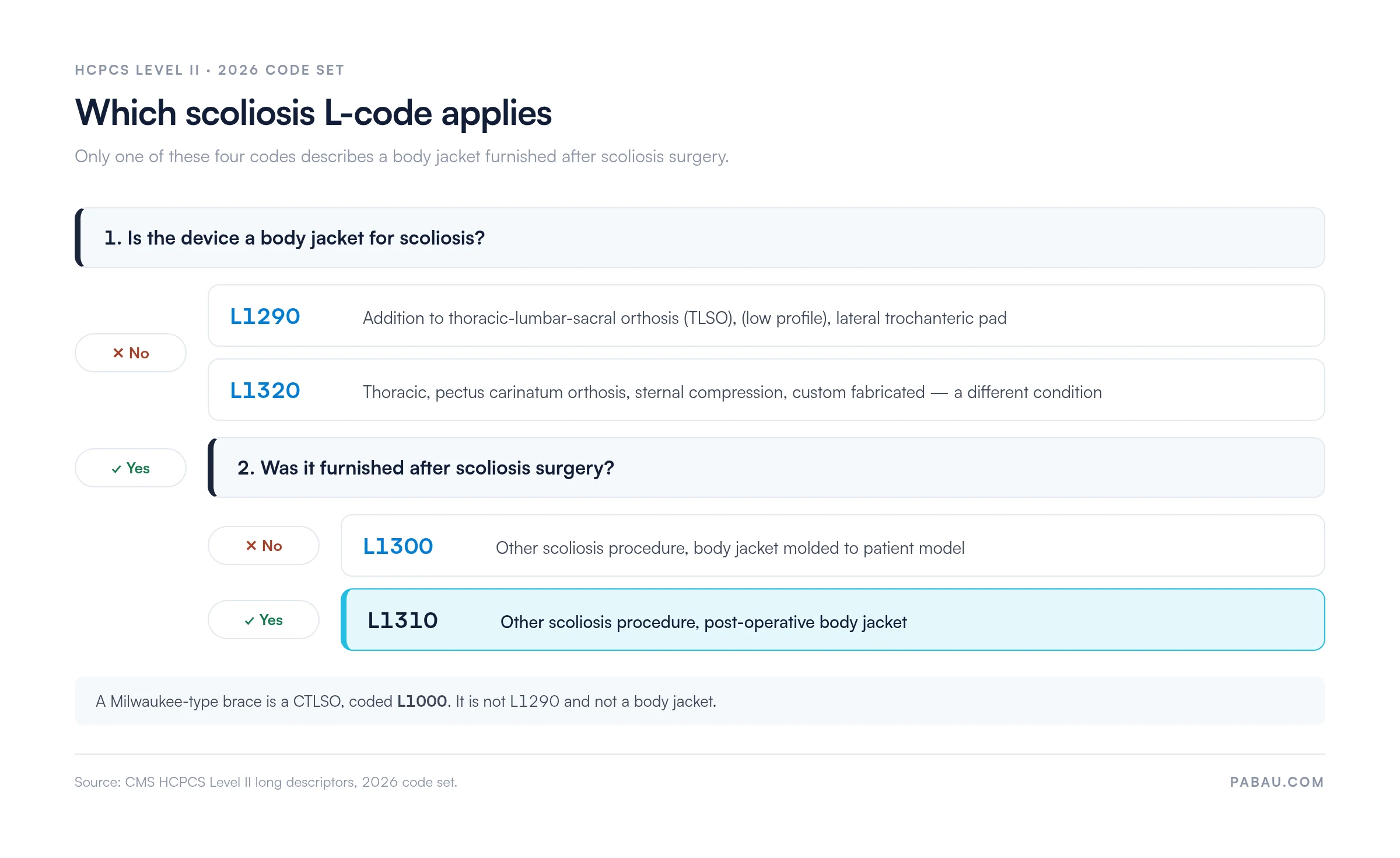
Two of those rows catch people out. L1290 is an addition code, so it never stands in for a complete jacket. L1320 sits one number along from L1310 and has nothing to do with scoliosis. A Milwaukee-type brace is a CTLSO, and that carries L1000.
That leaves L1300 as the one call worth slowing down for. A jacket molded to a patient model for an adolescent who has not had surgery is L1300. The same style of jacket furnished after spinal fusion is L1310. Confirm the surgical date in the clinical notes before you pick between them.
Auditing code selection in batches is easier with a lookup to hand. The AAPC HCPCS code lookup lets you browse descriptors across the whole L-code range. The free NLM HCPCS Level II API returns current descriptors for any code you query.
Most L1310 denials are preventable, and they repeat. The five below account for the bulk of what DME MAC reviewers send back on scoliosis orthosis claims.
Because L1310 is a residual code, payers examine it more closely than named-device codes. Material is never the deciding factor here, since HCPCS carries no separate code for a thermoplastic post-operative jacket. What does decide it is whether a named code such as L1300 or L1000 already describes the device. Note in the file why none of them fit.
A physician order signed after delivery fails the DMEPOS documentation standard outright. The fix is procedural rather than clinical. No jacket leaves the supplier until a signed, dated order sits in the file, and a date comparison before submission catches the rest.
Appending KX tells the DME MAC that the supplier reviewed the Local Coverage Determination (LCD) criteria and holds the documentation. Omit it on a claim that qualifies and you invite a denial or a reduced payment. Reading the remittance carefully is usually how a missing KX gets spotted, so it pays to know the common denial codes by sight.
L1310 claims route through the DMEPOS-enrolled supplier NPI. An orthotist’s individual NPI, or a group practice NPI, will reject at the clearinghouse or deny at adjudication. Confirm the billing NPI and taxonomy code before submission, then re-check enrollment status once a year.
A custom jacket needs documentation proving it was built to this patient’s measurements rather than pulled from stock. Without measurements, fabrication records and a fitting note, the payer can reclassify the claim to a prefabricated code at a lower rate. Keep the orthotist’s fabrication record in the patient file at the supplier.
Audit your last 20 L1310 claims before the next billing period. Check four things: order date against delivery date, KX modifier presence, billing NPI enrollment status, and custom fabrication documentation in the file. One workflow change usually fixes whichever pattern turns up.
An L1310 claim goes out on the CMS-1500 form, or its 837P electronic equivalent, to the beneficiary’s DME MAC. The charge line carries the HCPCS code, the beneficiary’s Medicare number, the date of service, and the ordering physician’s NPI. KX goes on when the LCD criteria are met, and GA goes on when an ABN is on file.
Then the clock starts. Medicare cannot release payment on a clean electronic claim before day 14, and paper claims wait until day 29. Past 30 days the contractor owes interest, so a claim still sitting open is usually worth chasing rather than waiting on.
The electronic remittance advice tells you what happened. A denial pointing at a documentation deficiency is usually re-submittable once the missing records are attached. A denial pointing at a coverage exclusion is not.
Most of the work, though, happens before any of that. A clean claim passes payer edits the first time, and on DMEPOS that comes down to dates and records.
A 30-day follow-up cycle on open DMEPOS claims keeps balances inside Medicare’s timely filing window, which runs one calendar year from the date of service.
Most orthotics practices run this on two systems. The clinical record holds the order, the measurements and the fitting note. The billing system holds the claim. Somebody copies between them, and the order date is usually the first detail to fall out of step.
Practice management software like Pabau keeps both in the same patient record. Its claims tools for practices build the form from what is already there. Codes attached to the service land on the charge line without re-keying. ICD-10 and HCPCS lookup libraries sit behind a search icon, refreshed with each official release.
Before the Send button unlocks, Pabau checks that the claim’s required fields are complete, including membership and authorization numbers. On US claims it also runs eligibility checks, posts remittance advice, and tracks claim status. So your team spends follow-up time on the claims that genuinely need it.
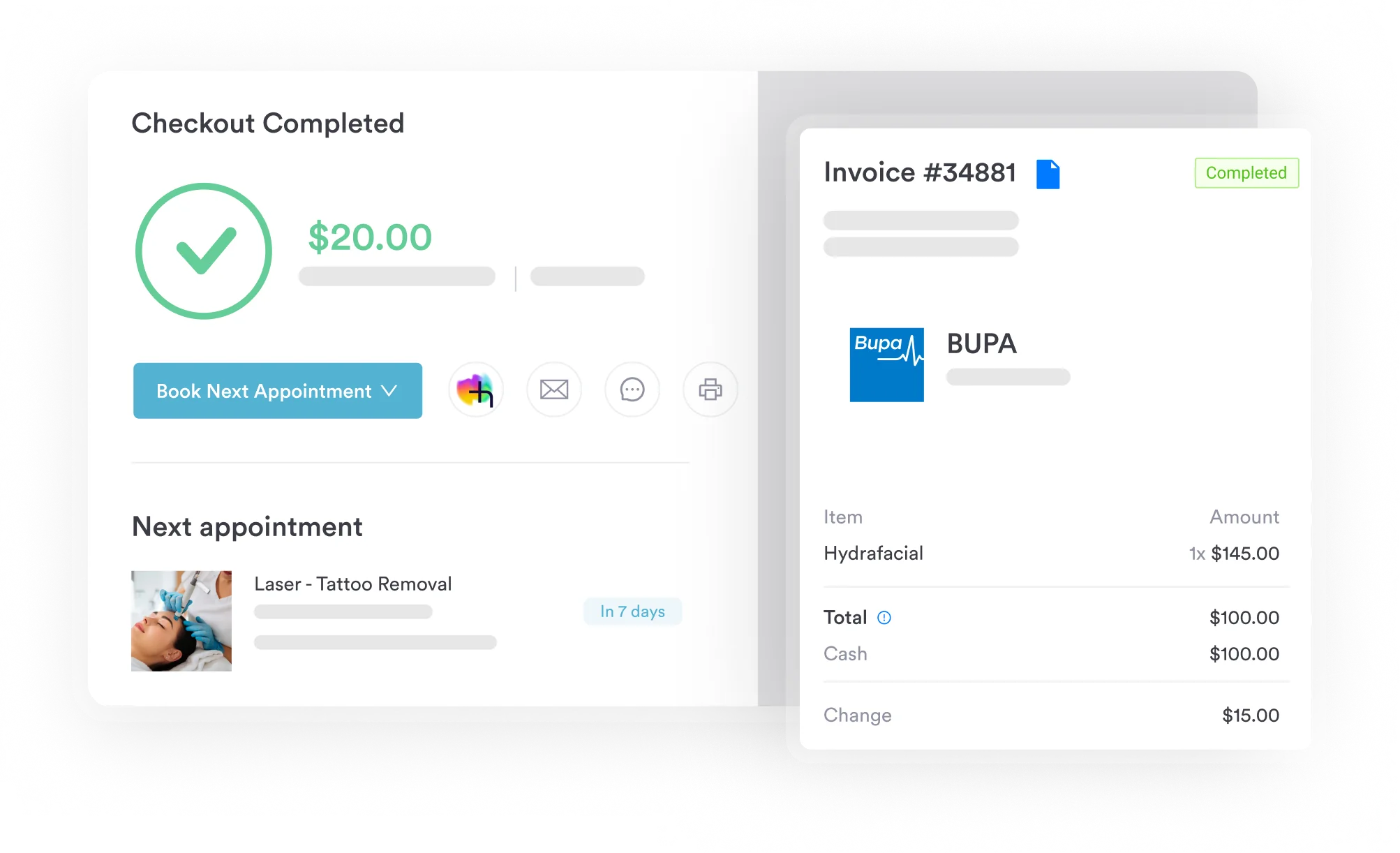

Pabau pre-fills the claim form from the patient record, checks that required claim fields are complete before submission, and tracks status and remittance afterwards. So DMEPOS follow-up stops living in a spreadsheet.

L1310 is a narrow code with a wide margin for error. The device has to be a body jacket, the surgery has to have happened first, and no named scoliosis code can describe it better. Get those three right and the coding question is closed.
What is left is process. Order before delivery, fabrication records in the file, KX where the criteria are met, and the supplier NPI on the claim. Practices that build those four into the workflow stop re-working the same denial every quarter.
Keeping the order, the fitting note and the claim in one patient record is what makes that consistent. Book a demo to see how Pabau handles DMEPOS documentation and claims from a single file.

Need a guide to the denial codes that hit DMEPOS claims? Denial codes in medical billing explains the most common remittance advice codes and how to respond to each.
Want to see where DMEPOS billing sits in the wider revenue cycle? What is revenue cycle management walks through the process from eligibility check to payment posting.
Looking for a checklist for first-pass claim submission? What is a clean claim covers the elements every DMEPOS claim needs to pass payer edits on the first try.
Chasing paid claims that never posted? Electronic remittance advice explains how to read an ERA file and act on the adjustment codes inside it.
A purchase code. CMS assigns L1310 type of service code P, a lump sum purchase of orthotics, so there is no rental stream to bill. The beneficiary owns the jacket once Medicare pays the claim.
The scoliosis diagnosis from the ICD-10-CM M41 category, paired with chart notes recording the spinal surgery. The diagnosis on its own will not carry the claim, because the post-operative timing is what L1310 turns on.
Yes, where two different devices were separately ordered, furnished and documented at different points in care. One jacket never carries both codes, and the surgery date decides which one applies.
Not before day 14 for a clean electronic claim, or day 29 for a paper one. Those payment floors are set by Medicare. If the contractor has not paid within 30 days of receipt, it owes interest on the claim.
No. An Advance Beneficiary Notice is needed only where coverage looks uncertain, and it has to be signed before delivery. Add the GA modifier to the claim line when one is on file.