CPT Code 28450: Closed treatment of tarsal bone fracture
CPT Code 28450: Official descriptor and code category CPT Code 28450 is classifi...

Last Updated: Nov 13, 2026
HCPCS code L1510 is a deleted Level II code for a thoracic-hip-knee-ankle orthosis (THKAO) standing frame, with or without tray and accessories. CMS removed it from the code set on January 1, 2012, as the January 2012 CMS code update (Transmittal 2370) confirms. A claim that still carries it fails as an invalid code.
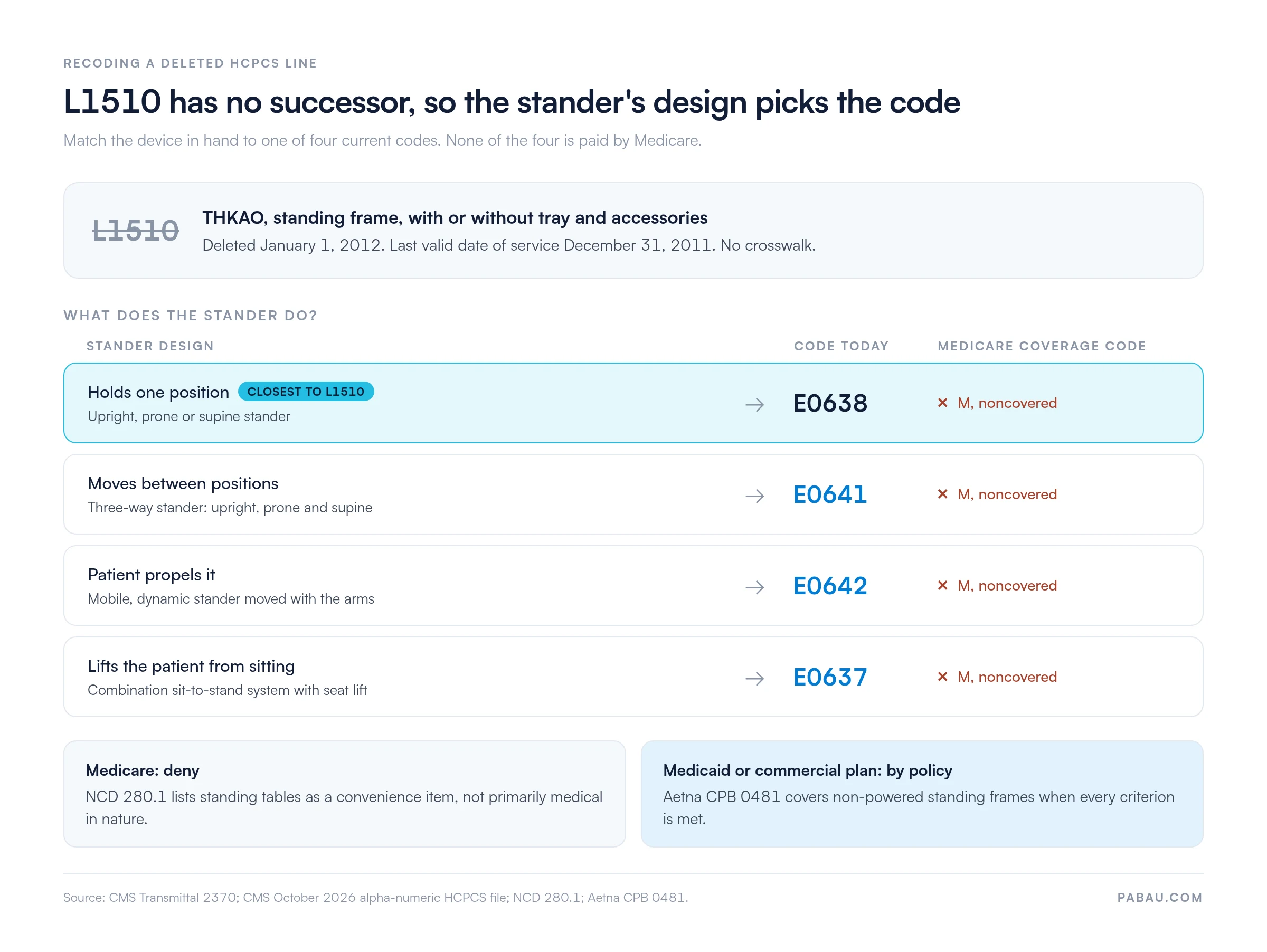
No code replaced L1510 one for one. A standing frame is now billed with the code that matches its design: E0637, E0638, E0641 or E0642. Medicare does not cover any of the four, so the claim’s route to payment runs through Medicaid or a commercial plan.
L1510 was never a knee brace code. The elastic knee orthosis with stays was L1800, a different code that was also retired.

HCPCS code L1510 described a THKAO standing frame, with or without tray and accessories.
CMS deleted L1510 on January 1, 2012, together with L1500 (mobility frame) and L1520 (swivel walker), with no crosswalk.
A standing frame is coded today as E0637, E0638, E0641 or E0642. The choice depends on the stander’s design.
Medicare treats standing frames as noncovered, and NCD 280.1 calls standing tables a convenience item that is not primarily medical in nature.
Medicaid programs and commercial plans such as Aetna may cover a stander when the record shows the patient meets their criteria.
Removing L1510 from price lists and claim templates stops the deleted code from reaching the next claim.
L1510 sat in the L section of HCPCS Level II, which covers orthotic and prosthetic procedures. Its descriptor read “THKAO, standing frame, with or without tray and accessories.” A THKAO supports the trunk, hips, knees and ankles at once, so the device held a patient upright who could not stand unaided.
CMS Transmittal 2370, dated December 16, 2011, lists L1510 among the codes deleted effective January 1, 2012. Its short descriptor there is “Thkao standing frame.” The last valid date of service was December 31, 2011.
The code is also absent from the CMS October 2026 alpha-numeric HCPCS file, available through the CMS quarterly HCPCS update page. That file holds no L15xx code at all.
A deleted code is different from a noncovered code. A noncovered code is still valid but fails the payer’s coverage rules. A deleted code is no longer in the code set, so the claim fails before anyone looks at medical necessity.
L1510 still surfaces in billing systems for a few predictable reasons:
The THKAO group held three codes, L1500, L1510 and L1520, and Transmittal 2370 deleted all three on the same date. They differed by what the frame let the patient do.
Source: CMS Transmittal 2370 and the New York State Medicaid 2012 DMEPOS manual. The manual lists all three as discontinued with no crosswalk. That manual’s L1510 entry points to E0638, E0641 and E0642 for positioning.
Pick the code from the device in hand, not from the old code on the template. The standing frame and table codes describe the stander’s design, and each one fits only a device that matches its descriptor.
Source: CMS October 2026 alpha-numeric HCPCS file. All four codes also carry pricing indicator 00, meaning Medicare Part B sets no separate payment for them.
Read as a decision, the stander’s design settles the code, and the coverage code then settles which payer can be billed. The chart below sets out both steps.
Medicare does not pay for standing frames. The Durable Medical Equipment Reference List (NCD 280.1) lists standing tables as “Deny – convenience item; not primarily medical in nature.” The HCPCS file gives E0637, E0638, E0641 and E0642 coverage code M, noncovered by Medicare.
A Medicare claim for a stander therefore ends in a denial, whatever the documentation shows. Some secondary payers ask for that Medicare denial before they pay. The GY modifier marks an item that “does not meet the definition of any Medicare benefit.” Confirm with your DME MAC whether it applies to your claim.
Medicaid programs and commercial plans set their own rules. Aetna’s Clinical Policy Bulletin 0481, for example, treats non-powered standing frames as medically necessary when the member meets all of its criteria:
State Medicaid programs often add prior approval and an initial rental period. Check the plan’s current policy before the stander is ordered.
Tell the patient before delivery that Medicare will not pay for a standing frame. Then confirm which secondary payer will review the claim, and what it needs to see first.
Payers that cover standers ask for proof that the device fits this patient and that cheaper options failed. Medicaid manuals and commercial policies usually expect the following:
Before the stander is delivered, run insurance eligibility verification and check whether the payer requires prior authorization.
A rejected L1510 claim points to a code that still lives somewhere in your system. Fix the claim and the source together:
When a deleted code such as L1510 still reaches a claim, the cause is usually an old price list or claim template. Correcting one claim does not stop the next if that entry stays in place.
In Pabau’s billing and records software, patient records, invoices and insurance claims share one system, with cleaner claims management built in. When CMS retires a code, your billing team updates it in one place.
US claims go out through the Claim.MD clearinghouse as CMS-1500 or 837P claims, with eligibility checks before delivery. A prior authorization’s code, dates and sessions sit on the patient’s case, and Pabau warns when one is missing.
That matters for standers, where one device can pass through Medicare, Medicaid and a commercial plan. Once Medicare denies the stander, your team sends the secondary claim from the same patient record.

Pabau sends US claims through Claim.MD, tracks prior authorizations on the patient’s case, and files the secondary claim once Medicare denies a stander.

An L1510 rejection means your code tables are out of date, and the next claim built from them will fail the same way. The deleted code has no path to payment, so the useful work is choosing the current code that matches the stander.
Start with the device. A one-position stander is E0638, a three-way stander E0641, a self-propelled one E0642, and a sit-to-stand system with a lift E0637. Then plan the claim around coverage. Medicare will deny it, so the documentation has to satisfy the Medicaid program or commercial plan that may pay.
Book a demo to see how Pabau keeps your DME billing and patient records in one place.

Need a denial management framework? Denial management in healthcare walks through tracking, appealing and preventing DMEPOS denials.
Want to understand clean-claim standards? Clean claim submission covers what a claim must contain to pass payer edits the first time.
No. CMS deleted HCPCS code L1510 effective January 1, 2012, and the last valid date of service was December 31, 2011. A claim that carries it fails as an invalid code.
L1510 described a thoracic-hip-knee-ankle orthosis (THKAO) standing frame, with or without tray and accessories. It held a patient upright who could not stand unaided. It was never a knee brace code.
No code replaced it directly, and CMS published no crosswalk. A standing frame is now coded as E0638, E0641, E0642 or E0637, depending on its design.
No. NCD 280.1 denies standing tables as a convenience item that is not primarily medical in nature. The HCPCS file gives E0637, E0638, E0641 and E0642 coverage code M, noncovered by Medicare.
Medicaid programs and commercial plans may cover them under their own criteria. Aetna, for example, covers non-powered standing frames for members with a qualifying neuromuscular condition who meet its other criteria.
All three were THKAO codes deleted on January 1, 2012. L1500 was a mobility frame of the Newington or parapodium type, L1510 a standing frame, and L1520 a swivel walker.
No. Medicare returns a claim with an invalid code as unprocessable, so there is no appeal to file. Correct the code and resubmit the claim to the right payer.