HCPCS Code Q4185: Cellesta flowable amnion billing guide
HCPCS Code Q4185: definition and official descriptor HCPCS Code Q4185 is the Lev...

Last Updated: Nov 20, 2026
L1290 is the HCPCS Level II code for an addition to thoracic-lumbar-sacral orthosis (TLSO), (low profile), lateral trochanteric pad. It bills one component, a pad fitted to a low-profile scoliosis TLSO, and never the brace itself.
L-codes cover orthotic and prosthetic devices. L1290 is an addition code, so it's billed on the same claim as base code L1200, which describes the TLSO. Billed without that base code, the line is denied as not separately payable.
Let Pabau's smart automation suggest the right codes, reduce claim denials, and keep your practice compliant—effortlessly.
Automate repetitive tasks and focus on what matters most—your patients.
Reduce coding errors and ensure compliance with the latest regulations.
Clean claims, fewer denials, and faster reimbursements.
Powerful insights and reporting to help your practice thrive.
HIPAA compliant SOC 2 certified GDPR-compliant Trusted by 4,000+ clinics worldwide

HCPCS code L1290 bills a lateral trochanteric pad added to a low-profile TLSO, and it’s paid only alongside base code L1200.
Billed alone, L1290 is denied as not separately payable, and it never goes with all-inclusive scoliosis codes such as L1300 or L1310.
Medicare needs a standard written order that lists the pad, plus a signed proof of delivery for the brace.
Claims go to the DME MAC for the patient’s state under Medicare’s prosthetics and orthotics benefit, and the record still has to show medical necessity.
Pabau sends US claims through Claim.MD, tracks prior authorizations on the case and produces superbills for the brace and its additions.
HCPCS code L1290 is the Level II code for an addition to thoracic-lumbar-sacral orthosis (TLSO), (low profile), lateral trochanteric pad.
It bills the pad, not the brace. The brace goes on the claim under its own base code, and L1290 rides on the same claim as a separate line. Its neighbors in the L1200 series are listed in our HCPCS codes library.
The code sits in the scoliosis section of the L-codes, which the Centers for Medicare & Medicaid Services maintains as part of HCPCS Level II.
Medicare prices it on the DMEPOS fee schedule, which sets orthotics amounts by state within national floor and ceiling limits. Download the current quarter’s file to find your state’s amount before you quote a patient.
L1200 is the base code, described as TLSO, inclusive of furnishing initial orthosis only. Every low-profile addition, L1290 included, attaches to it. A joint DME MAC and PDAC coding article says these additions are denied as not separately payable when billed without the related base code.
The same article names seven scoliosis base codes, and only two of them take additions. L1000, the Milwaukee-type CTLSO, has its own set of addition codes. L1005, L1006, L1007, L1300 and L1310 are all-inclusive, so billing any addition with them counts as unbundling.
The chart sorts each case.
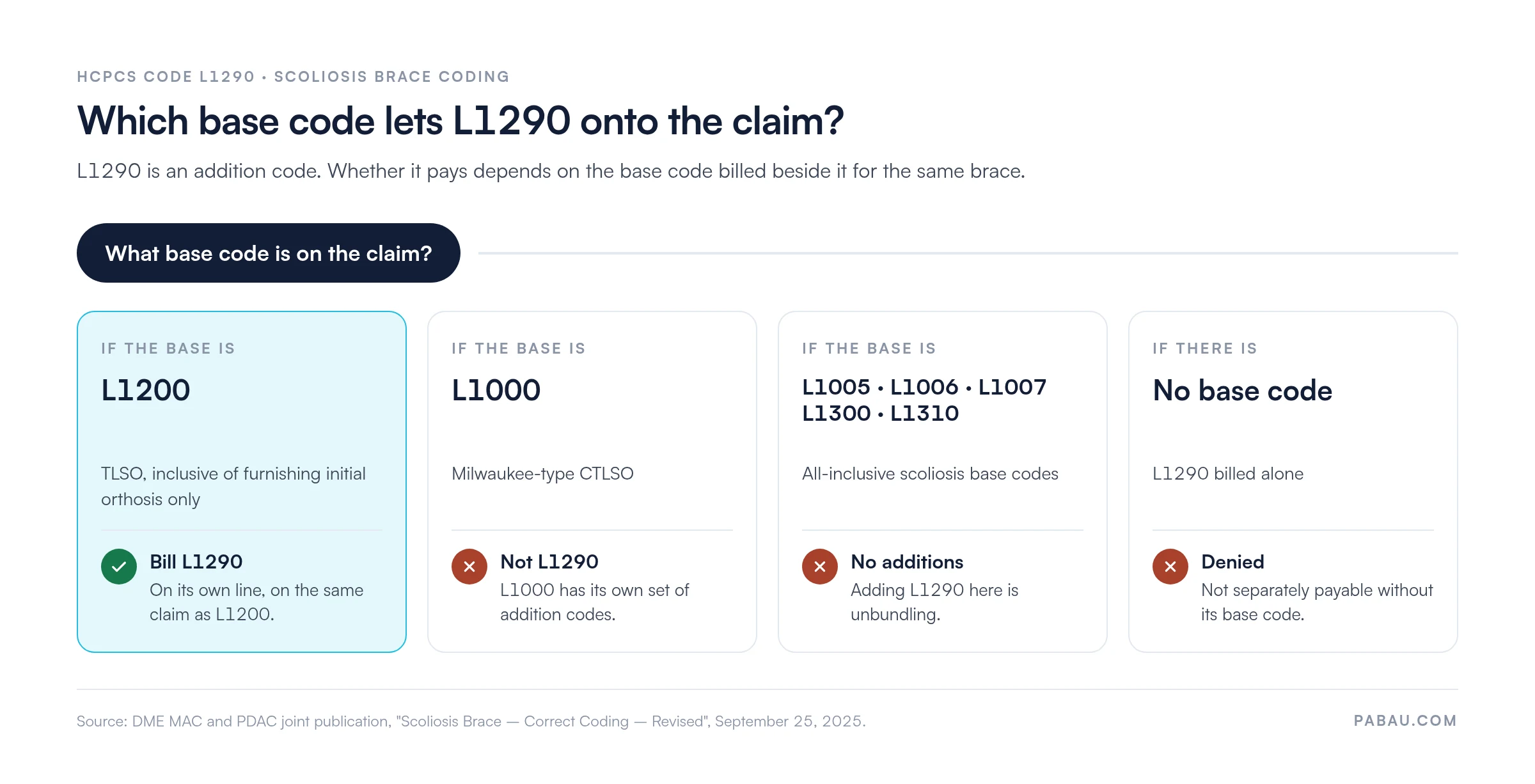
Say the prescription and the fitting notes both describe a low-profile TLSO with a lateral trochanteric pad. Then bill L1200 and L1290 together on the CMS-1500 or 837P. Leave the base code off and the pad line has nothing to attach to.
L1210 through L1290 are all additions to the same low-profile TLSO. Each official descriptor opens with “Addition to TLSO, (low profile)”, then names the part it adds.
Two pads get swapped for L1290 most easily. L1250 is the anterior ASIS pad, which sits at the front of the pelvis rather than the side. L1240 is a lumbar derotation pad, placed at the lumbar level rather than the hip. Read the fitting note for the pad’s position before you pick the code.
The other mix-up is the body jackets. L1310 is other scoliosis procedure, post-operative body jacket, and L1300 is a body jacket molded to a patient model. Both are all-inclusive, so no L1290 line goes with either one. Watch the unit wording too, because L1280 says “each” and L1290 doesn’t.
Before you bill L1290, you need a standard written order from the treating practitioner. CMS retired certificates of medical necessity (CMNs) for claims with dates of service on or after January 1, 2023. A CMN no longer supports the claim.
A few items must have the order in hand before delivery. Those sit on CMS’s Required Face-to-Face Encounter and Written Order Prior to Delivery List, and L1290 isn’t on it. For L1290, the order has to exist before you submit the claim.
Keep this set on file for each claim:
Ask for a standard written order that lists the pad as well as the brace. An order that only says “TLSO” leaves the L1290 line without an order of its own.
Medicare Part B covers braces under its prosthetics and orthotics benefit, and the supplier bills the DME MAC. Coverage for L1290 isn’t automatic, though. The record has to show why this patient needs the brace and the pad.
The Spinal Orthoses LCD, L33790, covers TLSO and LSO codes L0450 to L0651, not the scoliosis series. For L1200 and its additions, follow the scoliosis brace correct coding article and your DME MAC’s medical review guidance.
Coverage nuances by payer type:
Medicare doesn’t require prior authorization for L1290. Its Required Prior Authorization List names only a few orthoses, such as the L0648 and L0650 back braces, and L1290 isn’t one of them. CMS updates that list, so check it for your date of service.
Medicaid plans and commercial payers set their own rules, and some do require authorization for TLSO codes. Check the plan’s policy at intake, before you book the fitting. When a plan asks for authorization, the request usually includes:
A request sent before the fitting is far easier to manage than an appeal after delivery.
Here’s the path a clean L1290 claim takes on the CMS-1500 or 837P. Each step heads off a different denial.
Here’s how that looks on an illustrative claim. A patient is fitted with a low-profile TLSO and one lateral trochanteric pad. Line 1 is L1200, one unit. Line 2 is L1290, with its unit count checked against the fee schedule.
Both lines point to the patient’s scoliosis diagnosis from the M41 category, and the standard written order lists both items. The claim then goes to the DME MAC for the patient’s home state.
Our guide to the clean claim covers the fields every claim needs, whatever the code.
Most L1290 denials trace back to a step skipped before submission. Fix the step in your intake and billing routine, and the same denial stops coming back.
The diagnosis on the claim has to match what the practitioner documented. These categories commonly sit behind a scoliosis TLSO, but check your DME MAC’s guidance for the date of service.
Nonspecific low back pain is a weak fit. M54.5 was replaced by M54.50, M54.51 and M54.59 in October 2021, and back pain alone rarely explains a scoliosis brace. Code the most specific condition the notes support.
Re-check covered diagnoses whenever your DME MAC revises its guidance. AAPC Codify helps with code lookups, and the CMS Medicare Coverage Database holds the current LCDs and policy articles.
On a busy day, the order, the fitting note and the claim can sit in three different places. That’s how the L1200 line goes missing, or the order never mentions the pad.
Pabau, the practice management and billing platform we build, keeps them on one patient record. In the US, Pabau’s claims management software sends claims through Claim.MD, with eligibility checks and remittances posting back. Prior authorization codes, dates and sessions are tracked on the case, with a warning when one is missing.
Need to bill the patient or a secondary payer instead? Pabau produces a superbill from the same record, listing each code you recorded for the visit.

Pabau sends US claims through Claim.MD, tracks prior authorizations on the case and builds superbills from the patient record. Your L1200 and L1290 lines go out on one claim.

L1290 is a small line on a bigger claim. Get the base code, the order and the delivery proof right, and the pad goes through with the brace.
If your team changes one habit, make it this one. Read the base code before you add any addition, because L1200 is the only base that accepts L1290. The other scoliosis bases either carry their own additions or take none.
Book a demo to see how Pabau keeps the order, the authorization and the claim for each brace on one patient record.

Need a framework for reducing claim rejections? Denial management in healthcare covers how to build workflows that catch errors before submission.
Billing a molded body jacket instead? HCPCS code L1300 covers the all-inclusive scoliosis body jacket.
Not sure when to issue a superbill? Superbill guide explains what a superbill holds and when patients need one.
Want the full claim lifecycle in one place? Revenue cycle management fundamentals walks through the path from patient intake to payment posting.
Yes. L1290 is an active HCPCS Level II code for 2026. Check each quarterly HCPCS update anyway, since CMS can revise descriptors.
It’s a pad on the side of the brace at the level of the greater trochanter, the bony point at the outer hip. The prescription and fitting notes should say why this patient needs it.
Only if it’s enrolled with Medicare as a DMEPOS supplier. Without that enrollment, the orthotist or supplier who furnishes the brace bills L1200 and L1290.
The DME MAC for the patient’s permanent address handles the claim. A supplier in one state serving a patient from another bills that patient’s DME MAC.
Yes. One standard written order can cover L1200 and L1290, as long as it describes both items. A separately billed addition the order doesn’t list has no order behind it.