HCPCS code G0143: Thin-layer Pap screening with rescreening
HCPCS code G0143 means two manual reads of one liquid-based slide HCPCS code G01...

Last Updated: Oct 19, 2026
L1005 is the HCPCS Level II code for tension based scoliosis orthosis and accessory pads, includes fitting and adjustment. The brace is prefabricated and then custom fitted to the patient, with fitting, adjustment, and pads bundled into the code.
Because L1005 is a complete product, no addition code from L1010 to L1120 can be billed with it. A custom-fabricated Milwaukee brace made from a patient model bills under L1000 instead.
Let Pabau's smart automation suggest the right codes, reduce claim denials, and keep your practice compliant—effortlessly.
Automate repetitive tasks and focus on what matters most—your patients.
Reduce coding errors and ensure compliance with the latest regulations.
Clean claims, fewer denials, and faster reimbursements.
Powerful insights and reporting to help your practice thrive.
HIPAA compliant SOC 2 certified GDPR-compliant Trusted by 4,000+ clinics worldwide

L1005 covers a prefabricated, custom-fitted, tension-based scoliosis orthosis, not just any scoliosis brace. The tension mechanism in the descriptor is the key qualifier.
Fitting, adjustment, and accessory pads are bundled into L1005, and no addition code can be billed with it on the same claim.
Medicare claims need the KX modifier when coverage criteria are met and documented. Omitting it is the most common cause of L1005 denials.
Claims management software such as Pabau raises each L1005 claim from the patient’s invoice and validates it before submission, so missing details get fixed first.
HCPCS Code L1005 is the code for a prefabricated, tension-based scoliosis orthosis that the supplier custom fits, with accessory pads included. It sits in the L-code series of HCPCS Level II.
The Centers for Medicare and Medicaid Services (CMS) maintains this code set annually for durable medical equipment, prosthetics, orthotics, and supplies. The official descriptor reads: Tension based scoliosis orthosis and accessory pads, includes fitting and adjustment.
L1005 is a prefabricated, custom-fitted device. The supplier fits and adjusts a manufactured brace to the patient rather than building one from a patient model.
The table below summarizes the code’s key attributes at a glance.
L1005 covers a single prefabricated tension-based scoliosis orthosis, custom fitted to the patient. It is dispensed complete with fitting, adjustment, and any accessory pads provided at the time of dispensing.
Two MAC coding articles, one from Noridian Healthcare Solutions (Jurisdiction D DME) and one from CGS Administrators (Jurisdiction B DME), confirm this scope explicitly. Both were published in 2020 and remain the primary correct-coding guidance for this code.
What is included in L1005:
What is excluded and cannot be billed with L1005:
Unbundling fitting, pads, or addition codes on the same claim is the most common incorrect-coding error for this code.
Noridian’s correct-coding article explains why: “L1005 is a complete product, as it is inherent in the definition of ‘prefabricated’ that a particular item is complete.” Custom-fabricated additions billed with L1005 are denied as incorrect coding.
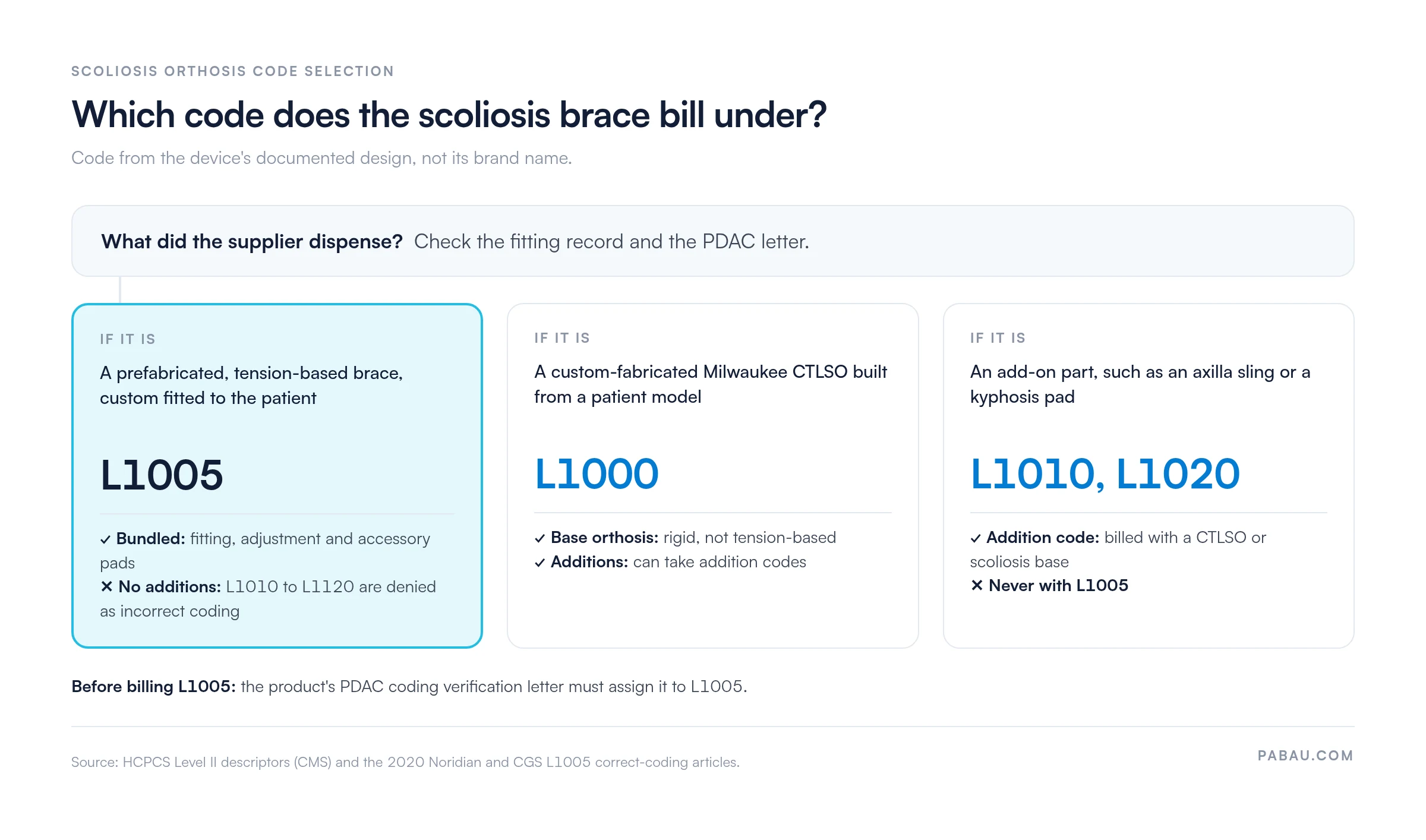
Two features set L1005 apart: its tension-based mechanism and its prefabricated build. L1000 is a different device, a custom-fabricated Milwaukee-style cervical-thoracic-lumbar-sacral orthosis (CTLSO) made from a patient model. L1010 and L1020 are not braces at all, but additions to a CTLSO or scoliosis orthosis.
Document the brace’s mechanism and its prefabricated build in the fitting record before selecting L1005. Choosing a code from the device name alone, rather than its documented design, invites a post-payment audit. The diagram below maps each device type to its code.
No. L1005 is an HCPCS Level II code, not a CPT code. CPT codes are maintained by the American Medical Association (AMA) and describe physician and facility procedures using a five-digit numeric format.
HCPCS Level II codes are maintained by CMS and use an alphanumeric format (one letter followed by four digits). They describe supplies, equipment, orthotics, prosthetics, and other items not covered by CPT.
The difference matters for claim submission. CPT codes are reported on CMS-1500 claims for physician services. A DMEPOS supplier reports L1005, typically also on the CMS-1500 form, under its own supplier number and the DMEPOS benefit.
Billers who search for a “CPT code for a scoliosis brace” will not find L1005 in CPT reference databases. It lives in the HCPCS code library alongside the other L-code orthotics.
Medicare and most commercial payers require a supporting ICD-10-CM diagnosis code that establishes medical necessity for the scoliosis orthosis. The M41 chapter (scoliosis) contains the primary codes used with L1005.
The specific codes accepted depend on the applicable MAC Local Coverage Determination (LCD), which coders should verify for the current version before billing.
Verify the applicable LCD for the current covered diagnosis list. Some MACs specify minimum Cobb angle thresholds (typically 20 to 45 degrees for bracing) as part of the coverage criteria. The diagnosis code alone does not establish medical necessity without that clinical documentation.
L1005 is reimbursed under the Medicare DMEPOS benefit when the ordering physician documents medical necessity and the DMEPOS supplier meets applicable coverage criteria.
Per guidance from CGS Administrators (Jurisdiction B DME MAC), suppliers must verify the applicable Local Coverage Determination before submitting.
Coverage policy is jurisdiction-specific, which is central to medical billing compliance across MACs. Coders working across several geographic areas must confirm which MAC governs each claim.
Key Medicare coverage requirements include:
Medicare does not currently run a blanket prior authorization program for L1005 across all jurisdictions. Individual MACs may still require prior authorization in specific circumstances. Suppliers should verify the current prior authorization status for their MAC jurisdiction before assuming no preauthorization is needed.
The Pricing, Data Analysis and Coding (PDAC) contractor, operating under CMS, issues coding verification letters for DMEPOS products submitted by manufacturers.
A PDAC coding verification letter confirms that a specific manufacturer’s product meets the HCPCS code descriptor requirements. For L1005 claims, PDAC verification applies to individual products, not to the code category as a whole.
A DMEPOS supplier billing L1005 should confirm that the orthosis being dispensed has a valid PDAC coding verification letter. That letter must assign it to L1005.
Billing L1005 for a product without PDAC verification creates audit exposure. Manufacturers submit products to PDAC for review, so ask the manufacturer for a copy of the letter before stocking the device.
Before ordering stock of any tension-based scoliosis orthosis, ask the manufacturer for the current PDAC coding verification letter. Verify that the letter explicitly lists L1005 as the assigned code, not a related L-code. Keep a copy on file with each patient’s dispensing record. Auditors routinely request PDAC documentation alongside the physician order and fitting record.
Modifier selection is the most consequential coding decision on an L1005 claim after code selection itself. The table below covers the modifiers Medicare requires or permits for DMEPOS orthotic claims, including their specific triggers and denial consequences.
For most L1005 claims where coverage criteria are met, the claim will carry both KX and NU (for a new device sold to the beneficiary). Billing KX without the clinical documentation to support it creates audit liability even if the claim initially pays.
The Medicare DMEPOS fee schedule for L1005 is updated annually by CMS and varies by geographic jurisdiction. The CMS DMEPOS fee schedule publishes current allowables by HCPCS code and state. Rates differ between the contiguous United States, Alaska, Hawaii, and Puerto Rico.
Competitive Bidding Area (CBA) rates may also apply in some areas. For that reason, the table below describes rate types rather than fixed dollar amounts.
Always retrieve the current allowable directly from CMS before quoting a patient their Medicare cost-sharing amount. Annual updates take effect on January 1, and rates published in prior-year fee schedules may understate or overstate the current allowable.
L1005 denials cluster around six preventable errors, each with its own root cause and fix. For DMEPOS codes like L1005, denial management starts before the claim goes out, while the documentation can still be corrected.
Strong pre-submission documentation is the difference between a first-pass payment and an ADR (additional documentation request) that ties up cash for weeks.
The checklist below reflects the documentation standards in MAC correct-coding articles from Noridian and CGS. It is consistent with medical billing fundamentals for DMEPOS orthotics. Checking for a clean claim before submission keeps the claim out of the denial cycle.
Build a pre-submission checklist specific to L1005 and run every claim through it before the batch goes out. Give each of the six documentation elements above a checkbox. They are the physician order, Cobb angle notes, PDAC letter, fitting record, ABN where applicable, and proof of delivery. A claim missing any one of these will generate an ADR or an outright denial. Five minutes of pre-submission review prevents weeks of follow-up.
Without one system, L1005 paperwork is spread across a billing tool, a shared drive, and the clearinghouse portal. A missing authorization number or a mistyped field often surfaces only when the claim comes back rejected.
Pabau’s claims management software raises each claim from the patient’s invoice, so the CMS-1500 starts pre-filled. Claim validation then checks it for missing or invalid details before it goes to Claim.MD, Pabau’s US clearinghouse connection.
Where a payer requires prior authorization, Pabau stores it as a case attached to the appointment, and the code follows the appointment to the claim. A claim still missing a code is flagged “Assign case”. Eligibility checks run before the visit, so coverage problems show up before the brace is dispensed.
Each claim then moves through one dashboard from Pending to Paid. A rejected claim is flagged Needs action, with a link to the field that needs correcting, so your team can resubmit the same day.
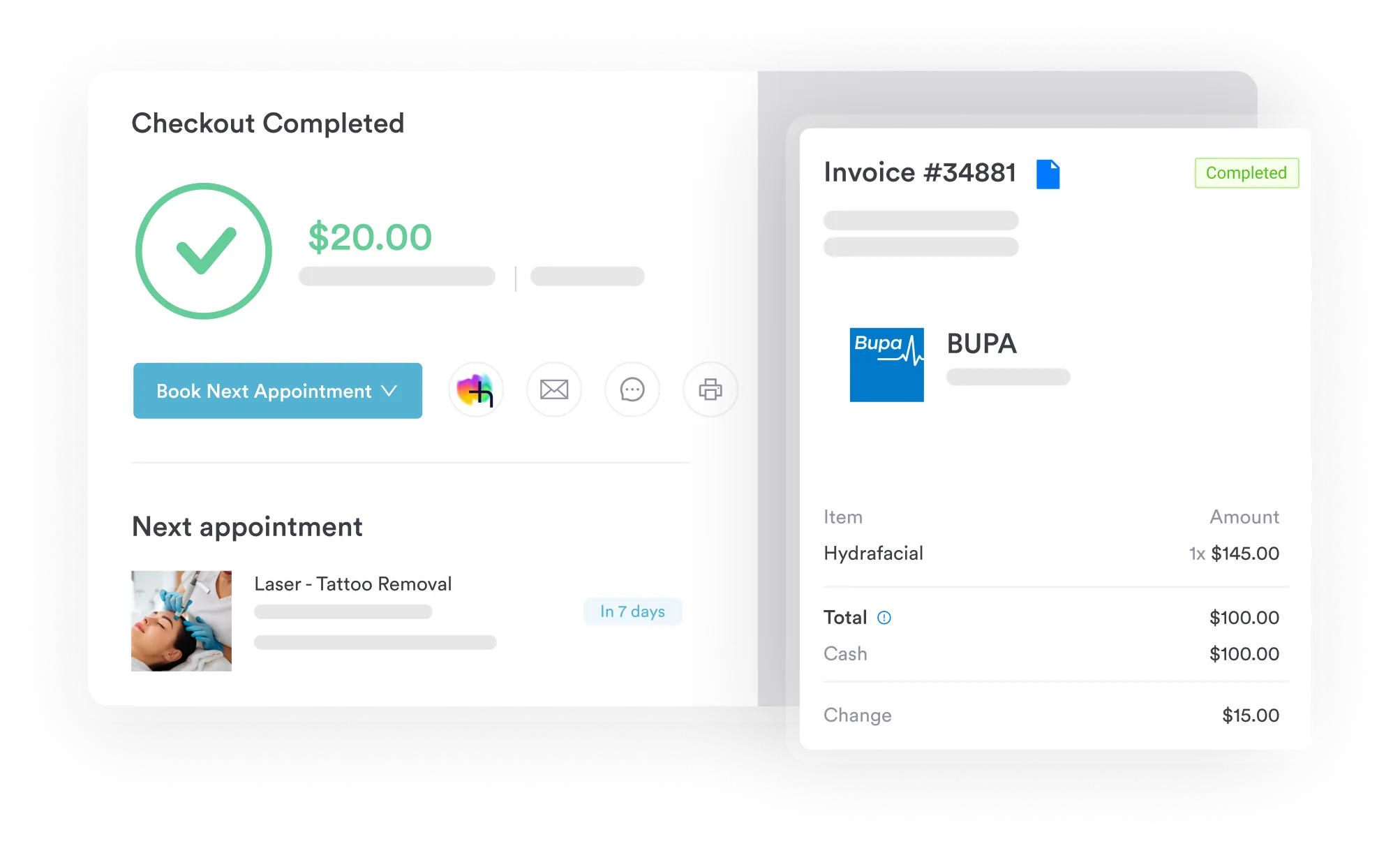

Pabau raises each L1005 claim from the patient’s invoice and validates it before it reaches your clearinghouse. Prior authorization codes and eligibility checks sit in the same workflow.

Treat L1005 as a closed package. Code it from the PDAC letter and the documented design, not the brace’s brand name, and keep every addition code off the claim.
Then hold each claim until the six documentation items are in the file. That check costs minutes per patient, while an ADR on an orthosis can hold payment for weeks.
The trade-off is speed at dispensing. A brace fitted before the written order exists can’t be billed under L1005, however well it fits. Book a demo to see how Pabau validates each L1005 claim and tracks it to payment in one dashboard.

Need help with DMEPOS denial patterns? Denial codes in medical billing breaks down the most common CARC and RARC denial codes that appear on DMEPOS remittances.
Want to reduce claim rework across your practice? Revenue cycle management explained covers the end-to-end RCM workflow for healthcare practices including DMEPOS suppliers.
Billing orthotics alongside other HCPCS codes? How to create a superbill covers superbill structure, HCPCS code entry, and how to export to a CMS-1500 format.
Billing a pad on a custom-fabricated base? HCPCS code L1060 covers the thoracic pad addition to a CTLSO or scoliosis orthosis.
Adding a cover to a scoliosis brace upright? HCPCS code L1120 explains how the upright cover addition is coded and billed.
HCPCS Code L1005 covers a prefabricated, custom-fitted, tension-based scoliosis orthosis, including fitting, adjustment, and accessory pads. It is a complete product, so no addition codes can be billed with it. It is an HCPCS Level II code under the DMEPOS benefit. Enrolled DMEPOS suppliers bill it, not the ordering physician.
L1005 is an HCPCS Level II code, not a CPT code. CPT codes use a five-digit numeric format and are maintained by the AMA. HCPCS Level II codes use an alphanumeric format (letter plus four digits). CMS maintains them for supplies, equipment, and orthotics not described in CPT.
L1005 is a prefabricated, tension-based scoliosis orthosis that the supplier custom fits. L1000 is a custom-fabricated Milwaukee-style CTLSO built from a patient model. The device’s mechanism and build, confirmed by its PDAC coding verification letter, decide which code applies. Additions such as L1010 go with custom-fabricated bases like L1000, never with L1005.
Yes. Fitting and adjustment are bundled into L1005 and cannot be billed as separate line items on the same claim. Both Noridian (Jurisdiction D DME MAC) and CGS (Jurisdiction B DME MAC) published correct-coding articles confirming this bundling rule. Separate fitting charges are denied as incorrect coding (unbundling).
The M41 chapter codes (idiopathic, neuromuscular, and secondary scoliosis) are the primary supporting diagnoses for L1005 claims. Congenital scoliosis is coded Q67.5, or Q76.3 when a vertebral bony malformation causes it. The specific codes accepted depend on the applicable MAC LCD, and minimum Cobb angle thresholds may apply as a coverage criterion. Always verify the current LCD before billing.
The KX modifier is required when LCD coverage criteria are met and documented. GA is used when criteria are not met but a signed ABN is on file. GZ applies when the item is expected to be denied and no ABN was issued. NU indicates new equipment (purchase); RR indicates rental. Most L1005 purchase claims will carry both KX and NU.
PDAC coding verification applies to specific manufacturer products billed under L1005, not to the code category as a whole. Each product must obtain its own PDAC coding verification letter confirming the device meets the L1005 descriptor. Dispensing and billing a product without a valid PDAC letter creates audit risk. Request the letter from the manufacturer before stocking the device.