CCSD code G5100: Bypass of duodenum billing guide
CCSD code G5100 bills a bypass that leaves the duodenum in place CCSD code G5100...

Last Updated: Oct 16, 2026
L0631 is the HCPCS Level II code for a lumbar-sacral orthosis (LSO) with sagittal control and rigid anterior and posterior panels. The posterior panel runs from the sacrococcygeal junction to T-9, and the brace uses intracavitary pressure to reduce load on the intervertebral discs.
L0631 is a prefabricated brace that an individual with expertise has trimmed, bent, molded, or otherwise customized to fit the patient. Bill L0648 when it is dispensed off the shelf and L0632 when it is custom-fabricated. Medicare has required prior authorization for L0631 nationwide since August 12, 2024.
Let Pabau's smart automation suggest the right codes, reduce claim denials, and keep your practice compliant—effortlessly.
Automate repetitive tasks and focus on what matters most—your patients.
Reduce coding errors and ensure compliance with the latest regulations.
Clean claims, fewer denials, and faster reimbursements.
Powerful insights and reporting to help your practice thrive.
HIPAA compliant SOC 2 certified GDPR-compliant Trusted by 4,000+ clinics worldwide

HCPCS code L0631 covers a prefabricated lumbar-sacral orthosis with rigid anterior and posterior panels, customized to fit the patient by an individual with expertise.
Bill L0648 when the same brace is dispensed off the shelf, L0632 when it is custom-fabricated, and L0630 when only the posterior panel is rigid.
Medicare has required prior authorization for L0631 nationwide since August 12, 2024, so confirm the current rules with your DME MAC before delivery.
A Medicare claim needs a standard written order, medical records that support the LCD criteria, the prior authorization tracking number, and proof of delivery.
Pabau’s claims management keeps the order, clinical notes, and delivery record on one patient file, so each L0631 claim matches its documentation.
HCPCS code L0631 is the Level II code for a lumbar-sacral orthosis (LSO) that limits flexion and extension with rigid anterior and posterior panels. It describes a prefabricated brace that an individual with expertise trims, bends, molds, assembles, or otherwise customizes to fit one patient.
That fitting step is what makes the brace L0631. The same brace handed over without substantial modification is L0648, its off-the-shelf counterpart. A brace built from scratch for the patient is L0632, the custom-fabricated version.
Medicare covers L0631 under the DMEPOS benefit and the Spinal Orthoses LCD (L33790). The code has also been on the CMS Required Prior Authorization List nationwide since August 12, 2024.
The official CMS HCPCS Level II code set describes L0631 by anatomy, function, and how the brace reaches the patient. Each part of the descriptor should be traceable to the product you dispense and the notes in the patient’s file.
Three questions separate L0631 from its neighbors. Which panels are rigid? Does the brace control the sagittal plane only, or the coronal plane as well? And did it reach the patient off the shelf, customized to fit, or custom-fabricated? The table below uses the official CMS descriptors.
L0631, L0632 and L0648 describe the same brace design. The difference lies in what happened to it before delivery:
The panels decide the branch before any of that. If only the posterior panel is rigid, the customized brace is L0630 instead. The diagram below runs both questions in order.
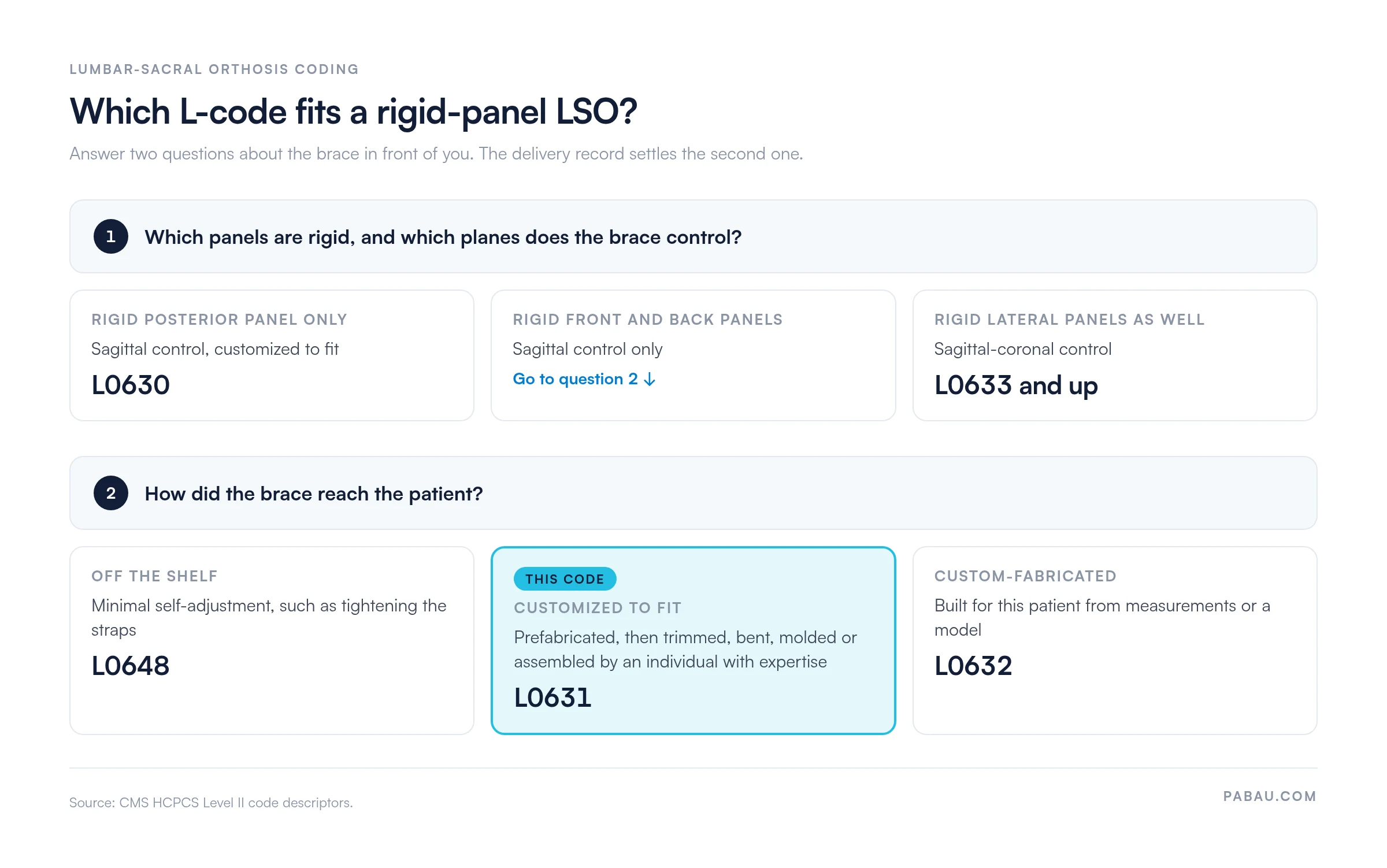
Code from the delivery record, not the order. A prescription for an “LSO with rigid panels” fits L0631, L0632 and L0648 alike. Only the notes from the day of delivery show whether the brace was customized, fabricated, or handed over off the shelf.
Medicare covers an LSO billed with L0631 when the patient’s records show it is reasonable and necessary under the Spinal Orthoses LCD (L33790). The LCD recognizes four uses for a spinal orthosis:
Commercial and Medicaid plans set their own criteria, and many add a trial of conservative care. Read the plan’s current orthotics policy before delivery, because coverage rules for this code vary from one payer to the next.
The diagnosis codes below often appear on LSO claims. The list is illustrative, not a covered-diagnosis list. Medical necessity rests on the clinical notes, so the diagnosis alone does not establish coverage.
Since August 12, 2024, L0631 has been on the CMS Required Prior Authorization List for DMEPOS in every state. Before you deliver the brace to a Medicare beneficiary, request a decision from your DME MAC. Program rules change, so confirm the current requirement with your DME MAC each time.
Running insurance eligibility verification and checking authorization status before every LSO delivery prevents the most common technical denial. That denial comes from dispensing the brace before a decision is on file.
Thin documentation is behind most L0631 denials and audit findings. Keep each of the following in the patient’s file before the claim goes out:
If the payer requires a letter of medical necessity or its own form, add it to the same file. Organized medical billing compliance workflows put these records in place at delivery, rather than leaving staff to chase them once an audit request arrives.
Medicare pays L0631 under the CMS DMEPOS fee schedule, which CMS updates each year and publishes by state. Look up the current allowed amount in the CMS file for your state. Third-party rate sites often carry last year’s figures after the January update.
Modifiers on an L0631 claim describe the claim’s circumstances, such as a replacement or an ABN on file. None of them tells Medicare how the brace was made, because the code itself carries that information. Confirm each requirement with your DME MAC or payer.
The AAPC HCPCS code reference lists modifier cross-references for the L-code range. The DME MAC’s instructions remain the authority for Medicare claims.
L0631 denials trace back to a short list of causes, and each one can be caught before the claim goes out. The payer reports them with standard denial codes on the remittance advice. Effective denial management in healthcare starts with a pre-claim review, so use the table below as a checklist.
Commercial insurers and Medicaid programs handle HCPCS code L0631 differently from Medicare. Check these points before you submit:
If your practice is new to DME claims, settle how it handles assignment before the first delivery. Assignment decides how much of the bill the patient can be asked to pay.
Most L0631 coding errors happen before anyone opens the claim. The order says “rigid LSO”, the fitter’s notes sit in one place, and the authorization letter sits in another. So the biller codes from the prescription, and L0648, L0631 and L0632 blur together.
Pabau’s practice software keeps the written order, fitting notes, authorization reference, and signed delivery record on one patient file. Its claims management software pulls those details into the claim, so nobody rekeys them. In the US, Pabau’s Claim.MD integration submits and tracks claims.
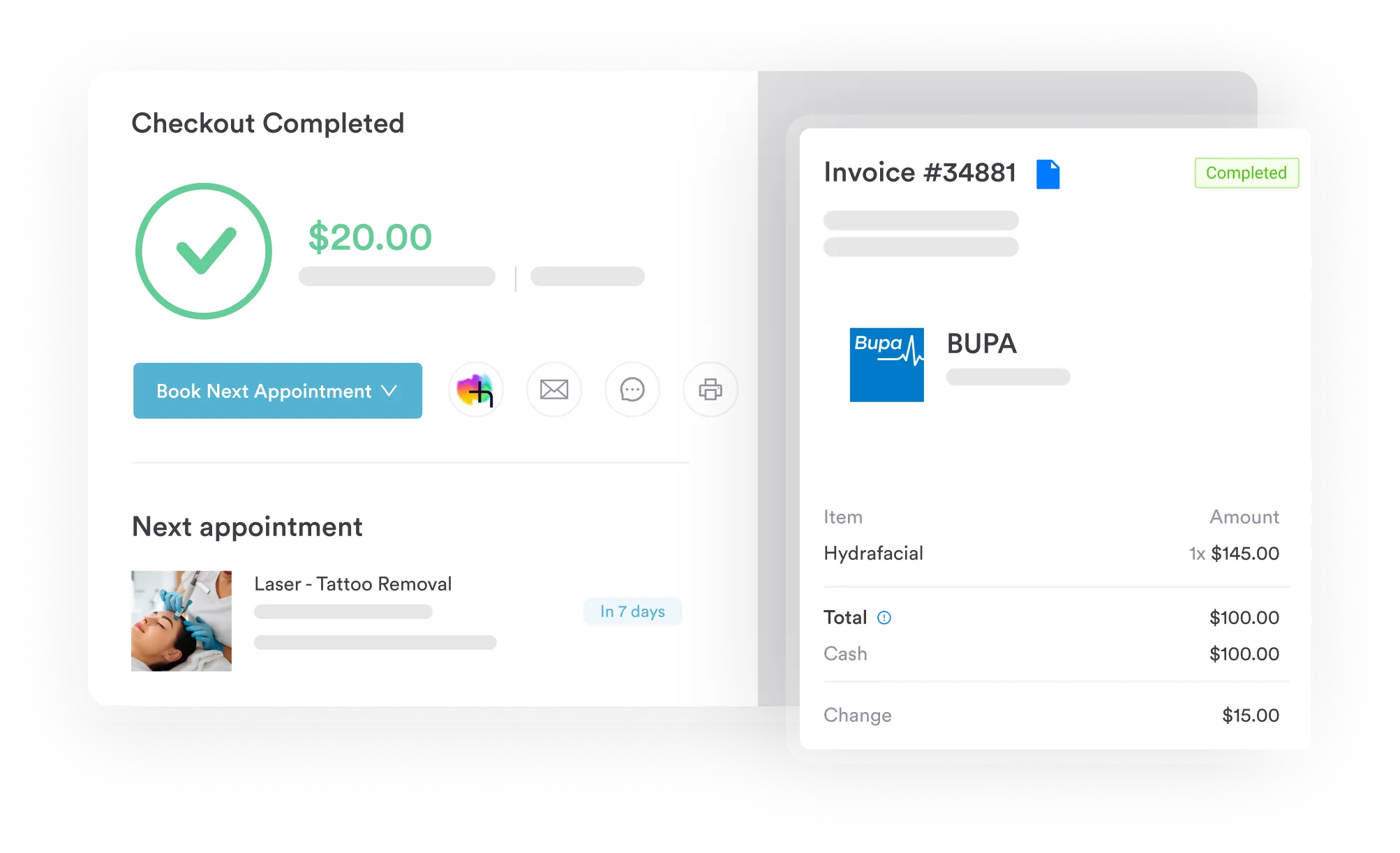
The result is a claim that matches its file. When a reviewer asks how the brace was supplied, the delivery notes sit next to the order and the UTN. Claim status tracking shows which claims came back denied, so staff can fix a repeat problem at intake.

Pabau keeps the order, authorization, and delivery record for every LSO claim on one patient file. Each L0631 claim then matches its documentation before it reaches the payer.

Treat L0631 as a statement about how the brace reached the patient. The same rigid-panel LSO can be L0648, L0631 or L0632, and only the delivery record settles which. If nobody substantially modified it to fit, L0631 is the wrong code.
Prior authorization raises the stakes. Medicare checks the file before delivery, so a brace coded from the prescription can fail before it ever ships. Settle the code, the order and the medical records first, then request the decision.
Book a demo to see how Pabau keeps the order, authorization and delivery record for each L0631 claim on one patient file.

Need to understand how clean claims reduce DMEPOS denials? Clean claim best practices walks through the documentation and coding steps that keep LSO claims from returning.
Working through a denial on a spinal orthosis claim? Denial codes in medical billing explains the most common CARC codes and how to route appeals correctly.
Evaluating billing software for your DME or orthopedic practice? Best medical billing software in the US compares the leading platforms by specialty and billing volume.
HCPCS code L0631 covers a lumbar-sacral orthosis with sagittal control and rigid anterior and posterior panels. The posterior panel runs from the sacrococcygeal junction to T-9. It is a prefabricated brace that an individual with expertise has trimmed, bent, molded, assembled, or otherwise customized to fit the patient.
No. L0631 is a prefabricated brace that has been customized to fit a specific patient by an individual with expertise. The custom-fabricated version of the same brace is L0632, and the off-the-shelf version is L0648.
L0630 has a rigid posterior panel only, while L0631 has rigid anterior and posterior panels. Both codes provide sagittal control, and both describe a prefabricated brace customized to fit by an individual with expertise.
Yes. Since August 12, 2024, L0631 has been on the CMS Required Prior Authorization List nationwide. Request a decision from your DME MAC before delivery and put the UTN on the claim. Confirm the current rules with your DME MAC, because the program changes.
The Medicare allowed amount for L0631 is published in the annual CMS DMEPOS fee schedule and varies by state. Look up the current figure in the CMS file. Medicare pays 80% of the allowed amount after the Part B deductible, and the beneficiary owes the 20% coinsurance.
A Medicare claim needs a standard written order and medical records that support the LCD criteria. It also needs the prior authorization decision, the UTN, and a signed proof of delivery. Add an ABN when you expect a denial. Include any letter of medical necessity or form if the payer requires it.