HCPCS code K0802: Very heavy duty scooter billing guide
K0802 is the group 1 scooter for patients up to 600 pounds HCPCS code K0802 bill...

Last Updated: Nov 2, 2026
L0638 is the HCPCS Level II code for lumbar-sacral orthosis, sagittal-coronal control, with rigid anterior and posterior frame/panels, posterior extends from sacrococcygeal junction to t-9 vertebra, lateral strength provided by rigid lateral frame/panels, produces intracavitary pressure to reduce load on intervertebral discs, includes straps, closures, may include padding, shoulder straps, pendulous abdomen design, custom fabricated.
Coders often misassign L0638 to a prefabricated brace that was trimmed or molded to fit, which is L0637 territory and triggers a denial. This reference covers the descriptor, coverage criteria, documentation, prior authorization status and the most common denial scenarios for HCPCS code L0638.
Let Pabau's smart automation suggest the right codes, reduce claim denials, and keep your practice compliant—effortlessly.
Automate repetitive tasks and focus on what matters most—your patients.
Reduce coding errors and ensure compliance with the latest regulations.
Clean claims, fewer denials, and faster reimbursements.
Powerful insights and reporting to help your practice thrive.
HIPAA compliant SOC 2 certified GDPR-compliant Trusted by 4,000+ clinics worldwide

HCPCS code L0638 is a custom fabricated sagittal-coronal LSO, built for one patient from casts, tracings or measurements.
L0637 describes the same brace design as a prefabricated, custom-fitted device, so the way the brace was built decides the code.
L0638 needs a face-to-face visit and a signed written order before delivery, but it is not on the Medicare prior authorization list.
The practitioner’s records must explain why a prefabricated brace won’t work, and the orthotist’s evaluation must back that up.
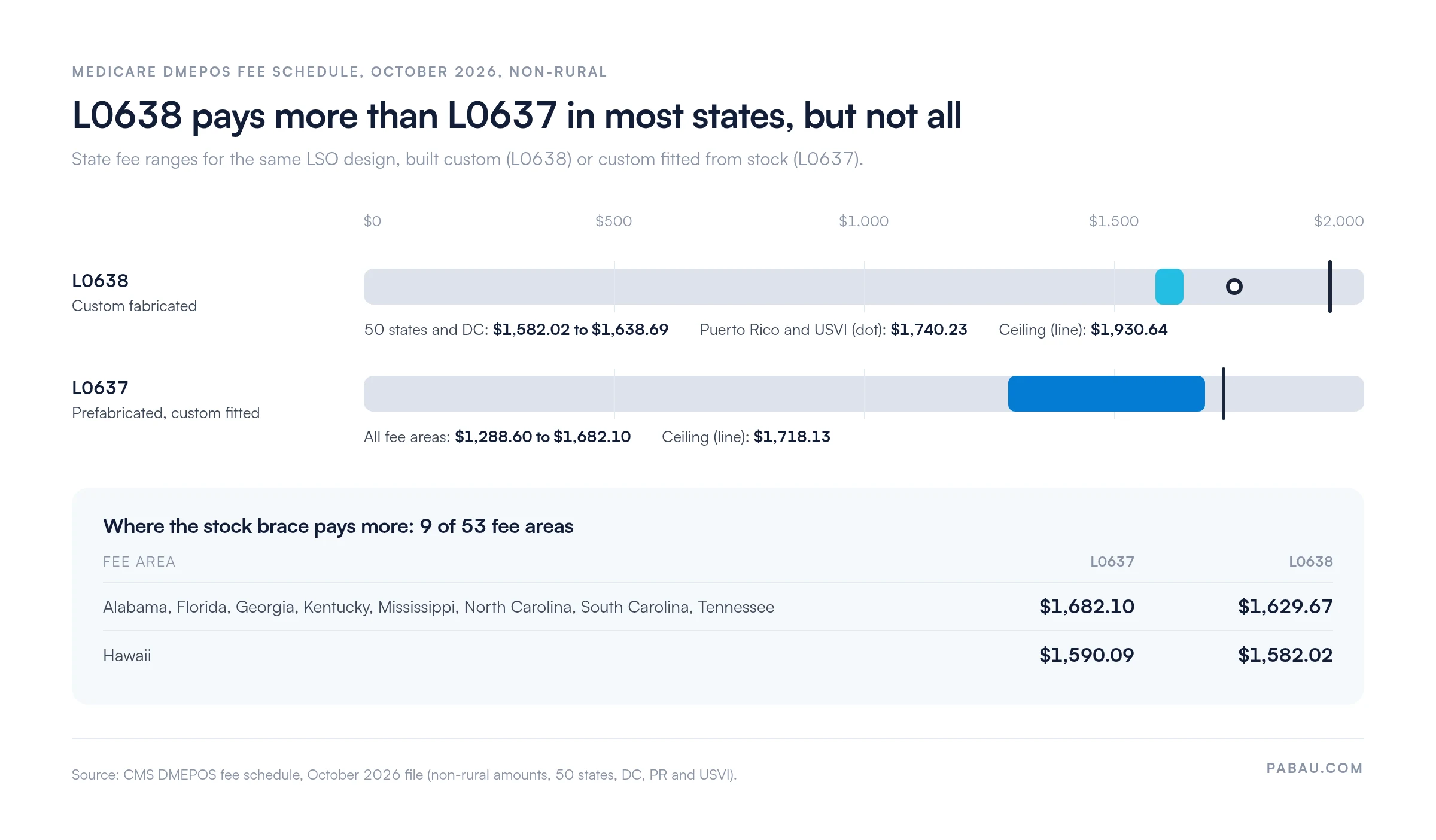
L0638 pays $1,582.02 to $1,638.69 across the 50 states and DC in the October 2026 fee schedule, though L0637 pays more in nine fee areas.
HCPCS code L0638 is the Level II code for a custom fabricated lumbar-sacral orthosis (LSO) with sagittal-coronal control. The brace limits bending forward, backward and to the side. It is made for one patient, starting from that patient’s casts, tracings or measurements.
The CMS descriptor spells out the build. Rigid anterior and posterior frames or panels hold the trunk, and the back section runs from the sacrococcygeal junction up to the T-9 vertebra. Rigid lateral panels add side strength, and the design produces intracavitary pressure to take load off the intervertebral discs.
Straps and closures are included, while padding, shoulder straps and a pendulous abdomen design are optional. Suppliers bill the brace to a DME MAC under Medicare Part B. Coverage follows LCD L33790 and Policy Article A52500 for spinal orthoses.
The closing phrase of the descriptor, “custom fabricated,” is where L0638 coding most often goes wrong.
L0637 and L0638 share almost every word of their descriptors. Both describe a sagittal-coronal LSO with rigid anterior, posterior and lateral panels that runs from the sacrococcygeal junction to T-9. The difference sits at the very end of each descriptor.
L0637 is a prefabricated brace that an individual with expertise trimmed, bent, molded or assembled to fit the patient. L0638 is custom fabricated. Policy Article A52500 defines a prefabricated orthosis as one made in quantity without a specific patient in mind, however much it is adjusted later.
Decision rule: Ask where the brace started. If it came out of a box in a stock size, bill L0637 when an expert customized it. Bill L0650 when the patient needed only minimal self-adjustment. If it started as this patient’s cast or measurements, bill L0638.
Picture a patient recovering from lumbar fusion whose trunk shape falls outside every size on the manufacturer’s chart. The orthotist measures and casts the patient, and the lab builds a sagittal-coronal brace to those measurements. That claim is L0638.
Now change one detail. The orthotist instead heats and reshapes the panels of a stock brace until it fits. However much work that took, the claim is L0637, and it needs an affirmed prior authorization before delivery.
The codes around L0638 run from soft off-the-shelf supports to a second custom build, and each step changes what the claim must prove. For orthoses outside this range, our HCPCS code library lists the other Level II codes.
LCD L33790 covers a spinal orthosis, including an LSO, when it is ordered for one of four reasons:
That gets a brace covered, but a custom fabricated brace needs one more layer. Policy Article A52500 requires detailed documentation in the treating practitioner’s records that supports the medical necessity of custom fabrication. The functional evaluation in the orthotist’s records must corroborate it.
So the note has to say what stops a prefabricated brace from working. Body dimensions outside standard sizing, a spinal deformity or a failed trial of a prefabricated LSO all make that case. A patient’s preference for a custom brace does not.
The spinal orthoses policy article publishes no list of covered ICD-10-CM codes. Coverage turns on the indication and the record, so the diagnosis supports the claim without deciding it. These codes often appear on LSO claims.
L0638 is on the CMS Required Face-to-Face Encounter and Written Order Prior to Delivery list. The treating practitioner must see the patient within six months before writing the order. The supplier must then receive a signed standard written order (SWO) before the brace reaches the patient.
An order that arrives after delivery cannot be fixed with a later one. Good medical billing compliance for custom braces means the file is complete before the patient walks out wearing the device.
Get the signed order before you cast, not just before you deliver. A brace built for one patient can’t be resold, so a missing order leaves the supplier holding the cost.
Spinal orthoses don’t use a Certificate of Medical Necessity, so a CMN on file adds nothing to an L0638 claim.
With the paperwork rules set, here is the order of operations on a typical custom LSO claim.
A brace made from raw materials and handed over by the entity that made it doesn’t need the PDAC listing. Prior authorization never enters the sequence, because L0638 is not on the Medicare list.
Policy Article A52500 lists no required modifiers for spinal orthoses, so an L0638 claim does not need the KX modifier. The article’s CG modifier rule covers a short list of other codes, such as L0625, and not L0638.
Medicare prices L0638 on the DMEPOS fee schedule, which sets an amount by state. In the October 2026 file, the non-rural amount ran from $1,582.02 to $1,638.69 across the 50 states and DC. Puerto Rico and the US Virgin Islands sat at $1,740.23.
L0637 ranged from $1,288.60 to $1,682.10 in the same file, so the custom build does not pay more everywhere. L0638 out-earns L0637 in 44 of the 53 fee areas.
The other nine favor the stock brace. In Alabama, Florida, Georgia, Kentucky, Mississippi, North Carolina, South Carolina and Tennessee, L0637 pays $1,682.10 against $1,629.67. Hawaii pays $1,590.09 for L0637 and $1,582.02 for L0638.
Medicare pays 80% of the lower of your charge or the fee schedule amount once the Part B deductible is met. Pull the current quarter from the CMS DMEPOS fee schedule before you quote a patient.
Each denial below has a cause you can check before the claim leaves your office. Pair this table with your wider denial management process so the same error doesn’t repeat.
Audit risk follows the money. L0638 carries a higher fee ceiling than L0637, at $1,930.64 against $1,718.13 in October 2026. Billing a customized stock brace as L0638 is upcoding, and the fabrication records are what protect a legitimate claim.
If a claim is denied anyway, Medicare’s five appeal levels apply. Send the full record set with the first request, because a cover letter alone gives the reviewer nothing new to weigh.
Commercial plans bill the same HCPCS code but write their own coverage criteria, authorization rules and fee schedules. A file that clears Medicare can still be denied by a plan that wants authorization before casting.
Pull the plan’s spinal orthotics policy, not only its general DME policy. Then run insurance eligibility verification before you cast, since a brace built for one patient can’t be returned to stock.
Custom brace claims stall when the pieces live in different places. The order sits in an inbox, the cast notes in a folder and the delivery slip in a drawer. Pabau, our practice software for records and billing, keeps signed orders, forms and delivery notes on the patient’s record, beside their appointment history.
Pabau’s claims management software submits claims electronically through Claim.MD in the US. Your team then tracks each brace claim’s status in Pabau, from submission to payment. Code choice and modifiers stay with your billers, guided by the checklist above.

Pabau submits and tracks your brace claims, with signed orders, forms and delivery records kept on the patient file.

L0638 rewards suppliers who settle the code before the brace exists. If the brace starts from this patient’s measurements, the rest follows. Get the face-to-face note and the signed order first, and make sure the practitioner explains why stock sizing failed.
The trade-off is effort for certainty. A custom build takes longer than fitting an L0637, but it skips prior authorization and carries a higher fee ceiling. That only pays off when your fabrication records prove the code.
Book a demo to see how Pabau keeps brace claims submitted and tracked in one place.

Fitting a prefabricated brace instead? HCPCS code L0637 covers the custom-fitted version of this brace and its prior authorization rules.
Building a flexion-design LSO? HCPCS code L0636 explains the other custom fabricated sagittal-coronal LSO and when it applies.
Working through a denied DME claim? Denial codes in medical billing maps common CARC and RARC codes to their corrective actions.
Sending DME claims through a clearinghouse? How a medical claims clearinghouse works explains the submission path from supplier to payer.
Yes, if it is individually made for one patient from that patient’s scan, cast or measurements. Policy Article A52500 says CAD/CAM or additive manufacturing alone does not make a product custom fabricated. The brace must still meet the custom fabricated definition.
A DMEPOS supplier with active Medicare enrollment and accreditation that covers spinal orthoses. The claim goes to the DME MAC for the patient’s state, not to the Part B contractor that processes the practitioner’s visit.
Yes, where the addition is not already in the descriptor. A52500 allows custom fabricated additions only on custom fabricated base orthoses, which L0638 is. Padding and shoulder straps are already part of L0638, so they are not billed separately.
No. L0638 describes a rigid, custom fabricated brace. A flexible prefabricated lumbar support is closer to L0625, so bill the code that matches the device you delivered.
It depends on the state. Medicaid programs set their own orthotics coverage, authorization and documentation rules, so check the state fee schedule and provider manual before casting.