HCPCS code K0552: Non-insulin infusion pump cartridge guide
HCPCS code K0552: Definition and code description HCPCS code K0552 describes sup...

Last Updated: Nov 23, 2026
HCPCS code L0633 is a custom-fitted lumbar-sacral orthosis (LSO) with sagittal-coronal control. Its rigid posterior frame runs from the sacrococcygeal junction to T-9, and rigid lateral panels add side-to-side strength. The brace applies intracavitary pressure to reduce the load on the intervertebral discs.
L0633 starts as a prefabricated brace that an orthotist or other trained fitter trims, bends, molds or assembles to fit one patient. That fitting work separates it from L0649, the off-the-shelf version, and from L0634, which is custom fabricated from raw materials.
Let Pabau's smart automation suggest the right codes, reduce claim denials, and keep your practice compliant—effortlessly.
Automate repetitive tasks and focus on what matters most—your patients.
Reduce coding errors and ensure compliance with the latest regulations.
Clean claims, fewer denials, and faster reimbursements.
Powerful insights and reporting to help your practice thrive.
HIPAA compliant SOC 2 certified GDPR-compliant Trusted by 4,000+ clinics worldwide

HCPCS code L0633 is a prefabricated sagittal-coronal LSO that a trained fitter customizes to one patient, so it is custom fitted, not custom fabricated.
If the brace needs only minimal self-adjustment at delivery, bill L0649, its off-the-shelf twin, instead of L0633.
L0634 is the custom-fabricated version of the same design, and it needs records showing why a prefabricated brace won’t do.
An L0633 claim rests on a PDAC-listed product, a standard written order, an LCD indication, fitting notes and proof of delivery.
L0633 isn’t on the CMS prior authorization list, so LCD L33790 and your DME MAC’s review rules set the bar.
HCPCS code L0633 is a lumbar-sacral orthosis (LSO) with sagittal-coronal control that a trained fitter customizes for one patient. CMS policy article A52500 lists it with the custom-fitted codes and pairs it with L0649, the off-the-shelf version of the same brace.
The brace starts life as a prefabricated product. At delivery, a certified orthotist or someone with specialized training trims, bends, molds or assembles it to fit. The fitting work is what earns the code.
Here’s the descriptor broken into the parts that matter when you bill it.
Start with the brace in front of you, not the order. L0633 fits when the brace meets all five of these conditions:
Any one of these points you to a different code:
Rigid LSO codes come in sets. Each design has a custom-fitted code, a custom-fabricated code and, in most cases, an off-the-shelf code. Once you know the design, the fitting decides the column.
The custom-fitted and off-the-shelf pairings come from the corresponding code sets in A52500; the custom-fabricated codes sit in its separate custom-fabricated list.
Two comparisons cause most of the trouble, and the diagram below shows how delivery settles both.
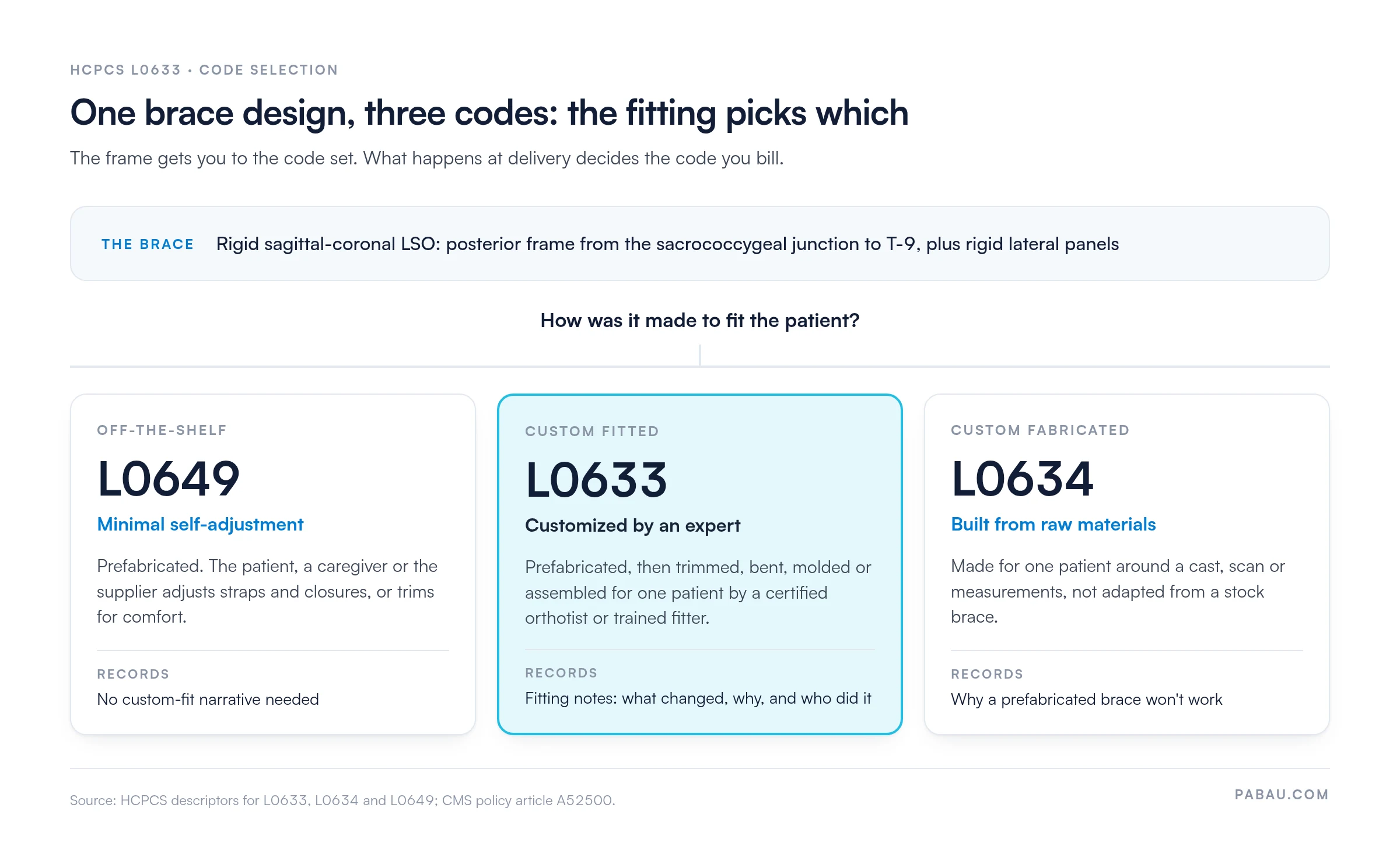
These two describe an identical brace. The difference is what happens at delivery. If the patient, a caregiver or the supplier gets a good fit by adjusting straps or trimming for comfort, it’s L0649.
If the fit needs an orthotist’s skill, it’s L0633. Your notes then have to say what was changed and why.
L0634 is the same design built for one patient from raw materials. The treating practitioner’s records must explain why a prefabricated brace won’t work. If a manufacturer or central fabrication facility made it, the product also needs a PDAC listing.
LCD L33790 covers a spinal orthosis when it’s ordered for one of four purposes:
Because the LCD works on purposes, a diagnosis code alone won’t carry the claim. The treating practitioner’s notes need to show which purpose applies and why this patient needs a rigid LSO.
Code each diagnosis to its full length, too. M48.06 isn’t billable on its own, so lumbar stenosis goes to M48.061 or M48.062. And M51.16 is a lumbar disc disorder with radiculopathy, not degenerative disc disease. Check the current LCD and A52500 before you lean on any code list.
Paperwork decides most LSO audits. In the 2024 reporting period, the LSO improper payment rate was 54.4%. Insufficient documentation drove 64.4% of those errors, according to the CMS spinal orthoses compliance tips.
Run this before-you-submit checklist on every L0633 claim. It’s the core of medical billing compliance for custom-fitted orthoses.
L0633 isn’t on the CMS list that requires a face-to-face encounter and a written order prior to delivery. That list covers L0631, L0635 through L0640, L0648, L0650 and L0651. Your DME MAC can still request every record above in a review.
With the file in place, the claim itself follows a predictable path. Here’s the walkthrough most suppliers use.
A patient arrives with an order for a rigid LSO after a stable lumbar compression fracture. The supplier stocks a sagittal-coronal brace with a rigid posterior frame and lateral panels.
In the first version, the patient tightens the straps and the brace sits well. That’s L0649, and the custom-fit narrative isn’t needed.
In the second, a long torso and a prominent iliac crest mean the orthotist heat-molds the posterior panel and trims both lateral panels. That’s L0633. The fitting note reads: “Posterior panel heat-molded to lumbar lordosis; lateral panels trimmed 2 cm at the iliac crest to relieve pressure.”
Most L0633 denials trace back to one of the seven errors below, each with its fix. Denial management goes faster when you can name the error before you appeal.
When a denial lands, read the remark codes on the remittance first. Our guide to denial codes in medical billing maps the common ones to their causes. Redetermination requests go to the DME MAC within 120 days of the initial determination.
Modifier advice for this code is often copied from other DME items. Here’s what holds up.
Is KX required on L0633? Not under any CMS source we checked. Neither A52500 nor the CMS spinal orthoses guidance calls for it. Follow LCD L33790 and your DME MAC’s current instructions.
What does KF mean? KF marks an item the FDA designates as a Class III device. It isn’t a supplier accreditation modifier.
When do GA and GZ apply? GA shows a valid Advance Beneficiary Notice is on file for an item you expect Medicare to deny. GZ shows you expect a denial and have no signed notice.
Do I need a Certificate of Medical Necessity? No. Spinal orthoses don’t use one. The order, the medical record, the fitting notes and proof of delivery carry the claim.
Medicare pays L0633 from the DMEPOS fee schedule, which CMS updates each January and publishes by state. Pull the current amount from the CMS DMEPOS fee schedule rather than an old remittance. The patient owes 20% coinsurance once the Part B deductible is met.
On an L0633 claim, a missing fitting note or an unsigned delivery record causes more trouble than the code itself. Paper files and shared drives make both easy to lose between the fitting room and the billing desk.
Pabau, a practice management platform with built-in billing, keeps the order, fitting notes and proof of delivery on the patient record. Digital forms capture the patient’s signature on the day of delivery, so the record is complete before the brace leaves.
For US practices, Pabau’s claims management software sends claims through Claim.MD and brings ERA remittances back to the record. When a denial arrives, it sits beside the paperwork you need to answer it.
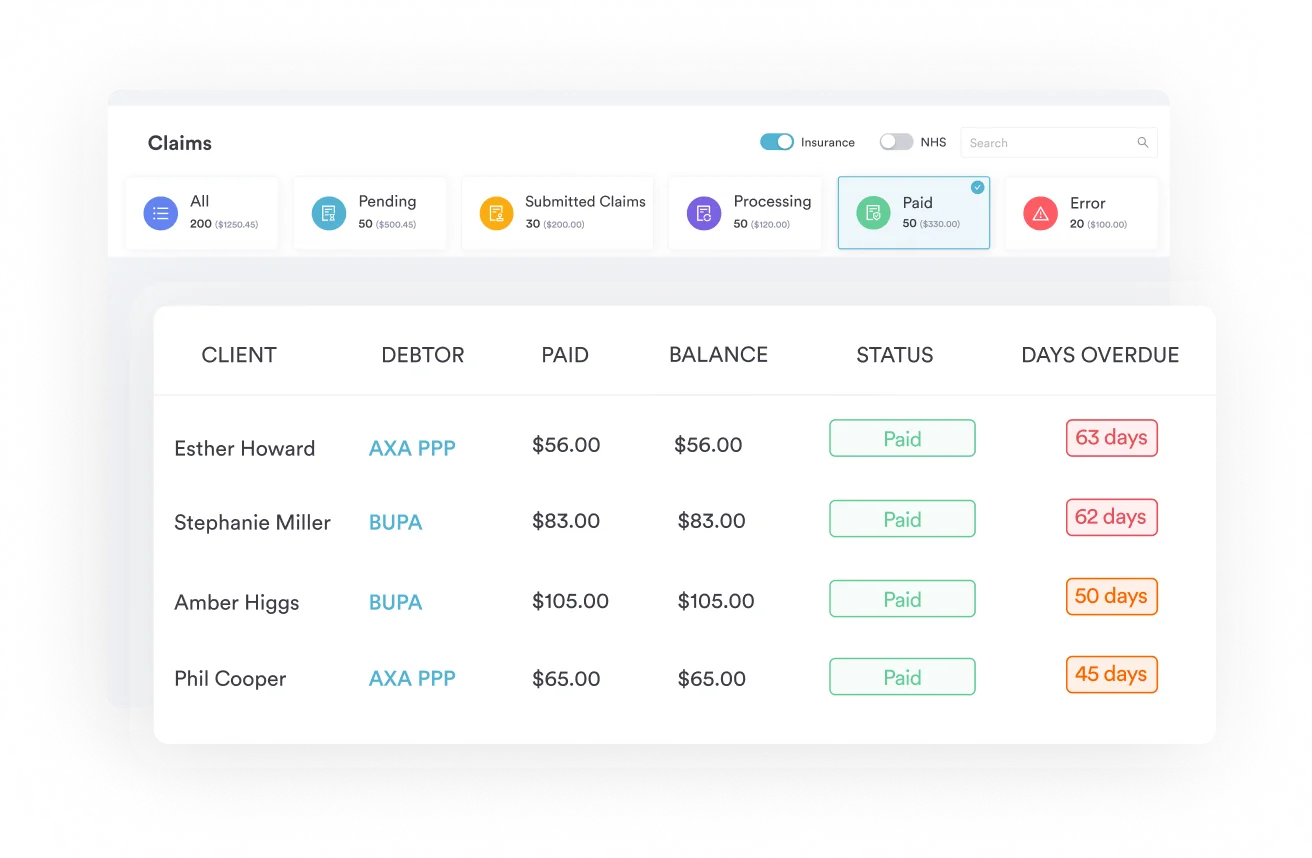

Pabau keeps orders, fitting notes and delivery signatures on the patient record, and brings each claim’s remittance back to the same place.

L0633 turns on one moment: delivery. The brace design gets you to the right family of codes, but the fitting decides between L0633 and L0649.
If you change one habit, make it the fitting note. Write what changed and why on the day, and check the PDAC listing before the brace leaves the shelf. Those two steps answer most of what a reviewer will ask.
Book a demo to see how Pabau keeps orders, fitting notes and delivery records together for every brace you bill.

Fitting came down to straps and closures? HCPCS code L0649 covers the off-the-shelf version of this brace.
Building the brace from a cast or scan? HCPCS code L0634 explains the custom-fabricated version and its records.
Rigid panels front and back? HCPCS code L0637 covers that design, which needs prior authorization.
Chasing too many DME denials? Denial management in healthcare sets out the workflow that cuts rework and write-offs.
New to the billing side? What is medical billing walks through the revenue cycle from encounter to payment.
Yes. Fitting and adjustment at delivery are part of the L0633 allowance. You can’t bill the orthotist’s fitting time as a separate line.
It’s a purchase. Medicare pays orthoses as a one-time payment, not as a monthly rental.
Medicare expects DMEPOS items to last their reasonable useful lifetime, generally five years. An earlier replacement needs a documented reason, such as loss, theft, irreparable damage or a change in the patient’s condition.
They must cover what Original Medicare covers, but they can set their own prior authorization and network rules. Check the plan’s policy before you dispense.