Pabau Engage inbox

Pabau Engage is here: every patient conversation in one inbox.

Learn more
HCPCS Code

HCPCS code L0643 – Lumbar-sacral orthosis with sagittal control


Code Definition

L0643 is the HCPCS Level II code for a prefabricated, off-the-shelf lumbar-sacral orthosis (LSO) with sagittal control and rigid posterior panel(s). The posterior panel runs from the sacrococcygeal junction to the T-9 vertebra and produces intracavitary pressure to reduce load on the intervertebral discs.

DMEPOS suppliers use HCPCS Code L0643 to bill Medicare and other payers for a stock back brace that needs only minimal self-adjustment at delivery. If a trained fitter has to do more, the same brace is billed as L0630. A brace with rigid anterior and posterior panels is billed as L0648, and coronal control starts at L0649.

Level
Level II
Category
L — Orthotic procedures and devices
Code range
L0643-L0651 Lumbar-sacral orthotics
Billable
No
Code also known as
LSO brace, lumbosacral brace, lumbar sacral brace, off-the-shelf LSO, rigid LSO
Save time. Improve accuracy. Get paid faster.
Automate coding with Pabau

Let Pabau's smart automation suggest the right codes, reduce claim denials, and keep your practice compliant—effortlessly.

  • AI-powered code suggestions
  • Real-time compliance checks
  • Faster claims, fewer denials
Why practices choose Pabau
Save hours every week

Automate repetitive tasks and focus on what matters most—your patients.

Improve accuracy

Reduce coding errors and ensure compliance with the latest regulations.

Get paid faster

Clean claims, fewer denials, and faster reimbursements.

Grow with confidence

Powerful insights and reporting to help your practice thrive.

HIPAA compliant SOC 2 certified GDPR-compliant Trusted by 4,000+ clinics worldwide

Key takeaways

Key takeaways

HCPCS Code L0643 is for a prefabricated, off-the-shelf LSO with sagittal control and rigid posterior panel(s), fitted with only minimal self-adjustment.

If the same brace needs more than minimal adjustment by a trained fitter, bill L0630. A rigid anterior panel means L0648, and coronal control starts at L0649.

Medicare pays only for models on the PDAC list for L0643, backed by a Standard Written Order, an LCD-supported medical record, and proof of delivery.

Pabau’s claims management software helps DMEPOS-affiliated practices track L0643 documentation, submit clean claims, and manage denials in one workflow.

HCPCS Code L0643: Official descriptor and code definition

HCPCS Code L0643 is the billing code for a prefabricated, off-the-shelf lumbar-sacral orthosis (LSO) with sagittal control and rigid posterior panel(s).

The posterior panel extends from the sacrococcygeal junction to the T-9 vertebra. The brace produces intracavitary pressure to reduce load on the intervertebral discs. Straps and closures are part of the item, and it may include padding, stays, shoulder straps, and a pendulous abdomen design.

HCPCS Code L0643 sits within the orthotics L-code range maintained by the Centers for Medicare and Medicaid Services (CMS). L-codes cover orthotic devices from spinal braces to limb supports, and the L06xx subset covers lumbar and lumbar-sacral orthoses specifically. Neighboring orthotic codes are in our library of HCPCS codes for suppliers.

Medicare also limits L0643 to brace models that its Pricing, Data Analysis and Coding (PDAC) contractor has reviewed and listed under the code.

Qualifying device specifications for HCPCS Code L0643

A brace must meet all five of the following criteria to qualify under L0643. Missing any one of them routes the claim to a different code or to a denial.

  • Lumbar-sacral coverage: The posterior panel must run from the sacrococcygeal junction to the T-9 vertebra. A brace whose posterior covers only L-1 to below L-5 is a lumbar orthosis, not an LSO.
  • Sagittal control: The brace limits flexion and extension. It has no rigid lateral frame or panels, so it provides no coronal (side-bending) control.
  • Rigid posterior panel(s): The rigid element sits at the back. A brace with rigid panels at both the front and the back is coded as L0648.
  • Off-the-shelf fit: The brace needs only minimal self-adjustment at delivery, such as adjusting straps and closures or bending and trimming for comfort. That adjustment does not require a certified orthotist or a fitter with specialized training.
  • Listed by the PDAC: The model must appear on the PDAC Product Classification List under L0643. That coding verification requirement has applied to L0643 since January 1, 2014.

If a trained fitter has to do more than minimal adjustment, the same brace is billed as L0630. Adding a rigid anterior panel moves the claim to L0648, and adding coronal control moves it into L0649–L0651. L0648, L0650, and L0651 also carry prior authorization and a face-to-face encounter requirement, which L0643 does not.

What L0643 excludes: Custom devices and scope limits

Each boundary below sends a brace that looks like an L0643 item to a different code. These are the points where claims most often land under the wrong one.

  • Custom-fitted braces: An L0643-type brace that needs more than minimal self-adjustment by an individual with expertise is billed as L0630. The policy article treats the two codes as the same item, separated only by the final fitting.
  • Custom-fabricated LSOs: A brace made for one patient from a cast, scan, or measurements takes a custom code such as L0632 or L0634. It is never billed as L0643.
  • Rigid anterior and posterior panels: A sagittal-control LSO with rigid panels at the front and back is L0648.
  • Coronal control: Rigid lateral frames or panels move the claim into L0649, L0650, or L0651.
  • Lumbar-only orthoses: A brace whose posterior runs from L-1 to below L-5 is a lumbar orthosis, such as L0641, not an LSO.
  • Thoracic control: Braces built to control the thoracic spine are thoracic-lumbar-sacral orthoses (TLSOs), billed in the L0450–L0492 range.

L0643 vs adjacent LSO codes: How to choose the right code

Lumbar-sacral orthoses are grouped by three variables: Control plane, panel design, and how the brace is made and fitted. The table below draws on the official HCPCS descriptors for the codes most often confused with L0643.

CodeControl planePanel designFabrication and fitKey differentiator
L0643SagittalRigid posterior panel(s)Prefabricated, off-the-shelfNeeds only minimal self-adjustment at delivery
L0630SagittalRigid posterior panel(s)Prefabricated, customized to fit by an individual with expertiseSame item as L0643, fitted with more than minimal adjustment
L0648SagittalRigid anterior and posterior panelsPrefabricated, off-the-shelfAdds a rigid anterior panel; prior authorization required
L0649Sagittal-coronalRigid posterior frame/panel(s) with rigid lateral frame/panelsPrefabricated, off-the-shelfThe first off-the-shelf LSO code with coronal control
L0650Sagittal-coronalRigid anterior and posterior frame/panel(s) with rigid lateral frame/panel(s)Prefabricated, off-the-shelfFront and back rigid panels plus lateral strength; prior authorization required
L0651Sagittal-coronalRigid shell(s)/panel(s); anterior extends from symphysis pubis to xiphoidPrefabricated, off-the-shelfOverlapping rigid shell design; prior authorization required
L0632SagittalRigid anterior and posterior panelsCustom fabricatedMade for one patient
L0634Sagittal-coronalRigid posterior frame/panel(s) with rigid lateral frame/panel(s)Custom fabricatedMade for one patient

The decision runs in three checks, shown in the path below. Start with the control plane. Sagittal only points to L0643, L0630, or L0648, while any coronal control points to L0649–L0651.

Next, check the panels. Rigid posterior panels alone stay with L0643, and rigid panels front and back mean L0648. Last, check the fitting. Minimal self-adjustment keeps the claim on L0643, and more than minimal adjustment by a trained fitter means L0630.
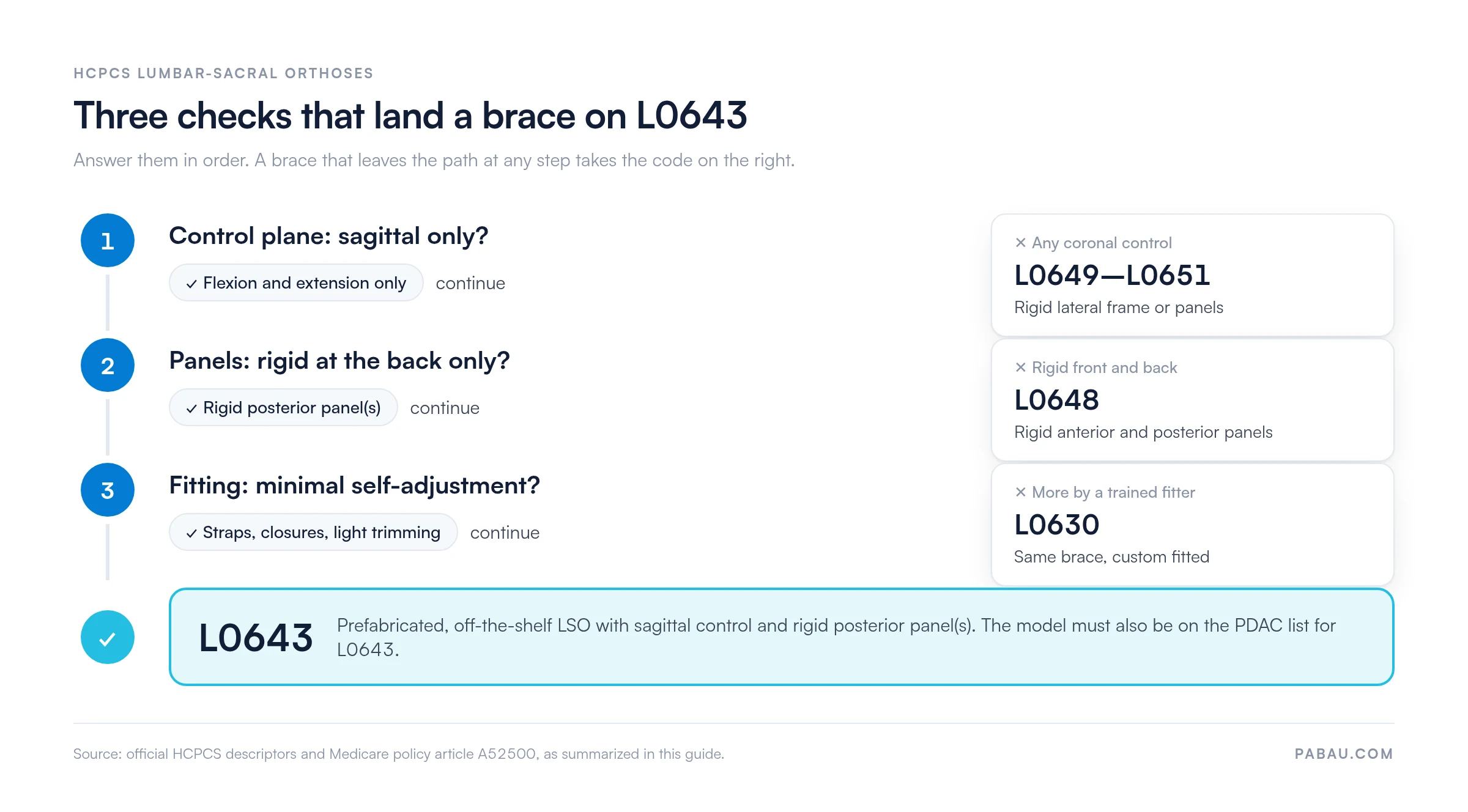
Decision path for lumbar-sacral orthosis codes: any coronal control goes to L0649 to L0651, rigid front and back panels go to L0648, more than minimal fitting by a trained fitter goes to L0630, and a sagittal-only brace with rigid posterior panels and minimal self-adjustment is L0643
A brace reaches L0643 only after passing all three checks, so each exit on the right is a common miscoding. Based on the official HCPCS descriptors and policy article A52500.

Medicare fee schedule for HCPCS Code L0643

L0643 Medicare reimbursement rates are set under the DMEPOS fee schedule, which CMS publishes each January and updates quarterly. Amounts are set by state, with separate rural and non-rural columns. For current figures, download the CMS DMEPOS fee schedule files and find the L0643 row for your state.

Fee schedule amountWhen it appliesHow to retrieve
Non-rural (NR)The beneficiary lives in a non-rural ZIP codeState non-rural column in the current DMEPOS fee schedule file
Rural (R)The beneficiary lives in a rural ZIP codeState rural column, after checking the ZIP against the DMEPOS rural ZIP code file
ReplacementThe brace is lost, stolen, or irreparably damaged, within coverage criteriaSame L0643 fee schedule line, billed with the RA modifier

CMS has set its next competitive bidding round to start no later than January 1, 2028, as a nationwide remote item delivery program. Off-the-shelf back braces are one of its product categories, so recheck the program before you set multi-year pricing assumptions.

Pro Tip

Download the CMS DMEPOS fee schedule file each quarter and save the L0643 row for your state, in both the rural and non-rural columns. Quoting a patient last year’s figure creates disputes when the EOB arrives with a different amount.

Medicare coverage requirements and L0643 billing requirements

Medicare will pay for HCPCS Code L0643 only when the brace meets a covered indication and the paperwork is in place. The rules sit in LCD L33790, Spinal Orthoses: TLSO and LSO and its policy article A52500.

  1. Enrolled DMEPOS supplier: The entity billing L0643 must hold an active Medicare DMEPOS supplier number. Claims from an unenrolled location are denied.
  2. Covered indication: The LCD covers a spinal orthosis ordered to reduce pain by restricting trunk mobility. It also covers bracing that aids healing after a spinal injury or surgery. Bracing that supports weak spinal muscles or a deformed spine is covered too.
  3. Standard Written Order (SWO): The supplier must receive an SWO before the claim is submitted. L0643 is not on the CMS list that requires a face-to-face encounter and a written order prior to delivery.
  4. Supporting medical record: The treating practitioner’s notes must document the condition and the indication the brace addresses.
  5. PDAC-listed product: The brace model must appear on the PDAC Product Classification List under L0643. A model missing from that list is denied as incorrect coding.
  6. Off-the-shelf fitting record: The record should show the brace needed only minimal self-adjustment at delivery. If it needed more, bill L0630 and keep the fitter’s detailed notes.
  7. Delivery and beneficiary signature: A signed delivery receipt or proof of delivery confirms the device reached the beneficiary. Without it, Medicare can deny L0643 on administrative grounds even when the clinical record is complete.

Modifiers used with HCPCS Code L0643

ModifierNameWhen to use
KXRequirements metNot required for spinal orthoses by LCD L33790 or policy article A52500. Add it only where a payer’s own policy asks for it.
GAABN on fileYou expect a denial as not reasonable and necessary, and the beneficiary signed an Advance Beneficiary Notice of Noncoverage.
GZNo ABN on fileYou expect a denial as not reasonable and necessary, but no signed ABN is on file.
RAReplacementReplacement of a lost, stolen, or irreparably damaged brace within coverage criteria.
CGPolicy criteria appliedNot used with L0643. The policy article limits CG to L0450, L0454, L0455, L0621, L0625, and L0628.

Medical necessity documentation required to bill L0643

The billing compliance documentation required for L0643 must establish two things. The patient’s condition meets an LCD indication for a lumbar-sacral orthosis, and the dispensed brace matches the code’s descriptor and fitting standard.

The following elements should be present in the patient record before the claim is submitted.

  • Standard Written Order: Beneficiary name, order date, item description, quantity, the treating practitioner’s name or NPI, and their signature.
  • Treating practitioner’s medical record: Notes that document the diagnosis, the functional limitation, and the LCD indication the brace addresses.
  • Product record: Brand and model, plus confirmation that the model is on the PDAC Product Classification List for L0643.
  • Fitting note: What was adjusted at delivery, showing the adjustment stayed minimal. No cast, scan, or fabrication records are needed for an off-the-shelf brace.
  • ABN, where used: A signed Advance Beneficiary Notice supports the GA modifier when you expect a medical necessity denial.
  • Delivery confirmation: Signed delivery receipt with date, beneficiary name, and device description. This single document often decides an L0643 appeal.

ICD-10 diagnosis codes that support L0643 medical necessity

The ICD-10-CM codes most commonly paired with L0643 claims cover lumbar-sacral pain, instability, and post-surgical status. Each can create a clinical indication for external sagittal control. Lumbar spondylolisthesis, for example, is reported with M43.16. Payer policy on qualifying diagnoses varies, so check each claim against LCD L33790 before billing.

ICD-10-CM codeDescriptionTypical clinical scenario
M51.360–M51.369Other intervertebral disc degeneration, lumbar region (split by discogenic back pain and lower extremity pain since FY2025)Chronic lumbar disc degeneration with functional limitation
M47.26Other spondylosis with radiculopathy, lumbar regionLumbar nerve root compression where trunk motion aggravates pain
M43.16Spondylolisthesis, lumbar regionVertebral slippage requiring external sagittal control
S32.10XA / S32.10XDUnspecified fracture of sacrum, initial encounter for closed fracture / subsequent encounter with routine healingPost-fracture immobilization and spinal protection
Z98.1Arthrodesis statusSupport during healing after a lumbar fusion

Note that M54.5 was retired in FY2022 and must not appear on current L0643 claims. Use M54.50 (low back pain, unspecified), M54.51 (vertebrogenic low back pain), or M54.59 (other low back pain) depending on the documented clinical picture. The same applies to M51.36, which became a header code when FY2025 added the sixth-character codes. A claim submitted with a retired ICD-10 code will reject at the clearinghouse before it reaches the payer.

Common reasons L0643 claims are denied and how to prevent them

L0643 denials cluster around a handful of recurring causes. Most are preventable before submission rather than fixable on appeal. That upstream focus is the core of denial management strategies for DMEPOS claims.

  • Off-the-shelf code on a custom-fitted brace: If the fitter made more than minimal adjustments, the claim belongs under L0630. The policy article denies the mismatch as incorrect coding, in either direction.
  • Model not on the PDAC list: Billing L0643 for a brace without a coding verification review under that code is denied as incorrect coding. Check the Product Classification List before you stock a model.
  • Wrong panel or control profile: A rigid anterior panel means L0648, and lateral control means L0649–L0651. Review the brace against the descriptor before billing.
  • Missing Standard Written Order: The SWO must reach the supplier before the claim goes out. Collect it with the referral so it is on file at delivery.
  • Unsupported indication: Notes that say only “back pain” do not tie the brace to an LCD indication and risk denial as not reasonable and necessary. Document the indication, such as restricting trunk motion to reduce pain.
  • No delivery documentation: A missing beneficiary signature on the delivery receipt is an administrative denial that cannot be overcome clinically. Capture the signature at delivery, not later.
  • Retired ICD-10 code on the claim: Submitting M54.5 or M51.36 causes an automatic reject. Update diagnosis code crosswalks every October.
  • No probationary prior authorization: A supplier enrolled on or after October 15, 2026 needs a prior authorization decision before furnishing L0643 during its probationary year.

How to submit an L0643 claim: Step-by-step billing guide

An L0643 claim moves through eight steps. Each one generates or confirms a document that protects the claim.

  1. Confirm the product code: Check that the brace model is on the PDAC Product Classification List under L0643.
  2. Confirm medical necessity: Make sure the treating practitioner’s notes support one of the LCD L33790 indications.
  3. Obtain the Standard Written Order: The SWO must reach you before you submit the claim. Getting it before delivery keeps the order and the dispensed brace aligned.
  4. Check authorization: A supplier in its probationary year needs a prior authorization decision before delivery. Medicare Advantage and commercial plans set their own rules.
  5. Fit and document: Fit the brace, record each adjustment, and confirm it stayed within minimal self-adjustment. Switch to L0630 if a trained fitter had to do more.
  6. Deliver and collect signature: Deliver the device and obtain the beneficiary’s signature on the delivery receipt with the delivery date recorded.
  7. Submit the claim: File with the DME MAC on CMS-1500 or the 837P electronic transaction. Include HCPCS Code L0643, the ICD-10-CM diagnosis code(s), and any modifier that applies, such as GA, GZ, or RA. The claims management workflow in Pabau keeps the claim and its status in one record.
  8. Answer documentation requests: When the DME MAC asks, send the SWO, the medical record, the fitting note, and the proof of delivery.

Prior authorization and private payer billing for L0643

Traditional Medicare does not require prior authorization for L0643 from established suppliers. The CMS required lists comparison chart (status as of October 28, 2026) lists no prior authorization and no face-to-face requirement for the code. The neighboring L0648 and L0650 have required prior authorization nationwide since October 10, 2022, and L0651 since April 13, 2026.

Newly enrolled suppliers are the exception. L0643 is on the CMS Probationary Prior Authorization List, effective October 15, 2026. It covers suppliers whose enrollment, or certain changes of ownership, is approved on or after that date. For one year from their first claim for a listed item, they need a prior authorization decision before furnishing the brace.

Commercial and Medicaid payers vary considerably in their coverage criteria for LSOs. Some require conservative treatment failure documentation (physical therapy records, prior imaging, chiropractic notes) before approving a brace. Others apply their own medical necessity criteria that differ from the Medicare LCD. For physical therapy and orthotics practices managing mixed payer panels, a payer-specific authorization matrix for L0643 helps prevent pre-delivery errors.

State Medicaid programs may cover LSOs under different codes or fee schedules, and some require separate enrollment as a Medicaid DMEPOS supplier. Check each state’s DMEPOS billing rules rather than assuming Medicare criteria carry over. Knowing the clean claim submission requirements for each payer cuts rework across the revenue cycle.

Pro Tip

Build a payer-specific L0643 checklist that covers authorization rules, order requirements, and covered ICD-10 codes for each major payer in your panel. Review it quarterly. Payer policies on DMEPOS change more often than CMS policy, and a checklist that is 18 months old may already be wrong.

Keep L0643 orders, fittings, and claims together in Pabau

An L0643 claim rests on four documents: the written order, the medical record, the fitting note, and the delivery receipt. They often live in different places. When one of them goes missing, the claim stalls or fails a documentation request.

Pabau keeps all four records on the patient file. Digital forms capture the fitting note and the patient’s signature at delivery. Claims management then handles submission and status tracking for US payers, so your team can confirm an L0643 claim is complete before it goes out.

Streamline your DMEPOS billing workflow

Pabau’s claims management tools help orthotics practices track documentation requirements, submit clean claims, and manage denials without switching between systems. See how it works for your practice.

Pabau claims management dashboard

Conclusion

HCPCS Code L0643 is an off-the-shelf code, so its billing risk sits in the fitting and the paperwork. Before each claim, confirm the model is on the PDAC list, the adjustment stayed minimal, and the record supports an LCD indication. Get those three right and L0643 becomes one of the more predictable DMEPOS codes to bill. Watch the enrollment date too, because newly enrolled suppliers now need prior authorization for this brace.

With the order, fitting note, and delivery signature on one patient file, your team answers a documentation request from a single record. Book a demo to see how Pabau carries an L0643 claim from order to payment.

Continue your research

Continue your research

Need to understand claim denial patterns in DMEPOS billing? Denial codes in medical billing explains the most common CARC codes that appear on rejected DMEPOS claims and what each one requires to resolve.

Want a structured overview of how 837P electronic claims work? 837 file guide covers the electronic claim transaction standard used for DMEPOS submissions, including segment requirements and common format errors.

Looking for guidance on insurance eligibility before dispensing? Insurance eligibility verification outlines the real-time eligibility checks that confirm patient coverage before the brace is dispensed.

Billing a brace that stops at the lumbar spine? HCPCS Code L0641 covers the off-the-shelf lumbar orthosis whose posterior panel runs from L-1 to below L-5.

Frequently asked questions

What does HCPCS Code L0643 cover?

HCPCS Code L0643 covers a prefabricated, off-the-shelf lumbar-sacral orthosis with sagittal control and rigid posterior panel(s). The posterior panel runs from the sacrococcygeal junction to T-9, and the brace needs only minimal self-adjustment at delivery.

How does L0643 differ from L0648?

Both are off-the-shelf LSOs with sagittal control. L0643 has rigid posterior panel(s), while L0648 has rigid anterior and posterior panels. L0648 also requires prior authorization and a face-to-face encounter, which L0643 does not.

Can L0643 be billed for a prefabricated LSO brace?

Yes. L0643 is a prefabricated, off-the-shelf code for a stock brace that needs only minimal self-adjustment. If a trained fitter customizes the same brace, bill L0630. A brace made for one patient takes a custom code such as L0632.

Does L0643 require prior authorization from Medicare?

Not for established suppliers, because L0643 is not on the Required Prior Authorization List. Suppliers newly enrolled on or after October 15, 2026 need a prior authorization decision during their probationary year. Medicare Advantage plans set their own rules.

What are the most common reasons L0643 claims are denied?

Common causes include an off-the-shelf code on a custom-fitted brace, a model missing from the PDAC list, and a missing Standard Written Order. A record that does not support an LCD indication, a missing delivery signature, and a retired ICD-10 code also cause denials. A pre-submission checklist prevents each one.

Which ICD-10 diagnosis codes support L0643 medical necessity?

Commonly paired codes include M51.360–M51.369 (lumbar disc degeneration), M47.26 (lumbar spondylosis with radiculopathy), M43.16 (lumbar spondylolisthesis), and S32.10XA/S32.10XD (sacral fracture). Always confirm the diagnosis supports an indication in LCD L33790.
Tanja Lepcheska
Content Writer

Tanja is a Senior Content Writer who has a skill to turn complex med spa topics into easy, engaging reads that actually make sense. She loves helping clinic owners feel confident about growing their business. When she’s not writing, you’ll probably find her rewatching her favorite romantic movies, working on a new crochet project, or rearranging her home decor “just one more time.”
×