

CCSD code G5100: Bypass of duodenum billing guide
CCSD code G5100 bills a bypass that leaves the duodenum in place CCSD code G5100...

Last Updated: Oct 16, 2026
L0632 is the HCPCS Level II code for a custom-fabricated lumbar-sacral orthosis (LSO) with sagittal control and rigid anterior and posterior panels. The posterior panel extends from the sacrococcygeal junction to the T-9 vertebra. The brace produces intracavitary pressure to reduce load on the intervertebral discs. It includes straps and closures, and may include padding, shoulder straps, and a pendulous abdomen design.
Fabrication method separates L0632 from L0631, which has the same panels but starts as a prefabricated brace customized to fit. Bill L0632 only when the orthosis was built for the patient from a cast, mold, or measurements.
Let Pabau's smart automation suggest the right codes, reduce claim denials, and keep your practice compliant—effortlessly.
Automate repetitive tasks and focus on what matters most—your patients.
Reduce coding errors and ensure compliance with the latest regulations.
Clean claims, fewer denials, and faster reimbursements.
Powerful insights and reporting to help your practice thrive.
HIPAA compliant SOC 2 certified GDPR-compliant Trusted by 4,000+ clinics worldwide

HCPCS Code L0632 is a custom-fabricated LSO with sagittal control and rigid anterior and posterior panels. L0631 has the same panels but starts as a prefabricated brace customized to fit.
L0633 adds lateral control to a posterior frame with no anterior panel. L0637 and L0638 add lateral control to the full anterior and posterior design.
An L0632 claim needs a standard written order, medical records that support an LCD L33790 indication, casting and fitting notes, and signed proof of delivery.
L0632 is not on CMS’s prior authorization list, unlike its prefabricated siblings L0631 and L0637. Medicare pays it as a purchase at state fee schedule amounts.
Claims management software like Pabau keeps the order, fitting notes, and proof of delivery on the patient record, then submits and tracks the claim.
HCPCS Code L0632 is a Level II HCPCS code for a custom-fabricated lumbar-sacral orthosis (LSO) with sagittal control and rigid anterior and posterior panels. It sits within the L-code orthotic series maintained by the Centers for Medicare and Medicaid Services (CMS). Medicare Part B covers it under the orthotics portion of the DMEPOS benefit.
“Sagittal control” means the brace restricts forward and backward trunk flexion and extension. It does not add rigid lateral panels for coronal-plane control. The rigid anterior and posterior panels work together, with the posterior panel running from the sacrococcygeal junction to the T-9 vertebra. Consequently, the design produces intracavitary pressure to reduce load on the intervertebral discs.
“Custom fabricated” is what makes a device L0632. The orthotist builds the brace for one patient from a cast, mold, or digital image of the torso, or from detailed measurements. A prefabricated brace with the same panels that an orthotist trims, bends, or molds to fit is L0631, not L0632. In short, billing L0632 for a customized prefabricated brace is overcoding and a common audit finding.
The table below summarizes the defining specifications of L0632 alongside the billing category details that coders and DME suppliers need at a glance.
L0632 bundles the device itself, its fabrication, the final fitting, and any adjustments made at the time of dispensing. Knowing what L0632 includes prevents unbundling errors, and knowing what it excludes prevents under-billing.
Included in L0632:
Separately billable (not included in L0632):
Devices that do NOT qualify for L0632:
Soft and semi-rigid LSOs without rigid anterior and posterior panels have their own codes. A flexible prefabricated off-the-shelf LSO is billed as L0628 instead.
L0632 and its neighbors differ on two axes: which rigid panels the brace has, and how the orthotist made it. The table below compares L0632 with the codes it is most often confused with.
Practical selection rule: confirm the panels first, then the fabrication method. In other words, rigid anterior and posterior panels with sagittal control only point to L0631 or L0632. If the orthotist built the brace for the patient from a cast, mold, or measurements, bill L0632. If it started as a prefabricated brace that the orthotist customized to fit, bill L0631.
In contrast, rigid lateral panels move the brace into sagittal-coronal control. With anterior and posterior panels, that is L0637 (prefabricated) or L0638 (custom fabricated). With a posterior frame and no anterior panel, it is L0633 or L0634.
Medicare covers L0632 under LCD L33790 (Spinal Orthoses: TLSO and LSO) when a practitioner orders the brace for a covered clinical purpose. Instead, coverage turns on that purpose, not on a list of diagnosis codes.
The LCD covers a spinal orthosis when a practitioner orders it for one of four indications:
The companion Policy Article A52500 lists no ICD-10-CM codes that support or fail medical necessity. Both of its code sections read “N/A.” So no diagnosis code qualifies an L0632 claim on its own.
What carries the claim is the treating practitioner’s record. It has to show which of the four indications applies to this patient, with the findings behind it. For a custom-fabricated brace, it is worth noting why a prefabricated LSO would not work, since that is what separates L0632 from L0631.
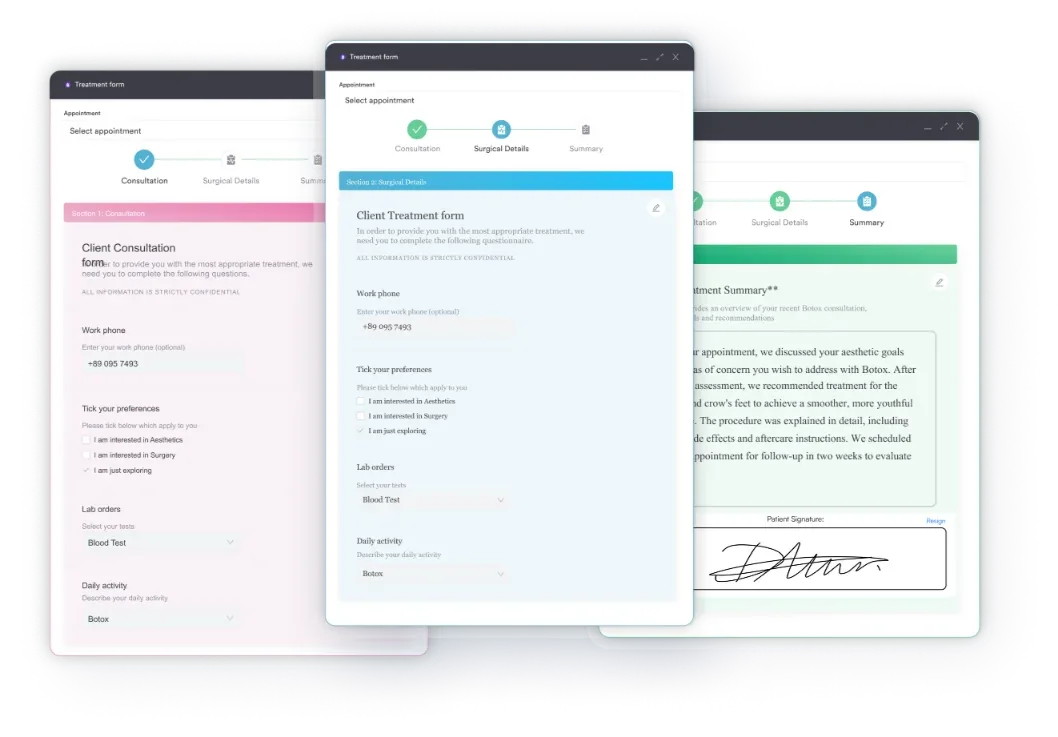
A complete documentation package for L0632 must exist before the supplier submits the claim. Therefore, missing any single element is sufficient grounds for denial on post-payment audit. Build these requirements into the intake workflow rather than reviewing them only at billing time. For example, Pabau’s digital intake and order forms can capture each required element at the point of dispensing.
Keep the full file for at least seven years from the date of service, in line with Medicare supplier record-retention rules. An auditor who requests it years later expects the order, the notes, and the delivery record to match.
L0632 is not currently subject to Medicare prior authorization. The CMS Required Prior Authorization List, updated July 29, 2026, names the prefabricated LSO codes L0631, L0637, L0639, L0648, L0650, and L0651. However, L0632, the custom-fabricated version, does not appear on it.
The face-to-face rule follows a similar pattern. From October 28, 2026, the CMS Required Face-to-Face Encounter and Written Order Prior to Delivery List covers L0631, L0637, L0638, and L0648. It lists other spinal orthoses too. L0632 is not on it, so its order does not have to predate delivery.
The matrix below shows how list status shifts across the codes a brace is most often confused with.
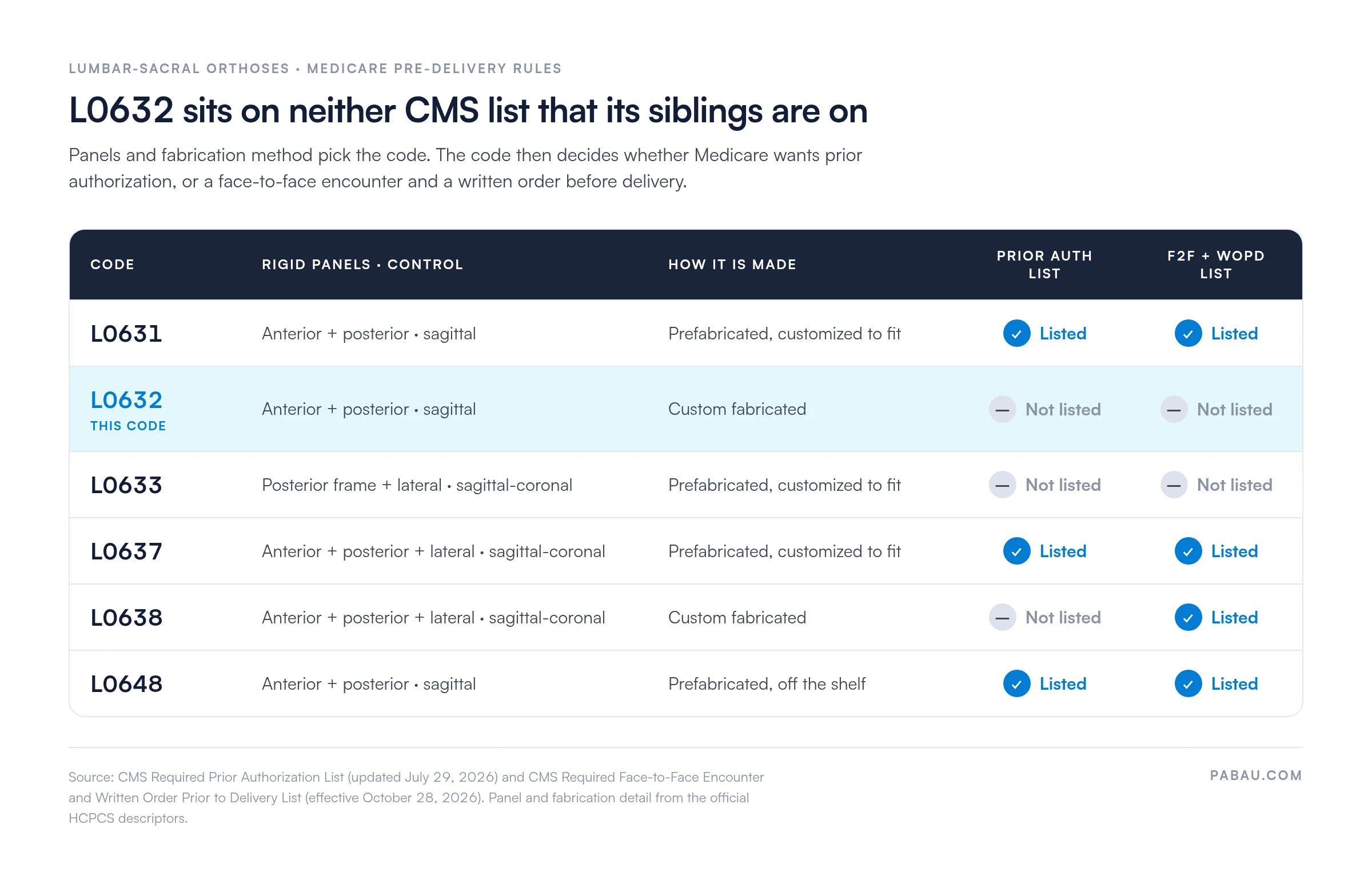
Overall, that makes code selection consequential. A customized prefabricated brace billed as L0632 skips the prior authorization request that L0631 requires, and auditors treat that as overcoding. CMS updates both lists, so check the current versions before dispensing.
Commercial payers set their own prior authorization rules, and these differ by plan. Confirm each payer individually, since the Medicare lists do not apply to commercial plans.
Notably, Medicare pays for L0632 as a purchase, at the amount set in the annual CMS DMEPOS fee schedule. Medicare pays 80% of the allowed amount after the Part B deductible. The table below explains the rate structure rather than reproducing figures that change each year.
For the current 2026 allowed amount, download the DMEPOS fee schedule file and look up L0632 for your state.
The denial reasons below are the ones that recur on LSO claims, and each one is preventable. Reviewing common denial codes alongside claim-level error reports shows which of them repeat in your own orthotics claims.
Run a pre-submission audit on every L0632 claim. Confirm the code matches the device’s panels and fabrication method, and that the standard written order is on file. Check that the medical record supports an LCD indication and that proof of delivery is signed. Make sure the modifier matches the documentation. This five-point check catches the most common denial triggers before the claim reaches the payer.
Each liability modifier tells the payer who pays on a denied claim. Thus, the wrong one shifts that cost between the supplier and the patient. For the wider checklist of what a payer needs on a first pass, see the guide to submitting a clean claim.
Check your DME MAC’s supplier manual for any other modifier it expects on orthotic claims.
Claim submission for L0632 follows standard DMEPOS rules on the CMS-1500 form (or its 837P electronic equivalent). Place of service is typically the patient’s home (place of service 12) when the supplier mails the device. It is 11 (office) when the supplier dispenses it in person. Specifically, each L0632 claim should carry the HCPCS code, any modifier, the diagnosis code, and the date of service. It also needs the NPI of the treating and billing entity. Review the CGS Medicare coding verification guidance for PDAC-verified product coding requirements.
Most L0632 errors start before billing. The correct code depends on the brace’s rigid panels, control planes, and fabrication method, and the order often doesn’t show them. When the fitting notes live in one system and the claim in another, the biller codes from the prescription instead of the device.
For instance, practice management software like Pabau keeps the written order, the orthotist’s casting and fitting notes, and the signed proof of delivery on one patient record. Pabau’s claims management software pulls those details into the claim, so nobody rekeys them. In the US, Pabau’s Claim.MD integration submits and tracks claims.
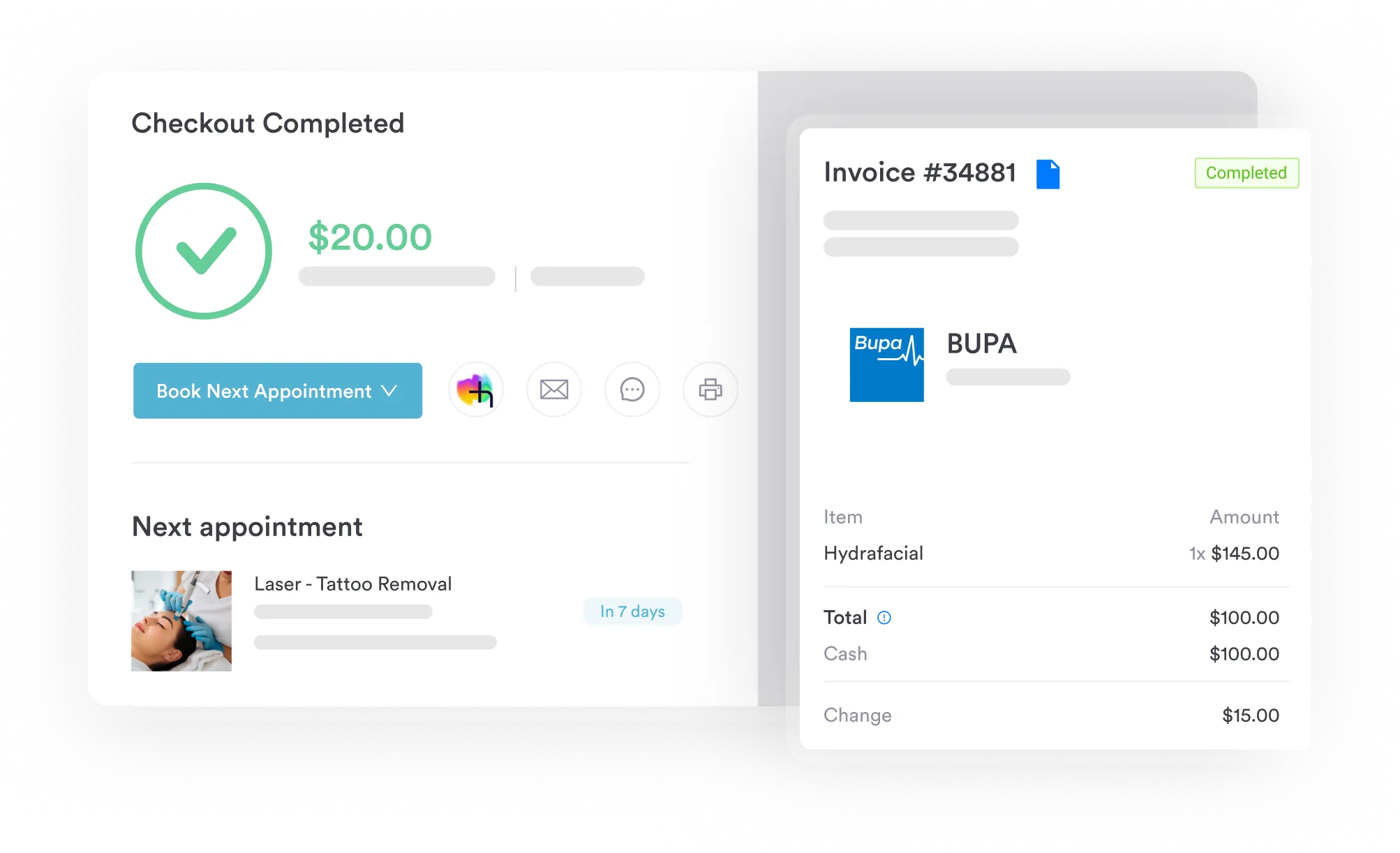
Consequently, the outcome is a file that matches the claim. When an auditor asks for the fabrication record behind an L0632, it sits next to the order and the delivery signature. Claim status tracking shows which claims came back denied, so staff fix a repeat problem at intake rather than on every claim.

Pabau keeps orders, fitting notes, and proof of delivery on one patient record, then pulls them into the claim. See how it fits your orthotics workflow.

Code the brace from the fabrication record, not the prescription. If the orthotist can’t show a cast, mold, scan, or measurement set taken for this patient, the device is L0631, whatever the order says.
L0632 skips Medicare’s prior authorization and pre-delivery order lists, so no payer checks the file before dispensing. The first review it gets may be a post-payment audit. That is why the documentation has to be complete on the day of delivery.
Book a demo to see how Pabau keeps L0632 orders, fitting notes, and proof of delivery together for a cleaner claim.

Billing a sibling code with lateral panels? HCPCS Code L0637 covers the prefabricated LSO that adds rigid lateral panels, and its prior authorization rules.
Supplying the same panels off the shelf? HCPCS Code L0648 explains the off-the-shelf version of this brace design and how it is billed.
Need a framework for managing claim rejections systematically? Denial management in healthcare covers root-cause analysis and appeal workflows for DME and orthotics practices.
Want to understand the revenue cycle context behind HCPCS billing? Revenue cycle management explained maps the full journey from patient encounter to collected payment.
Looking for HCPCS denial code definitions? Common denial codes in medical billing provides a reference guide to the remittance codes that appear on L-code rejections.
HCPCS Code L0632 covers a custom-fabricated lumbar-sacral orthosis with rigid anterior and posterior panels that provides sagittal plane control. The code includes the device, its fabrication, the final fitting, and adjustments at dispensing. It does not include replacement components, thoracic extensions, or prefabricated devices.
No. L0632 is not on the CMS Required Prior Authorization List, updated July 29, 2026. Its prefabricated counterparts L0631, L0637, L0639, L0648, L0650, and L0651 are. CMS updates the list, so check the current version before dispensing.
L0632 is a custom-fabricated orthosis code. The brace must be built for one patient from a cast, mold, digital image, or measurements. A prefabricated LSO with the same panels that is customized to fit is L0631, and an off-the-shelf version is L0648. Billing either as L0632 is overcoding.
The most common L0632 denial cause is selecting the wrong neighboring code, usually L0631 or L0637. Others include a deficient standard written order and medical records that don’t support an LCD indication. A retired diagnosis code, missing proof of delivery, and liability modifier errors round out the list.



