HCPCS Code G0160: OT maintenance program billing guide
What is HCPCS code G0160? HCPCS code G0160 reports skilled occupational therapy ...

Last Updated: Oct 19, 2026
L0648 is the HCPCS Level II code for lumbar-sacral orthosis, sagittal control, with rigid anterior and posterior panels, posterior extends from sacrococcygeal junction to t-9 vertebra, produces intracavitary pressure to reduce load on the intervertebral discs, includes straps, closures, may include padding, shoulder straps, pendulous abdomen design, prefabricated, off-the-shelf.
It is one of the most commonly billed lumbar orthosis codes under Medicare.
Two conditions of payment come before the claim. The specific brace model needs PDAC coding verification. Medicare also requires prior authorization, because L0648 sits on CMS's Required Prior Authorization List for DMEPOS.
Let Pabau's smart automation suggest the right codes, reduce claim denials, and keep your practice compliant—effortlessly.
Automate repetitive tasks and focus on what matters most—your patients.
Reduce coding errors and ensure compliance with the latest regulations.
Clean claims, fewer denials, and faster reimbursements.
Powerful insights and reporting to help your practice thrive.
HIPAA compliant SOC 2 certified GDPR-compliant Trusted by 4,000+ clinics worldwide

HCPCS Code L0648 describes a prefabricated, off-the-shelf lumbar-sacral orthosis with rigid anterior and posterior panels, effective since 2005.
PDAC coding verification is required before billing L0648 to Medicare, and billing a non-PDAC-approved product risks full claim denial.
L0648 sits on CMS’s Required Prior Authorization List for DMEPOS, so an affirmative decision must be on file before delivery.
The 2026 Medicare allowable for L0648 varies by MAC region and competitive bidding area. Verify the current rate in the CMS DMEPOS fee schedule.
Practice management software like Pabau tracks DME claims from eligibility check through submission and denial follow-up.
HCPCS Code L0648 is a Level II code maintained by the Centers for Medicare and Medicaid Services (CMS). It sits in the L-series, which covers orthotic and prosthetic devices, and it has been effective since 2005. The official full descriptor runs as one string of build requirements:
DME suppliers, orthotists, and medical billers can verify the current descriptor language through CMS’s official HCPCS code files and the AAPC HCPCS code lookup tool. The rest of the L-series sits alongside every other Level II code in Pabau’s HCPCS codes library.
What each descriptor element means in plain language: The “sagittal control” designation means the brace limits forward flexion and extension of the lumbar spine. “Rigid anterior and posterior panels” separates L0648 from the semi-rigid and flexible designs coded elsewhere in the L range.
The posterior coverage from the sacrococcygeal junction to T-9 is a specific anatomical requirement. A brace with shorter posterior coverage may not meet this code’s criteria. “Produces intracavitary pressure” refers to the abdominal compression mechanism that reduces load on the lumbar intervertebral discs.
“May include padding, shoulder straps, pendulous abdomen design” marks optional components, so their absence does not disqualify a brace. “Prefabricated, off-the-shelf” confirms this is not a custom-fabricated orthosis, which would be coded differently. L0631 covers that same brace when an individual with expertise has trimmed, bent, or molded it to fit a specific patient.
Medicare coverage for L0648 requires documented medical necessity under the applicable DME MAC Local Coverage Determination (LCD). The LCD governing LSO and TLSO coverage is L33790, “Spinal Orthoses: TLSO and LSO.” Billers should still confirm the LCD and the related policy article that apply in their MAC jurisdiction.
Covered clinical conditions typically include lumbar spinal stenosis, degenerative disc disease, spondylolisthesis, compression fractures, and post-surgical lumbar instability. Billers must pair L0648 with a supporting ICD-10-CM diagnosis code that establishes medical necessity per the applicable LCD. The following diagnoses are commonly paired with L0648 claims, though each must be substantiated by clinical documentation.
Always confirm that the ICD-10-CM code selected is on the covered diagnosis list within the applicable LCD. Codes listed above are illustrative. Covered diagnoses vary by MAC jurisdiction, and only codes supported by clinical documentation will satisfy medical necessity requirements.
A Medicaid patient’s claim is reviewed against coverage criteria written by the state agency. Criteria for HCPCS code S0160 differ from one state program to the next, so a practice billing across state lines checks each program separately.
L0648 is reimbursed under the Medicare DMEPOS fee schedule. That schedule is administered by the four Durable Medical Equipment Medicare Administrative Contractors: CGS, Noridian, Palmetto GBA, and National Government Services. Amounts vary by MAC jurisdiction. In competitive bidding areas (CBAs), the applicable rate may be the competitively bid price rather than the standard allowable.
Verify the exact 2026 allowable for L0648 through the CMS DMEPOS fee schedule, which is updated annually and varies by region. Third-party fee schedule estimates on commercial coding sites may not match the current CMS-published allowable for your MAC jurisdiction. Use the official CMS source for billing decisions.
In CBAs, off-the-shelf orthoses including L0648 are subject to competitive bid pricing. Suppliers must be contract suppliers in the CBA, or hold an applicable exception, to bill Medicare for beneficiaries there. Verify CBA applicability before dispensing.
PDAC stands for Pricing, Data Analysis and Coding, a CMS contractor that assists DME MACs with coding verification for DMEPOS items. For off-the-shelf orthoses like L0648, PDAC coding verification confirms that a specific product meets the code’s descriptor requirements before it is billed to Medicare. This is separate from a product being covered by Medicare in general. PDAC verification is product-specific rather than code-wide.
Per CGS Medicare’s coding verification guidance, DME suppliers should check the PDAC product classification list at dmepdac.com before billing L0648. Only products that have undergone PDAC verification and appear on that list can be billed under this code for Medicare patients.
Billing a product that has not been PDAC-verified under L0648 is an incorrect code assignment. It exposes the supplier to full claim denial, recoupment, and compliance risk. Catching it at the product-selection stage prevents the denial entirely.
CMS added L0648 to the Required Prior Authorization List for DMEPOS in October 2022, and the requirement applies nationwide. L0648 remains on the list CMS published in January 2026. Prior authorization is a condition of payment. A claim submitted without an affirmative decision will be denied, however complete the rest of the file is.
Send the prior authorization request to your DME MAC before the brace is delivered, using the same clinical documentation the claim will rely on. The MAC returns an affirmative or non-affirmative decision. A non-affirmative decision can be resubmitted once the documentation is corrected. L0650 carries the same requirement, so moving to the neighboring code does not avoid it.
CMS keeps the current list on its master list of DMEPOS items subject to conditions of payment. Check it each time the list is updated, because codes move on and off it.
Insufficient documentation is the most common root cause of L0648 claim denials on post-payment audit. Medicare requires a complete documentation trail from the prescribing physician through to the delivery confirmation. The goal is submitting a clean claim the first time. That means assembling every required record before the claim goes out, not after a denial comes back.
Audit your documentation package before submitting any L0648 claim. Run through all seven documents in the table above for every claim. A missing proof of delivery or an unsigned physician order will generate a denial on audit. Clinical appropriateness does not save it.
Billing L0648 correctly requires a structured workflow that runs from clinical evaluation through claim submission. DMEPOS billing differs from physician billing in two places that matter here. One is the PDAC verification step. The other is the prior authorization decision, which has to land before delivery. Tracking each step in claims management software reduces errors and shortens the reimbursement cycle.
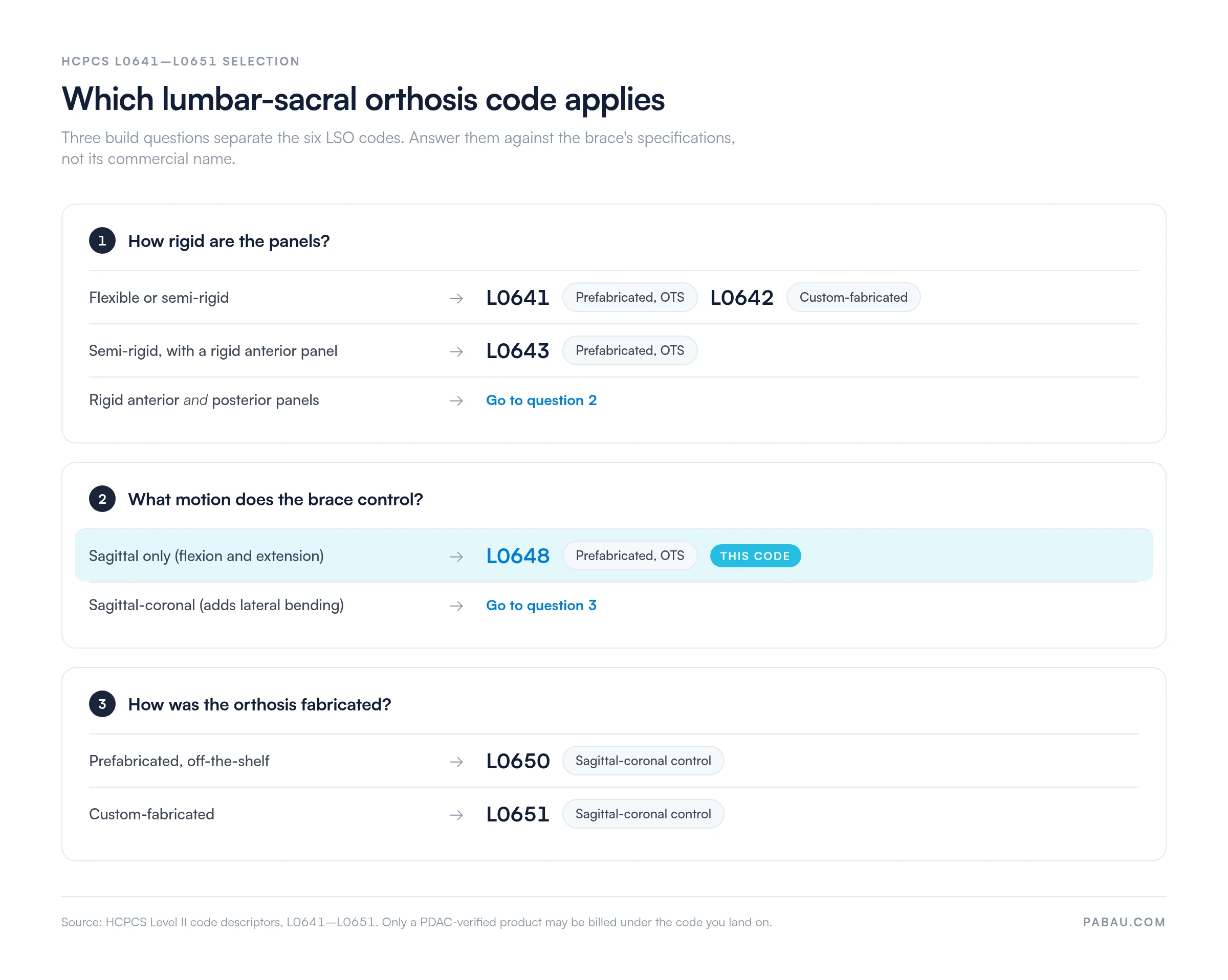
Choosing the wrong code within the L0641-L0651 range is one of the most common L0648 billing errors. The codes in this range share the same device category, the lumbar-sacral orthosis. They differ in control type, panel rigidity, posterior coverage, and whether the device is prefabricated or custom-fabricated. Selecting the correct code means matching the brace’s physical specifications to the descriptor, not its commercial name or general appearance.
Key differentiator between L0648 and L0650: Both are prefabricated off-the-shelf orthoses with rigid anterior and posterior panels. The critical difference is control type. L0648 provides sagittal control only, limiting flexion and extension. L0650 provides sagittal-coronal control, so it also limits lateral bending. The brace’s design and PDAC-verified classification determine the correct code, not the clinical rationale for prescribing it.
Sagittal-coronal control does not always mean a rigid anterior panel. L0649 covers the off-the-shelf brace that pairs that control with a rigid posterior frame and a soft anterior apron.
Three build questions separate the six codes, in the order a fitter would ask them.
The fabrication question repeats outside the lumbar-sacral range. L0113 covers the prefabricated torticollis orthosis, and L0112 covers the custom-fabricated version.
L0648 claims fail for a predictable set of reasons, and each one has a step that prevents it. Tracking denials at the code level lets a billing team fix the process instead of working appeals one at a time. Below are the most frequent root causes and their prevention steps.
An L0648 claim depends on seven records held by four different people. The physician’s office writes the order. The fitter records the fitting. The MAC returns the prior authorization decision. The patient signs for delivery. Most suppliers track those across a shared drive, an email thread, and the billing system.
Pabau, practice management software for healthcare practices, holds the whole file on one patient record. That includes the order, the clinical notes, the prior authorization decision, and the proof of delivery.
Claims management sits in the same place, so a biller can see whether the file is complete before the claim goes out. Denials come back into the same view, tagged by code, so a pattern across L0648 claims is visible without a spreadsheet.
The outcome is fewer claims sent short a document, and fewer recoupments found on a post-payment audit months later.

Pabau’s claims management tools help DME suppliers and orthotists track documentation requirements, submit accurate claims, and manage denials from one platform.

L0648 denials are largely preventable, and the two conditions of payment are where prevention lives. PDAC verification decides whether the product may be billed under this code. Prior authorization decides whether the claim can be paid at all. Both are settled before the brace reaches the patient.
That moves the work upstream, into product selection and order intake, where it costs a few minutes. Caught later, on a post-payment audit, the same file costs the reimbursement plus the recoupment. Book a demo to see how Pabau tracks DME documentation and claim status in one place.

Need to understand what makes a claim clean from the start? Clean claim submission guide walks through every data element a payer requires before approving a DME claim.
Working a denial on a DMEPOS claim? Denial codes in medical billing explains what each code means and what to correct before you resubmit.
Want to reduce denial rates across your billing operation? Denial management in healthcare covers tracking, appealing, and preventing common claim rejections.
Looking for a deeper grounding in DME billing processes? What is medical billing? explains the full revenue cycle from order through payment for DME and other provider types.
HCPCS Code L0648 covers a prefabricated, off-the-shelf lumbar-sacral orthosis (LSO) with sagittal control and rigid anterior and posterior panels. The posterior panel extends from the sacrococcygeal junction to the T-9 vertebra. The device must produce intracavitary pressure to reduce intervertebral disc load and may include padding, shoulder straps, or a pendulous abdomen design. Only products that have been PDAC-verified for this code can be billed to Medicare under L0648.
The 2026 Medicare allowable for L0648 varies by DME MAC jurisdiction. In competitive bidding areas (CBAs), the rate may be a competitively bid price rather than the standard fee schedule amount. Verify the current allowable on the CMS DMEPOS fee schedule at cms.gov. Commercial fee schedule sites are not a source for billing decisions.
Yes. PDAC coding verification is required before billing L0648 to Medicare. Only products that appear on the PDAC product classification list at dmepdac.com have been verified to meet the L0648 descriptor. Billing a non-PDAC-approved brace under this code is a coding error and exposes the supplier to claim denial and recoupment.
Yes. L0648 has been on CMS’s Required Prior Authorization List for DMEPOS nationwide since October 2022, and it remains on the January 2026 list. Submit the request to your DME MAC and wait for an affirmative decision before delivering the brace. A claim without one will be denied, whatever else is in the file.
L0648 provides sagittal control only, meaning it limits flexion and extension of the lumbar spine. L0650 provides sagittal-coronal control, adding lateral bending restriction. Both are prefabricated off-the-shelf orthoses with rigid anterior and posterior panels. The correct code is determined by the brace’s PDAC-verified specifications, not by the prescribing clinician’s preference.
Required documentation includes a written physician order with the provider’s signature and NPI, plus clinical notes establishing medical necessity per LCD L33790. You also need PDAC product verification for the brace model, an affirmative prior authorization decision, fitting notes, and a signed proof of delivery. An Advance Beneficiary Notice is required when medical necessity is uncertain. Missing any of these can result in denial or recoupment on audit.
Common modifiers for L0648 include KX for met LCD coverage criteria, NU for a new equipment purchase, and RR for a rental. KE marks a bid item furnished by a contract supplier in a competitive bidding area. The correct modifier depends on the payer, transaction type, and whether the patient’s location is in a CBA. Consult your DME MAC’s billing guidelines for current modifier requirements.