CCSD code H4430: Examination of rectum under anaesthetic
CCSD code H4430 pays for the examination alone CCSD code H4430 is the UK private...

Last Updated: Oct 20, 2026
L0630 is the HCPCS Level II code for lumbar-sacral orthosis, sagittal control, with rigid posterior panel(s), posterior extends from sacrococcygeal junction to t-9 vertebra, produces intracavitary pressure to reduce load on the intervertebral discs, includes straps, closures, may include padding, stays, shoulder straps, pendulous abdomen design, prefabricated item that has been trimmed, bent, molded, assembled, or otherwise customized to fit a specific patient by an individual with expertise.
HCPCS code L0630 bills a prefabricated lumbar-sacral orthosis (LSO) with sagittal control and rigid posterior panels, custom fitted to the patient at delivery. The posterior section extends from the sacrococcygeal junction to the T-9 vertebra. The device works by producing intracavitary pressure, which reduces load on the intervertebral discs.
L0630 is a HCPCS Level II code administered by the Centers for Medicare and Medicaid Services (CMS). It sits within the L-code orthotic and prosthetic range, in the lumbar-sacral orthosis subset. CMS and the DME MACs group it under prefabricated orthoses that are custom fitted, a tier between off-the-shelf braces and custom-fabricated devices.
Let Pabau's smart automation suggest the right codes, reduce claim denials, and keep your practice compliant—effortlessly.
Automate repetitive tasks and focus on what matters most—your patients.
Reduce coding errors and ensure compliance with the latest regulations.
Clean claims, fewer denials, and faster reimbursements.
Powerful insights and reporting to help your practice thrive.
HIPAA compliant SOC 2 certified GDPR-compliant Trusted by 4,000+ clinics worldwide

HCPCS code L0630 describes a prefabricated, custom fitted lumbar-sacral orthosis (LSO) with sagittal control and rigid posterior panels. The posterior section extends from the sacrococcygeal junction to the T-9 vertebra.
L0630 is a custom fitted code, so a certified orthotist or an equivalently trained individual fits the device at delivery. It cannot be shipped to the beneficiary.
L0630 is billed under Medicare Part B as DMEPOS. The 2026 Medicare fee schedule rate varies by geographic locality and DME MAC jurisdiction.
Medical necessity documentation must include a physician prescription and face-to-face encounter notes. It also needs a narrative linking the diagnosis to the need for LSO support, plus a fitting record.
Practice management software like Pabau attaches HCPCS codes to the patient encounter itself. Orthotics and physical therapy practices then submit from a record that is already claim-ready.
The official CMS descriptor for L0630 is precise. Every element matters for correct billing and medical necessity documentation. The table below shows the long descriptor in its three segments.
Three descriptor elements carry most of the billing risk. First, “sagittal control” means the brace restricts flexion and extension but not lateral bending or rotation. Choosing a code that implies coronal or rotational control when only sagittal control is provided is a coding error. Second, “rigid posterior panel(s)” separates L0630 from semi-rigid and flexible designs.
Third, the descriptor closes with custom fitting language rather than off-the-shelf language. L0630 covers a prefabricated item that has been trimmed, bent, molded, assembled, or otherwise customized to fit a specific patient by an individual with expertise. That closing phrase is the element practices most often get wrong.
Custom fitting carries obligations that off-the-shelf codes do not. The DME MACs place L0630 under prefabricated orthoses that are custom fitted, which requires more than minimal self-adjustment by the patient. Someone with expertise must trim, bend, mold, or assemble the device and fit it to the patient at delivery.
That person is usually a certified orthotist, or an individual with equivalent specialized training in fitting spinal orthoses. Because a qualified fitter has to be present, CMS policy does not allow a custom fitted item to be shipped directly to the beneficiary.
L0630 is prescribed when a patient needs rigid posterior support across the lumbar and lower thoracic spine. The goal is to reduce mechanical load on the intervertebral discs. The device does this through intracavitary (intraabdominal) pressure, which offloads the spine when the patient is upright.
Practices billing this code need a clear clinical rationale on file. That rationale has to explain why this level of support is medically necessary for this patient.
Common clinical indications that may support medical necessity for L0630 include:
The clinical documentation must connect the diagnosis to three specific features of L0630. Those features are the rigid posterior panel, the sagittal control, and the sacrococcygeal-to-T9 extent. A prescription that reads “lumbar brace” without linking the clinical need to those characteristics will not satisfy medical necessity review.
L0630 is reimbursed under Medicare Part B through the DMEPOS fee schedule. Rates are set annually by CMS and vary by geographic locality and DME Medicare Administrative Contractor (MAC) jurisdiction.
Verify the 2026 rate directly against the CMS fee schedule lookup tool for your locality. The figures below are published national benchmark rates, which may differ from your MAC’s allowed amounts.
Billing DMEPOS items like L0630 means tracking both the Medicare-allowed amount and your MAC’s locality adjustment. Practices in competitive bidding areas should also confirm whether L0630 falls inside an active bidding round, which can move reimbursement sharply. Once payment posts, reading the remittance advice at code level surfaces systematic underpayments early.
Verify your L0630 rate using the CMS DMEPOS fee schedule file for your specific MAC jurisdiction before setting your charge master. National benchmark figures published on third-party sites may not reflect locality adjustments or competitive bidding program rates that apply to your practice.
Missing or incomplete documentation is the most preventable cause of L0630 claim denial. CMS and the DME MACs set documentation standards under the applicable Local Coverage Determination (LCD).
Build those requirements into your intake and ordering workflow before the device is dispensed. Capturing every required element at the point of care stops omissions that would otherwise surface at claims review.
Required documentation elements for L0630 claims include:
Confirm eligibility before the device leaves the practice. A patient whose coverage lapsed, or whose plan excludes DME orthotics, produces a denial that better documentation cannot repair afterward.
Pairing L0630 with the correct ICD-10 diagnosis code is critical for medical necessity review. The table below lists codes commonly accepted alongside L0630 claims, based on typical DME MAC LCD coverage criteria. Verify against your applicable MAC LCD before billing, as coverage policies vary by region and payer.
A single ICD-10 code is rarely sufficient on its own. The diagnosis code must be supported by the clinical documentation in the face-to-face encounter note. Payers routinely deny L0630 claims where the ICD-10 code is present but the encounter note falls short. The note must substantiate the functional impairment that makes rigid sagittal support necessary.
Specificity in these families shifts between annual ICD-10-CM updates. Several of the codes above have child codes that did not exist a few revisions ago. Check each pairing against the current ICD-10-CM code index before you submit.
Choosing the wrong L-code for an LSO is one of the most common coding errors in orthotic billing. The table below compares L0630 against adjacent codes to support accurate code selection. Refer to the AAPC HCPCS code range for full descriptor text when evaluating adjacent codes.
A flexible support with no rigid panel bills as L0628 instead. L0630 applies only when the brace has a rigid posterior panel. When the same custom fitted brace also has a rigid anterior panel, the correct code is L0631.
The most common confusion is between L0630 and L0643. Their descriptors are identical up to the final phrase, and both cover a sagittal-control LSO with rigid posterior panel(s). L0643 is supplied off the shelf, while L0630 is custom fitted by an individual with expertise.
What happens at delivery determines the correct code. Billing by clinical intent alone, without documenting who fitted the device and what was adjusted, is a common audit finding.
Orthotic L-codes split into three fitting tiers, and L0630 sits in the middle one. Two choices fix the code between them: how the brace is built, and what a qualified person does to it at delivery. The grid below maps one against the other.
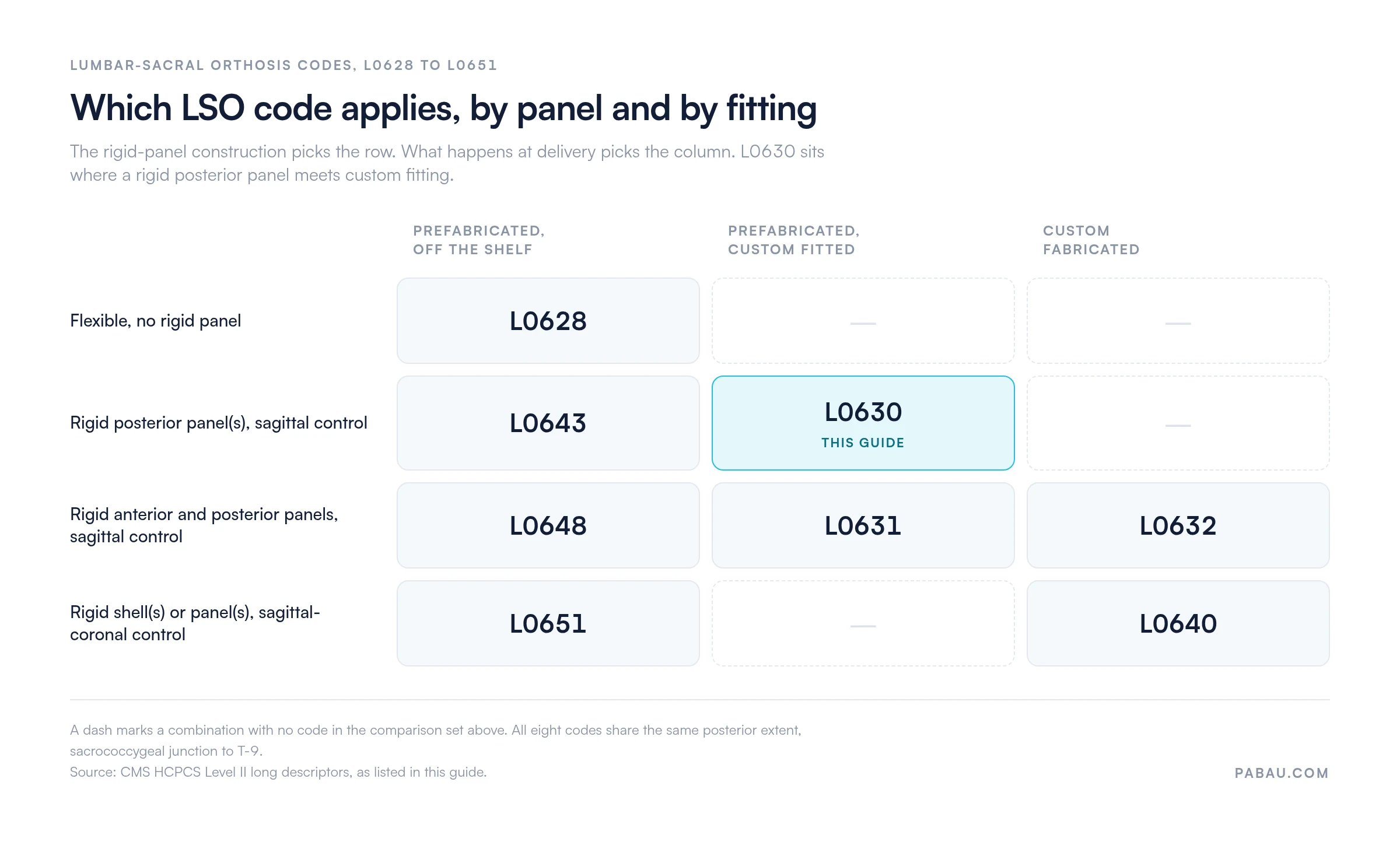
Picking the wrong tier is a compliance risk in both directions. Billing a custom-fabricated code such as L0632 when a prefabricated device was dispensed is upcoding, which carries fraud and abuse exposure.
Billing L0630 when the patient received an off-the-shelf brace and fitted it themselves is the same error one tier down. Billing off the shelf for a custom fitted device means systematic underpayment.
The supplying entity must select the code that matches the device dispensed and the work done at delivery, not the device that was prescribed.
When in doubt, document the dispensing encounter in detail. Record what device was supplied, who fitted it, what was modified, and how sizing was determined. That record is what auditors examine when they review the fitting tier you billed.
L0630 denials cluster around six preventable patterns. Proactive denial management workflows for DME orthotic claims should address each one at intake and before dispensing.
Most L0630 claim problems start in the paperwork rather than in the treatment room. The device is appropriate and the record behind it falls short. These practice-level steps reduce denial rates for orthotic L-code claims without adding clinical burden. Submitting correctly the first time also avoids the rework cost of appeals and resubmissions.
Audit your L0630 denials quarterly by CARC code. CARC 50 (non-covered service, not deemed a medical necessity) points to thin documentation. CARC 4 covers a procedure code inconsistent with the modifier used, or a required modifier that is missing. On an L0630 claim it usually means the KX modifier never made it on. Each reason code maps to a different corrective action.
In most orthotics practices the order lives in one system, the fitting note in another, and the claim in a third. A coder rebuilds the story at submission time. The fitting detail that proves the custom fitted tier is exactly the piece that fails to make the trip.
Practice management software like Pabau holds the encounter, the documents and the claim in one patient record. HCPCS codes attach to the encounter itself, so the L0630 line carries its ICD-10 pairing, its KX modifier and the delivery note behind it. Pabau’s streamlined claims management then submits from that record rather than from a re-keyed copy of it.
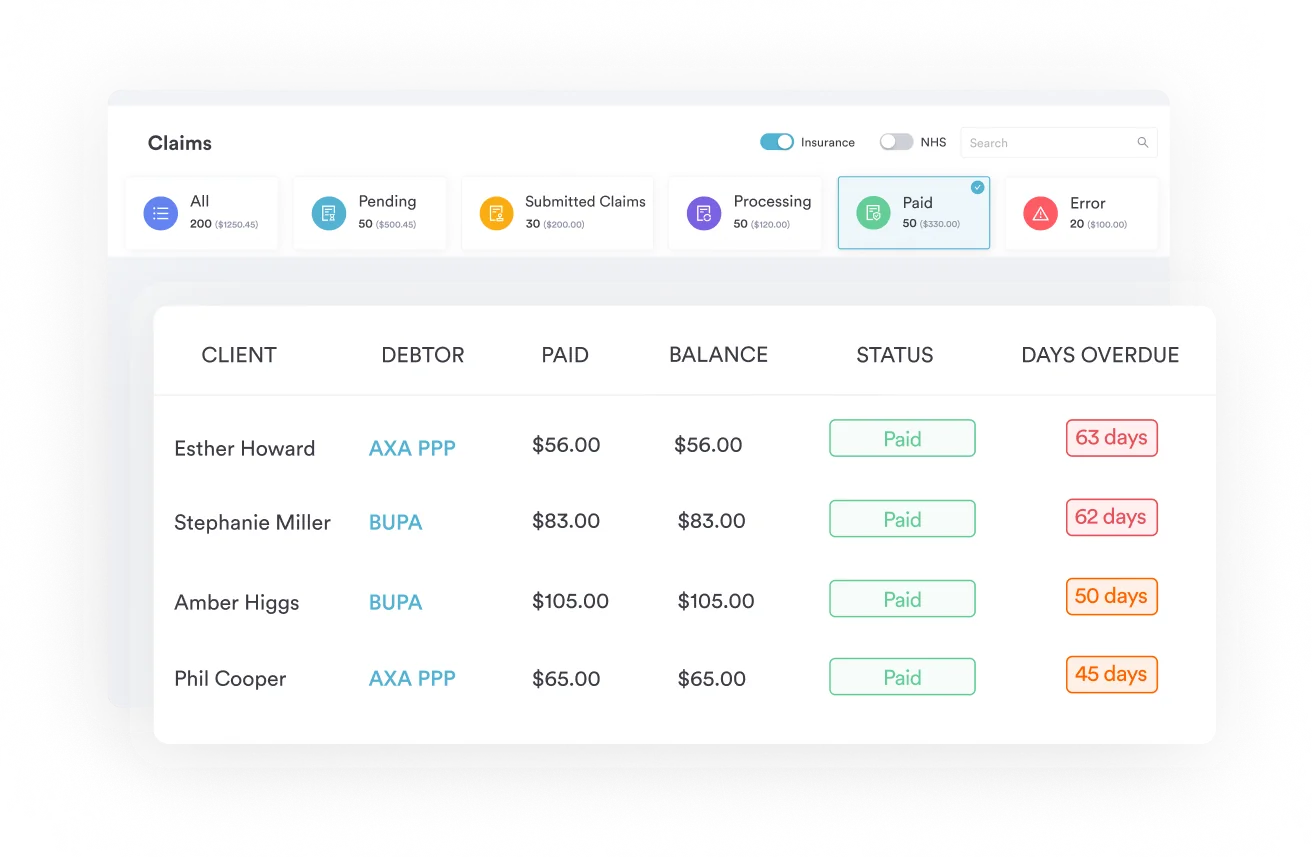
The outcome is a shorter path from delivery to payment. Staff stop chasing the fitter for a note after the denial has already arrived. The audit trail exists before a MAC asks to see it.

Pabau’s claims management tools help orthotics, physical therapy, and DME practices attach HCPCS codes directly to patient encounters and generate claim-ready records without switching systems.

L0630 rewards practices that treat the delivery encounter as a billing event. The code itself is settled and rarely in dispute. What decides the claim is whether the record names the fitter, the adjustment made, and the diagnosis that required rigid sagittal support.
So start at the descriptor. Treat L0630 as a custom fitted code and let the fitting note prove it. Pair it with a supported ICD-10 diagnosis, then file modifier KX inside the face-to-face window. Practices that do all four rarely argue with a DME MAC twice about the same brace.
The trade-off worth remembering is that the fitting tier is decided by staff at the counter, not by the coder. Book a demo to see how Pabau keeps the HCPCS code, the fitting note and the claim on one patient record.

Need to understand how medical billing works from first principles? What is medical billing covers the full claims lifecycle from documentation through remittance.
Want the claim to go through on the first pass? What is a clean claim sets out the fields payers check before an orthotic claim is accepted.
Building documentation rules an auditor will accept? Medical billing compliance explains the standards behind LCD documentation and DMEPOS supplier obligations.
Losing DMEPOS claims to lapsed coverage? Insurance eligibility verification shows how to confirm benefits before the device is dispensed.
HCPCS code L0630 is used to bill for a prefabricated, custom fitted lumbar-sacral orthosis (LSO) with sagittal control and rigid posterior panels. The posterior section extends from the sacrococcygeal junction to the T-9 vertebra. It is billed under Medicare Part B as a DMEPOS item. It applies when a physician prescribes this device to reduce intervertebral disc load, in conditions such as degenerative disc disease or spinal stenosis.
The 2026 Medicare fee schedule rate for L0630 varies by geographic locality and DME MAC jurisdiction. Verify the current allowed amount for your service area using the CMS DMEPOS fee schedule lookup tool at cms.gov. National benchmark figures published on third-party sites may not reflect locality adjustments or competitive bidding program rates.
ICD-10 codes commonly accepted with L0630 include M51.16 (intervertebral disc disorders with radiculopathy, lumbar region) and M47.26 (spondylosis with radiculopathy, lumbar region). Two more are M48.062 (spinal stenosis, lumbar region with neurogenic claudication) and M43.16 (spondylolisthesis, lumbar region). Verify accepted codes against your applicable DME MAC Local Coverage Determination (LCD), as covered diagnoses vary by region.
L0630 is a prefabricated orthosis that is custom fitted, not an off-the-shelf item. CMS and the DME MACs require more than minimal self-adjustment, so a certified orthotist or equivalently trained individual must fit the device at delivery. That also means it cannot be shipped directly to the beneficiary. The off-the-shelf counterpart with the same device profile is L0643.
L0630 and L0643 share the same device descriptor, a lumbar-sacral orthosis with sagittal control and rigid posterior panels. The difference is how the device is supplied. L0643 is off the shelf and needs only minimal self-adjustment by the patient. L0630 is custom fitted, so an individual with expertise must trim, bend, mold, or assemble it for that patient. Bill the code that matches what happened at delivery.
A handful of patterns account for most L0630 denials. The most frequent is missing or insufficient medical necessity documentation in the face-to-face encounter note. Others include an incorrect or non-covered ICD-10 pairing, and billing L0630 when an off-the-shelf device such as L0643 was supplied. Denials also follow when the fitting is not documented, when the face-to-face encounter falls outside the LCD-required window, or when modifier KX is missing. Commercial and Medicare Advantage plans add prior authorization as a further trigger.