CCSD code H4430: Examination of rectum under anaesthetic
CCSD code H4430 pays for the examination alone CCSD code H4430 is the UK private...

Last Updated: Oct 20, 2026
J7610 is the HCPCS Level II code for albuterol, inhalation solution, compounded product, administered through dme, concentrated form, 1 mg.
HCPCS Code J7610 bills albuterol inhalation solution that a pharmacy compounded and dispensed in concentrated form, at 1 mg per unit. The drug is administered through durable medical equipment, usually a home nebulizer.
Two attributes decide which albuterol code belongs on the claim. Was the product compounded, and did the beneficiary receive a unit dose or a concentrate?
Let Pabau's smart automation suggest the right codes, reduce claim denials, and keep your practice compliant—effortlessly.
Automate repetitive tasks and focus on what matters most—your patients.
Reduce coding errors and ensure compliance with the latest regulations.
Clean claims, fewer denials, and faster reimbursements.
Powerful insights and reporting to help your practice thrive.
HIPAA compliant SOC 2 certified GDPR-compliant Trusted by 4,000+ clinics worldwide

HCPCS Code J7610 describes albuterol, inhalation solution, compounded product, administered through DME, concentrated form, billed per 1 mg.
J7609 covers compounded unit-dose albuterol, J7611 covers non-compounded concentrated albuterol, and J7613 covers non-compounded unit-dose albuterol.
The container the beneficiary receives decides the code. A concentrate the pharmacy dilutes into single-dose vials is billed as J7609, not J7610.
The KO, KP, and KQ modifiers belong on unit-dose codes only, so a J7610 line never carries any of the three.
Medicare Part B covers J7610 when medical necessity is documented for conditions such as asthma, COPD, or bronchospasm, with a valid physician written order.
Practice management software like Pabau supports DME drug billing workflows, so your team can submit accurate HCPCS J-code claims and track reimbursements.
HCPCS Code J7610 identifies a specific drug formulation and delivery method. The official long description reads: Albuterol, inhalation solution, compounded product, administered through DME, concentrated form, 1 mg.
Four elements in that descriptor decide whether the code fits: compounded, administered through DME, concentrated form, and 1 mg.
Two terms decide whether J7610 is the right code: compounded and concentrated form. If the albuterol is not pharmacy-compounded, or if it is dispensed as a pre-mixed unit-dose vial rather than a concentrated solution, a different code applies.
According to the CMS HCPCS coding system, J-codes classify drugs administered by routes other than oral. Each J-code encodes the drug name, formulation, route, and unit of measure in a single billable descriptor.
Both J7610 and J7609 describe compounded albuterol administered through a nebulizer, so compounding status does not separate them. Only the form as dispensed does. That single attribute changes the code, the modifier, and the allowable. That is what makes the pair easy to mix up on a DME claim.
Medicare’s nebulizer policy article is explicit about which container governs. Say a pharmacist takes concentrated 0.5% albuterol and dilutes it to a ready-to-use 0.083% strength.
If those single-dose vials go to the beneficiary, the claim goes out as compounded unit dose. That product is J7609, even though the pharmacy started from a concentrate.
J7610 fits only when the beneficiary receives the concentrate itself and dilutes each dose before use. Neither code covers a commercially manufactured product. An FDA-approved albuterol solution bills as J7613 in unit dose and J7611 in concentrated form.
Reading the strength off the source bottle instead of the dispensed container is what produces the overpayments CMS recovers on review.
Where J7610 vs J7609 turns on the dispensed form, J7610 vs J7611 turns on who prepared the product. Both codes describe concentrated albuterol delivered through DME, and both are billed per 1 mg. Compounding status is the only difference between them.
Look for the phrase “compounded product” or “FDA-approved final product” on the pharmacy record before you choose between the two. Billing J7610 for a commercial concentrate misstates the product dispensed, and reversing the pair understates it.
Compounded drug reimbursement can also sit at a different allowable than the commercial rate. The mismatch then shows up in the payment as well as the descriptor.
The J76xx family covers the full range of albuterol and levalbuterol nebulizer formulations. Two attributes place every code in it: compounding status, and the form as dispensed. The grid below shows where the four albuterol codes land, and which of them carry a unit-dose modifier.
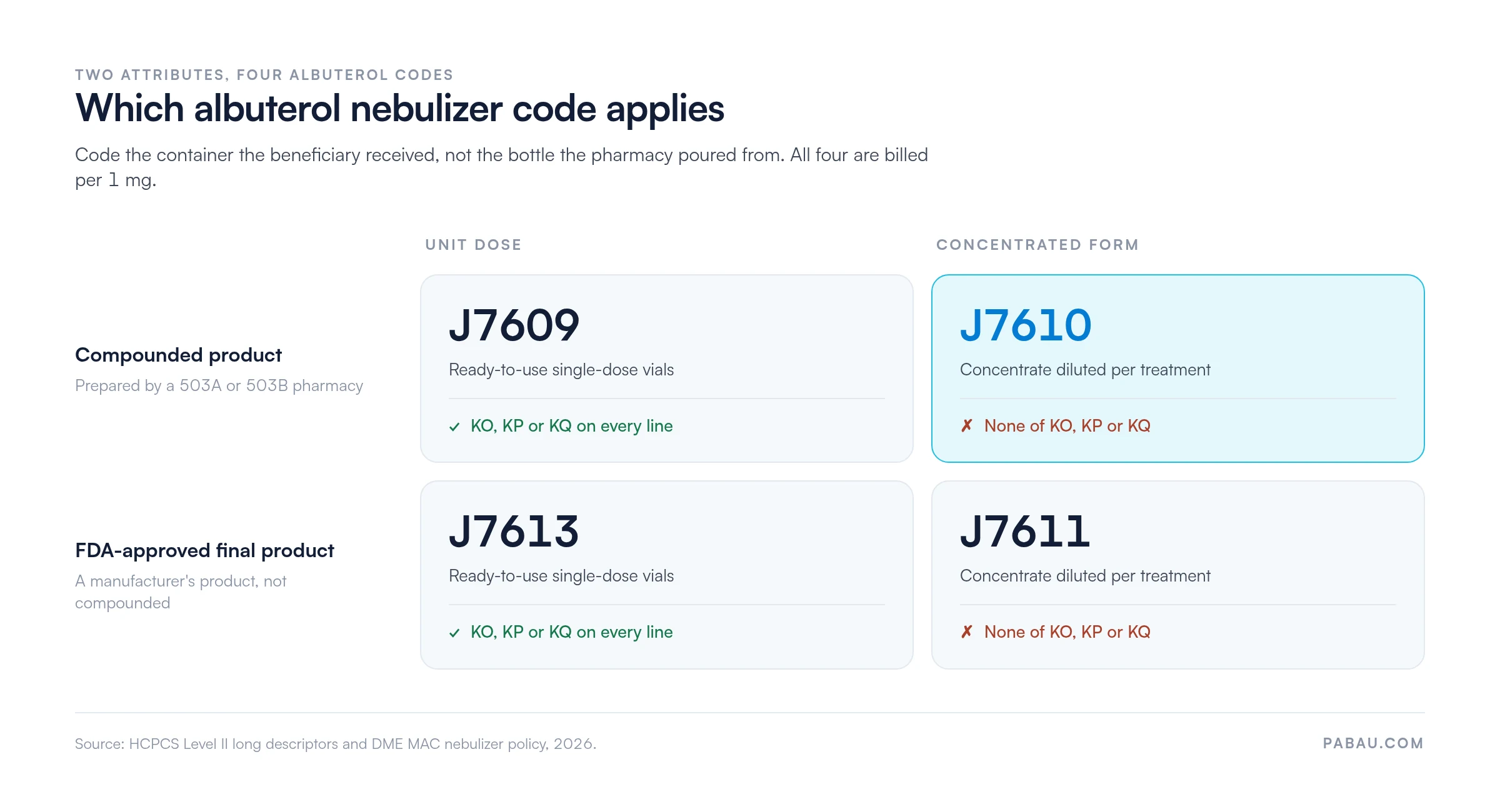
Only J7609 and J7610 describe compounded albuterol. The rest of the family is an FDA-approved final product, so a compounded dispensing record narrows your choice to two codes immediately. Route matters as well, since the injectable form of acetylcysteine bills as J0132 rather than J7608.
For a full HCPCS Level II search across the J-code drug category, use the AAPC HCPCS code lookup tool. It filters by code range, drug name, and description. Verify against the current-year code set, since descriptors and coverage rules are updated annually by the HCPCS National Panel.
Medicare Part B covers HCPCS Code J7610 when the claim meets five core criteria. Missing any one of them results in denial. Confirming the beneficiary’s Part B nebulizer drug coverage before dispensing keeps you from billing a patient who is not eligible.
Coverage details vary by Medicare Administrative Contractor (MAC) jurisdiction. Undocumented medical necessity is a frequent source of post-payment recoupment on DME drug claims. File the physician’s reasoning with the order rather than reconstruct it after a review.
Missing documentation is the primary driver of J7610 claim denials. The following checklist reflects medical billing compliance standards as outlined in CMS MLN guidance and MAC local coverage articles. Maintain all items in the patient file before submitting a claim.
Flag each J7610 claim for a pre-submission documentation audit. Confirm the physician order date precedes the dispensing date. Confirm the ICD-10 code on the claim matches the clinical notes. Confirm the pharmacy record says compounded product, concentrated form. Those three mismatches account for most J7610 rejections before adjudication.
Billing HCPCS Code J7610 accurately requires confirming the drug form, calculating units correctly, and attaching the right supporting codes. A structured workflow using claims management software reduces the manual-check burden on billing staff and helps catch unit-calculation errors before submission.
The billing unit for J7610 is 1 mg of albuterol. The number of units on the claim equals the total milligrams dispensed, not the number of vials or treatments. Typical albuterol nebulizer doses run from 1.25 mg to 5 mg per treatment.
A monthly supply for a patient on 2.5 mg twice daily equals 150 mg, so 150 units are billed. A patient on 5 mg three times daily for 30 days equals 450 mg. Check the figure against the clean claim requirements for DME drug codes, and cross-check the quantity on the pharmacy label.
Both DME MACs publish a nebulizer drug calculator for exactly this arithmetic. Enter the strength, the vial size, and the frequency. The CGS albuterol nebulizer calculator returns the maximum units billable in a 31-day or 90-day period.
Run any large refill through it before you submit. Quantities above the published maximum draw a review even when your own math is right.
A J7610 line carries none of the KO, KP, or KQ modifiers, because all three belong to unit-dose codes only. Medicare’s nebulizer policy article assigns them by container, not by drug. Once you know which container the beneficiary received, the modifier follows without a judgment call.
The failure runs in both directions. A biller who treats KO as a generic nebulizer modifier appends it to J7610, and the line rejects. A biller who dispenses ready-to-use vials under J7609 and omits KO gets a denial for an invalid code. Attach the modifier decision to the container, and both cases disappear from your denial queue.
KX, GA, and GZ answer a separate question. They record whether the coverage criteria in the LCD are met, and what the beneficiary was told about non-covered items. The DME MAC instructions covering nebulizers, drugs, and supplies were revised for 2026. Read your jurisdiction’s current article rather than an internal cheat sheet written for an earlier policy year.
The drug and the act of dispensing it are paid separately. A pharmacy furnishing inhalation drugs through DME bills a dispensing fee in addition to the J7610 drug line. Three codes cover it.
Only one of the three is payable for the same period, whatever the number of drugs, shipments, or pharmacies involved. On a refill, the fee is payable no sooner than 10 days before the end of the current usage period.
Medicare also caps dispensing fees at 12 months’ worth per beneficiary in any 12-month period. Check the current DMEPOS fee schedule for the allowable amounts, since the figures published when these codes launched are long out of date.
Medicare reimbursement for HCPCS Code J7610 is set annually by CMS under the DMEPOS fee schedule. Rates vary by MAC jurisdiction and are updated each calendar year. Do not rely on a prior year’s rate for current billing.
The CMS DMEPOS fee schedule publishes the current allowable amounts by HCPCS code, year, and locality. The same file prices every other DMEPOS code your practice bills, from nebulizer equipment to items like K0843 and L0859.
After adjudication, the payment details arrive via electronic remittance advice, which itemizes the allowed amount, any adjustments, and the reason for any reduction.
A few general principles apply across MAC jurisdictions:
CMS nebulizer compliance audits consistently identify the same error patterns for J7610 claims. The denial management work required after these errors is far more costly than preventing them upfront. The most frequent issues are listed below alongside their root cause and fix.
Each of the errors above shows up as a recognizable denial code on the remittance advice. Map the code back to its cause, then update your pre-submission checklist so the same line does not fail twice.
Selecting the correct ICD-10-CM diagnosis code is a prerequisite for J7610 claim approval. CMS and the DME MACs cross-reference the diagnosis code on the claim against their covered diagnosis lists.
The table below covers the ICD-10-CM codes most commonly paired with J7610 claims. Use the most specific code that matches the physician’s documented diagnosis.
Verify the current covered-diagnosis list for your MAC’s LCD on nebulizer drugs. MACs periodically update covered diagnosis lists, and a code that was covered in a prior year may carry new documentation requirements in the current year.
Cross-reference the ICD-10-CM code on every J7610 claim against the DME MAC’s active covered-diagnosis list for nebulizer drugs before submission. MACs update these lists mid-year without announcing individual code changes. A quarterly audit of your top five diagnosis codes used with J7610 catches outdated pairings before they generate systematic denials.
Most DME teams reconcile this by hand, including the infusion centers that buy and bill their own drugs. The pharmacy record sits in one system, the physician order in a second, and the claim gets built in a third.
A coder reads a strength off a label and picks a code from memory. Nobody compares that code against the container the beneficiary received until a denial arrives weeks later.
Pabau, our practice management software, keeps the order, the clinical note, and the dispensing detail on one patient record. The person coding the claim can see what was dispensed without leaving the screen. Claims then go out from that record through our Claim.MD integration, and the remittance returns to it.
That turns the compounded-versus-concentrated check into a glance rather than a phone call. A J7610 line that should have been J7609 gets caught before it becomes a recoupment letter.
Your billers then spend their time on the exceptions instead of re-reading pharmacy labels.

Pabau’s claims management software supports HCPCS J-code billing workflows, helping DME suppliers and respiratory therapy practices submit accurate claims, track reimbursements, and reduce denial rates.

Accurate J7610 billing comes down to four checks. Confirm the product was compounded and dispensed as a concentrate. Calculate units in milligrams rather than vials. Leave KO, KP, and KQ off the line. Pair the claim with a diagnosis your MAC covers.
Each check is simple on its own, and the denials come from the handoffs between dispensing, documentation, and coding.
Pabau supports structured HCPCS J-code billing, so your team can track dispensing records, attach the right diagnosis code, and submit to the correct MAC. To see how that works on your own claims, book a demo.

Billing another bronchodilator through Part B? J0280 covers injectable aminophylline, with its unit definition and coverage rules.
Need to calculate units for a drug billed by milligram? J1556 works through immune globulin unit math and the documentation payers ask for.
Collecting the beneficiary’s 20% share? Patient payment plans shows how to set up, automate, and collect the balance Medicare does not pay.
HCPCS Code J7610 bills albuterol inhalation solution that a pharmacy compounded and dispensed in concentrated form, at 1 mg per unit. The drug must be administered through durable medical equipment, such as a home nebulizer. It applies under Medicare Part B when a physician has ordered nebulizer bronchodilator therapy. The patient needs a qualifying respiratory diagnosis such as asthma or COPD.
Both codes describe compounded albuterol, so compounding status does not separate them. J7609 is the unit-dose form, dispensed in ready-to-use single-dose vials. J7610 is the concentrated form, which the beneficiary dilutes before each treatment. A concentrate that the pharmacy dilutes and dispenses in single-dose vials is billed as J7609, not J7610.
Both codes describe concentrated albuterol administered through DME, so the dispensed form does not separate them. J7610 covers a pharmacy-compounded concentrate. J7611 covers an FDA-approved final product dispensed without compounding. Check the pharmacy record for the phrase compounded product or FDA-approved final product before choosing between the two.
No. Those three modifiers apply to unit-dose codes such as J7609 and J7613. Medicare’s nebulizer policy article does not allow them on concentrated form codes. A unit-dose line submitted without one of the three is denied as an invalid code. The combination code J7620 is a stated exception and takes none of them.
J7610 is billed per 1 mg of albuterol, so the number of units equals the total milligrams dispensed in the billing period. Take a patient receiving 2.5 mg per treatment twice daily for 30 days. That is 150 mg in total, billed as 150 units of J7610. Count the dispensed milligrams, not the number of vials or treatments.
Medicare Part B covers J7610 when four things line up. The beneficiary has a qualifying diagnosis such as asthma, COPD, or bronchospasm. A valid physician written order is on file and the patient has a covered nebulizer. The compounding pharmacy meets FDA 503A or 503B requirements. Coverage is not automatic, so every claim needs documentation that satisfies your MAC’s local coverage policy.
The ICD-10-CM codes most commonly paired with J7610 include J44.1 (COPD with acute exacerbation) and J44.9 (COPD, unspecified). Asthma codes J45.20 and J45.50 also apply, along with J98.01 for bronchospasm and R06.2 for wheezing. Use the most specific code the physician documented. Verify it against your DME MAC’s current covered-diagnosis list for nebulizer drugs.
Yes. A dispensing fee is paid separately from the drug line. Use G0333 for the initial 30-day supply, Q0513 for a 30-day period, or Q0514 for a 90-day period. Only one of the three is payable for the same period. A refill fee is payable no sooner than 10 days before the end of the current usage period.