CCSD code F5010: Parotid duct transposition billing guide
CCSD code F5010 covers parotid duct transposition, one side or both CCSD code F5...

Last Updated: Oct 9, 2026
J0132 is the HCPCS Level II code for injection, acetylcysteine, 100 mg.
Those numbers are where the trouble starts. Units come from the administration record, not from the vial. A waste modifier has to sit on the line as well. Get either one wrong and the line comes back denied or underpaid.
Let Pabau's smart automation suggest the right codes, reduce claim denials, and keep your practice compliant—effortlessly.
Automate repetitive tasks and focus on what matters most—your patients.
Reduce coding errors and ensure compliance with the latest regulations.
Clean claims, fewer denials, and faster reimbursements.
Powerful insights and reporting to help your practice thrive.
HIPAA compliant SOC 2 certified GDPR-compliant Trusted by 4,000+ clinics worldwide

HCPCS code J0132 covers injection, acetylcysteine, 100 mg, the intravenous antidote sold as Acetadote.
Bill one unit for every 100 mg given, taken from the administration record rather than the vial size.
Single-dose vial claims need a waste modifier. Use JW when drug is discarded and JZ when none is.
Medicare pays J0132 from the quarterly ASP file in a physician office, and under OPPS in hospital outpatient.
Practice management software like Pabau gives billers code lookup libraries, required-field checks, and one route to the clearinghouse.
J0132 is the Healthcare Common Procedure Coding System (HCPCS) Level II code for Injection, acetylcysteine, 100 mg.
The Centers for Medicare and Medicaid Services maintains the code set. The J series covers drugs given by injection or infusion that a patient cannot take at home. J0132 is billed per 100 mg and covers intravenous administration in any approved setting.
Acetylcysteine, sold as Acetadote, is the intravenous form of N-acetylcysteine.
The FDA label approves it for one indication, which is preventing or reducing liver injury after an acetaminophen overdose. It works by restoring glutathione, the compound the liver runs through when it has to process too much acetaminophen.
Two points matter for billing. Oral and inhaled acetylcysteine are separate products and are never billed under J0132. And acetylcysteine is sometimes given off-label to protect the kidneys before contrast imaging, where payment depends entirely on the plan.
Medicare Part B pays J0132 using Average Sales Price (ASP) methodology. In a physician office, place of service 11, the rate is ASP plus 6%, which covers the drug and a handling allowance.
Hospital outpatient departments, place of service 22, fall under the Outpatient Prospective Payment System instead. CMS republishes the rates every quarter, so check the current figure in the CMS ASP pricing files before you submit.
Rate mismatches are a quiet source of partial payment on drug lines. A claim built on last quarter’s figure still goes out clean, so the shortfall only shows up on the remittance. Put the ASP file release in the diary alongside your other quarterly billing tasks.
One exception matters: J0132 is not separately payable during an inpatient stay, because the drug cost sits inside the DRG payment. Billing it as its own line there earns a denial.
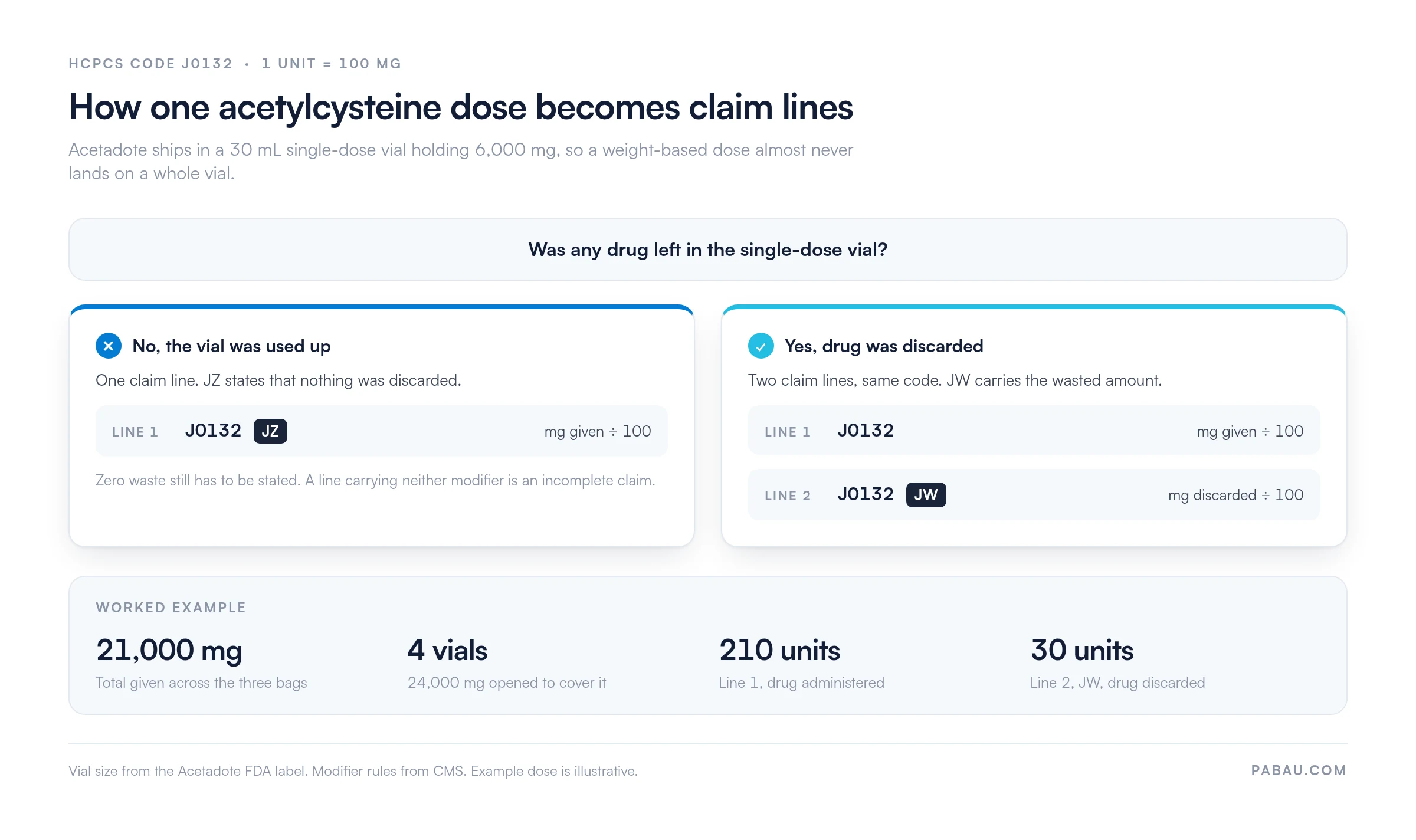
The unit math is a division problem. Take the total milligrams of acetylcysteine the patient received across all three infusion bags, then divide by 100.
Pull that total from the administration record rather than the physician order, since the ordered dose and the delivered dose do not always match.
Vial size decides the rest. Acetadote comes in a 30 mL single-dose vial holding 6,000 mg, which is 60 billable units. A weight-based dose rarely lands on a whole vial, so the remainder gets discarded and billed on its own line.
The diagram below follows one dose through both routes.
Unit definitions belong to the code, not to the drug class. J3470 measures hyaluronidase in 150-unit increments, while J3487 bills zoledronic acid per milligram. A habit built on one J-code will not carry over to the next.
Because Acetadote ships in single-dose vials, Medicare wants to know what happened to the rest of the vial.
Two modifiers answer that question. JW reports the discarded amount and has been mandatory since January 1, 2017. JZ reports that nothing was discarded, and CMS required it from July 1, 2023 under change request CR13056.
A single-dose vial line with neither modifier is an incomplete claim, and it is one of the most common J-code rejections. Building the check into denial management before submission catches it earlier than the remittance does.
Wastage always sits on its own line. One line carries J0132 plus the units given. A second line, also J0132, carries JW plus the units discarded.
Both belong on the same claim, and both show up separately on the remittance advice. It pays to know the common denial codes behind those adjustments.
Write the discarded milligrams into the administration record at the time of infusion, not afterwards. Auditors reviewing JW claims look for a note made at the bedside. A vague ‘some drug wasted’ entry will not satisfy Medicare.
A National Drug Code (NDC) names the exact product, manufacturer, and package a practice bought. Medicaid requires one on almost every drug claim, and commercial payers keep adding the requirement. When you bill J0132, the NDC from the vial you actually opened goes on the same claim line.
Format is what trips people up. The NDC printed on the carton is 10 digits, in a 4-4-2, 5-3-2, or 5-4-1 pattern. Claims want the 11-digit 5-4-2 version, which you build by adding a leading zero to whichever segment is short. Copy it off the package rather than from memory, because one product can carry several package sizes.
Every J0132 claim needs a diagnosis that explains why the drug went in. Payers match the ICD-10-CM code against the approved indication, so a mismatch is an easy denial for them to make.
These are the pairings you will meet most often.
Sequence matters as much as selection. The poisoning code leads when acetaminophen toxicity is the reason for the encounter, with any liver injury coded after it.
The 7th character has to match the visit as well. Use A for the initial encounter, D for follow-up care, and S for a sequela. That rule runs through the whole T chapter, including adverse-effect codes such as T45.625D.
Documentation on a drug claim has one job. It has to trace a straight line from the order, to the drug in the patient’s vein, to the units on the claim.
Six pieces do that work for J0132, and all six should be in the record before a clean claim goes out.
Front-loading these checkpoints beats chasing them later. Capture the lot number, the NDC, and the administered total at the bedside. Then nobody has to email the nurse three days later to rebuild a claim.
Medicare Part B covers J0132 in a hospital outpatient department, a physician office, or an infusion center, as long as the record supports medical necessity.
Medicaid covers overdose treatment broadly, though state formularies and NDC rules vary. Commercial plans generally follow, with more questions about the indication.
Prior authorization is rare for an overdose, because nobody pauses an antidote to fill in a form. Off-label use is the opposite. A contrast-nephropathy dose is planned days ahead, and that is exactly when a plan expects the authorization on file first.
Stocking a drug and infusing it on site is the buy-and-bill model. IV therapy practices and functional medicine practices run it for most injectables. You buy the drug, you give it, and you bill afterwards.
The practice carries the inventory risk and the paperwork. Acquisition price and ASP reimbursement also move on separate schedules, so the margin on a J-code is never fixed.
That last step is where money quietly disappears. An underpaid drug line looks identical to a paid one on a summary report, so somebody has to compare line by line.
J0131 is injection, acetaminophen, 10 mg. J0132 is injection, acetylcysteine, 100 mg. One is the painkiller. The other is the antidote for taking too much of it, and the two sit side by side in the HCPCS manual. A biller moving quickly reads the first four characters and picks the wrong one.
Two other habits produce the same denial. Some billers reach for an unlisted drug code when J0132 already exists, which buys a records request and a long wait.
Others carry last year’s unit definition forward without checking. Read the descriptor, not just the number, when you post the charge.
Reconcile your J-code list against the CMS HCPCS file once a quarter. That catches codes that have been deleted, replaced, or had their billing unit changed. HCPCS Level II updates annually on January 1, and drug codes can change in between.
You can catch almost every J0132 problem in about a minute. Here is the pass worth making while the claim is still yours.
Two mistakes survive that pass and still cost money. Billing the ordered dose instead of the delivered dose puts your units out of step with the chart, which is the version an auditor reads. And leaving the JW line off a partial vial gives away drug the practice has already paid for.
Most of the failure points above are clerical rather than clinical. The dose is in the nurse’s note, the NDC is on the vial, and the modifier rule is well known. The claim still goes out short because those three pieces live in three different places.
Practice management software like Pabau keeps them together. The claim screen pre-fills from the client record. HCPCS and ICD-10-CM lookup libraries sit right there, so a coder can check a descriptor without leaving the chart.
Required fields are validated before a claim can be sent. US claims then go out through our Claim.MD integration, which brings eligibility checks, claim status, and remittance posting back the same way.
Pabau will not choose your modifier, and no software should. JW against JZ is a documentation call, and only the clinician at the vial can make it.
Claims management software earns its place elsewhere. It stops an incomplete claim before it reaches the clearinghouse, then gives you one screen to watch the payment come back.

Pabau’s claims management tools give billing teams HCPCS and ICD-10 lookup libraries plus required-field checks before submission. Monitor drug claims and resolve denials in one place. See how it works for your practice.

J0132 is not a complicated code, but it has four places to slip. Those are the unit math, the waste modifier, the diagnosis, and the record sitting behind all three. Get them right on the first submission and the rest of the drug’s billing looks after itself.
The practices that stay clean on drug claims capture the numbers at the bedside instead of rebuilding them a week later. That is a workflow decision more than a coding one, and it is the part you control.
Pabau’s claims management software gives billing teams code lookup libraries, required-field validation, denial tracking, and remittance reconciliation in one workflow. Book a demo to see how it handles J-code drug claims from submission through to payment.

Billing another high-cost single-dose vial? J7189 works through per-microgram unit math on a clotting factor, where a rounding slip costs far more.
Need the same waste rules for a blood product? J7187 covers per-IU billing and the documentation payers expect behind it.
Coding a long-acting product instead? J7301 explains how a supply-style drug is billed once, with no unit arithmetic at all.
Yes. J0132 pays for the drug only. The time spent infusing it is billed separately under the IV infusion administration codes, starting with 96365 for the first hour. Both lines belong on the same claim, each with its own units.
Medicare publishes a Medically Unlikely Edit for most drug codes, which caps the units one line can carry per day. A weight-based acetylcysteine course can pass that cap. Check the current MUE table on the CMS site, and expect to appeal with the administration record when a large dose is clinically correct.
No. J0132 is for the intravenous form only. Oral and inhaled acetylcysteine are separate products with their own codes, and many plans handle them under the pharmacy benefit instead. Billing J0132 for a nebulized dose is a straightforward denial.
Pull the administration record and add the milligrams up again. Most unit denials come from billing the ordered dose, missing a bag, or leaving the discarded amount off the JW line. If the math holds, appeal with the signed administration record and the wastage note attached.
No. J-codes cover drugs a patient cannot reasonably give themselves, and an intravenous antidote clearly qualifies. Medicare Part B pays for J0132 when a clinician administers it in a covered outpatient setting.