

HCPCS code E0198: Water pressure pad billing guide
HCPCS code E0198 is a water pad for a standard mattress HCPCS code E0198 is the ...

Last Updated: Oct 13, 2026
J0280 is the HCPCS Level II code for injection, aminophyllin, up to 250 mg.
Aminophylline also stopped being a first-line bronchodilator years ago, so payers read these claims closely and ask for the clinical reasoning. After that come the JW and JZ modifiers, coverage limits, and what the chart has to show.
Let Pabau's smart automation suggest the right codes, reduce claim denials, and keep your practice compliant—effortlessly.
Automate repetitive tasks and focus on what matters most—your patients.
Reduce coding errors and ensure compliance with the latest regulations.
Clean claims, fewer denials, and faster reimbursements.
Powerful insights and reporting to help your practice thrive.
HIPAA compliant SOC 2 certified GDPR-compliant Trusted by 4,000+ clinics worldwide

HCPCS code J0280 covers injection of aminophyllin (aminophylline), up to 250 mg per billing unit.
One unit stops at 250 mg, so a documented 500 mg dose is billed as two units.
The code pays for the drug alone, so an administration code such as 96374 or 96365 goes beside it.
Aminophylline is given intravenously, by slow IV push or infusion, and never by the intramuscular route.
Single-dose vial claims carry the JW modifier when drug is discarded, and JZ when none is.
Practice management software like Pabau pre-fills the claim from the record and offers HCPCS and ICD-10 lookup libraries.
HCPCS code J0280 is the medical billing identifier for injection of aminophyllin (aminophylline), up to 250 mg. It sits in the J-code range of HCPCS Level II, the CMS-maintained system for drugs, biologicals, and supplies that CPT does not describe.
The code represents the drug product itself. Whoever performs the injection still bills a separate CPT administration code, and the claim needs both lines before it pays.
Two rows in that table do most of the work. The 250 mg unit drives the quantity on the claim, and the intravenous-only route drives which administration code sits beside it.
Aminophylline is a xanthine bronchodilator, and it earns its place when inhaled agents alone do not open the airway enough.
Chemically it is theophylline joined to ethylenediamine, which makes it soluble enough to inject. It relaxes bronchial smooth muscle and lowers airway resistance.
Payers tie coverage to the indication, so the diagnosis on the claim has to match one they accept.
Because the drug is no longer first-line, medical necessity carries more weight here than it does on a routine claim. Reviewers may ask for evidence that alternatives were tried, ruled out, or contraindicated first. Once the indication holds up, the claim itself turns on a single number.
One unit of J0280 covers up to 250 mg, and partial units do not exist. Take the milligrams recorded in the administration note, divide by 250, then round up to the next whole unit. So 250 mg is one unit, 400 mg is two, 500 mg is also two, and 750 mg is three.
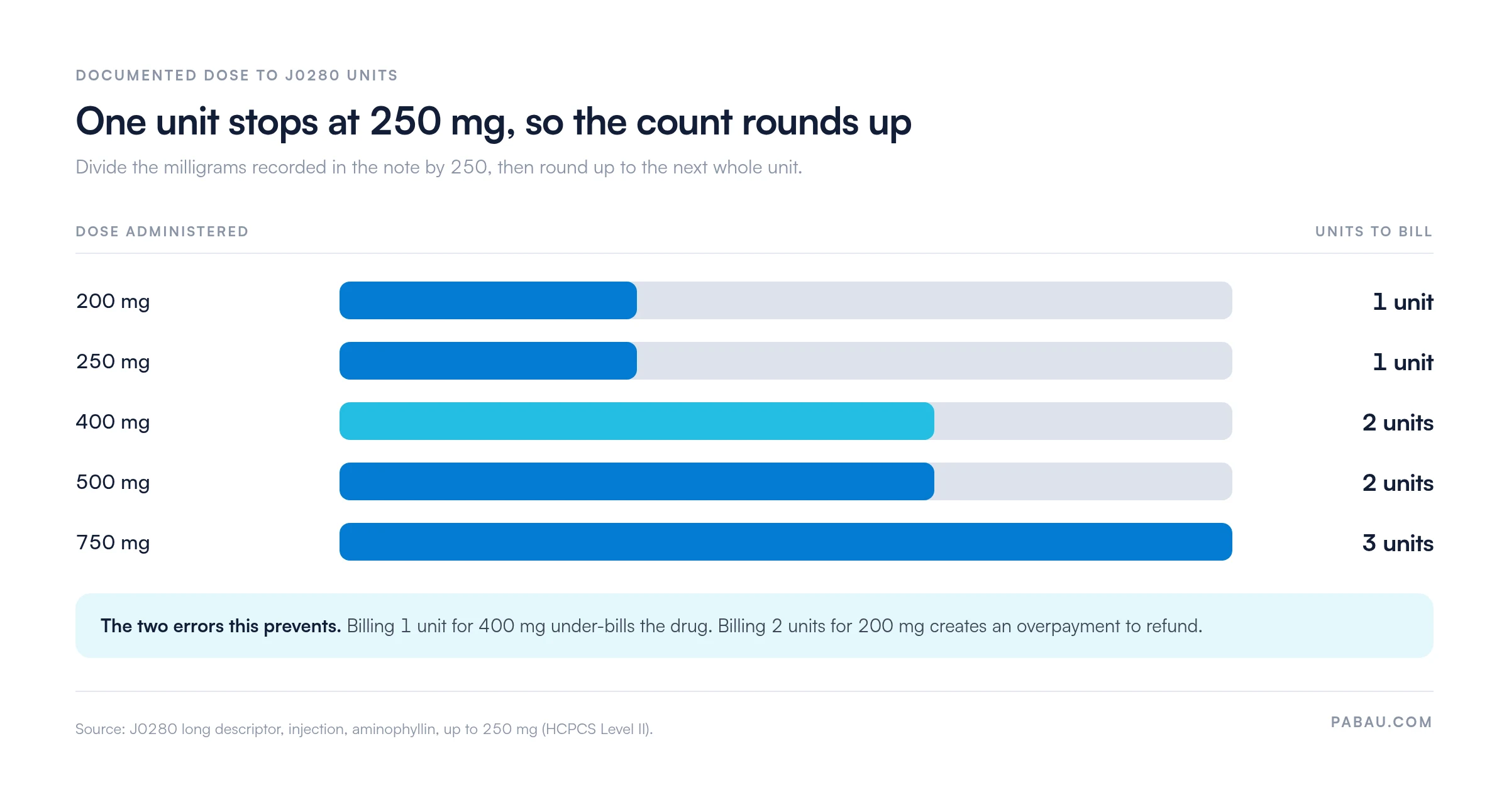
Bill one unit for 400 mg and you under-bill the drug. Bill two for 200 mg and you have an overpayment to give back.
Practices that run an infusion suite hit this math several times a week, so it belongs in the charge template rather than in someone’s head.
Pull a monthly report of J0280 units billed and compare each line against the dose in the chart. A pattern of mismatches is what turns a J-code audit from education into overpayment recovery.
Medicare Part B pays the drug at average sales price, or ASP, plus 6%. That figure is a flat national rate, so locality does not move it.
CMS republishes the ASP file every quarter, which means the aminophylline allowable shifts four times a year. Pull the current quarter from the CMS ASP drug pricing files before you quote a number to anyone.
The administration code beside it behaves differently. Its RVUs run through the physician fee schedule, which adjusts payment by locality using geographic practice cost indices.
So the same encounter pays slightly differently in San Francisco and in rural Kansas, but only on that line. Check it in the CMS fee schedule lookup.
Report the National Drug Code (NDC) printed on the vial you used. Medicare Part B wants it on most drug claims, including J0280, because it identifies the product, the manufacturer, and the package size.
An NDC that does not map to aminophylline injection is a fast rejection. Record it at the time of administration, while the label is in front of you.
Several manufacturers make aminophylline injection, and NDCs differ by manufacturer, package size, and concentration. Products get discontinued and replaced without much notice.
A static NDC list in a spreadsheet goes stale quietly, so treat the vial label as the source and the spreadsheet as a convenience.
Medicare Part B covers J0280 when the injection is medically necessary and given incident to a physician’s service. Beyond that baseline, the detail sits in the local coverage determination (LCD) published by your Medicare Administrative Contractor.
LCDs differ, so a claim that pays cleanly under one MAC can deny under another. Read yours before you assume broad coverage.
Insurance eligibility verification at the scheduling stage catches an exclusion before the drug is drawn up. A patient whose plan excludes the indication deserves that news before treatment, not after a denial.
Commercial policies vary more widely still. Some plans require prior authorization for non-emergent use, while others simply mirror Medicare’s incident-to rules.
An IV therapy service that treats respiratory patients should check the policy for each plan it takes.
When a denial does land, track it at code level. Denial management only works when you can see that J0280 is the line coming back. Read a batch of drug denials as one problem and the pattern stays hidden.
A J0280 claim is only as strong as the note behind it. A denial for lack of medical necessity almost always means the chart never proved the drug was indicated that day. Medical billing compliance rests on having each of these in the record before the claim goes out.
HIPAA-compliant record-keeping keeps that evidence available for as long as your MAC requires, which is typically seven years for Medicare. Internal spot checks of drug administration records are cheaper than an external audit, and they surface the same problems earlier.
The mix-ups are rarely with another bronchodilator. They happen with codes for other drugs given at the same visit.
Before you use any of the codes below, read its current long descriptor, because the dose in the descriptor sets the quantity you can bill.
J1200, the diphenhydramine code, is the one that gets confused with J0280 most often, because a single respiratory or allergy encounter can involve both drugs.
The two drugs share neither their pharmacology nor their billing rules. Submitting one when the other was given is a coding error, and leaving it uncorrected is what turns it into a compliance problem.
Once a quarter, pull every J-code line from your respiratory and allergy encounters and check the code against the drug name in the note. J0280 and J1200 sit side by side on plenty of those visits, which is exactly where the swap happens.
Five steps, in order, and they take about a minute per encounter.
A step you cannot answer from the chart is a reason to hold the claim, not a reason to file it and appeal later. Appeals cost more staff time than a same-day query to the clinician.
A J-code line has more moving parts than most procedure codes. The drug, the administration code, the NDC, the unit count, the diagnosis, and the place of service all have to agree.
When the chart lives in one system and the claim in another, someone retypes each of those by hand. Practices that bill injectable drugs weekly should judge medical billing software on how it handles drug lines, not just office visits.
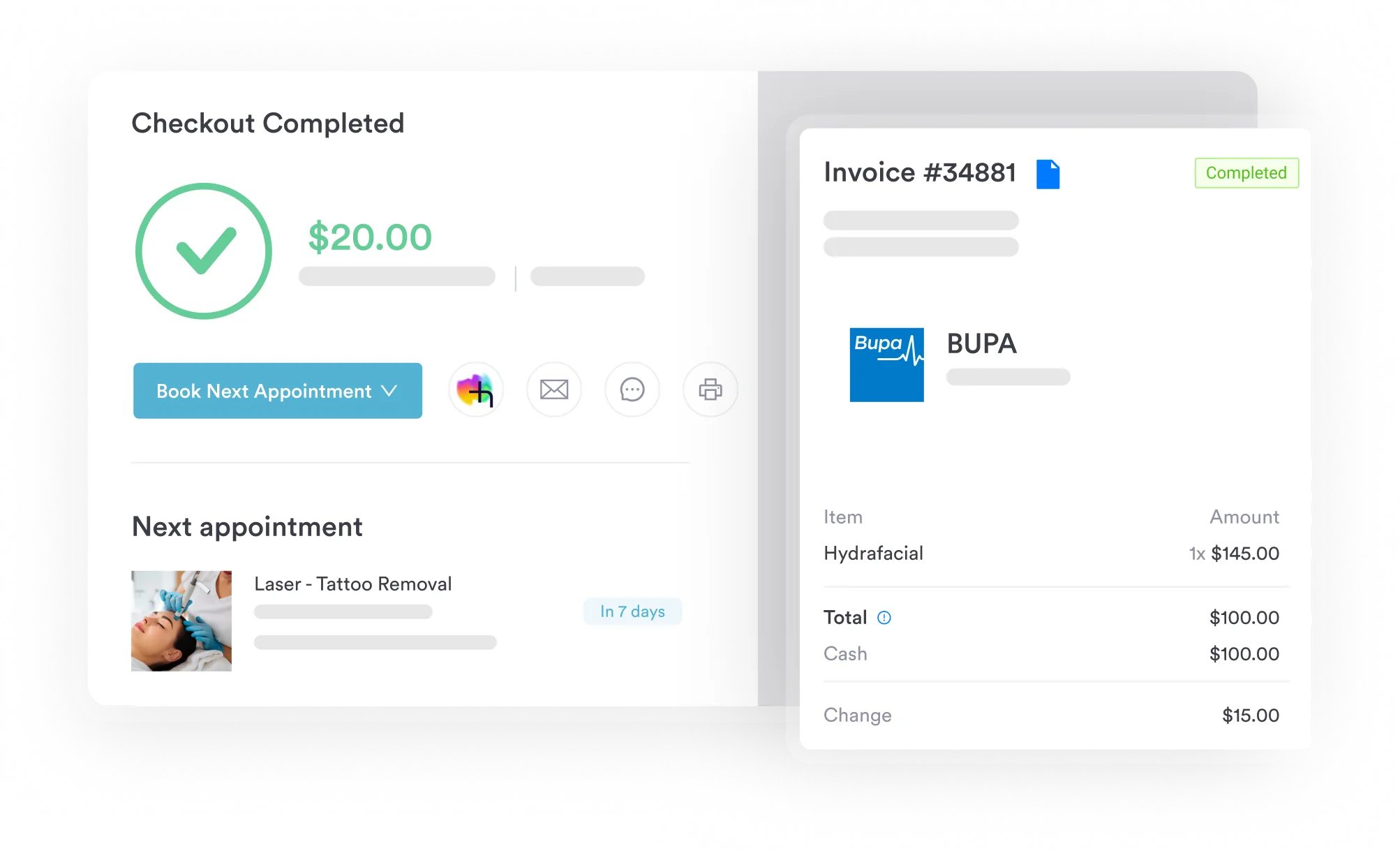
Practice management software like Pabau removes most of that retyping. Its claims management software pre-fills the claim from the encounter.
The code already attached to the service lands on the charge line, and diagnosis slots come from the recorded problem list. Built-in HCPCS, CPT, and ICD-10 lookup libraries let a biller confirm the current J0280 descriptor without leaving the claim. It then checks required fields for completeness before it lets the claim go out.
Submission itself runs through a clearinghouse. In the US that is the Claim.MD integration, which also handles eligibility checks and claim status tracking.
Remittance codes post back against the individual claim line through electronic remittance advice. A run of J0280 denials then shows up without anyone building a tally by hand.

Pabau’s claims management software pre-fills the claim from the encounter, offers HCPCS and ICD-10 lookup libraries, and submits through Claim.MD in the US. Fewer hand-typed fields means fewer J0280 lines coming back.

Three details decide whether a J0280 claim pays: the unit count, the NDC, and a note that justifies the drug. Capture all three at the chairside and the rest of the line falls into place. Chase them a week later and you are rebuilding a story the payer has no reason to accept.
Careful billers help, though a workflow that carries the data forward helps more. When the claim is built from the record, your biller checks fields instead of retyping them.
Book a demo to see how Pabau pre-fills a drug claim from the encounter and tracks what comes back from the payer.

Billing another respiratory drug by injection? J0132 covers the same ground for acetylcysteine, from unit counting to documentation.
Need the unit math on a 500 mg drug code? J1556 walks through immune globulin units and the chart detail payers expect.
Billing a parenteral immunosuppressant? J7525 explains tacrolimus injection billing, including its per-5 mg unit and coverage rules.
Working on an ophthalmic drug claim? J7315 sets out how a 0.2 mg mitomycin unit is reported and supported.
No. Aminophylline is theophylline joined to ethylenediamine, which makes it soluble enough to inject. Theophylline given by injection has its own HCPCS code, J2810, reported per 40 mg. Read the drug name on the vial before you choose between the two.
Yes, when the visit is a separately identifiable service and the note supports both. Append modifier 25 to the evaluation and management code, never to J0280. If the patient came in purely for the injection, bill the drug and the administration code alone.
CMS publishes a medically unlikely edit, or MUE, for most drug codes. A claim above that number denies on the line, however good the documentation is. Look up the current MUE value for J0280 before you submit a high unit count.
No. J-codes describe drugs given by a route other than the mouth, so oral aminophylline never bills under J0280. An oral prescription falls to the patient’s pharmacy benefit, which for most Medicare patients means Part D.



