CCSD code F5010: Parotid duct transposition billing guide
CCSD code F5010 covers parotid duct transposition, one side or both CCSD code F5...

Last Updated: Oct 9, 2026
L0859 is the HCPCS Level II code for addition to halo procedure, magnetic resonance image compatible systems, rings and pins, any material.
The Centers for Medicare and Medicaid Services (CMS) maintains the HCPCS Level II system. It covers durable medical equipment, prosthetics, orthotics, and supplies (DMEPOS) that sit outside the CPT code set. L-codes cover orthotic devices, and L0859 sits in the spinal orthoses subsection directly beneath the halo procedure family. Reading it alongside the rest of that family, rather than on its own, is what makes its billing rules clear.
Let Pabau's smart automation suggest the right codes, reduce claim denials, and keep your practice compliant—effortlessly.
Automate repetitive tasks and focus on what matters most—your patients.
Reduce coding errors and ensure compliance with the latest regulations.
Clean claims, fewer denials, and faster reimbursements.
Powerful insights and reporting to help your practice thrive.
HIPAA compliant SOC 2 certified GDPR-compliant Trusted by 4,000+ clinics worldwide

HCPCS code L0859 is an add-on for MRI-compatible halo rings and pins, in any material.
It is never billed on its own, so a base halo code such as L0830 has to sit on the same claim.
L0859 sits in HCPCS Level II under spinal orthoses, and orthotists or DME suppliers bill it rather than physicians.
Claims fail most often when the physician order and supplier records never state that the components are MRI-safe.
Practice management software like Pabau keeps orders, consent, and delivery records on the patient file, so staff can check documentation before submitting.
L0859 applies when a patient wearing or being fitted with a halo orthosis needs MRI-compatible components. That means rings and pins, in any material, verified as MRI-safe. The clinical scenarios are narrower than the code description suggests.
L0859 is only appropriate when the physician explicitly orders MRI-compatible components. If the order simply says “halo system,” the supplier cannot presume MRI compatibility. The MRI-safe specification has to appear in the written order. Pin insertion itself is a physician service billed under CPT code 20650, and it stays separate from the supplier’s L-code claim.
The decision below runs that test in three steps, in the order a MAC reviewer applies them.
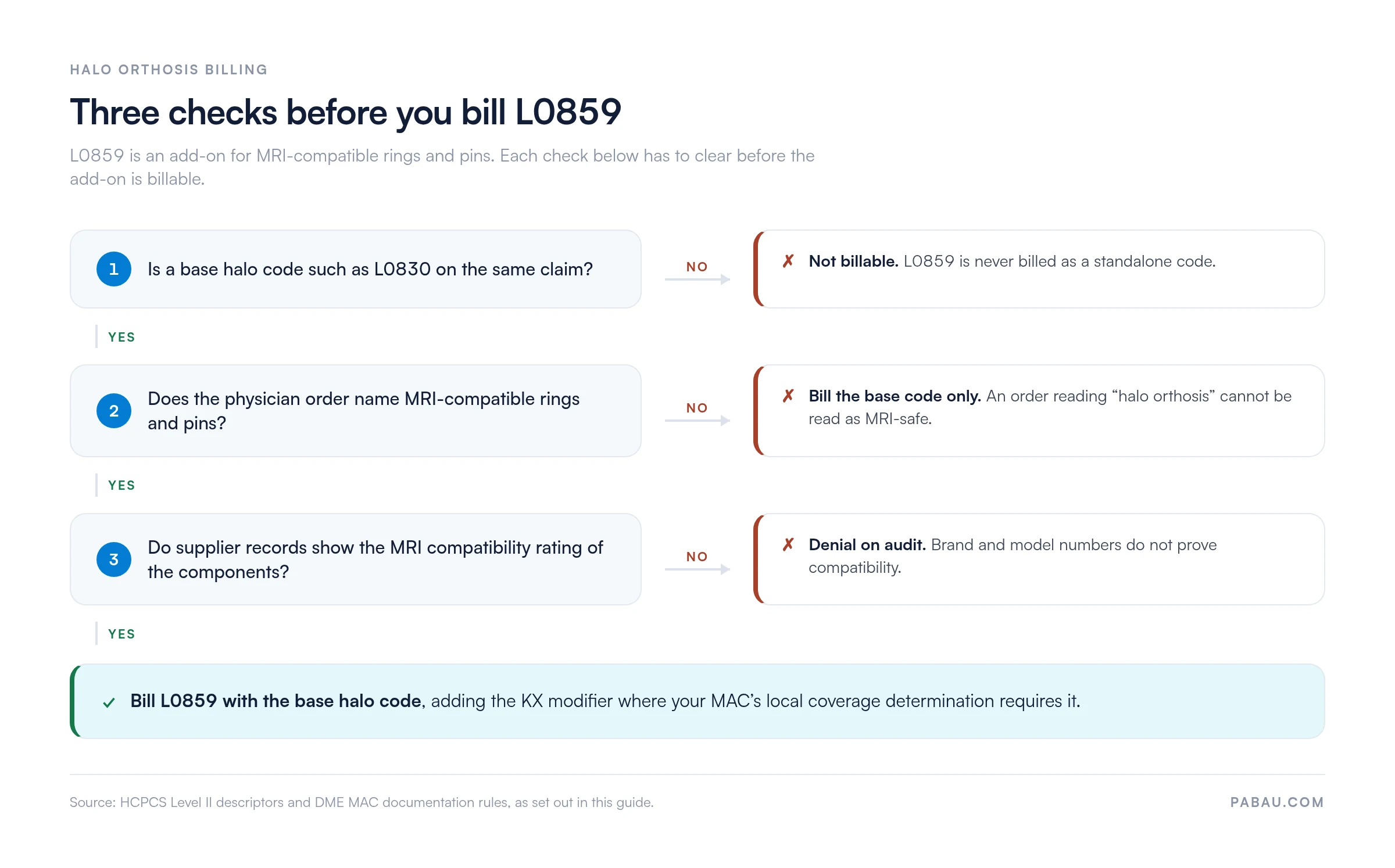
L0830 is the base halo procedure code, covering the complete cervical halo orthosis system. L0859 is always an add-on to L0830 or an equivalent base halo code, and is never billed independently. Confusion between the two drives a large share of halo-related denials. Suppliers bill L0859 without the base code, or bill both without checking which components each one covers.
The Pricing, Data Analysis and Coding contractor (PDAC) publishes advisory guidance on correct coding of halo procedures for DME MAC jurisdictions. Verify the current advisory with your jurisdiction’s MAC before billing, since coding advice is reissued as products change.
CMS publishes DMEPOS fee schedule amounts every year. The 2026 allowable for L0859 reflects its add-on status, so it sits below the L0830 base rate and moves with regional jurisdiction adjustments. Confirm the dollar amount against the CMS fee schedule lookup before you quote it. Rates change each January 1 and vary by locality.
After a claim pays, the electronic remittance advice (ERA) from the payer will show the allowed amount, patient liability, and any adjustment reason codes. Reconcile ERAs for L0859 claims against the CMS fee schedule to catch systematic underpayments before they compound.
Check your MAC’s DMEPOS fee schedule after each quarterly update, not only in January. CMS sometimes adjusts allowables mid-cycle. Set a reminder for the first week of October, January, April, and July to pull the current L-code rates.
Halo add-on codes fail at a rate out of proportion to their volume. L0859 is billed rarely, so billing staff never build up pattern recognition for its rules. The guidelines below reflect standard DME MAC requirements. Always verify them against your MAC’s local coverage determination (LCD) before submitting.
L0859 is billed by orthotists and DMEPOS-enrolled suppliers, not by the ordering physician. The physician writes the order and documents medical necessity. The supplier owns the claim, including MRI-compatibility verification and modifier selection. The order can come from a trauma service, a spine surgeon, or a sports medicine practice, but the claim stays with the supplier.
Confirm that your NPI and DMEPOS enrollment are current before you submit. A medical billing compliance failure at the enrollment level denies every claim you file, not just the one in front of you.
Modifier selection for L0859 depends on payer policy and the billing situation in front of you. The table below covers the modifiers that come up most often. Verify them with your MAC before each submission, since requirements vary by jurisdiction.
Never stack GA and GZ on the same claim, since only one waiver modifier applies per line item. Wrong modifier combinations are among the top reasons DMEPOS claims enter the denial management queue. Build a modifier decision tree into your pre-submission workflow, so staff are not judging a rare code from memory.
Standard halo documentation usually passes review. What goes missing is the MRI-compatibility record, because nobody thought to add it. Auditors and MACs do not infer MRI compatibility from a brand name or a model number, so the record has to state it. The checklist below reflects standard requirements, and your MAC’s LCD may add its own.
A superbill carrying the MRI-compatibility notation next to the order details anchors the documentation for both L0830 and L0859. Building that into your intake workflow heads off document requests when a claim is audited months later.
Medicare Part B covers L0859 when the medical necessity criteria in the applicable LCD are met. The code on its own does not guarantee payment, because the clinical record has to support it. Running insurance eligibility verification before every halo fitting confirms Part B status and any secondary coverage, which decides how the co-insurance gets collected.
Rehabilitation after the halo comes off is billed separately by the treating physical therapy practice. It has no bearing on the L0859 claim, and it does not extend the episode the add-on was billed under.
HCPCS L-codes like L0859 are low-volume, high-scrutiny claims. Billing staff meet them rarely enough that no routine builds up around them. Every claim needs a fresh read of the modifier rules, the documentation list, and the coverage criteria.
Practice management software like Pabau is built for medical aesthetics and private practice rather than DME supply. It will not replace an orthotics-specific billing stack. What it does cover is the record-keeping underneath the claim. Orders, consent forms, delivery confirmations, and clinical notes sit on the patient file, so a biller can see what supports a claim before submission.
Pabau’s claims management software then submits electronically through the Claim.MD integration, and remittances post back against the same patient record. On a rare code, that keeps the review in one place instead of in an appeal three weeks later.
Run a quarterly audit of your L0859 and L0830 claims. Pull any that carry modifier GZ, which flags a claim submitted in the expectation of a denial. If GZ shows up regularly, the problem sits upstream. Either the order workflow is not capturing the MRI-compatible specification, or eligibility is not being checked before fitting.

Pabau keeps orders, consent forms, and delivery confirmations on the patient file, and submits claims electronically through Claim.MD. Your billers can check what supports a claim before it leaves the practice.

L0859 claims fail on documentation rather than on coding. The relationship between the base code and the add-on is simple once you have seen it laid out. What breaks is the handoff, where the MRI-compatible specification never travels from the physician’s reasoning into the supplier’s record.
So build MRI-compatibility confirmation into the order template itself, as a required field rather than a free-text note. Digital forms in Pabau capture that detail as structured data on the patient record. It is then there when a payer asks for it.
That is the difference between a clean first-time claim and a three-week appeal. Book a demo to see how Pabau keeps claim documentation and submissions in one place.

Billing another add-on that cannot stand alone? CPT code 22512 works through the same base-plus-add-on logic for vertebroplasty.
Coding the surgery behind the halo? CPT code 22844 covers posterior segmental instrumentation across 13 or more segments.
Working from a vertebral fracture record? CPT code 22328 sets out what posterior open treatment needs in the documentation.
Billing a fusion alongside an orthotic supply claim? CPT code 22532 explains what the lateral extracavitary approach has to show.
HCPCS code L0859 is an add-on that covers magnetic resonance image compatible systems, rings and pins, of any material, added to a halo procedure. It sits in HCPCS Level II under spinal orthoses. Orthotists and DME suppliers bill it, never as a standalone code.
L0830 is the base halo procedure code covering the complete cervical halo orthosis system. L0859 is always an add-on to the base code, covering only the MRI-compatible rings and pins. L0830 can be billed alone. L0859 cannot, because it needs an accompanying base halo code on the same claim.
Bill L0859 with a physician order that explicitly specifies MRI-compatible components. You also need clinical notes supporting medical necessity, a signed proof of delivery, and product records confirming the MRI compatibility rating. A face-to-face treating physician note within the LCD-specified timeframe is required as well. Verify your MAC’s LCD for any jurisdiction-specific additions.
The most commonly required modifier is KX, which affirms that LCD requirements are met and is required by most MACs for Medicare claims. GA is used when an advance beneficiary notice (ABN) has been signed. GZ applies when coverage is unlikely and no ABN was issued. NU applies for new equipment, UE for used equipment, and RR for rentals. Never append both GA and GZ to the same claim line.
Yes, Medicare Part B covers L0859 when the applicable LCD criteria are met and medical necessity is documented. Coverage is subject to a 20% co-insurance after the deductible. Medicaid coverage varies by state and does not automatically mirror Medicare LCD standards for DMEPOS orthotics.
Only MRI-compatible add-on components qualify for L0859. Standard, non-MRI-safe halo rings and pins are not billable under this code. The MRI compatibility must be explicitly documented in the physician order and supported by product-specific compatibility documentation from the supplier. The code cannot be used for generic halo component upgrades.