

CCSD code G5100: Bypass of duodenum billing guide
CCSD code G5100 bills a bypass that leaves the duodenum in place CCSD code G5100...

Last Updated: Oct 16, 2026
Billable Code
L2030 is the HCPCS Level II code for a custom-fabricated knee ankle foot orthosis (KAFO). The device has double uprights, a free ankle, a solid stirrup, and thigh and calf bands or cuffs. CMS names it a double bar AK orthosis, and the code applies only when the brace has no knee joint.
Most L2030 denials trace back to three mistakes. Suppliers bill it for a custom-fit device, file incomplete medical necessity documentation, or apply the KX modifier before checking the LCD criteria.
Let Pabau's smart automation suggest the right codes, reduce claim denials, and keep your practice compliant—effortlessly.
Automate repetitive tasks and focus on what matters most—your patients.
Reduce coding errors and ensure compliance with the latest regulations.
Clean claims, fewer denials, and faster reimbursements.
Powerful insights and reporting to help your practice thrive.
HIPAA compliant SOC 2 certified GDPR-compliant Trusted by 4,000+ clinics worldwide

HCPCS code L2030 covers a custom-fabricated knee ankle foot orthosis (KAFO) with a thigh band. Ankle foot orthoses are coded L1900 to L1990 instead.
L2020 and L2030 share one descriptor and differ on a single component. L2020 has a knee joint and L2030 does not.
Medicare coverage requires a treating physician order, documented medical necessity per LCD L33686, and a supporting ICD-10 diagnosis code.
The KX modifier is required when billing L2030 to Medicare to attest that all LCD coverage criteria are documented on file.
Practice management software like Pabau helps DMEPOS suppliers track documentation requirements and reduce L2030 claim denials.
HCPCS code L2030 describes a custom-fabricated knee ankle foot orthosis (KAFO). The official descriptor specifies double uprights, a free ankle, a solid stirrup, thigh and calf bands or cuffs, and no knee joint. CMS also names the device a double bar “AK” orthosis. According to the Centers for Medicare and Medicaid Services (CMS), HCPCS Level II L-codes cover orthotic devices billed under the Medicare DMEPOS benefit.
L2030 is not a CPT code, and it is not an ankle foot orthosis code either. Both points cause billing errors. Practitioners searching for a CPT number find nothing, because orthotic devices are billed exclusively under HCPCS Level II L-codes. Coders who read “AFO” into the description reach for the wrong range entirely.
The key components of L2030 are:
Two components carry most of the billing weight. The thigh band places the device above the knee, which is why L2030 belongs to the KAFO range rather than the AFO range. An ankle foot orthosis stops below the knee, and those devices are coded L1900 through L1990.
Custom fabrication carries the rest. It is a specific manufacturing process that produces a device unique to one patient. A custom-fit or off-the-shelf device adjusted at fitting does not qualify, however much adjustment it needed. The difference determines which code applies and whether Medicare will pay.
L2030 sits within the HCPCS L2000 to L2038 range, which covers custom-fabricated knee ankle foot orthoses. Billers often confuse it with codes in the L1900 to L1990 range, which covers ankle foot orthoses that stop below the knee. Neighboring KAFO codes cause trouble too, because several descriptors differ by one component. Fabrication material is one such component, and HCPCS code L2034 covers the full plastic, single upright version. The table below shows the codes most often confused with L2030.
The distinction between L2020 and L2030 is the knee joint. Their descriptors are otherwise identical, so the deciding fact is whether the brace articulates at the knee. L2020 covers the version that does, and L2030 covers the version that does not. Billing one when the other was supplied is a claim accuracy error that triggers denials and audit exposure under DMEPOS review protocols.
Where the brace is a full plastic shell rather than metal uprights with bands and a stirrup, the double upright version codes to L2036.
Collar or cuff material never decides the code in this range. No official descriptor between L2000 and L2038 mentions a leather collar of any kind. A supplier who picks L2030 on that basis has chosen the code on a component the descriptor never names. Four checks on the device itself settle the code, in the order below.
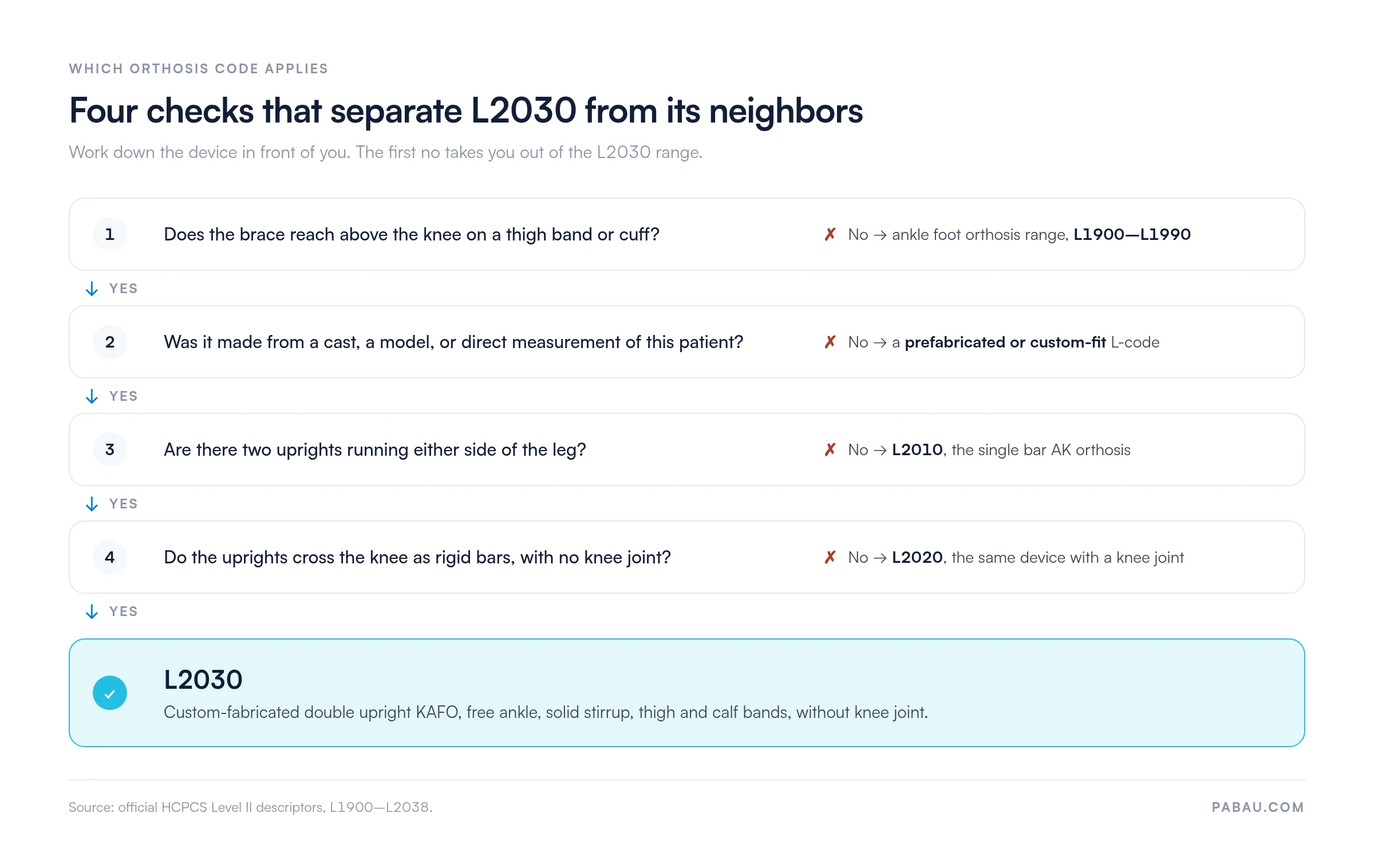
Custom fabricated and custom fit are not interchangeable terms in DMEPOS billing. The difference determines which HCPCS code applies and whether Medicare covers the claim at all.
Billing L2030 for a device that was actually custom-fit rather than custom-fabricated is upcoding. CMS considers this a false claims risk under its DMEPOS program integrity reviews. The supplier’s records must document the casting or direct measurement process to support L2030 on audit. A fitting note on its own will not do it.
Medicare covers custom-fabricated KAFOs billed under L2030 when the beneficiary’s condition meets the criteria in LCD L33686 and CMS Policy Article 52457. That LCD is titled Ankle-Foot/Knee-Ankle-Foot Orthosis and governs both device levels. Coverage requires that the device is expected to improve the patient’s condition or prevent its deterioration. The treating physician must document medical necessity before the supplier delivers the device.
The core coverage requirements are:
Medicare does not cover a device billed under L2030 solely because a physician prescribed one. The clinical record must show the functional impairment and the expected benefit. It must also explain why a custom-fabricated knee-level brace is necessary rather than a lower-cost prefabricated alternative. Coverage detail varies by MAC jurisdiction, so check the criteria your contractor applies before the device is ordered.
LCD L33686 lists the ICD-10-CM codes that support medical necessity for AFO and KAFO coverage. The table below shows commonly accepted diagnosis codes organized by condition category. This list is representative, not exhaustive. ICD-10 code sets are updated annually, so verify current codes against the live LCD in the CMS Medicare Coverage Database.
The ICD-10 code alone does not guarantee coverage. The diagnosis must correlate with the documented functional limitation that makes a custom-fabricated double upright KAFO the clinically appropriate intervention. Knee-level instability, quadriceps weakness, and patellar trauma are the findings that justify a brace extending above the knee. Check the full LCD ICD-10 list against the patient’s record before the claim goes out, since that list is revised annually.
CMS Policy Article 52457 defines the documentation that must be on file before and at the time of billing. Missing any required element is the fastest route to a claim denial or, in a post-payment audit, a recoupment demand. Good documentation habits that support a clean claim submission include verifying completeness before delivery.
Required documentation for L2030 claims includes:
All records must be retained for a minimum of seven years and made available on request during a CMS or MAC audit. Capture each element at the point of service, because a file rebuilt months later rarely satisfies a reviewer.
Build a pre-delivery documentation checklist for every L2030 order: written physician order, face-to-face encounter note, fabrication records (cast or model), and signed delivery confirmation. Verify all four are complete before the device leaves the supplier. Missing fabrication records is the most common audit finding for custom-fabricated KAFO claims and results in full recoupment.
HCPCS code L2030 reimbursement rates are set annually under the CMS DMEPOS fee schedule and vary by Medicare Administrative Contractor (MAC) jurisdiction. The allowed amount reflects a fee-schedule rate, not a charge. Medicare pays 80% of the allowed amount after the beneficiary’s deductible, and the remaining 20% is the beneficiary’s coinsurance responsibility.
Key reimbursement facts for L2030:
For current L2030 allowed amounts by MAC jurisdiction, search the CMS DMEPOS fee schedule file for your contractor and locality. Suppliers carrying several DMEPOS product lines should re-check those figures every January, when the new schedule takes effect.
Modifiers tell Medicare why a claim is being submitted and whether specific documentation conditions are met. For DMEPOS claims including L2030, modifier selection is not optional. Incorrect or missing modifiers are a direct denial trigger.
The KX modifier carries the highest compliance risk. Applying it attests to Medicare that all LCD coverage criteria are satisfied and that supporting documentation exists in the supplier’s files. Suppliers audited after submitting L2030 claims with KX who cannot produce complete documentation face full recoupment. Treat KX as a compliance certification, not a billing convenience. Refer to CGS Medicare DMEPOS coding guidance for jurisdiction-specific modifier requirements.
L2030 has one of the higher denial rates among custom-fabricated DMEPOS codes, largely because billers and suppliers conflate clinical and billing concepts. The most frequent denial reasons are consistent across MAC jurisdictions and identifiable before claim submission with the right review process. Reading the medical billing denial codes on the remittance tells a team which of them caused a given rejection.
Practices and suppliers that run DMEPOS claims through software that prevents denials catch these errors at review rather than after a rejection. A pre-submission documentation checklist mapped to LCD L33686 criteria catches the majority of L2030 denial triggers at the review stage.
DMEPOS suppliers must meet specific CMS accreditation requirements before they can bill Medicare for L2030. These requirements are set out under 42 CFR Part 424, Subpart D, at §424.57, and enforced through CMS and MAC provider enrollment processes.
Suppliers working with ordering practices across orthopedics, neurology, and rehabilitation medicine benefit from standardized order intake processes. Verifying physician enrollment status when the order arrives, rather than at billing, prevents a denial that cannot be corrected afterwards. Build that check into the intake form so it happens before anyone casts a device.
Verify the ordering physician’s Medicare enrollment status before accepting an L2030 order. Use the CMS PECOS lookup to confirm active enrollment. A lapsed or opted-out physician’s order results in a claim denial that cannot be corrected retroactively. The order must be re-issued by an enrolled provider, which delays delivery and payment.
Most suppliers track L2030 orders across a scheduling system, a shared drive of scanned physician orders, and a spreadsheet of submitted claims. The fabrication records that prove custom manufacture usually sit somewhere else again. When a MAC requests documentation, the team rebuilds the file from four places under a deadline.
Practice management software like Pabau keeps the whole chain on one patient record. The written physician order, the face-to-face encounter note, the cast record, and the signed delivery confirmation all attach to the same patient. The L2030 audit file is therefore assembled before the claim goes out, not after a MAC questions it.
Custom forms let you build the LCD L33686 checklist once and apply it to every knee-level orthosis order your team takes. Staff cannot mark an order ready for billing while a required element is outstanding. That single control removes two of the most common denial reasons. Fabrication records stop going missing, and nobody applies a KX modifier before the criteria are verified.

Pabau helps DMEPOS suppliers and ordering practices track documentation requirements, manage claim submissions, and reduce L2030 denials before they happen. See how the claims management tools work in practice.

L2030 is a knee ankle foot orthosis code, and treating it as an ankle foot orthosis code is where most trouble with it starts. The thigh band puts the device above the knee. The absent knee joint separates it from L2020, and custom fabrication separates it from a device fitted from stock. Check those three components against the device supplied and the code follows.
The denials that follow are preventable at the desk, not in the clinic. Wrong code for the device level, missing fabrication records, and a KX modifier applied ahead of the documentation account for most of them. A checklist built from LCD L33686 and run before delivery catches all three.
Pabau brings DMEPOS documentation and claim workflows into one place. Suppliers and ordering practices can build pre-submission checklists and track LCD compliance requirements alongside the patient record. To see how it handles DMEPOS billing in practice, book a demo.

Need a framework for reducing claim denials across all DMEPOS codes? Denial management in healthcare covers how to build a structured denial tracking and appeals workflow.
Want to understand how clean claim standards apply to DMEPOS billing? Clean claim submission requirements explains the elements Medicare checks before processing payment.
Looking to align your documentation workflows with HIPAA and payer standards? Medical billing compliance guidance outlines the documentation and retention requirements that apply across DMEPOS suppliers.
HCPCS code L2030 is a Level II DMEPOS billing code for a custom-fabricated knee ankle foot orthosis (KAFO). The device has double uprights, a free ankle, a solid stirrup, and thigh and calf bands or cuffs, and it has no knee joint. CMS also calls it a double bar AK orthosis. It must be manufactured from a cast or direct measurement of the individual patient.
No. L2030 is a knee ankle foot orthosis code. Its descriptor includes a thigh band or cuff, which places the device above the knee. Ankle foot orthoses stop below the knee and are coded in the separate L1900 to L1990 range.
L2030 is an HCPCS Level II code, not a CPT code. Knee ankle foot orthoses and other orthotic devices are billed under HCPCS L-codes, which sit within the Medicare DMEPOS benefit. CPT codes cover physician services and procedures instead.
The knee joint. L2020 and L2030 share the same descriptor for a custom-fabricated double upright KAFO with a free ankle, a solid stirrup, and thigh and calf bands. L2030 applies when the brace has no knee joint, and L2020 applies when it has one. No other component separates the two codes.
Yes, Medicare covers L2030 when the beneficiary meets the coverage criteria in LCD L33686. The beneficiary needs a documented condition expected to improve with the orthosis and a supporting ICD-10 diagnosis code listed in the LCD. A treating physician must order the brace after a face-to-face encounter, and an accredited DMEPOS supplier must bill the claim.
Billing L2030 requires a written physician order, a face-to-face encounter note predating the order, and clinical records documenting medical necessity. You also need fabrication records confirming the device was custom-made for the patient and a signed delivery confirmation. The supplier’s DMEPOS accreditation and Medicare billing number must both be valid.
The KX modifier is required when billing L2030 to Medicare. It attests that all LCD L33686 coverage criteria are met and that supporting documentation is on file with the supplier. If the beneficiary does not meet coverage criteria, use the GA modifier (ABN on file) or the GY modifier (non-covered item) instead. A laterality modifier (RT or LT) is also required.



