CCSD code F5010: Parotid duct transposition billing guide
CCSD code F5010 covers parotid duct transposition, one side or both CCSD code F5...

Last Updated: Oct 9, 2026
J1556 is the HCPCS Level II code for injection, immune globulin (bivigam), 500 mg.
The official long description reads: "Injection, immune globulin (Bivigam), 500 mg." Bivigam is the only product billed under this code. The 2026 change billing teams need to know sits next to J1556 rather than inside it. Qivigy, the new immune globulin from Kedrion Biopharma, has a code of its own: J1577.
Mixing up those two codes is an expensive way to lose a high-cost infusion claim. It also marks the exact point where J1577 takes over.
Let Pabau's smart automation suggest the right codes, reduce claim denials, and keep your practice compliant—effortlessly.
Automate repetitive tasks and focus on what matters most—your patients.
Reduce coding errors and ensure compliance with the latest regulations.
Clean claims, fewer denials, and faster reimbursements.
Powerful insights and reporting to help your practice thrive.
HIPAA compliant SOC 2 certified GDPR-compliant Trusted by 4,000+ clinics worldwide

HCPCS code J1556 covers injection of immune globulin (Bivigam) and is reported per 500 mg administered.
Bivigam is licensed to ADMA Biologics, which acquired the product from Biotest Pharmaceuticals in 2017.
Qivigy is not billed under J1556. It has its own code, J1577, reported per 100 mg and effective July 1, 2026.
Medicare pays J1556 under ASP+6% and the rate moves every quarter, so read the current CMS ASP file instead of hardcoding a figure.
Unit miscalculation and the wrong modifier (JW, JZ, EY) cause most J1556 denials.
Practice management software like Pabau carries the administered dose onto the claim, so the units on the claim match the infusion record.
Bivigam is the only drug billed under HCPCS code J1556. The code description names the product directly, so J1556 is product-specific rather than a general immune globulin code.
Record the product name, lot number, and National Drug Code (NDC) in the infusion record for every administration. Several Medicare Administrative Contractors (MACs) require NDC detail on the claim line for drug J-codes, and the record is what supports it on review.
Qivigy is billed under J1577, not J1556. CMS created J1577, “Injection, immune globulin (qivigy), 100 mg,” in the quarterly HCPCS update effective July 1, 2026.
The unit size is the part that catches billers out. J1556 is reported per 500 mg, while J1577 is reported per 100 mg. The same 10,000 mg dose is therefore 20 units of J1556 or 100 units of J1577. The comparison below runs that math across common doses.
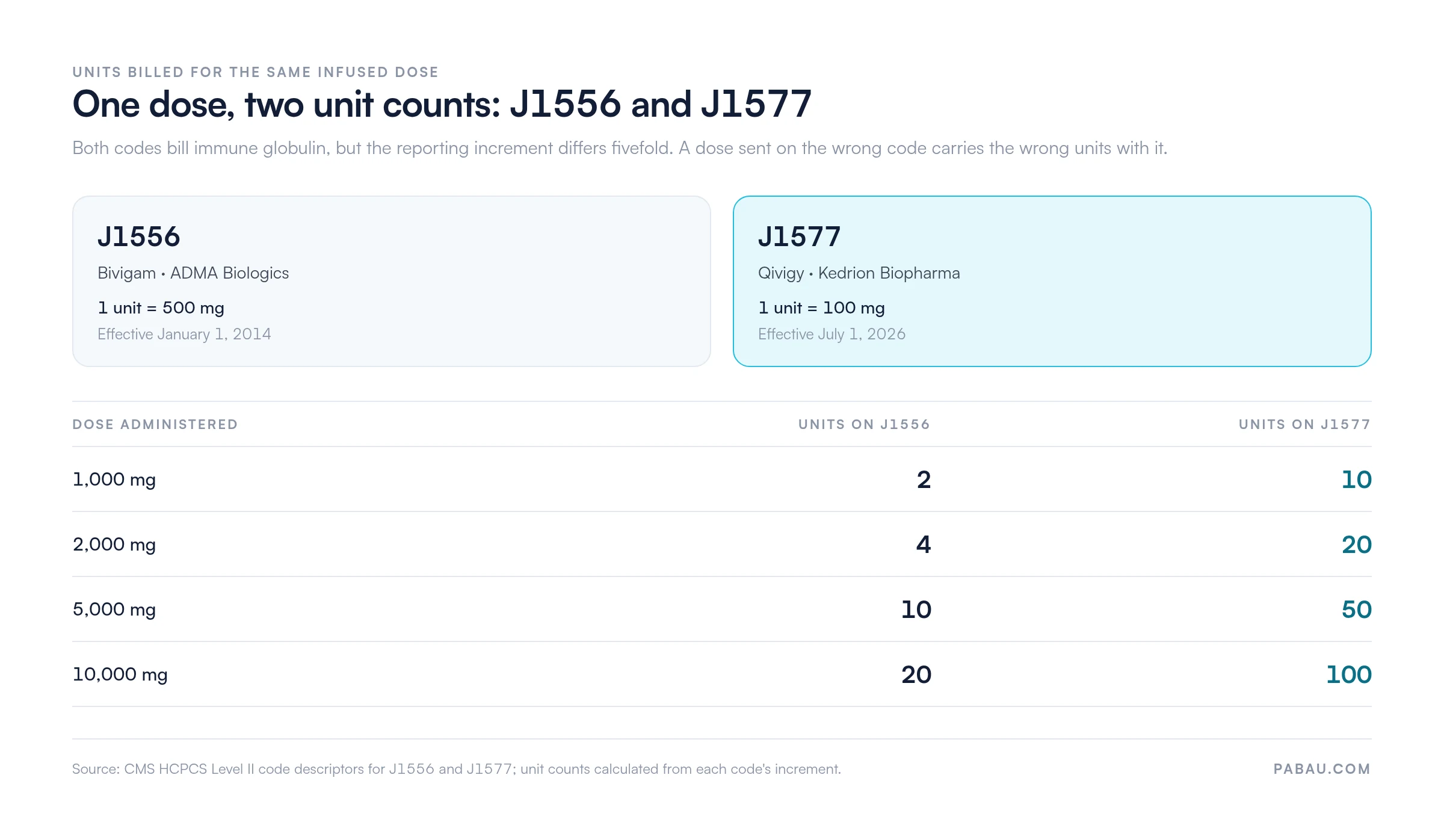
Practices that added Qivigy to their formulary in 2026 should check how the product is mapped in their charge master and their claim scrubber. A Qivigy dose submitted on J1556 is a product mismatch, and it invites a denial or a recoupment after payment.
Unit miscalculation is the leading cause of J1556 claim denials. The reporting unit for HCPCS code J1556 is 500 mg. Divide the total dose administered, in milligrams, by 500 to get the number of units to report.
Formula: Total dose administered (mg) divided by 500 mg = units to bill.
For weight-based dosing, common in primary immunodeficiency and CIDP protocols, calculate the total mg from the patient’s weight and then divide by 500. Round to the nearest whole unit. Vial overfill never counts toward billable units. Only the amount infused into the patient is billable. Do not carry the 500 mg increment across to other drug codes, since J7187 is reported per 100 IU.
Medicare Part B reimburses HCPCS code J1556 using the Average Sales Price (ASP) methodology. The standard payment rate is ASP+6% for the drug component, the CMS Part B formula applied to most single-source biologics. Reimbursement is adjusted quarterly as ASP data updates, so the Q1 rate may differ from the Q3 rate in the same year.
Do not hardcode a dollar figure into an internal billing reference sheet. A rate that was accurate last quarter may be wrong today. The CMS Physician Fee Schedule lookup tool gives current allowable amounts by HCPCS code and place of service. For revenue cycle management teams, a standing quarterly reminder to check ASP updates on high-cost drugs like Bivigam prevents quiet under-billing after a rate change.
J1556 pays for the drug alone. The infusion itself is billed separately, with 96365 for the initial hour and its add-on codes for each hour after that. Dropping the administration code leaves the visit underbilled even when the drug units are right.
Reimbursement also varies by site of service. A claim submitted with place of service code 11 for an office is paid differently from one submitted under place of service 22. The drug is the same, but the setting changes the rate. Confirm the rate for your facility type each quarter in the CMS ASP drug pricing files.
Medicare coverage for J1556 runs through LCD L34007 and its paired billing article A57778, published by First Coast Service Options. Claims need a covered ICD-10-CM diagnosis code behind them, and a missing or unsupported diagnosis is one of the fastest routes to a denial. In infusion therapy software, linking the diagnosis to the order at the point of care stops that problem upstream.
This table reflects common covered diagnoses from CMS article A57778. Check the current text of LCD L34007 in the CMS Medicare Coverage Database before you submit, because covered diagnoses do get revised. Commercial payer approval lists can differ substantially from Medicare’s covered indications.
Before submitting a J1556 claim for CIDP (G61.81), check whether the patient’s commercial plan requires prior authorization. Medicare usually does not require it for CIDP-indicated IVIG, but most commercial plans do. Verify eligibility and prior auth status at the start of each infusion series rather than visit by visit. One retrospective denial can otherwise wipe out a whole course of treatment.
Modifier selection is where a large share of J1556 claims fail after submission. Three modifiers matter most for this code, and the right choice depends on what happened to the vial during the infusion. Building denial management practices for infusion drug codes into onboarding pays for itself with the first avoided recoupment.
Every Part B claim for a single-dose vial with zero waste carries JZ, in every MAC jurisdiction. CMS discarded drug policy has required it since July 1, 2023, with claim edits in force since October 1, 2023. Applying JZ where JW belongs, or the reverse, is a common error that holds up payment. The same rules cover a Qivigy infusion billed on J1577 and other single-dose vial drugs such as J0132. One internal waste policy can serve them all.
Where Bivigam is administered affects both the applicable reimbursement rate and the documentation you need. Pick the place of service code that matches the setting where care is delivered.
Independent infusion suites, including those inside regenerative medicine practices, report POS 49 rather than POS 11. Run insurance eligibility verification before the appointment to confirm the plan covers infusion in that setting.
CMS article A57778 and LCD L34007 set out what the medical record must show to support a J1556 claim. Thin documentation is the main reason claims pass initial submission and then fail on audit or medical review.
Keep documentation for as long as your payer contracts and HIPAA standards require. Medicare expects records to be retained for at least seven years from the date of service.
A clean J1556 claim follows the same seven steps every time. Turning them into a standard billing checklist cuts the rework that avoidable denials create. Pabau’s claims management software captures these fields at the time of service, so nobody reconstructs them from the chart a week later.
Medicare Part B covers immune globulin given by injection or infusion when it is medically necessary for an approved indication. Coverage for Bivigam sits under LCD L34007 and CMS billing article A57778. Covered conditions include primary immunodeficiency disorders, CIDP, immune thrombocytopenic purpura, and the other diagnoses listed in the LCD.
Medicare generally does not require prior authorization for IVIG in covered indications, while commercial payers almost always do. A medical billing compliance approach to high-cost drugs means checking commercial prior auth requirements at the start of each infusion course rather than per visit.
Limitations include quantity restrictions on some indications and, for others, documented treatment failure with alternative therapies. Read the current LCD for the limitations in force on your date of service.
Immune globulin J-codes are product-specific, and each one carries its own dose increment. Billing the wrong one is a coding error rather than a rounding issue. Use the table below to confirm J1556 is the right code before submission. The AAPC’s HCPCS code lookup lets billers cross-reference a product name to its J-code while the claim is still open.
The CMS HCPCS system holds the definitive list of drug J-codes and the products they map to. That mapping moves when a manufacturer rebrands a product or a new immune globulin is approved, as J1577 shows. Codes also get retired, so a deleted code such as J3487 has to be crosswalked to its replacement before the next claim. For an immune globulin product with no code of its own, check J3490 for unclassified drugs or ask your MAC.
Put a quarterly HCPCS review in the billing calendar. Product-to-code mapping for immune globulins changes, and J1577 is the current example. Qivigy arrived with its own code and its own 100 mg unit rather than joining J1556. Billing a new product under an old J-code triggers recoupment, so check the quarterly update file before the first claim goes out.
In most infusion practices, a J1556 claim is built twice. The nurse charts the dose during the visit, and a biller retypes the milligrams into the claim afterwards. Each retype is another chance to send a unit count that does not match the chart.
Practice management software like Pabau keeps the administered dose, the diagnosis, and the code on one record. Your team charts the infusion once, and the claim picks up the units and the waste modifier from that entry. Claims then leave through our Claim.MD integration, the clearinghouse Pabau submits electronic claims through.
The outcome is fewer unit-count denials and less month-end rework for a small billing team. When a payer queries a claim, its history shows what was infused and what was billed. Your biller can answer in minutes.

Pabau carries the administered dose onto the claim, applies the JW or JZ modifier, and submits through Claim.MD. Your billers stop rebuilding unit counts by hand, and denials stop arriving for arithmetic nobody can trace.

Accurate J1556 billing rests on three things. The right units, the right modifier, and documentation that matches what was actually infused.
The code itself did not change for 2026. What changed sits beside it. Qivigy bills under J1577 at 100 mg per unit from July 1, 2026. Any code library or charge master that still points Qivigy at J1556 needs correcting before those claims go out.
For a team running several IVIG patients across a mixed payer panel, a structured workflow keeps reimbursement steady. Without one, the denial backlog grows. Book a demo to see how Pabau supports HCPCS J-code billing from documentation through claim submission.

Billing another IVIG product? J1568 covers Octagam at 500 mg per unit, with the same JW and JZ waste rules.
Moving a patient to subcutaneous dosing? J1562 is deleted, and seven product-specific codes now cover subcutaneous immune globulin.
Handling Rho(D) immune globulin in obstetrics? J2788 is the minidose code, reported in micrograms rather than milligrams.
Billing other high-cost biologics? J7189 shows how a per-microgram increment changes the unit count on a factor product.
HCPCS code J1556 bills the injection of immune globulin (Bivigam) given intravenously, reported per 500 mg administered. It is a Level II HCPCS J-code for drugs administered by routes other than oral. The code applies to Medicare Part B and to most commercial payers that cover IVIG therapy.
Bivigam, immune globulin intravenous 10% liquid, is the only drug billed under J1556. The product is licensed to ADMA Biologics, which acquired it in 2017. Biotest Pharmaceuticals held the original 2012 FDA approval, so older reference pages still name Biotest as the manufacturer.
No. Qivigy, the immune globulin from Kedrion Biopharma, has its own HCPCS code: J1577, “Injection, immune globulin (qivigy), 100 mg,” effective July 1, 2026. The unit differs as well, since J1577 is reported per 100 mg and J1556 per 500 mg. Submitting a Qivigy dose on J1556 is a product mismatch.
Bill one unit of J1556 per 500 mg administered. Divide the total dose in mg by 500 to get the units, so a 2,000 mg dose is 4 units. Report administered units only, because vial overfill does not count toward billable units.
Primary immunodeficiency disorders (D80-D84) and chronic inflammatory demyelinating polyneuropathy (G61.81) are the most common covered diagnoses under LCD L34007. Other approved diagnoses include immune thrombocytopenic purpura (D69.3) and autoimmune hemolytic anemia (D59.1). Check the current LCD for the full list.
J1556 covers Bivigam, while J1561 covers Gamunex-C and Gammaked. Both are reported per 500 mg of intravenous immune globulin, but each code is tied to its own products. Billing J1561 for a Bivigam infusion, or the reverse, is a coding error that can trigger recoupment.
Append JW when part of the vial is discarded, and JZ to attest zero waste when the full vial is administered. EY signals the absence of a physician order and is used only when no order is on file. CMS requires JZ on every Part B single-dose vial claim with no waste, nationwide. All MACs have edited claims for it since October 1, 2023.