CPT code 93503: Swan-Ganz catheter billing and modifiers
CPT code 93503: Official descriptor and procedure overview In the AMA CPT code s...

Last Updated: Oct 23, 2026
H0036 is the HCPCS Level II code for community psychiatric supportive treatment, face-to-face, per 15 minutes.
Let Pabau's smart automation suggest the right codes, reduce claim denials, and keep your practice compliant—effortlessly.
Automate repetitive tasks and focus on what matters most—your patients.
Reduce coding errors and ensure compliance with the latest regulations.
Clean claims, fewer denials, and faster reimbursements.
Powerful insights and reporting to help your practice thrive.
HIPAA compliant SOC 2 certified GDPR-compliant Trusted by 4,000+ clinics worldwide

HCPCS code H0036 describes community psychiatric supportive treatment (CPST), face-to-face, billed in 15-minute increments.
H0036 is not payable by Medicare in most cases and is covered primarily through state Medicaid programs with rates varying by state.
Providers must document the start and end time of each CPST session, a qualifying ICD-10 diagnosis, and a treatment plan signed by a qualified mental health professional.
Practice management software like Pabau helps behavioral health practices track session units, attach documentation, and submit Medicaid claims accurately.
The official long description, as maintained by the Centers for Medicare and Medicaid Services (CMS), is: Community psychiatric supportive treatment, face-to-face, per 15 minutes.
H0036 falls under CMS’s Mental Health Programs category within the HCPCS Level II code set. It was added to the HCPCS registry on January 1, 2003, with action code N (no maintenance), meaning it has remained stable with no substantive definitional changes since introduction.
You will often see H0036 called a “CPT code” in billing tools and search results, but that is a misnomer. H0036 is a HCPCS Level II code maintained by CMS, not a Current Procedural Terminology (CPT) code. CPT codes are five-digit numeric codes maintained by the American Medical Association, while HCPCS Level II codes like H0036 begin with a letter. The H0036 code description stays the same whichever term a payer’s system happens to use. Coding compliance rests on the note supporting the code, every time, not on the code being plausible.
Community Psychiatric Supportive Treatment (CPST) refers to a range of face-to-face, community-based mental health services delivered to individuals with serious mental illness (SMI).
CPST aims to support community integration, functional recovery, and psychiatric stabilization outside of inpatient or residential settings. Services typically include skills training, psychoeducation, care coordination, and supportive counseling delivered in natural community environments such as the patient’s home, workplace, or community center. Care coordination delivered under CPST can overlap with targeted case management.
In most states, the code is payable when services are rendered by or under the supervision of a qualified mental health professional (QMHP). Eligibility is defined at the state plan level, not by CMS directly.
Providers who commonly bill H0036, depending on state Medicaid rules, include:
The billing entity is typically the community mental health center or behavioral health agency, not the individual clinician. Services may be rendered by a staff member under a QMHP’s clinical oversight, provided the state plan permits delegated service delivery and the supervising QMHP countersigns required documentation.
Billing under a psychiatry or behavioral health practice requires confirming that the rendering provider meets the state’s QMHP credentialing standards before submitting any H0036 claims. Some states publish approved provider type lists in their Medicaid billing manuals. Check your state Medicaid agency’s behavioral health fee schedule or provider handbook before billing.
Check your state Medicaid behavioral health manual before billing H0036. Provider eligibility, daily unit limits, and documentation requirements are set at the state level and can differ significantly from neighboring states. A Texas CPST program may have different QMHP credentialing thresholds than a Colorado program billing identical services.
Each H0036 session note must include all of the following to withstand audit review:
The treatment plan must be updated at intervals specified in the state Medicaid plan, typically every 90 or 180 days.
Services rendered without a current, signed treatment plan on file are not billable under H0036, regardless of how well the session is documented. Standardizing the initial workup with an assessment and evaluation template helps practices open a compliant treatment plan before CPST services begin.
Using digital intake forms and templated session notes reduces the risk of missing required fields. A structured psychiatric evaluation workflow ensures initial assessments capture the diagnostic information needed to open a CPST episode of care.
A consistent note structure also supports HIPAA-compliant documentation practices, which behavioral health records require just as much as clinical accuracy.
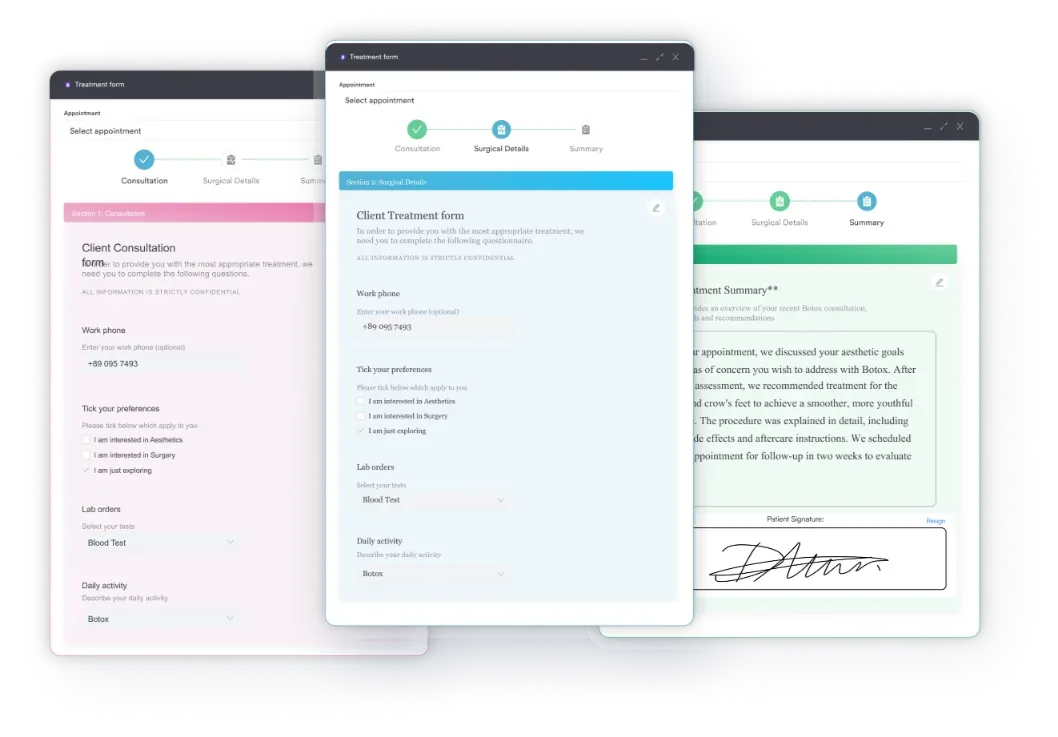
Many CPST providers use a modified SOAP format for H0036 session notes. The Objective section should include the exact start and end time and the place of service. The Assessment section should reference the active treatment plan goals addressed. The Plan section should document next-session objectives and any changes to the support approach.
Whatever format the provider uses, the note must support the number of units billed on that date of service. Under the 8-minute rule commonly applied to time-based codes, a 45-minute session and a 40-minute session both support three units, though state Medicaid plans may specify their own rounding conventions.
Confirm your state’s rounding methodology before applying it to H0036 claims.

Pabau’s claims management software helps behavioral health practices track session units, attach CPST documentation, and submit Medicaid claims accurately. Fewer denials, less rework.

H0036 is billed per 15-minute increment of face-to-face contact. The number of units on the claim must correspond to the documented service duration.
State Medicaid programs typically set a maximum daily unit limit for H0036, often in the range of 8 to 16 units (2 to 4 hours) per day, though this varies by state. Some states apply an annual or monthly unit cap as well.
Travel time, documentation time, and supervisory consultation time are not billable under H0036. Only the face-to-face portion of the service counts toward units. If a provider spends 30 minutes driving to a client’s home and 45 minutes in direct service, the claim supports three units, not eight.
State Medicaid programs may require specific modifiers on H0036 claims. The most common include:
Several states also stack service-identifying modifiers onto H0036 to distinguish who received the service. Kansas Medicaid, for instance, separates CPST for children (HA), adults (HB), and co-occurring or dual-diagnosis cases (HH) using modifiers on the same base code.
Missing or mismatched service modifiers are a frequent cause of state-level denials, so the modifier set is as important as the base code itself.
Using automated billing workflows that flag required modifiers at claim submission reduces the risk of submitting H0036 claims without state-mandated modifier attachments, a common source of avoidable denials.
H0036 services are delivered in community settings, so the place of service (POS) code on the claim must reflect the actual service location. Common POS codes for CPST include:
Audit your H0036 claims quarterly for place of service consistency. A claim with POS 12 (home) should have a session note documenting service at the client’s residence. A mismatch between the POS code and the documented service location is an audit flag that can trigger recoupment of otherwise valid claims.
Other behavioral health HCPCS codes get confused with H0036 too. H0004 covers general behavioral health counseling rather than CPST’s community-based skills training.
The choice between H0036 and H0037 depends on how your state Medicaid program has structured CPST reimbursement, not on clinical preference. Some states require H0036 (time-based) exclusively, while others allow or require H0037 (per diem) for program-enrolled clients receiving multiple CPST contacts in a single day.
Using H0036 when your state requires H0037 for program billing results in claim rejection, not just denial, because the billing model is incompatible.
H0039 covers Assertive Community Treatment (ACT), a specific evidence-based model that requires a multidisciplinary team structure, a designated team leader, psychiatrist involvement, and a specific caseload ratio. ACT is a more intensive level of care than general CPST, and billing H0039 requires that the program is formally structured as an ACT team per CMS and state Medicaid requirements.
General CPST providers cannot substitute H0039 for H0036 to obtain higher reimbursement rates. Some programs bill intensive outpatient psychiatric services under S9480 as a separate program model entirely, so confirm which code set your state requires based on program structure, not diagnosis alone.
ACT teams that bill a full program day instead of 15-minute units report H0040, the per diem assertive community treatment code.
H0036 requires a supporting ICD-10 diagnosis that establishes medical necessity for community psychiatric supportive treatment. Common paired diagnoses include schizophrenia spectrum disorders such as F20.9 and bipolar disorders such as F31.
Other qualifying diagnoses include major depressive disorder with psychotic features.
Some states also extend H0036 to autism spectrum and eating disorder diagnoses when CPST is in the approved service array. Screening tools such as an autism pattern recognition test or a binge eating disorder quiz can support that initial diagnostic workup.
Always confirm your state Medicaid’s covered diagnosis list before billing CPST for a diagnosis outside the core SMI categories.
H0036 is not payable by Medicare in most cases. The code is classified as non-covered by the Medicare fee schedule, and the CMS fee schedule lookup confirms no Medicare payment rate is established for this code. For dual-eligible clients (Medicare and Medicaid), H0036 services are billed to Medicaid only, not to Medicare as primary.
The H0036 reimbursement rate varies by state. Most states reimburse per 15-minute unit, with rates typically influenced by provider credential level, program type, and geographic factors. Because Medicaid is administered at the state level, the rate in one state cannot be applied to billing in another.
To find current rates, consult your state Medicaid agency’s behavioral health fee schedule, which is typically published annually through the provider portal. State agencies such as Ohio Medicaid list their CPST rates and unit limits directly in that schedule, so the fee schedule is the authoritative source rather than any third-party rate estimate.
To look up current HCPCS H0036 code properties and any Medicare fee schedule reference values, the AAPC Codify HCPCS lookup and the PGM Billing HCPCS lookup provide free access to CMS-sourced code data.
Behavioral health billing teams encounter several recurring denial patterns with H0036:
Using claims management software that validates documentation completeness before submission catches most of these errors at the practice level, before the claim reaches the Medicaid payer. Practices using Pabau can attach session notes, treatment plans, and provider credentials directly to claims, creating an audit-ready record at the point of submission.
This is especially useful for behavioral health teams managing high volumes of H0036 units across multiple community-based staff, where tracking documentation against individual claims manually creates significant administrative risk.
HCPCS code H0036 is the primary billing vehicle for community psychiatric supportive treatment in Medicaid-funded behavioral health programs. Its time-based structure demands precise documentation, and its state-level variation means that no two Medicaid programs administer it identically. The most common billing failures are preventable: missing start/end times, expired treatment plans, and unit counts that exceed documented durations.
Pabau’s claims management software helps behavioral health and community mental health practices build documentation workflows that support H0036 claims from intake through submission. For teams looking to reduce administrative burden in behavioral health billing, book a demo to see how Pabau handles behavioral health claims workflows end to end.

Coding a confirmed magnesium deficiency? Hypomagnesemia coding guide This guide covers documenting and billing for magnesium deficiency once low serum levels are confirmed through laboratory testing.
Coding a localized fat pad instead? Localized adiposity coding guide This guide covers the billable code for localized fat pads, and how it differs from the E66 obesity codes.
Coding a specific obesity diagnosis? Morbid obesity coding guide This guide covers choosing the correct morbid obesity code so payers do not flag the claim as a mismatch.
Coding cystic fibrosis with added complications? Cystic fibrosis coding guide This guide covers the billable code for cystic fibrosis with other manifestations, since the parent category is not billable.
HCPCS code H0036 is a HCPCS Level II code that describes community psychiatric supportive treatment (CPST), face-to-face, per 15 minutes. It is used by behavioral health providers to bill Medicaid for community-based mental health support services delivered to individuals with serious mental illness, billed in 15-minute increments for each face-to-face contact.
No, H0036 is not payable by Medicare in most cases. The code is classified as non-covered on the Medicare fee schedule. For dual-eligible patients, H0036 is billed to Medicaid only, not submitted to Medicare as primary. Coverage is provided through state Medicaid programs, each of which sets its own reimbursement rates and requirements.
The maximum number of H0036 units per day is set by each state Medicaid program, typically ranging from 8 to 16 units (2 to 4 hours of face-to-face contact). Only the face-to-face service time counts toward units; travel time and documentation time are excluded. Always confirm your state’s specific daily unit limit in the Medicaid behavioral health fee schedule.
H0036 is billed per 15-minute unit of face-to-face CPST contact, while H0037 is a per diem code for CPST programs, billing one unit per day regardless of the total service duration. The choice between them depends on how your state Medicaid program has structured CPST billing, not on clinical preference. Some states require one or the other exclusively; check your state Medicaid billing manual before selecting between these two codes.
Common modifiers for H0036 include GT (telehealth, where permitted by the state Medicaid plan), HN (bachelor’s-level provider), and HO (master’s-level provider) in states that stratify reimbursement by credential. State-assigned modifiers (U1-U9, UA-UD) may also be required. Modifier requirements are state-specific; confirm required modifiers in your state Medicaid behavioral health provider handbook before submitting H0036 claims.
Each H0036 session requires a note documenting the date of service, exact start and end times, place of service, ICD-10 diagnosis code, summary of interventions and client response, progress toward treatment plan goals, and provider signature with credentials. A current, signed treatment plan must also be on file as a precondition for billing; sessions delivered without an active treatment plan are not billable under H0036.
H0036 is a HCPCS Level II code maintained by CMS, not a CPT code. It is commonly searched as the H0036 CPT code, but Current Procedural Terminology codes are five-digit numeric codes maintained by the American Medical Association. HCPCS Level II codes like H0036 begin with a letter and cover services, such as community psychiatric supportive treatment, that CPT does not describe.
In most states, H0036 bills community psychiatric supportive treatment for serious mental illness. Some states extend it to community-based substance use programs using a state modifier. Louisiana Medicaid, for example, pairs H0036 with the HF modifier for substance use services. Confirm your state’s approved use before billing H0036 for substance use treatment.