

CCSD code G5100: Bypass of duodenum billing guide
CCSD code G5100 bills a bypass that leaves the duodenum in place CCSD code G5100...

Last Updated: Oct 16, 2026
G9903 is the HCPCS Level II code for patient screened for tobacco use and identified as a tobacco non-user.
Accurate claims management software that handles quality measure codes correctly is essential for practices participating in value-based care programs, where each documented screening feeds directly into the quality score.
Let Pabau's smart automation suggest the right codes, reduce claim denials, and keep your practice compliant—effortlessly.
Automate repetitive tasks and focus on what matters most—your patients.
Reduce coding errors and ensure compliance with the latest regulations.
Clean claims, fewer denials, and faster reimbursements.
Powerful insights and reporting to help your practice thrive.
HIPAA compliant SOC 2 certified GDPR-compliant Trusted by 4,000+ clinics worldwide

HCPCS code G9903 reports that a patient was screened for tobacco use and confirmed as a tobacco non-user, used primarily for QPP/MIPS quality reporting under Measure 226.
G9903 carries a coverage code of C (carrier judgment), meaning Medicare reimbursement is not guaranteed and varies by local MAC policy.
The four related G-codes (G9902, G9903, G9904, G9905) are mutually exclusive: only one may be submitted per patient encounter for Measure 226.
Pabau’s claims management software lets practices attach G9903 and related quality measure codes directly to patient encounters, reducing documentation errors at the point of care.
G9903 records that a tobacco use screening was performed during the encounter and that the patient was identified as a non-user. It is one of a family of G-codes that report the outcome of tobacco screening for quality measurement.
The official long descriptor for G9903 is: Patient screened for tobacco use and identified as a tobacco non-user. Its short descriptor is “Pt scrn tbco id as non user.” This code was added to the HCPCS Level II code set by the Centers for Medicare and Medicaid Services (CMS), which maintains the G-code series, and it became effective January 1, 2018.
G9903 is not a billable procedure in the traditional fee-for-service sense. It is a quality reporting code used to document that a preventive screening activity occurred and produced a specific result. Understanding that distinction is where many billing teams go wrong.
Every HCPCS code carries a set of administrative properties that govern how it is processed. G9903 has two properties billing teams need to know before submitting a claim.
| Property | Value | What it means |
|---|---|---|
| Coverage code | C (Carrier judgment) | Medicare reimbursement is at the discretion of the local MAC; not nationally guaranteed |
| Action code | N (No maintenance) | CMS does not actively update this code; the descriptor is stable |
| Action effective date | January 1, 2018 | The code became active in the HCPCS system on this date |
| Valid for 2025/2026 | Yes | Active and billable in the current code year |
| Code series | HCPCS Level II G-codes | Temporary codes maintained by CMS for quality programs |
The carrier judgment designation is significant. Unlike nationally covered procedures, G9903 reimbursement depends on local Medicare Administrative Contractor (MAC) policy. Some MACs cover quality reporting G-codes under specific quality measure reporting scenarios; others do not issue direct payment. Verify with your MAC before assuming reimbursement. When a claim on this code comes back unpaid, the denial reason codes on the remittance name the cause.
Use the CMS Physician Fee Schedule search tool to look up current national payment indicators for G9903. For HCPCS Level II code reference and crosswalk lookups, AAPC Codify provides a searchable database with coverage notes.
The primary context for G9903 is the Quality Payment Program (QPP) under MIPS (Merit-based Incentive Payment System). G9903 is one of four G-codes used to report performance on QPP Quality Measure 226: Tobacco Use: Screening and Cessation Intervention.
Measure 226 requires eligible clinicians to document one of three outcomes for every patient encounter: the patient was screened and is a tobacco non-user (G9903), the patient was screened and is a tobacco user and received or was referred for cessation intervention (G9902), or the screening was not performed (G9904 or G9905 with a reason). G9903 represents performance met for the non-user population.
For MIPS reporting purposes, submitting G9903 counts toward your performance rate for Measure 226. The denominator includes all eligible encounters; the numerator includes encounters where performance was met (G9903 or G9902 with cessation intervention). A higher numerator-to-denominator ratio improves your quality score.
Practices with strong patient compliance documentation workflows consistently see better quality reporting outcomes because screening is recorded at every eligible visit rather than only on demand. Maintaining this discipline requires systematic documentation at the point of care, not a retroactive review.
Check annual QPP participation thresholds on the CMS QPP website, as eligibility criteria update each performance year.
GP clinic software can flag which patients qualify for the preventive services these G codes describe.
G9903 belongs to a family of four tobacco screening G-codes under Measure 226. Only one may appear on a claim for a given encounter. Selecting the wrong code is the most common billing error in this code family.
The critical distinction between G9903 and G9902: G9902 applies when the patient IS a tobacco user and received or was referred for cessation counseling. G9903 applies when the patient is NOT a tobacco user. Submitting G9903 for a known tobacco user is a coding error that misrepresents the clinical encounter and inflates your Measure 226 performance rate.
G9904 vs G9905: G9904 is a medical exception for documented clinical reasons (for example, a patient with dementia unable to complete the screening). G9905 is the default “not screened, no reason given” code and counts as performance not met. Only use G9905 when no other code applies and no exception exists.
Other MIPS measures follow the same pattern. M1004 is the documented medical reason exception for measure #176, tuberculosis screening before biologic therapy, the way G9904 works for tobacco screening.
Flag tobacco status as a required field in your patient intake workflow. When staff document non-user status at check-in, the G9903 code can be attached to the encounter automatically rather than relying on providers to remember to add it at the end of a busy session.
Submitting G9903 without supporting documentation is an audit risk. The chart must show that a tobacco use screening was actively conducted during the encounter, not simply that the patient reported non-use at a prior visit. Solid HIPAA-compliant documentation practices protect your practice in the event of a post-payment audit.
Using digital forms to capture tobacco screening as a structured intake question creates an automatic time-stamped record tied to the encounter. This is substantially more defensible in an audit than a free-text note written hours after the visit.
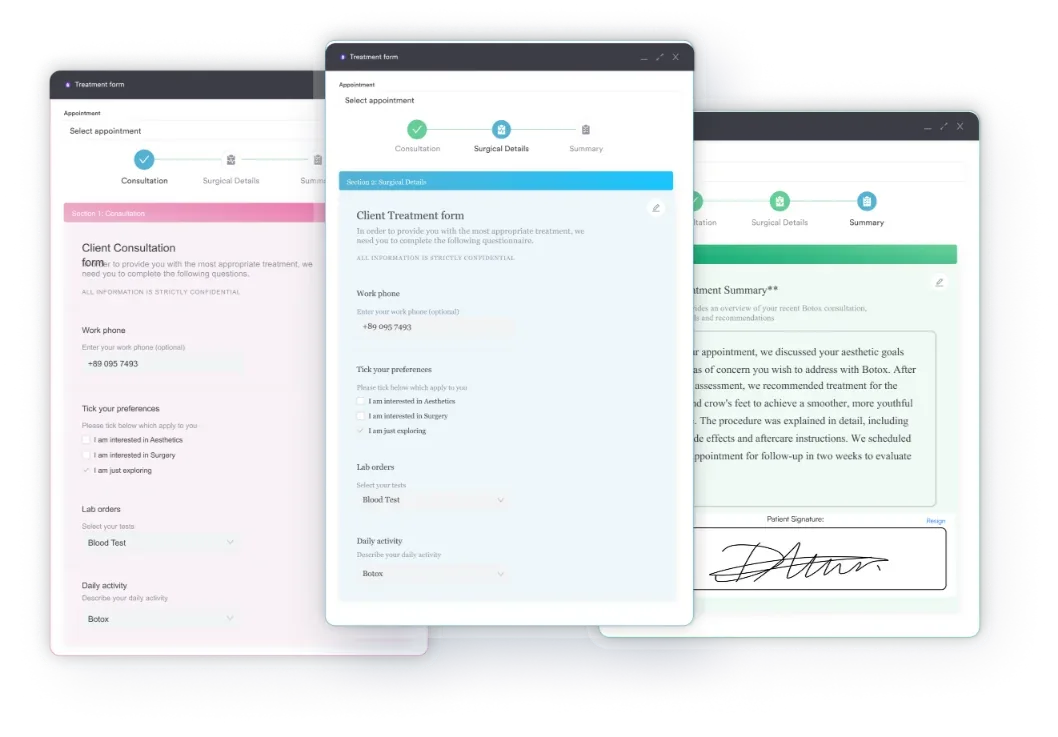
Billing teams reviewing medical forms at your practice should confirm that tobacco screening is a required field, not an optional one. Optional fields get skipped. Required fields become standard workflow.

Pabau lets practices attach HCPCS quality measure codes like G9903 directly to patient encounters, flag tobacco screening as a required intake field, and reduce coding errors at the point of care.

HCPCS Code G9903 is reported on the same claim as the primary evaluation and management (E/M) or preventive care visit code. It is appended to, not submitted in place of, the visit code. Here is how the medical billing process typically works for Measure 226 reporting.
Practices using automated workflows can build a rule that prompts coders to verify the tobacco screening field before the claim is finalized. Choosing the right medical billing software makes this kind of automated check standard rather than manual, catching the most common error before submission rather than after denial. The filing deadline runs from the date of service, not the date the practice noticed the claim was unpaid.
A primary care compliance checklist should include a regular audit of Measure 226 coding accuracy, reviewing a sample of encounters each quarter to confirm the correct G-code was selected for each documented screening outcome.
Run a monthly coding accuracy report on your G9902/G9903 split. If more than 95% of your Measure 226 submissions are G9903 (non-user), the data likely reflects under-screening of actual tobacco users rather than a genuinely low-tobacco patient population. Investigate before your MIPS data is reviewed.
Coverage for G9903 varies significantly by payer. The carrier judgment designation means no national Medicare payment amount is guaranteed. Here is what practices typically encounter by payer type.
| Payer type | Typical G9903 handling | Billing guidance |
|---|---|---|
| Medicare Part B (MAC-dependent) | Zero or nominal payment; accepted for MIPS reporting purposes | Check your local MAC’s LCD/NCD for quality reporting policies |
| Medicare Advantage | Varies by plan; some mirror Medicare, others pay for preventive quality codes | Check plan-specific coverage and prior authorization rules |
| Commercial insurers | Most do not reimburse G-codes separately; may require different quality reporting mechanisms | Confirm with payer prior to routine submission |
| Medicaid | State-dependent; some states use G-codes for quality programs | Contact state Medicaid agency or MAC equivalent |
To cross-reference G9903 payment indicators across fee schedules, use the CMS Physician Fee Schedule and HCPCS resources linked above, which draw directly on official CMS data. For practices concerned about HIPAA-compliant practice software during payer audits, ensuring your platform maintains a complete encounter-level audit trail is as important as selecting the right G-code.
The biggest operational challenge with Measure 226 is not the coding itself. It is building a workflow where tobacco screening happens consistently at every eligible encounter, the result is captured in a structured field, and the right G-code is appended to the claim without requiring manual lookup every time.
Practices using structured patient records with tobacco status as a dedicated field can configure their billing workflow to suggest G9903 automatically when non-user status is confirmed. This eliminates the cognitive burden on coders and reduces the risk of selecting the wrong code on a high-volume practice day.
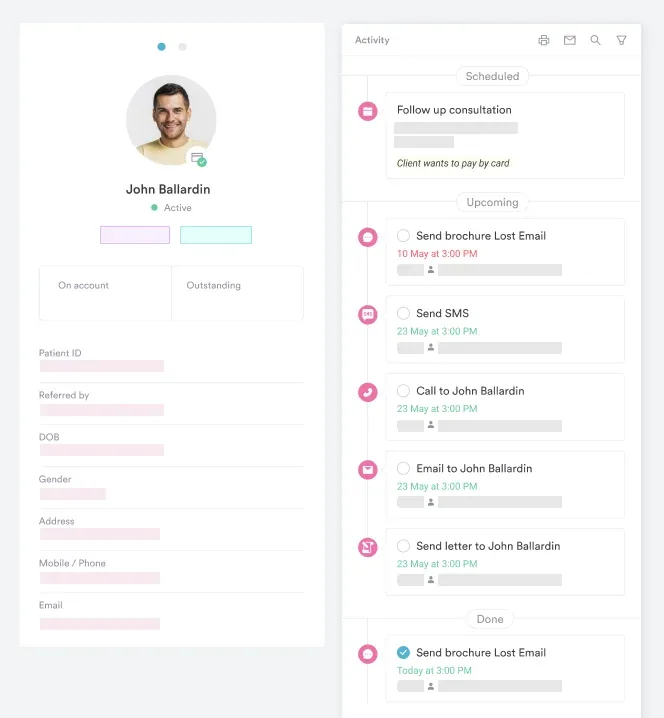
Pabau supports HCPCS and CPT code documentation within its EHR and billing workflows, enabling practices to attach quality measure codes like G9903 directly to patient encounters. Tools such as AI clinical documentation can further reduce manual coding effort by capturing screening outcomes in structured fields. This is particularly valuable for multi-specialty or wellness clinic environments where preventive screening codes span multiple provider types and visit formats.
For practices looking to review broader workflow improvements.
Maintaining consistent practice management workflows ensures that quality reporting activity like Measure 226 does not rely on individual provider memory but is instead embedded into the standard encounter flow for every eligible visit type.
HCPCS Code G9903 is a straightforward code with a very specific clinical and administrative purpose: documenting that a patient was screened for tobacco use and confirmed as a non-user, contributing to performance on QPP Measure 226. The coding errors that create audit risk are equally straightforward to prevent: choose only one G-code per encounter, document the screening actively rather than relying on carry-forward notes, and confirm your MAC’s coverage policy before assuming reimbursement.
Pabau’s claims management and digital documentation tools help practices build the structured workflows that make accurate G9903 reporting routine rather than reactive. To see how Pabau handles quality measure coding in a live environment, book a demo.

Coding an unidentified viral rash? ICD-10 code B09 covers an unspecified viral infection with skin lesions when the virus cannot be identified.
Coding a confirmed HIV diagnosis? ICD-10 code B20 is the billable code for confirmed human immunodeficiency virus disease.
Coding an unconfirmed fungal infection? ICD-10 code B49 covers an unspecified fungal infection that is confirmed but not tied to a specific organism.
G9903 is the HCPCS Level II code used when a patient is screened for tobacco use during a clinical encounter and identified as a tobacco non-user. It is reported for quality measure purposes under QPP MIPS Measure 226 and carries a carrier judgment (C) coverage designation, meaning Medicare reimbursement depends on local MAC policy rather than a guaranteed national payment rate.
G9902 is reported when a patient is screened for tobacco use, identified as a tobacco user, and received or was referred for cessation intervention. G9903 is reported when the patient is screened and identified as a non-user. Only one of these codes may appear on a single encounter claim; submitting both simultaneously is a billing error.
Yes. G9903 is one of four G-codes (G9902, G9903, G9904, G9905) that report performance on QPP Quality Measure 226: Tobacco Use: Screening and Cessation Intervention. Submitting G9903 counts as performance met for the non-user population in your MIPS quality reporting score.
The encounter record must show the date of the screening, the method or question set used, the patient’s confirmed non-user status, and the clinician’s signature. Relying on a carry-forward tobacco status from a prior visit without re-screening at the current encounter does not satisfy the documentation requirement and creates audit exposure.
Not always. G9903 carries a coverage code of C (carrier judgment), which means payment is determined by the local Medicare Administrative Contractor (MAC), not a fixed national rate. Many MACs accept G9903 for MIPS reporting purposes but issue zero-dollar payment. Confirm your MAC’s specific policy before building expected revenue around this code.



