CPT code 92537: Caloric vestibular test billing guide
CPT code 92537: Quick reference CPT code 92537 reports a bilateral, bithermal ca...

Last Updated: Oct 21, 2026

CPT code 99495 covers transitional care management (TCM) services requiring moderate medical decision-making complexity after a qualifying facility discharge.
Three elements are required: interactive contact with the patient or caregiver within 2 business days of discharge, moderate-complexity MDM throughout the 30-day service period, and a face-to-face visit within 14 calendar days.
The required face-to-face visit is bundled into the 99495 payment. It is not billed as a separate E&M code unless a distinct, unrelated problem is addressed on the same date.
Only one TCM code (99495 or 99496) may be billed per patient per 30-day service period; selecting the wrong code based on MDM level is a leading cause of claim denial.
Pabau’s claims management software and automated workflow tools help practices track TCM timelines, document required elements, and submit clean claims without manual chasing.
CPT code 99495 is a transitional care management (TCM) code that reports structured post-discharge services for patients requiring moderate medical decision-making (MDM) complexity. It belongs to the Evaluation and Management (E&M) family within the Current Procedural Terminology (CPT) code set maintained by the American Medical Association (AMA).
Medicare reimburses CPT code 99495 under the CMS Physician Fee Schedule. Rates vary by geographic locality and the annual conversion factor update.
The official CPT code 99495 description covers a 30-day service period that begins on the day of discharge and continues for the next 29 days. It reports the transition of care from an inpatient or observation stay back to the community.
So a hospital discharge follow-up visit and the coordination around it are billed as one service. The 2-business-day window for interactive patient contact starts the day after discharge. Throughout the period, the billing provider coordinates care, reconciles medications, provides patient education, and documents follow-up to support the claim.
CPT code 99495 has three non-negotiable components. Miss any one and the claim fails. Each carries specific documentation and timing rules, covered below.
The billing provider or a clinical staff member must make interactive contact with the patient or their caregiver within 2 business days of discharge. According to CMS guidance and confirmed by the American Academy of Family Physicians (AAFP), this contact may be by telephone, secure electronic message, or direct face-to-face interaction.
The key word is “interactive.” A voicemail left for the patient does not satisfy this requirement. If the first attempt is unsuccessful, document each attempt and continue trying. Some practices build an automated outreach workflow that flags discharge notifications and triggers a same-day call task, which keeps the 2-day window from being missed.
Good care management documentation at this stage captures the date, time, method of contact, and who participated. This detail becomes the foundation for the rest of the TCM claim.
CPT code 99495 requires moderate complexity MDM throughout the service period, as defined by AMA guidelines. Moderate complexity typically involves multiple chronic conditions, prescription drug management, or test review with independent interpretation. This is the element that distinguishes 99495 from its higher-complexity counterpart, CPT 99496.
The MDM level applies to the service period as a whole, not just the face-to-face visit. Document the clinical complexity in the progress note at the time of the office visit, and reference the ongoing coordination activities (medication reconciliation, specialist communication, patient education) that supported that level of decision-making.
The specialist who answered that communication may be billing their own side of it. An interprofessional consult of 5 minutes or more, returned as a written report, is reported with CPT code 99451.
A face-to-face visit with the patient must occur within 14 calendar days of the discharge date. This is not 14 business days, it is 14 calendar days including weekends. According to CMS MLN908628 and confirmed by multiple authoritative billing references, this visit can take place in the office, a hospital outpatient setting, a nursing facility, or the patient’s home.
Practices that struggle with this requirement typically lack a system to track discharge dates and flag upcoming deadlines. Using automated workflow tools to assign a 14-day follow-up task from the moment a discharge notification is received prevents visit windows from expiring. This visit is bundled into the 99495 payment; it is not reported as a separate E&M code (see the billing rules section below).
Not every discharge triggers TCM eligibility. CMS specifies qualifying inpatient and outpatient settings for which 99495 may be reported.
Emergency department visits without inpatient admission do not qualify. The patient must have had a qualifying stay in one of the above settings. Always confirm the discharge summary indicates the correct facility type before coding 99495, since this is a common audit trigger.
For practices managing clinical documentation at scale, capturing the discharge setting as a structured field in the patient record, rather than relying on free text, makes eligibility verification faster and more consistent.
The two TCM codes differ on MDM complexity and the face-to-face visit timeline. Choosing the right one requires a clear understanding of the clinical situation documented in the record.
Only one TCM code may be reported per patient per 30-day service period. If you bill 99495 but the documentation supports 99496, you under-bill the encounter and lose reimbursement you are entitled to. Upcoding to 99496 without documented high-complexity MDM creates audit risk. Match the code to the documented MDM level every time.
The same complexity-based selection logic applies across other CPT codes requiring complexity-level selection.
Set a standing protocol: after every qualifying discharge, assign the MDM complexity level in the EHR at the time of the face-to-face visit, not at billing time. Billing staff who code from incomplete notes frequently downcode to 99495 when the clinical picture supports 99496, or vice versa. A contemporaneous MDM note eliminates ambiguity and protects against payer audits.
Modern primary care platforms template routine visits, so E/M documentation takes minutes rather than the whole lunch break.
Every element billed must be documented in the medical record. CMS and commercial payers audit TCM claims for completeness, and missing documentation is the fastest path to denial or recoupment.
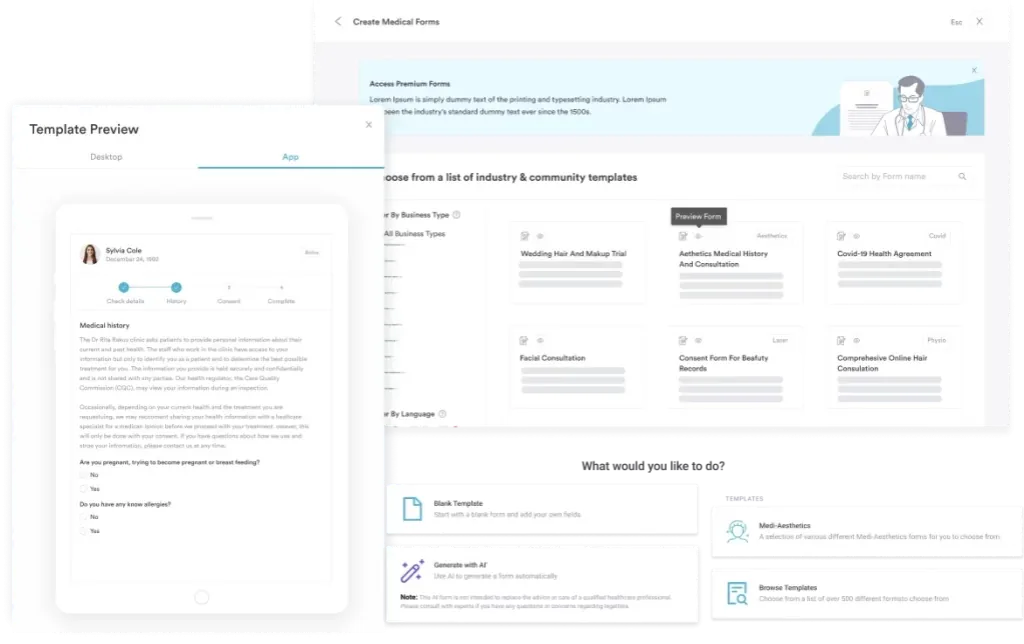
Practices using digital clinical forms can build TCM-specific documentation templates that prompt staff to capture each required element at the point of care. A consistent SOAP note format keeps the progress note structured across visits and reviewers.
For primary care teams looking at broader HIPAA-compliant documentation practices, TCM documentation fits naturally into the same framework: structured fields, contemporaneous entry, and audit-ready records.

Pabau’s claims management tools and automated workflows help practices stay on top of discharge follow-ups, document required TCM elements, and submit clean claims, without spreadsheets or manual chasing.

Understanding what can and cannot be billed alongside 99495 prevents claim rejections before they happen.
The face-to-face visit required by CPT code 99495 is bundled into the TCM payment and is not billed as a separate E&M code. A separate same-day E&M code with modifier 25 is appropriate only when the provider addresses a distinct, medically necessary problem unrelated to the TCM visit itself.
Confirm payer-specific documentation expectations with your Medicare Administrative Contractor (MAC), since interpretation of “unrelated” can vary by region.
The required face-to-face visit can be delivered by telehealth. CMS added CPT codes 99495 and 99496 to its list of covered telehealth services, so a two-way audio-video visit inside the 14-day window satisfies the face-to-face requirement when it meets the same documentation standard as an in-person visit.
Confirm current telehealth coverage with your MAC before each service period, since the list of permitted telehealth codes and any audio-only allowances are set year to year. Record the visit modality in the note so the claim shows how the face-to-face element was met.
Billing CCM and TCM in the same month for the same patient is one of the more common NCCI (National Correct Coding Initiative) edits that triggers automatic denial. Review your billing software’s code-pairing rules to ensure these combinations are flagged before submission.
Remote physiologic monitoring is an exception to that overlap rule. CMS allows 99457 in the same 30-day period as TCM, provided the monitoring minutes are documented separately.
CPT code 99495 itself does not routinely require a modifier. The TCM-required face-to-face visit is bundled into 99495 and is not billed separately. If a distinct, medically necessary problem unrelated to that visit is addressed on the same date, modifier 25 identifies the separate E&M code as a separately identifiable service.
Some MAC regions and commercial payers apply additional modifier requirements, so verify with your specific payer before submitting. Good claims management software can flag modifier requirements based on code pairings and payer rules.
Physicians, nurse practitioners, and physician assistants may bill CPT code 99495 directly. Clinical staff (RNs, social workers, care coordinators) may perform many of the non-face-to-face TCM services under the supervision of the billing provider. Incident-to billing rules apply for non-physician practitioners; confirm the supervision requirements with your MAC for the specific billing context.
Automated task assignment and documentation prompts support this division of labor by routing each TCM step to the right team member as it comes due.
Run a monthly TCM opportunity audit: pull a list of all qualifying discharges from the prior 30 days and match them against submitted TCM claims. Each eligible discharge without a matching TCM claim is unbilled revenue. Even capturing 50% of previously missed TCM encounters in a busy primary care practice can add thousands per month to net revenue.
Medicare reimbursement for CPT code 99495 varies by geographic locality, practice setting (facility vs. non-facility), and annual conversion factor updates. Dollar amounts change each year with the Medicare Physician Fee Schedule, so always reference current CMS data rather than cached figures from prior years.
To find current reimbursement rates for your locality, use the CMS Physician Fee Schedule lookup tool. Search for code 99495, select your MAC region, and filter by facility or non-facility status.
Nationally, CPT code 99495 typically reimburses at a higher rate than a standard office visit because the payment reflects the full 30-day post-discharge coordination period, not just the face-to-face encounter. Recent published estimates put the national average payment in the range of roughly $200 to $215, though your locality rate will differ.
The number matters because of what practices give up by miscoding. The American Academy of Family Physicians (AAFP) notes that a qualifying encounter billed as a standard 99214 office visit instead of 99495 forfeits about 0.6 work RVUs, roughly $57 per encounter. Across a month of discharges, defaulting to the office-visit code quietly erodes revenue the practice has already earned. See our guide to healthcare revenue cycle management for how coding accuracy on codes like this one affects overall collections. A retroactive authorization is rarely granted, so the check belongs before the appointment. Where a payer still requires a paper claim, the practice needs the current revision of the form.
Like most E&M codes, 99495 has separate facility and non-facility payment amounts. Non-facility (office-based) reimbursement is typically higher because the practice absorbs the overhead costs that a hospital or facility would otherwise cover. Confirm which rate applies based on where the face-to-face visit occurs.
Commercial payers follow their own fee schedules, which may be higher or lower than Medicare rates. Always verify TCM reimbursement amounts per payer in your contracts, particularly for managed care plans and Medicare Advantage.
CPT code 99495 sits within a broader care management coding ecosystem. Understanding the adjacent codes helps practices build compliant billing strategies across the full patient care continuum.
For a full list of CPT codes covered under the Medicare Physician Fee Schedule, the CMS CPT/HCPCS code list is the authoritative reference. The AAPC Codify CPT lookup provides cross-reference data, modifier guidance, and payer-specific coverage notes for 99495 and related codes.
Practices running EHR-integrated billing workflows can use direct primary care EHR systems built around care management coding, making TCM tracking a built-in function rather than a manual workaround.
CPT code 99495 requires initial communication within 2 business days, moderate-complexity MDM throughout the 30-day period, and a face-to-face visit within 14 calendar days. Meeting all three consistently, for every qualifying discharge, is what keeps TCM claims clean and free of denials.
Pabau’s claims management software and automated workflow tools give practices the infrastructure to track discharge timelines, prompt documentation at each required touchpoint, and submit clean TCM claims consistently. To see how Pabau handles this in practice, book a demo.

Billing full-length bed side rails? bed side rails billing guide covers when full-length bed side rails are payable and the signed order and modifiers required.
Need to bill a pediatric hospital bed? pediatric hospital bed billing guide explains the 2026 HCPCS Level II code for an electric pediatric hospital bed and its billing rules.
Billing for a same-day unrelated eye problem? ICD-10 code H18.10 covers bullous keratopathy diagnosis and documentation.
Ordering toxicology screening for a patient? CPT code 80307 covers presumptive drug test billing rules.
Handling an orthopedic anesthesia claim? CPT code 01390 explains billing for tibia, fibula, and patella procedures.
CPT code 99495 is used to report transitional care management (TCM) services for patients discharged from a qualifying inpatient or observation setting who require moderate medical decision-making complexity during the 30-day post-discharge period. It covers care coordination, medication reconciliation, patient education, and a required face-to-face visit within 14 calendar days.
CPT 99495 requires moderate medical decision-making complexity and a face-to-face visit within 14 calendar days of discharge. CPT 99496 requires high medical decision-making complexity and a face-to-face visit within 7 calendar days. Both share the same 2-business-day communication requirement and 30-day service period. Only one may be billed per patient per TCM period.
CPT code 99495 does not routinely require a modifier on the TCM claim itself. The required face-to-face visit is bundled into 99495 and is not billed as a separate E&M code. If a distinct, medically necessary problem unrelated to that visit is addressed on the same date, modifier 25 is appended to the separate E&M code to show it as a separately identifiable service. Confirm modifier requirements with your MAC and commercial payers, as policies can vary.
Not for the required TCM visit itself. That visit is bundled into the 99495 payment. A separate E&M code with modifier 25 is appropriate only for a distinct, medically necessary problem unrelated to the TCM visit on the same date. CPT 99495 also cannot be billed in the same calendar month as Chronic Care Management codes (99490, 99491) for the same patient, and only one TCM code may be submitted per 30-day service period.
Medicare reimbursement for CPT 99495 varies by geographic locality, facility vs. non-facility setting, and the annual CMS conversion factor. Check the CMS Physician Fee Schedule lookup tool for current rates in your specific region. Non-facility (office-based) rates are typically higher than facility rates because the practice absorbs overhead costs.
Required documentation for CPT 99495 includes the discharge date and facility type, date and method of initial patient or caregiver communication within 2 business days, medication reconciliation, care plan review and patient education provided, the date of the face-to-face visit with a progress note supporting moderate MDM, and any coordination with other providers during the service period.
Yes. CMS lists transitional care management among covered telehealth services, so the required face-to-face visit can be a two-way audio-video visit within the 14-day window when it meets the same documentation standard as an in-person encounter. Verify current rules with your MAC each year, as the covered telehealth codes and any audio-only allowances change annually.
Not for the transitional care visit itself, since that visit is bundled into the 99495 payment. A 99214 office visit is separately reportable with modifier 25 only when the provider treats a distinct problem unrelated to the post-discharge care on the same date. Billing the routine follow-up as a 99214 instead also under-reports the work by roughly 0.6 work RVUs.
Only one transitional care management claim, either 99495 or 99496, may be submitted per patient per 30-day service period following a qualifying discharge. A fresh period can start only after another eligible inpatient or observation discharge, and the service cannot overlap with chronic care management in the same calendar month.