

CPT Code 98981: RTM Treatment Management Billing Guide
CPT code 98981: Definition and official descriptor CPT code 98981 is an add-on c...

Last Updated: Nov 9, 2026
87040 is the CPT code for culture, bacterial; blood, aerobic, with isolation and presumptive identification of isolates. Its official descriptor also includes anaerobic culture, if appropriate, so one blood culture set bills as one unit.
The performing laboratory reports it when blood is incubated to detect bacteremia or work up suspected sepsis. Incorrect unit counts, missing ICD-10 pairings and claims filed by the ordering physician are common causes of 87040 denials.
Let Pabau's smart automation suggest the right codes, reduce claim denials, and keep your practice compliant—effortlessly.
Automate repetitive tasks and focus on what matters most—your patients.
Reduce coding errors and ensure compliance with the latest regulations.
Clean claims, fewer denials, and faster reimbursements.
Powerful insights and reporting to help your practice thrive.
HIPAA compliant SOC 2 certified GDPR-compliant Trusted by 4,000+ clinics worldwide

CPT code 87040 covers one bacterial blood culture set, aerobic and anaerobic bottles together, with isolation and presumptive identification.
Bill one unit per separately collected set, and record the collection time and site for each one.
Only the performing laboratory bills 87040, and Medicare pays it on the Clinical Laboratory Fee Schedule.
Missing ICD-10 links and undocumented second units are common reasons 87040 claims get denied.
Pabau’s claims management software checks eligibility, sends claims through Claim.MD and tracks 835 remittances in one place.
CPT code 87040 is the code for a bacterial blood culture with isolation and presumptive identification of any organisms that grow. Its official descriptor names aerobic culture and adds “includes anaerobic culture, if appropriate.” So the standard two-bottle set, one aerobic and one anaerobic, is one unit of 87040.
The American Medical Association maintains the CPT code set. 87040 sits in the Microbiology subsection (87001-87999) of the Pathology and Laboratory chapter.
“Presumptive identification” means the lab grew the organism and made a preliminary ID. Susceptibility testing is a separate step, reported with 87184 or 87186. Definitive identification of an aerobic isolate by additional methods goes to 87077, one unit per isolate.
The fastest way to code a blood culture order correctly is to know where 87040 stops. Use this table when the requisition lists more than the culture itself.
The draw itself sits outside 87040. Venipuncture is reported separately with 36415 by whoever collects the specimen, whether that is the lab or the practice.
An 87040 claim passes through five hand-offs before it is paid, and each one has a slip that can turn into a denial. The flow below maps them.
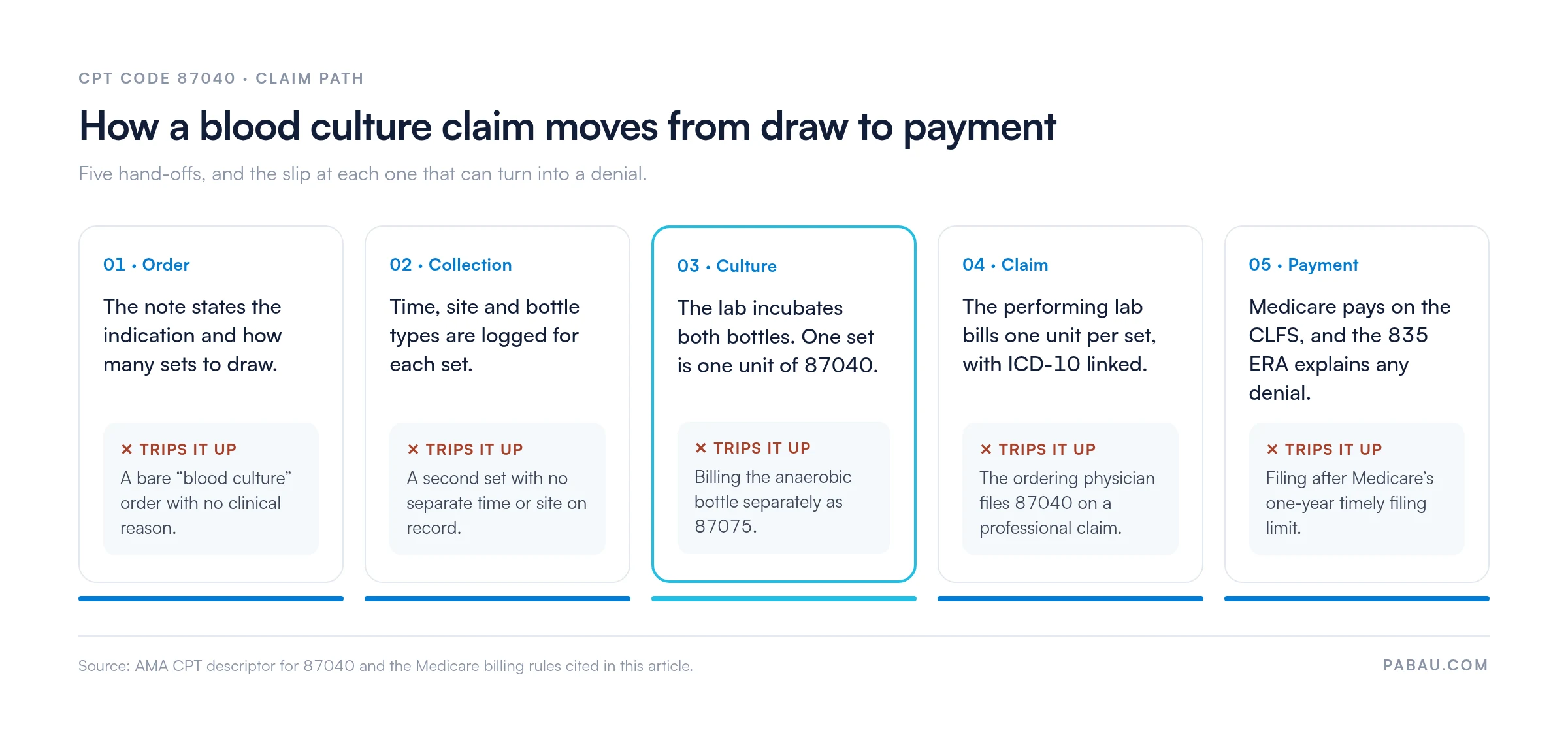
Payers cover 87040 when the record makes bacteremia a reasonable suspicion. Medicare contractors and commercial plans expect the ordering note to name one of these scenarios.
Sepsis protocols often produce two or more sets drawn minutes apart. Following the CPT per-set convention, each separately collected set can be billed as its own unit of 87040.
That only holds up with paperwork behind it. The lab report needs the collection times and set count, and the order note needs the clinical reason. Without them, a second unit on the same date tends to come back as a duplicate-service denial.
CPT code 87040 is billed per blood culture set. A standard set is two bottles from a single venipuncture, one aerobic and one anaerobic. Both bottles sit inside that one unit, so the anaerobic bottle is never billed as 87075.
Here is how that plays out. A patient arrives in the emergency department with a 102.4°F fever and rigors, and the physician orders two sets. The nurse draws set one from the left arm at 2:05 PM and set two from the right arm at 2:20 PM. That is four bottles and two units of 87040.
Two units from a single draw is a coding error, and payers catch it through Medically Unlikely Edits (MUE) or a duplicate-service denial. When the second set is legitimate, payers differ on the modifier. Many expect 59 or XS on the second line, while some ask for 91, so check the payer’s policy first.
Record the collection time, site and set number on every blood culture order. Without distinct times in the lab report, a second unit of 87040 on the same date looks like a duplicate claim. Overturning that denial can take weeks, while the fix at collection takes seconds.
The performing laboratory bills CPT code 87040, never the ordering physician. It is a technical laboratory code with no professional component and no TC/26 split, so the ordering physician has no role to bill under it.
The claim form and payment route depend on which kind of lab ran the culture.
A physician who submits 87040 on a professional claim will see it rejected, because the physician did not perform the test.
Under the Medicare Clinical Laboratory Fee Schedule (CLFS), 87040 pays a single national rate. CMS updates CLFS rates every year, and PAMA market-based pricing can move them. Check the current figure in the CMS Clinical Laboratory Fee Schedule before quoting a rate to a practice or payer.
87040 denials cluster around a handful of root causes. Each one can be prevented before the claim leaves the building.
When a claim comes back, match its CARC and RARC to the right category in our guide to medical billing denial codes. That tells your team whether to correct and resubmit or to appeal.
A clean claim for 87040 needs the order note and the lab report to agree. Run through this list while both are on file, not after a denial arrives.
The superbill behind the order should also carry the ordering provider’s NPI, the lab’s CLIA number and the date of service. Electronic claims check all three, and a missing one triggers a front-end rejection before adjudication.
Blood culture orders often share a requisition with other microbiology codes. Coding a urine specimen as 87040, or a blood specimen as 87086, is a material error that this table helps you avoid.
Many laboratory information systems (LIS) assign CPT codes automatically from LOINC test orders, so a mismatch between the two is a common source of miscoding. The LOINC database has several codes for blood culture results, and LOINC publishes no official CPT crosswalk.
LOINC codes are versioned, so re-check your LIS mappings against the current release whenever the LIS or EHR is upgraded. A stale mapping can attach a wrong-specimen CPT code to blood culture orders, an error that is easy to miss at volume.
Run a quarterly reconciliation between your LIS LOINC mappings and the CPT codes on submitted 87040 claims. If blood specimen orders are generating 87086 or 87075, update the LOINC-to-CPT table before the next billing cycle.
Many lab billing teams check eligibility in one portal, build claims in another and reconcile payments by hand. Each switch between systems is a chance to drop a collection time or a diagnosis pointer.
Pabau, the practice management platform we build, brings those steps into one place. Its claims management software runs real-time eligibility checks and sends CMS-1500 and 837P claims through the Claim.MD clearinghouse to thousands of US payers.
Remittances come back as 835 ERAs, so your team sees each CARC code next to the 87040 line it applies to. Payments can then be reconciled against expected CLFS rates without logging into individual payer portals.
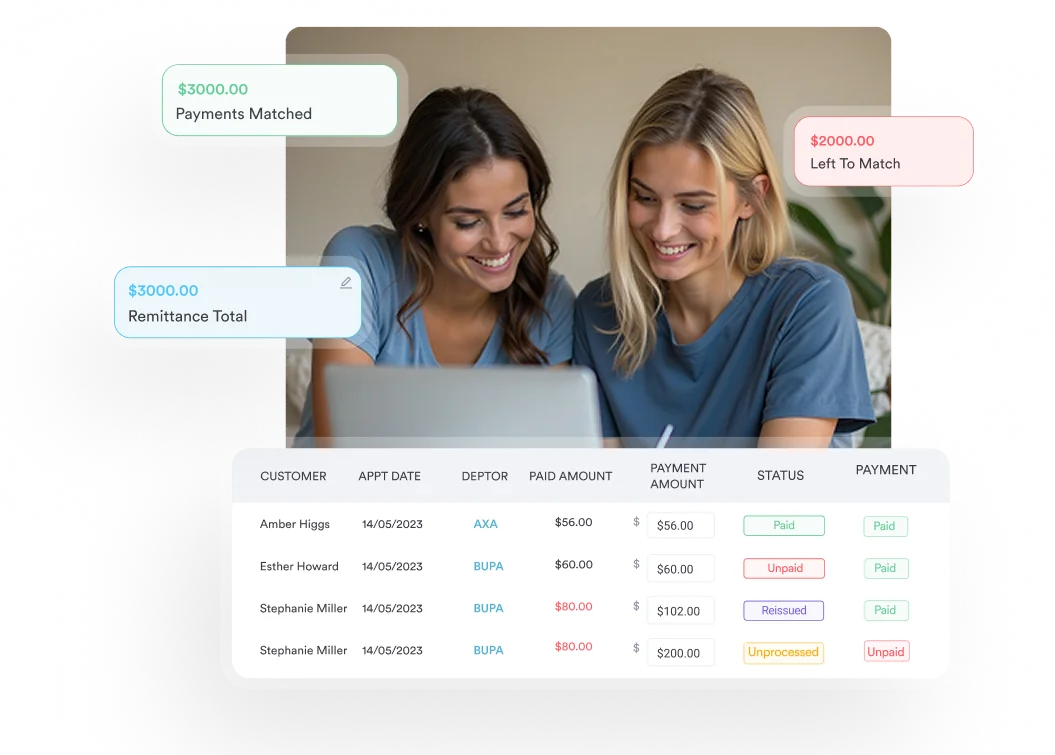

Pabau checks eligibility, sends blood culture claims through the Claim.MD clearinghouse and tracks 835 remittances, so your team spends less time in payer portals.

Blood culture billing turns on one count, and it is sets rather than bottles. Record a time and site for every set at the draw. Do that, and 87040 becomes one of the simpler lab codes to get paid.
The work worth doing this week is upstream of the claim. Pull a sample of last month’s 87040 claims and compare each one with its lab report. Where units and collection records disagree, fix the order template and the collection checklist before you touch the claim scrubber.
Book a demo to see how Pabau checks eligibility, submits your 87040 claims and tracks every remittance in one place.

Need to understand how clearinghouse submission works for lab codes? Medical claims clearinghouse guide explains how payer routing, rejection codes, and ERA processing work for laboratory claims.
Getting NCCI edits on microbiology codes? Medical billing compliance overview covers how NCCI edits work and what documentation supports modifier use.
Want to understand how 835 remittance data maps to denial reasons? Electronic remittance advice explained breaks down ERA file structure, CARC codes, and how to read payer explanation of benefits data.
Building a denial workflow for lab claims? Denial management in healthcare walks through tracking, appealing and preventing denied claims.
87040 is the blood culture itself, with presumptive identification of what grows. 87076 covers the additional methods needed to definitively identify an anaerobic isolate, billed per isolate. Its aerobic counterpart is 87077.
The culture is still 87040, because the specimen is blood. The collection code changes, though. A draw from an established central or peripheral venous catheter is reported with 36592 instead of venipuncture code 36415.
No. Blood culture is not on the CLIA-waived test list, so the lab needs a CLIA certificate that covers non-waived testing. Payers check the CLIA number on the claim.
Yes, when the lab runs additional identification methods on an isolate from a positive culture. Bill 87077 once per isolate, and check the NCCI edit table for the pair first.
Many positive cultures flag within 24 to 48 hours. A final no-growth report usually takes about five days, depending on the lab’s protocol. For Medicare, the date of service is generally the collection date, not the result date.




