HCPCS Code G0163: Skilled nursing observation and assessment
What is HCPCS Code G0163? HCPCS Code G0163 is a deleted Level II code for skille...

Last Updated: Oct 15, 2026
87077 is the CPT code for culture, bacterial; aerobic isolate, additional methods required for definitive identification, each isolate.
It covers the laboratory step that names an aerobic organism to species level after a primary culture grows colonies. It is billed once per isolate, and only when the lab performed a distinct identification procedure.
Let Pabau's smart automation suggest the right codes, reduce claim denials, and keep your practice compliant—effortlessly.
Automate repetitive tasks and focus on what matters most—your patients.
Reduce coding errors and ensure compliance with the latest regulations.
Clean claims, fewer denials, and faster reimbursements.
Powerful insights and reporting to help your practice thrive.
HIPAA compliant SOC 2 certified GDPR-compliant Trusted by 4,000+ clinics worldwide

CPT 87077 covers species-level identification of a single aerobic bacterium isolated from culture, not the initial culture itself or susceptibility testing.
It is separately billable from the primary culture code (87086 or 87070) and from susceptibility testing (87186), but each service needs its own supporting documentation.
Most denials occur because the lab report lacks a species-level result or the physician order does not specify organism identification as a separate service.
Claims management software like Pabau links the lab codes on a claim and flags missing documentation before submission.
CPT Code 87077 carries the official AMA descriptor: Culture, bacterial; aerobic isolate, additional methods required for definitive identification, each isolate. It covers the laboratory work that follows a primary culture. Once colonies grow, a separate identification step names the organism to the species level.
The key phrase is “additional methods required.” Routine colony identification that happens as part of the primary culture is bundled into 87086 or 87070. CPT 87077 is appropriate only when the lab performs a distinct, documented identification procedure on an isolated organism.
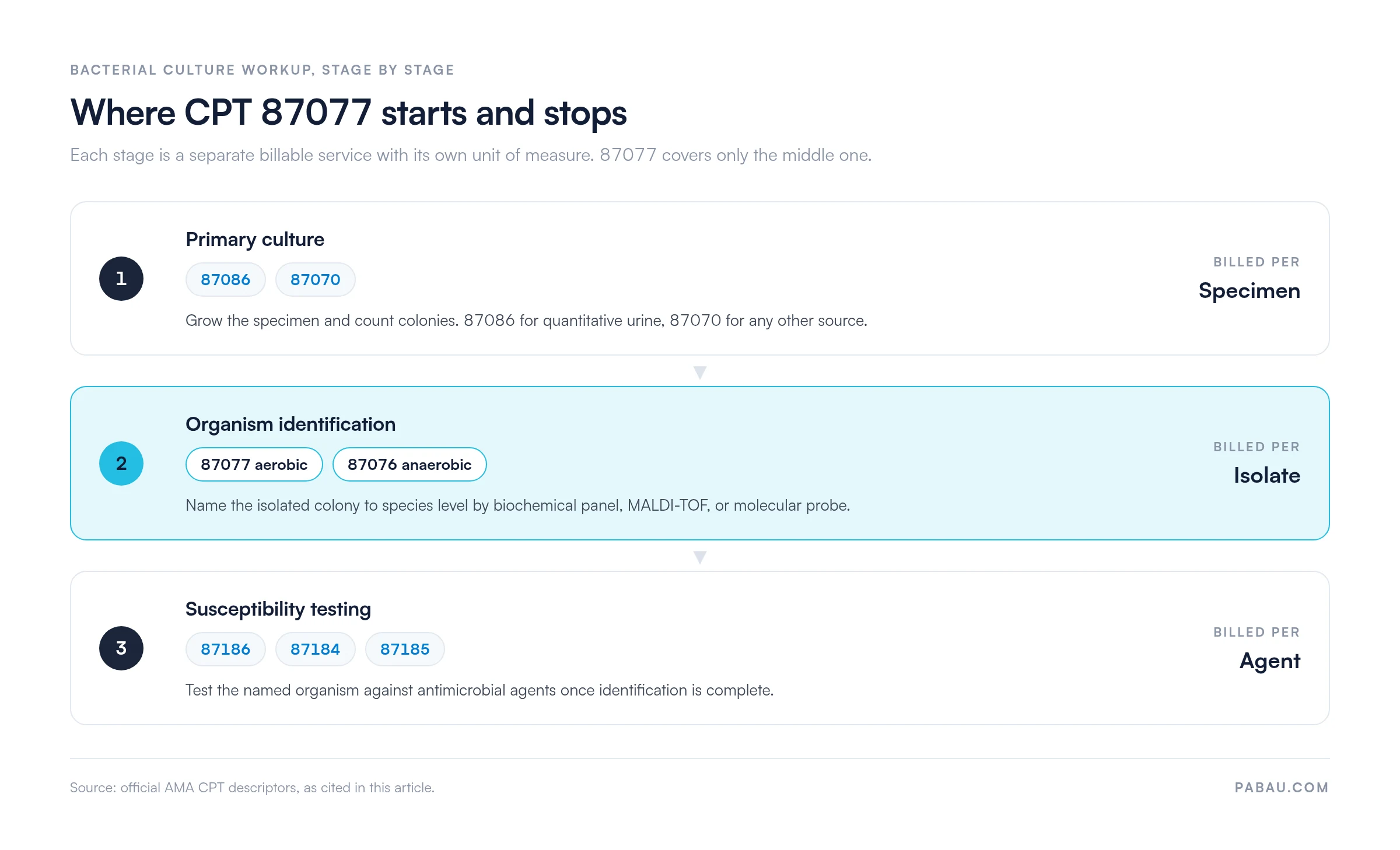
The 87077 workflow begins after a primary culture grows visible colonies. 87086 covers quantitative urine cultures and 87070 covers other sources. The lab then selects an isolated colony and applies additional methods to identify the organism at the species level. Those methods include automated biochemical panels, MALDI-TOF mass spectrometry, and molecular probes. Which one a lab reaches for depends on the organism suspected and the equipment on hand.
Use 87077 when species-level identification is medically necessary and performed as a distinct laboratory service. Wound infections that need pathogen-directed antibiotic therapy are the common case. So are urinary tract infections where a positive growth result is not enough on its own. Respiratory specimens qualify too, when the clinician needs a named organism before prescribing.
A screening-only culture sits outside this workflow. Reported with 87081, it produces no isolate, so 87077 has no organism to identify.
Coders most often ask two questions. Can 87077 be stacked on 87086 or 87070 for the same specimen, and can 87186 be billed alongside it? 87077 and 87186 are generally separately billable. 87077 and the primary culture codes can also go on one claim, but only when both services were performed. The three stages below each carry their own codes and their own billing unit.
Yes, in most cases. Organism identification (87077) and susceptibility testing (87186) are distinct laboratory services with different clinical purposes. Identification names the organism. Susceptibility testing then determines which antibiotics will work against it. They run in sequence, and each answers a different question.
No National Correct Coding Initiative (NCCI) bundling edit universally prohibits billing 87077 and 87186 together. That said, payer-specific policies vary. Some Medicare Administrative Contractors and commercial payers require a linked physician order specifying both services before reimbursing both on the same claim. Check your MAC’s LCD and your payer contracts before you assume the two always separate.
Flag 87077 claims that also include 87186 for a pre-submission eligibility check. Some payers require advance notification when multiple microbiology codes appear on the same date of service. Catching it before submission costs seconds. Catching it after a denial costs days.
Documentation is what separates a paid 87077 claim from a denied one. Labs that submit without the four elements below see the code returned again and again.
Capture the primary culture and the identification step on the same internal record. That keeps the claim, the lab report, and the order in agreement when a payer asks for support.
The ICD-10-CM codes below appear most frequently on claims billed alongside 87077. Payers expect the listed diagnosis to be consistent with the specimen source and the clinical context documented in the ordering note.
For Medicare claims, the Local Coverage Determination (LCD) for your MAC jurisdiction specifies which diagnoses qualify as covered indications. LCDs for microbiology codes vary by region, so confirm coverage criteria with your MAC before you assume Medicare covers the code everywhere.
CPT 87077 is priced under the Clinical Laboratory Fee Schedule (CLFS), not the Physician Fee Schedule. The CLFS sets national Medicare payment rates for laboratory services with no geographic adjustment. The allowed amount is therefore consistent across MAC jurisdictions, unlike PFS codes priced with Geographic Practice Cost Indices.
For the current allowed amount, check the CMS Clinical Laboratory Fee Schedule file. CLFS rates for microbiology codes typically run in the low-to-mid single digits per isolate. CMS updates the file annually, so confirm 2026 amounts against the current release before you quote a figure.
Labs submit 87077 claims electronically in the 837P format. Pabau’s Claim.MD integration reaches thousands of US payers and returns Electronic Remittance Advice (835) files, so payments can be reconciled against expected CLFS amounts. Where the lab code or the linked diagnosis is mapped wrongly on the way out, the remittance is where it surfaces.
Private payer variability: Commercial payer rates for 87077 differ from Medicare CLFS amounts. Some payers price microbiology identification codes at a percentage of Medicare, commonly 100-130%. Others use internally negotiated fee schedules, so pull your own contracts before quoting an expected reimbursement to billing teams.
Most 87077 rejections trace back to five patterns, and each one has a specific fix. Read the CARC on the remittance first, because it tells you which pattern applies. Our wider guide to denial codes covers the ones that fall outside this table.
Build a workflow step for 87077 claims that arrive without a linked 87086 or 87070 on the same date of service. Those are the ones a payer bundles first.
The AMA descriptor specifies “each isolate,” so 87077 can be billed once per aerobic organism that required additional identification methods. Two aerobic organisms from one specimen, each needing a distinct identification procedure, can in theory support two units.
In practice, per-isolate billing is where payer policies diverge most sharply from the AMA descriptor. Several Medicare Administrative Contractors and commercial payers apply a one-unit-per-date-of-service policy for 87077, whatever the organism count. Others follow the descriptor and reimburse per isolate, provided the lab report documents each organism separately.
A clean first submission needs the lab report, the ordering note, and payer policy confirmation on file before the claim goes out. Retroactive appeals on per-isolate denials are winnable, but they cost weeks of staff time.
Audit your lab’s 87077 claims from the last 90 days. Filter by claims with units greater than one. Compare the lab reports attached to those claims against payer remittance data. If per-isolate denials cluster around one MAC or one commercial payer, that is a payer policy issue to resolve proactively, not claim by claim.
Most labs hold the primary culture result, the identification result, and the physician order in three separate places. The claim gets built from one of them, and the payer asks for the other two.
Pabau, practice management software built for clinical practices, keeps the order, the lab result, and the claim on one patient record. When a coder adds 87077, the linked 87086 or 87070 and the supporting ICD-10 code are already on screen.
Claims then go out through Claim.MD, and the 835 files come back into the same record for reconciliation. Teams that want cleaner claims management get that linkage checked before submission rather than after a denial.

Pabau’s claims management software checks code linkages, flags missing lab documentation, and reaches thousands of US payers through our Claim.MD integration.

87077 has a narrow scope, and its billing rules follow from that scope. It pays for one aerobic isolate, identified to species level by a method the lab performed and documented.
The denials come from treating that identification as part of the primary culture. Order it separately, name the species in the report, and link a diagnosis that fits the specimen. Those three habits settle most of what a payer would otherwise send back.
Labs seeing repeat 87077 rejections usually have the evidence on file and no way to attach it to the claim. Book a demo to see how Pabau connects the order, the lab report, and the claim in one record.

Need to understand how clearinghouse claim submission works end to end? Medical claims clearinghouse guide explains how 837 files move from your billing system to payers and back.
Dealing with repeated denial codes on lab claims? Electronic remittance advice (ERA) shows how to read 835 files and match CARC codes to specific line-item denials.
Want to verify payer credentialing before submitting microbiology claims? Insurance credentialing guide covers the enrollment steps that affect claim acceptance by MAC and commercial payers.
Need the claim right on the first pass? Clean claim guide lists the fields a payer checks before it accepts a claim for adjudication.
Working a backlog of rejected lab claims? Denial management in healthcare sets out a workflow for sorting, appealing, and preventing repeat denials.
CPT Code 87077 covers aerobic bacterial organism identification from culture using additional methods, reported per isolate. It covers the step where a colony isolated from a primary culture is named to species level. Labs do that with biochemical panels, MALDI-TOF mass spectrometry, or molecular methods. It does not include the primary culture (87086/87070), susceptibility testing (87186), or anaerobic organism identification (87076).
CPT 87077 is reimbursed under the Clinical Laboratory Fee Schedule (CLFS), which sets a national allowed amount. CMS updates that amount annually. Check the current CMS CLFS file for the rate, because quoting last year’s figure risks billing to an outdated allowed amount.
Three reasons account for most of them. First, the lab report does not name the organism to species level. Second, the claim lacks a supporting ICD-10 code consistent with the specimen source. Third, the payer bundles 87077 into the primary culture code because no separate order for organism identification was on file. Review the remittance CARC to see which applies, then attach the corrected documentation to the appeal.
The AMA descriptor allows one unit per isolate requiring additional identification methods. Multiple aerobic organisms from the same specimen could each generate a separate 87077 claim. Payer policies on per-isolate billing vary widely, and some MACs and commercial payers limit reimbursement to one unit per date of service. Confirm your payer’s policy before submitting more than one unit.