HCPCS Code V5095: Semi-implantable middle ear hearing prosthesis
HCPCS Code V5095: Definition and clinical descriptor HCPCS Code V5095 is the Lev...

Last Updated: Nov 25, 2026
84145 is the CPT code for procalcitonin (PCT), a quantitative blood test that helps clinicians tell a bacterial infection from other causes of inflammation. Laboratories bill it under the Medicare Clinical Laboratory Fee Schedule, not the Physician Fee Schedule.
Most 84145 denials trace back to the diagnosis pairing. The ICD-10 code on the claim has to show that the physician suspected a bacterial infection, such as sepsis or bacterial pneumonia.
Let Pabau's smart automation suggest the right codes, reduce claim denials, and keep your practice compliant—effortlessly.
Automate repetitive tasks and focus on what matters most—your patients.
Reduce coding errors and ensure compliance with the latest regulations.
Clean claims, fewer denials, and faster reimbursements.
Powerful insights and reporting to help your practice thrive.
HIPAA compliant SOC 2 certified GDPR-compliant Trusted by 4,000+ clinics worldwide

CPT code 84145 reports the quantitative procalcitonin immunoassay only. Qualitative and point-of-care PCT assays are not billed with it.
The claim needs an ICD-10 code that reflects suspected bacterial infection, because payers do not cover viral-only indications.
Medicare pays 84145 under the Clinical Laboratory Fee Schedule at one national rate, $27.22 in 2026.
Procalcitonin rises within 2-4 hours of bacterial infection onset, well ahead of CRP or ESR.
Pabau’s claims management software keeps the eligibility check, the documented indication and the claim on one patient record.
CPT code 84145 is the procedure code for a quantitative procalcitonin (PCT) immunoassay performed on a blood specimen. Its official descriptor reads simply Procalcitonin (PCT), and Medicare pays it as a lab test under CMS’s CY 2011 lab payment determination.
The code sits in the Chemistry subsection (82009-84999) of the Pathology and Laboratory section of the CPT code set, which the American Medical Association maintains.
The code covers only the quantitative immunoassay. A point-of-care qualitative PCT test is not reported with 84145, so the lab bills the code that matches the method it ran.
The procalcitonin test measures the blood level of procalcitonin, a peptide precursor of calcitonin that healthy people produce at very low concentrations. Bacterial infection pushes PCT up within 2-4 hours of onset, and levels peak within 6-24 hours. That is faster than most other inflammatory markers.
That speed is the clinical rationale for ordering 84145. C-reactive protein (CRP), billed with 86140, rises over 24-48 hours. White blood cell (WBC) count is non-specific. Speed and bacterial specificity together make PCT most useful in emergency and critical care, where antibiotic decisions cannot wait.
Medical necessity for CPT code 84145 requires a documented clinical indication of suspected or confirmed bacterial infection. Payers, including Medicare, do not cover PCT testing ordered for viral infection monitoring, routine wellness panels, or non-infectious inflammatory conditions.
Clinically appropriate indications generally accepted by payers include:
Antibiotic stewardship is an increasingly documented indication. A 2018 Lancet Infectious Diseases meta-analysis pooled 26 randomized trials in acute respiratory infections. PCT-guided treatment cut antibiotic exposure from 8.1 to 5.7 days. When 84145 is ordered for stewardship, the ordering note should state that rationale.
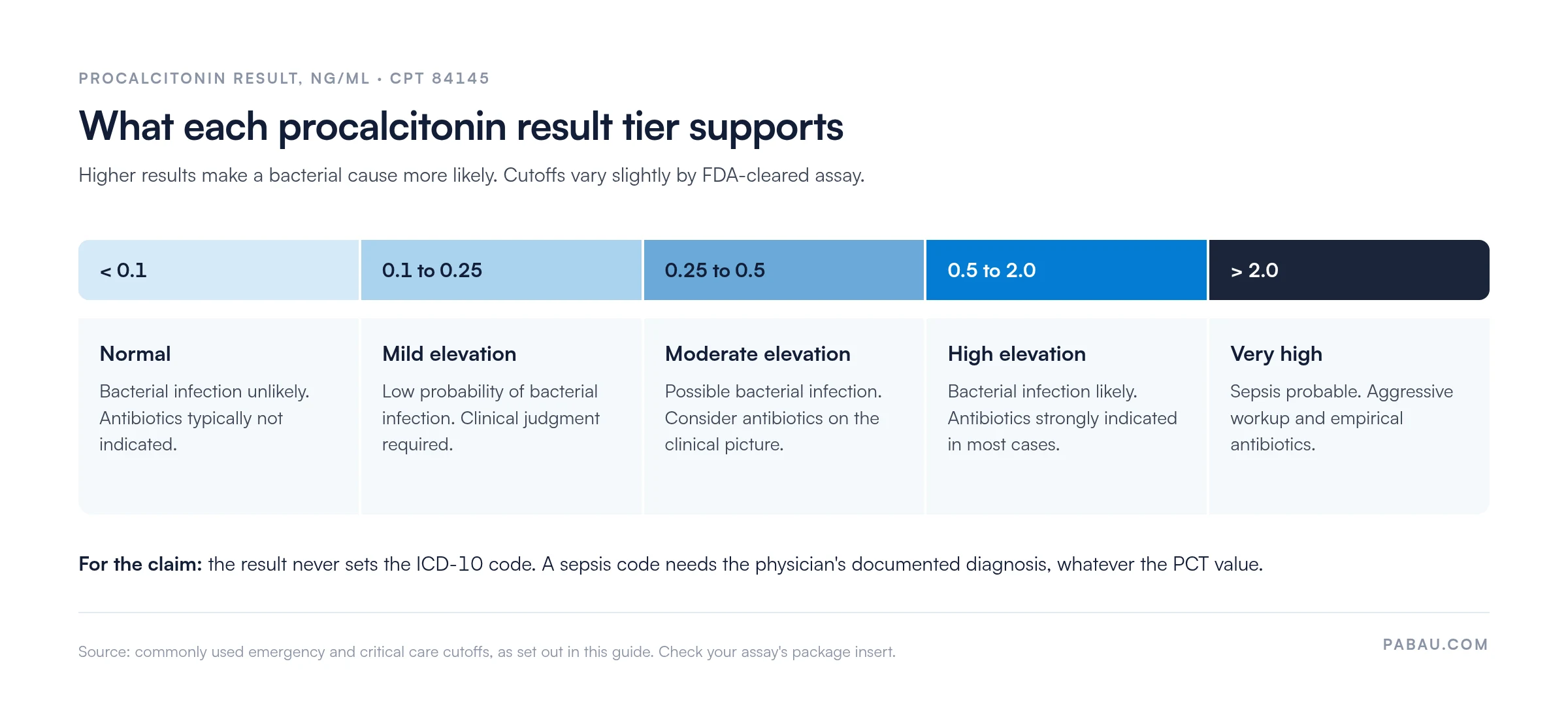
Reference ranges for procalcitonin vary slightly by assay manufacturer. The tiers below reflect thresholds broadly used in emergency medicine and critical care. Coders need them because the documentation must reflect the clinical severity that justifies the test.
Specific cutoffs vary by FDA-cleared assay, so the clinical note should name the assay used and interpret the result in context. Coders should never assign a sepsis ICD-10 code from a PCT value alone. The physician has to document the diagnosis, which is why the scale below ends on the claim rather than the result.
The ICD-10-CM pairing decides more CPT code 84145 claims than any other factor in medical necessity review. The diagnosis code must reflect why the physician ordered the procalcitonin test. A symptom that could apply to any workup does not do that.
Use the most specific ICD-10-CM code the physician’s documentation supports. When a sepsis code such as A41.9 goes on the claim, the record must contain physician-documented clinical criteria for sepsis. R50.9 alone, with no documented suspicion of bacterial infection, is a leading cause of medical necessity denials.
Medicare covers CPT code 84145 under the Clinical Laboratory Fee Schedule (CLFS) when the test is medically necessary. Your Medicare Administrative Contractor (MAC) may narrow the covered indications through a local coverage determination (LCD) or billing article. Check the Medicare Coverage Database for your jurisdiction before billing.
Checking coverage before the draw saves denial work later. Run insurance eligibility verification when the test is ordered to confirm the patient’s plan covers laboratory services. In Pabau’s claims management software, that eligibility response sits on the same patient record as the claim.
Before ordering a repeat procalcitonin series in an outpatient setting, check whether your MAC’s policy limits how often 84145 is covered per episode. Document the clinical rationale for each additional test separately.
CPT code 84145 is a laboratory code paid under the CMS Clinical Laboratory Fee Schedule, so it carries no RVUs from the Physician Fee Schedule. That decides who bills it. A physician office that sends the specimen to an outside lab typically cannot bill 84145. The reference laboratory bills under its own NPI and receives the CLFS payment.
To confirm the current Medicare rate, download the latest quarterly CLFS file from the CMS page linked above and search for 84145. CLFS rates come from the private payer rates that labs report under the Protecting Access to Medicare Act (PAMA), with no RVU calculation involved.
Several lab codes cover adjacent analytes or methods that coders confuse with CPT code 84145. A wrong code creates compliance risk as well as a payment problem.
The most consequential confusion is 84145 versus 84999. Using 84999 (unlisted) for procalcitonin when 84145 exists creates a compliance red flag and forces manual pricing negotiations with payers. Always use the specific code when it exists.
Documentation decides whether an 84145 claim pays and whether it survives an audit. For a clean claim, the medical record must contain each of these elements:
Serial PCT testing requires individual documentation for each draw. Each subsequent test order should reference the clinical rationale for continued monitoring, such as tracking treatment response or adjusting antibiotic duration. One indication note covering a whole series of draws will not satisfy most MACs.
These are the five most common reasons CPT code 84145 claims are denied. Each one can be prevented at the point of order, which is where denial management for lab codes should start.
An 84145 appeal on medical necessity grounds succeeds most often when the redetermination request adds new clinical documentation. Resubmitting the same record rarely changes the outcome. Read the denial codes on the remittance advice first, to see whether the denial cites medical necessity, a non-covered service, or a frequency limit.
Attach the relevant LCD document number and cite the covered indications section directly when the denial contradicts the written policy.
Run a quarterly audit of the remittance codes on your 84145 denials. If CARC 50 (not medically necessary) outnumbers CARC 197 (precertification or authorization absent), fix the ICD-10 pairing before you look at prior authorization. A corrected diagnosis workflow clears repeat denials faster than case-by-case appeals.
Most 84145 denials are set up before the specimen is drawn. The order says “infection workup,” the claim goes out paired with R50.9, and the remittance comes back weeks later with CARC 50.
Pabau keeps the physician’s note, the diagnosis code and the claim on one patient record. The biller reads the documented indication before the claim leaves, so a fever-only pairing gets caught while it can still be fixed.
Claims go out through the Claim.MD clearinghouse, which routes 837P transactions to thousands of US payers. Electronic remittance advice (ERA) comes back the same way, so each payment is matched against the 84145 claim it settles.
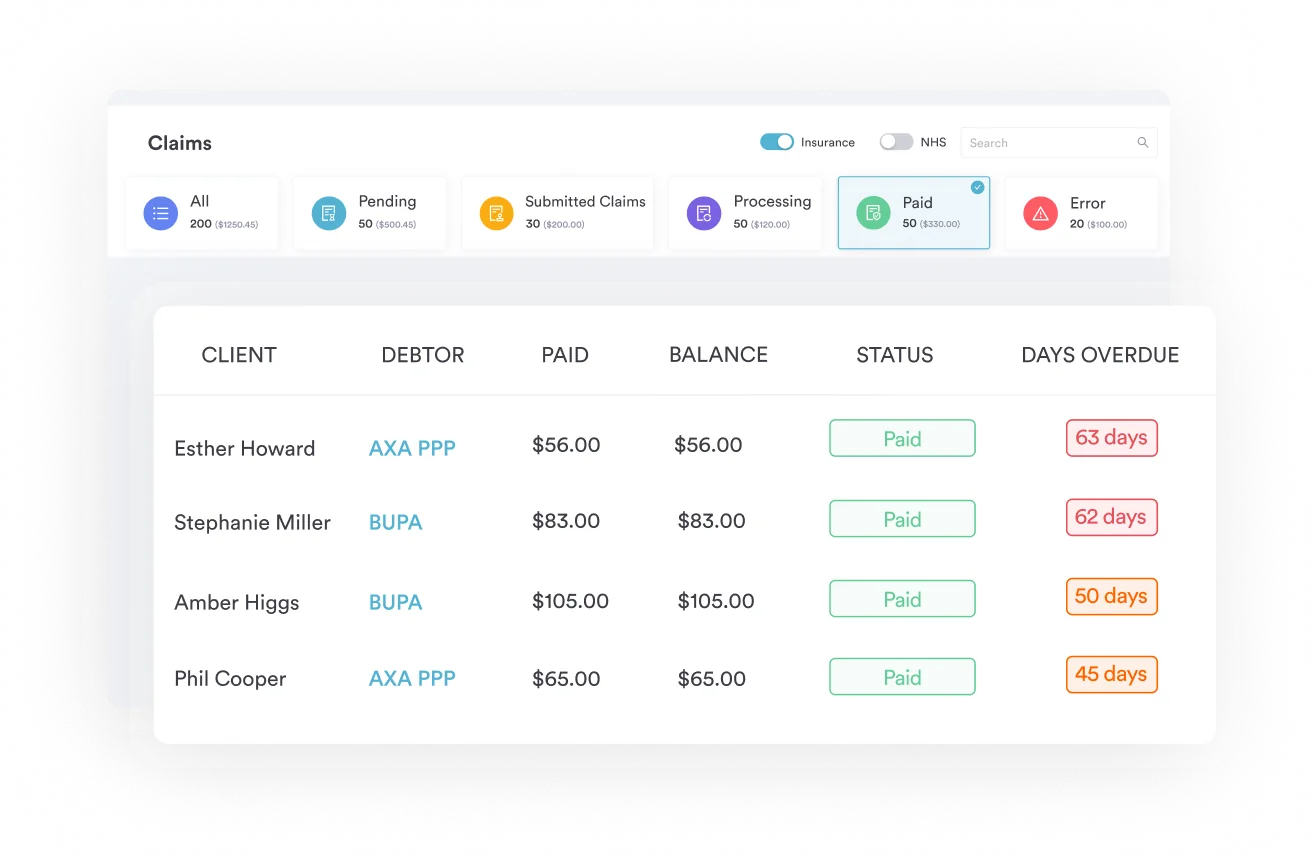

Pabau keeps the documented indication, the eligibility check and the claim on one patient record. Claims go out through the Claim.MD clearinghouse, so your team spends less time chasing 84145 denials.

An 84145 claim is won or lost when the test is ordered. If the note names the suspected bacterial infection and the claim carries a matching ICD-10 code, the test pays at the CLFS rate. If either piece is missing, the claim joins the appeal queue, and the appeal has to supply what the order left out.
Serial testing raises the stakes, because every additional draw needs its own documented reason. A lab that builds the indication into the order form stops paying for the same denial twice. Book a demo to see how Pabau carries the clinical indication from the order through to the 84145 claim.

Getting repeat denials with no clear pattern? 837 EDI transaction guide covers how electronic claims are structured and where data errors cause downstream denials.
Want the right codes captured at the point of care? Superbill documentation guide walks through how to record codes and clinical data before the claim is built.
Mapping where lab revenue leaks between order and payment? Revenue cycle management explained covers the full process from patient intake to payment posting.
CPT code 84145 bills a quantitative procalcitonin (PCT) immunoassay. The lab test measures blood procalcitonin to support the diagnosis and monitoring of bacterial infections, sepsis, and antibiotic therapy decisions. It covers only the quantitative assay, so qualitative or point-of-care PCT methods are not reported with it.
The most accepted pairings for CPT 84145 are A41.9 (sepsis, unspecified organism) and J18.9 (pneumonia, unspecified organism). R65.20 and R65.21 (severe sepsis without and with septic shock) are widely accepted too, and G00.9 (bacterial meningitis) and N39.0 (urinary tract infection) also qualify. The diagnosis code must reflect documented suspicion of bacterial infection, not a viral indication alone.
Yes. Medicare covers CPT code 84145 under the Clinical Laboratory Fee Schedule when the test is medically necessary and a covered ICD-10 code supports the claim. Your MAC may narrow the covered indications through a local coverage determination or billing article, so check the Medicare Coverage Database before billing.
Medicare pays CPT 84145 at one national CLFS rate, which is $27.22 for 2026. The rate changes each year, so confirm it in the current CMS CLFS file. Commercial payers generally reimburse $30-80 or more, depending on contracted rates.
The most common reasons are a non-covered ICD-10 pairing, missing medical necessity documentation, and a MAC frequency limit exceeded. Ordering for a viral indication only, or billing without a signed physician order, also triggers denials. Fixing the ICD-10 pairing at the point of order resolves most repeat denials.
A procalcitonin level above 0.5 ng/mL is broadly associated with likely bacterial infection, and levels above 2.0 ng/mL suggest probable sepsis. Levels below 0.1 ng/mL make bacterial infection unlikely. Thresholds vary by FDA-cleared assay, and a PCT result alone never confirms or excludes a bacterial diagnosis.