CPT code 82272: Fecal occult blood test billing guide
CPT code 82272: official descriptor and when to use it CPT code 82272 is the gua...

Last Updated: Oct 20, 2026

CPT code 36415 describes routine venipuncture (collection of venous blood by a needle) and does not require the skill of a physician to perform or bill.
Medicare pays 36415 under the Clinical Laboratory Fee Schedule (CLFS), not the Physician Fee Schedule: a flat national rate of $9.34 in 2026 ($11.34 for SNF/HHA specimens). Always verify against the current CLFS.
Bundling is the top denial risk: several payers, including CHRISTUS Health Plan, deny 36415 when billed same-day with lab panel codes 80048-89399 by the same provider.
Pabau’s claims management software flags bundling conflicts and automates claim submission, reducing venipuncture denials before they reach the payer.
CPT code 36415 is the venipuncture CPT code that covers the routine collection of venous blood by needle for laboratory testing. Some older billing references still call it procedure code 36415. It’s the standard CPT code for a venipuncture blood draw, billed by phlebotomists, nurses, or medical assistants across physician offices, labs, and outpatient clinics.
This guide walks through how to bill 36415 accurately: its definition and 2026 reimbursement, modifiers, bundling rules, documentation, and the denials that trip up practices most often.
Most billing errors for CPT code 36415 surface at submission. The code is straightforward on paper, but payer-specific bundling rules, modifier requirements, and incident-to nuances catch practices off guard every week.
CPT code 36415 is the standard code for the collection of venous blood by venipuncture. As defined by the American Medical Association (AMA), it falls under the venipuncture and transfusion procedures range and describes routine blood draws performed for laboratory testing, diagnostic monitoring, or clinical evaluation.
It’s the CPT code for phlebotomy most practices reach for, and the correct CPT code for a venipuncture blood draw in the vast majority of outpatient encounters. The procedure doesn’t require physician skill, which separates it from CPT 36410.
CPT code 36415 replaced HCPCS code G0001 effective January 1, 2005, per the 2005 CPT update. G0001 had been used by Medicare to describe routine venipuncture, and the transition brought the service in line with standard CPT classification.
Practices still occasionally receive rejections when legacy billing systems or clearinghouses reference G0001. If you encounter this, confirm your system is submitting 36415 for all post-2005 dates of service.
CPT code 36415 is used by a wide range of practice types: primary care, functional medicine practices, internal medicine. The code covers the act of venipuncture itself, not the laboratory test that follows.
This is where many billers make their first mistake. What separates 36415 from 36410 is whether a physician’s skill is medically necessary for the collection, regardless of who performs the draw.
Per Novitas Solutions guidance, CPT code 36415 does not necessitate a physician’s skill. Routine venipuncture may be safely and effectively performed by non-physician staff. Billing 36410 when 36415 is appropriate is an upcoding risk that attracts audit attention.
Practices with claims management software can configure code pairing rules to catch 36410 submissions that lack appropriate clinical documentation, flagging them for review before submission.
Not every needle stick collects a specimen. When venous access is placed to start therapy instead, the service is reported with 36000, which cannot be billed alongside 36415.
With integrated lab management, spirometry and cardiac test results file themselves against the right patient.
CPT code 36415 does not receive payment under the Medicare Physician Fee Schedule (MPFS). CMS assigns it Status Indicator X, a statutory exclusion, with 0 relative value units (RVUs), which is why an MPFS lookup for 36415 shows no payment.
Medicare instead pays 36415 as a nominal specimen-collection fee under the Clinical Laboratory Fee Schedule (CLFS). The CY2026 national rate is $9.34, up from $9.09 in CY2025. The CLFS is a flat national fee, not adjusted by locality the way the MPFS is.
When the specimen is collected from a beneficiary in a skilled nursing facility, or on behalf of a home health agency, CMS bills the collection under HCPCS code G0471 instead of 36415. G0471 carries a $2 higher PAMA collection fee, bringing the rate to $11.34.
Always verify the current rate using the CMS Clinical Laboratory Fee Schedule page, since CLFS rates update annually with the CPI-U adjustment. Because 36415 carries 0 RVUs, an RVU lookup won’t return a payment figure for this code. Rely on the CLFS rate above instead.
State variation runs deeper in the T-code range, which CMS established for state Medicaid agencies rather than for Medicare. Each state sets the payment rate and the eligible biller types for HCPCS code T2024, so a CMS fee schedule lookup returns no figure.
Multi-specialty practices that bill 36415 alongside other procedure codes benefit from tracking per-code reimbursement trends as part of broader revenue cycle management, to understand overall lab-billing revenue contribution.
CPT code 36415 is paid under the CLFS, a flat national fee, so there is no locality-adjusted MPFS lookup to run for this code. When negotiating commercial rates, use $9.34 as your Medicare reference point. Contracted commercial rates vary by payer and often exceed that figure, so confirm the actual rate in each contract.
Modifiers for 36415 are not used routinely, but knowing when they apply prevents denials and protects your practice from ABN-related liability issues.
One frequent mistake: modifier 25 belongs on the office-visit E/M code, not on 36415 itself, when a payer requires it to confirm the visit was a significant, separately identifiable service from the blood draw. Appending 25 to 36415 instead of the E/M line is a common cause of same-day denials.
One common confusion: CMS Article A52470 confirms that an Advance Beneficiary Notice (ABN) is not required when 36415 is denied by Medicare, and the limitation of liability does not apply. This is specific to Medicare. For commercial payers, check individual payer policies before skipping ABN requirements.

Pabau’s claims management software flags bundling conflicts, automates claim submission, and tracks denial patterns across your entire code set. See how practices use it to clean up lab billing before claims leave the office.

Bundling is where most 36415 denials originate. The NCCI (National Correct Coding Initiative) and individual payer policies create a complicated landscape, particularly when 36415 is billed on the same day as laboratory panel codes.
From a CPT perspective, specimen collection by venipuncture is not considered integral to the laboratory procedure itself, as confirmed by the American Academy of Family Physicians (AAFP). The two may be coded separately. However, payer policies frequently override this CPT interpretation.
CHRISTUS Health Plan does not allow separate reimbursement for CPT 36415 when billed in conjunction with lab procedure codes in the 80048-89399 range on the same day by the same provider. Similar policies exist at Premera Blue Cross and Moda Health. Before billing 36415 with a same-day lab panel, check that specific payer’s reimbursement policy document.
The practical rule many payers apply comes down to where the test runs. When you draw the specimen and run the lab in-house on the same day, several payers treat the venipuncture as integral to the lab test and bundle it, so 36415 is denied.
When you draw the specimen in your office and send it out to an independent or reference laboratory, 36415 is more often separately reimbursable, because your practice performed only the collection. This distinction matters most with common same-day panels such as CPT code 80053, where the panel and the draw frequently land on one claim.
The most common same-day bundling conflict in primary care involves CPT code 80053, the basic metabolic panel. When the same practice draws the specimen and runs the panel in-house, several payers treat the draw as part of the panel and deny 36415 separately.
Sending the specimen to an outside reference lab for the same panel typically preserves separate reimbursement for the draw. The same in-house-versus-reference-lab logic applies to CPT code 85025 (complete blood count with differential) and CPT code 85027 (complete blood count without differential), two of the next most frequently ordered same-day panels alongside 36415.
CPT 99000 describes the handling and conveyance of a specimen from the office to a laboratory. Billing 36415 and 99000 together is common in primary care, but real-world payer behavior is inconsistent.
Community coding forums report that many payers routinely deny 99000 regardless of 36415, and some deny both when billed together. There is no CMS prohibition on billing these together, but individual payer policies vary substantially. Verify your payer mix before relying on 99000 for incremental revenue.
For outpatient hospital billing, CPT 36415 is typically paired with revenue code 0300 (laboratory services). Rural health clinics (RHCs) generally use revenue codes 030X or 031X instead, reflecting the RHC all-inclusive billing structure. Confirm your facility’s UB-04 claim mapping before assuming the same billing logic applies across settings.
Practices that also bill IVF-related procedures can benefit from reviewing bundling logic across their full code set.
CPT 36415 does not require extensive documentation compared to evaluation and management codes, but incomplete records still drive denials and audit risk. At minimum, the medical record should support the following. A payer processing this claim looks for the same itemized superbill basics: visit date, procedure code, and charge.
Collecting the specimen does not itself require a CLIA certificate — only the laboratory performing the test needs CLIA certification. If your practice also runs the test in-house rather than sending it to a reference lab, confirm your CLIA certificate covers that specific test before billing both services.
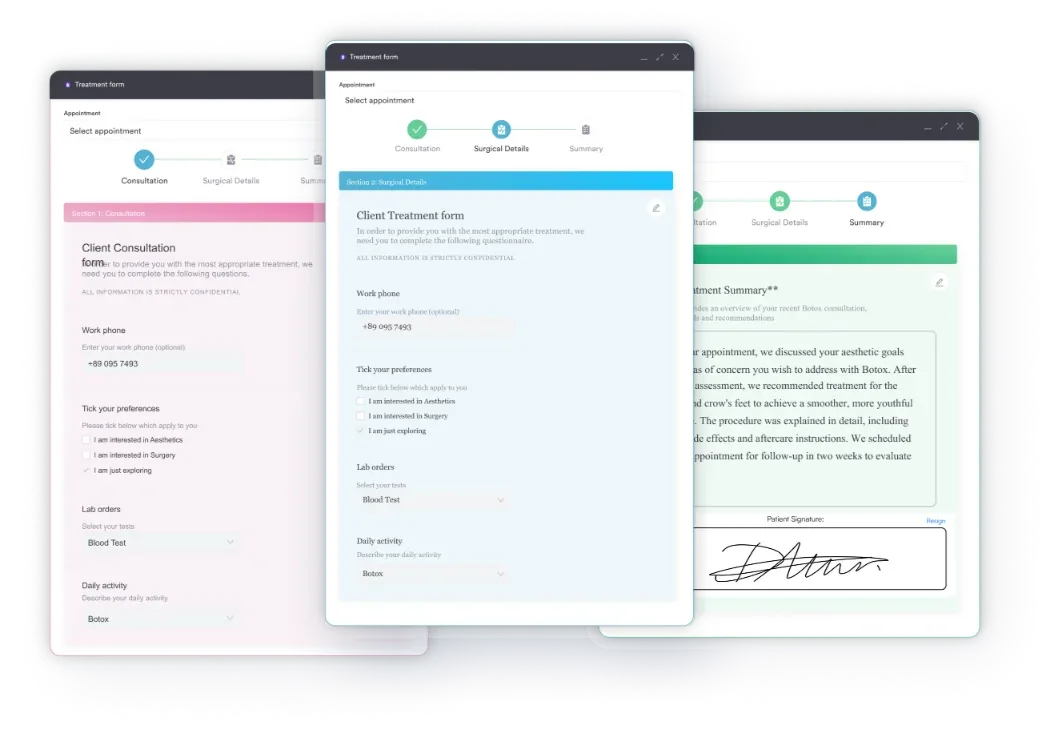
For practices using digital intake forms and electronic clinical records, this documentation is typically captured automatically through lab order workflows integrated with the patient record. Maintaining HIPAA-compliant documentation practices across all lab-related encounters also protects against secondary liability if a payer audit surfaces during a bundled-code review.
Standardizing common lab orders.
When a non-physician (phlebotomist, MA, RN) performs the blood draw in a physician-owned practice, the claim should be billed under the supervising physician’s NPI per CMS incident-to guidelines. The physician must be present in the office suite, though not necessarily in the room, at the time of service.
Billing 36415 under a non-enrolled staff member’s NPI, or billing it as a standalone service without appropriate supervision documentation, creates incident-to compliance exposure.
Run a quarterly audit on your 36415 claims by payer. Pull denials by reason code and segment by payer. If one insurer is consistently denying 36415 on lab-draw days, their bundling policy may have changed without notification. Catching this quarterly versus annually typically recovers two to three times more revenue.
Knowing the denial patterns for CPT code 36415 in advance lets you build preventive billing logic rather than reactive appeals. Below are the five most common denial scenarios.
Practices using automated billing workflows can configure claim scrubbing rules that catch several of these issues before submission, including duplicate-date checks and missing-diagnosis flags.
For practices tracking full CPT code performance alongside other procedure lines, linking 36415 to other ancillary service codes in a single reporting view clarifies which codes are driving denial volume. A clear view of medical billing across the practice makes that pattern easier to spot.
Yes, CPT 36415 can be billed on the same day as an office visit code. The blood draw is a separate, identifiable service from the evaluation and management encounter. The AAFP coding guidance from July 2003 confirmed that specimen collection is not considered integral to the E&M service and may be reported separately.
A few practical considerations apply when billing 36415 alongside an office visit.
Check the payer’s fee schedule and billing policy before relying on this combination for revenue.
Using medical practice management software with built-in claims review lets practices identify which payers consistently pay 36415 alongside E&M codes and which ones bundle it, so billing teams can adjust expectations by payer before claims are submitted.
Understanding how 36415 sits within its code family helps coders make the right selection and avoid the most common cross-code billing errors. When blood is removed as treatment rather than for testing, the session is reported as 99195, and NCCI bundles 36415 into it.
The AAPC Codify CPT lookup provides the full venipuncture code range with descriptor text, bundling edits, and modifier guidance in one searchable interface. Practices that also manage private healthcare billing outside the US can reference comparable private healthcare procedure codes for equivalent specimen collection billing in insurer-specific systems.
Coders managing a broader code set may also want to review other recently published billing guides, including HCPCS code A5120, ICD-10 code I87.9.
Venipuncture is one of the most common in-office procedures billed, yet CPT code 36415 remains one of the most frequently denied codes in multi-specialty practices. The denial drivers are almost always preventable: same-day bundling with lab panels, missing incident-to documentation, or incorrect modifier application.
Pabau’s claims management software helps practices configure pre-submission scrubbing rules that catch 36415 bundling conflicts, flag missing diagnoses, and track denial patterns by payer before they become write-offs.
If your practice is losing revenue on routine blood draws, it’s worth looking at how your billing workflow handles this code. Book a demo to see how Pabau handles claims from documentation through to submission.

Billing a vascular fistula repair instead? CCSD code L7520 guide explains why coding an acquired fistula differently from a congenital one affects the claim.
Billing a varicose vein procedure instead? CCSD code L8512 guide covers picking the right code among the three EVLT options for varicose vein treatment.
Looking to streamline how your practice handles lab-adjacent workflows? Lab management software shows how Pabau connects lab orders, specimen tracking, and billing in a single workflow.
CPT code 36415 is used to report the routine collection of venous blood by venipuncture for laboratory testing, diagnostic monitoring, or clinical evaluation. Physician skill is not required, which distinguishes it from CPT 36410.
Most submissions require no modifier. Modifier GY applies when billing Medicare for a non-covered service and triggers an automatic denial. Modifier SC may be required by some payers when 36415 is billed alongside an office visit.
It depends on the payer. CPT guidance permits separate billing from lab panel codes (80048-89399), but payers such as CHRISTUS Health Plan and Premera Blue Cross bundle 36415 into the lab payment when billed same-day by the same provider. Always check the payer’s policy before submitting.
36415 covers routine venipuncture requiring no physician skill. 36410 applies when the patient’s condition makes access difficult enough to require physician expertise. Billing 36410 without supporting clinical documentation is an upcoding risk.
Yes. 36415 can be billed on the same date as an E&M code (99202-99215) because the draw is a separate, identifiable service. Some payers require modifier SC, and a few commercial plans bundle the code into the office visit payment, so verify your payer’s policy.
Medicare pays approximately $9.34 for CPT 36415 under the CY2026 Clinical Laboratory Fee Schedule (CLFS), not the Physician Fee Schedule, rising to $11.34 when the specimen is collected from a beneficiary in a skilled nursing facility or on behalf of a home health agency. It’s a flat national fee, not locality-adjusted. Commercial payer rates vary by contract, so verify your specific fee schedule.
CPT 36415 covers collecting venous blood by venipuncture (a standard needle draw from a vein). CPT 36416 covers a capillary blood specimen by finger, heel, or ear stick, typically for point-of-care testing. Choose the code that matches how the sample was actually obtained.
No. CPT 36415 has no age limit and applies to routine venipuncture at any age. Venipuncture requiring a physician’s skill is reported with CPT 36400, 36405, or 36406 for patients younger than age 3 (by site: femoral or jugular vein, scalp vein, or other vein), and with CPT 36410 for patients age 3 and older. 36415 itself carries no age restriction.
No. CPT code 36415 is a routine specimen-collection code, not a preventive service. It is paid under the Clinical Laboratory Fee Schedule based on the ordering diagnosis for the lab test, not under Medicare’s preventive-service coverage rules. Whether the underlying lab test itself counts as preventive depends on the specific test and diagnosis code, not on the venipuncture code.