ICD-10 code E55.9: Vitamin D deficiency, unspecified
ICD-10 code E55.9: Definition and official descriptor ICD-10 code E55.9 is the I...

Last Updated: Nov 10, 2026
Billable Code Specific Code
A41.9 is the billable ICD-10-CM code for sepsis, unspecified organism. It applies when the physician documents sepsis but names no causative organism. The code sits in category A41 (Other sepsis), in Chapter 1 of the tabular list.
A documented organism moves the claim to a specific A41.x code, and severe sepsis or septic shock adds R65.20 or R65.21. The physician must write "sepsis" explicitly. Terms like "urosepsis," "bacteremia" or "SIRS" do not support A41.9, per the ICD-10-CM Official Guidelines for Coding and Reporting (FY2027), Chapter 1, Section C.1.d.
Let Pabau's smart automation suggest the right codes, reduce claim denials, and keep your practice compliant—effortlessly.
Automate repetitive tasks and focus on what matters most—your patients.
Reduce coding errors and ensure compliance with the latest regulations.
Clean claims, fewer denials, and faster reimbursements.
Powerful insights and reporting to help your practice thrive.
HIPAA compliant SOC 2 certified GDPR-compliant Trusted by 4,000+ clinics worldwide

A41.9 is the billable ICD-10-CM code for sepsis when the physician documents sepsis but no causative organism.
When the organism is documented, a specific A41.x code replaces A41.9, and streptococcal sepsis moves to category A40.
Severe sepsis adds R65.20 and septic shock adds R65.21, each with a code for every acute organ dysfunction.
The physician must write the word “sepsis”, because urosepsis, bacteremia and SIRS do not map to A41.9.
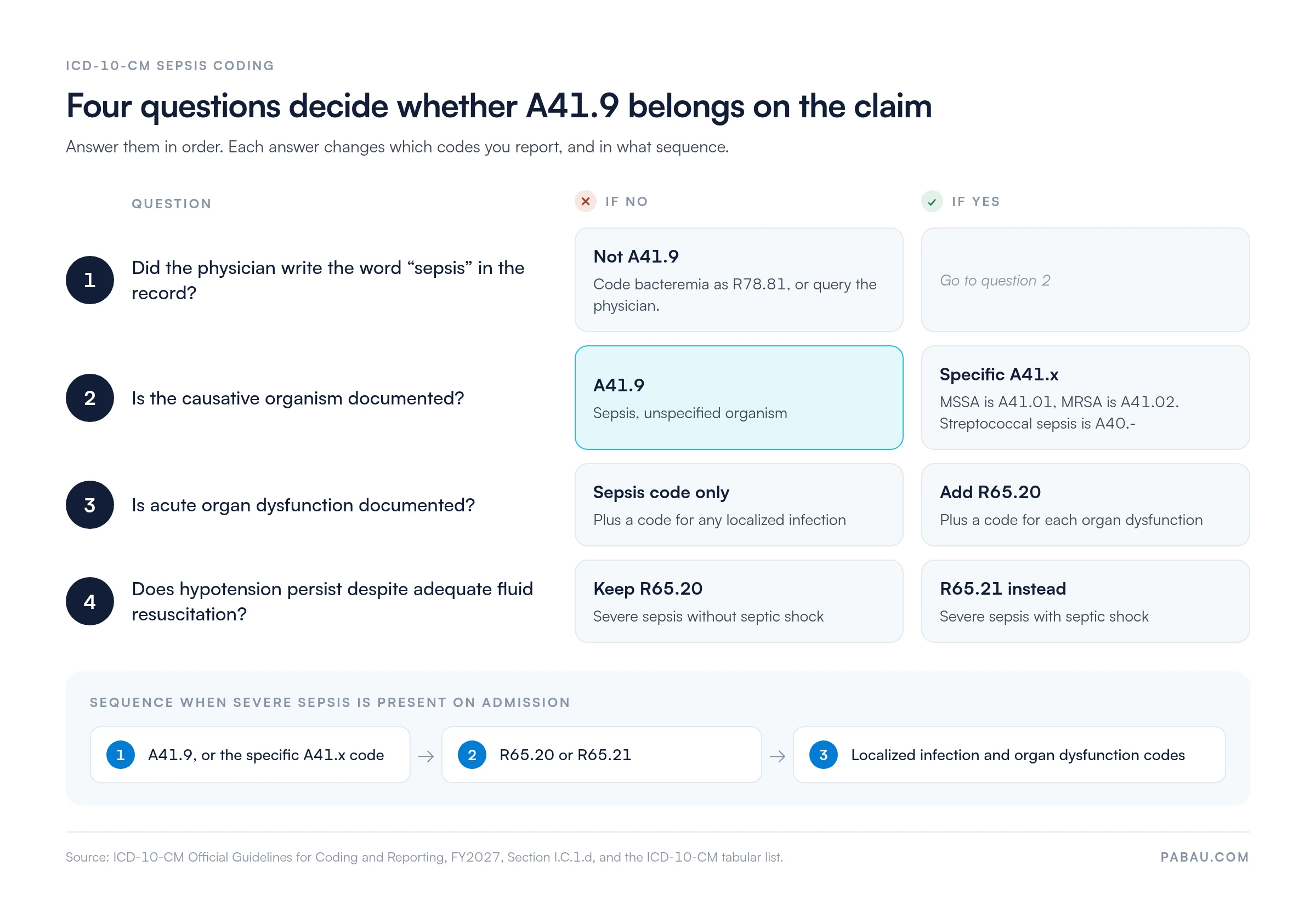
When severe sepsis is present on admission, A41.9 sequences first, followed by R65.20 or R65.21.
ICD-10 code A41.9 is the billable ICD-10-CM code for sepsis, unspecified organism. Assign it when the physician documents sepsis but names no causative organism. It counts as a major complication or comorbidity (MCC) and groups to MS-DRGs 870 to 872.
The table holds the reference data coders and clinical documentation specialists check before billing or querying a physician.
A41.9 applies when sepsis is documented without identification of the causative organism. The code captures the clinical syndrome of sepsis itself, not any specific bacterial, fungal, or viral source.
Clinical scenarios legitimately mapped to A41.9 include:
The category A41 covers sepsis due to Staphylococcus (A41.01, A41.02, A41.1, A41.2), Haemophilus influenzae (A41.3), anaerobes (A41.4), Gram-negative organisms (A41.5x), and other specified organisms (A41.89). Streptococcal sepsis is coded in category A40, not A41. A41.9 is the residual option when none of those apply.
Key documentation point: “Unspecified organism” in ICD-10-CM means the physician has not documented which organism caused the sepsis, not that an organism was never present. If culture results later confirm an organism and documentation is updated, the code should be updated to the more specific A41.x equivalent.
The ICD-10-CM tabular list includes critical exclusion notes for A41.9 that coders must apply before assigning this code.
Excludes1 notes (cannot be coded together with A41.9):
When a more specific A41.x code applies instead: If the treating physician documents the causative organism, A41.9 must not be used. For example, MSSA sepsis is A41.01 and MRSA sepsis is A41.02, not A41.9. Using A41.9 when organism documentation exists is a documentation-accuracy issue and may trigger a medical necessity denial.
Four questions, asked in order, settle which sepsis codes belong on the claim. The decision path below walks through each one, and the table after it compares the codes most often confused with A41.9.
These three terms are clinically and coding-distinct. Bacteremia (R78.81) means bacteria are present in the blood but the patient does not meet the systemic criteria for sepsis. SIRS (R65.10/R65.11) describes a systemic inflammatory response that may arise from non-infectious causes such as trauma or pancreatitis.
Sepsis (A41.9) requires that the physician explicitly document the word “sepsis.” Chapter 1 of the CDC/NCHS ICD-10-CM Official Guidelines bars coders from inferring sepsis. Abnormal lab values, clinical indicators alone and unrecognized synonym terms do not count. If documentation says “bacteremia,” code R78.81. If it says “sepsis,” code A41.9 (or the organism-specific equivalent).
Severe sepsis exists when sepsis is accompanied by acute organ dysfunction. Septic shock adds sepsis-induced hypotension that persists despite adequate fluid resuscitation.
Coding sequence when severe sepsis or septic shock is documented:
The organ dysfunction codes are not optional. The ICD-10-CM tabular notes under R65.2 say “code first underlying infection” and “use additional code to identify specific acute organ dysfunction.” Missing those codes understates severity and reduces the DRG weight.
A41.9 is the correct principal diagnosis when sepsis is the condition chiefly responsible for the inpatient admission after study. That rule comes from Section II of the ICD-10-CM Official Guidelines.
Three sequencing scenarios arise most frequently:
Outpatient encounters follow different rules. For outpatient coding, the condition established by the encounter is listed first. A confirmed outpatient sepsis diagnosis is coded directly from the provider’s documentation.
When sepsis develops as a complication of a procedure, the postoperative complication code takes the sequencing lead. For unspecified-organism postoperative sepsis, T81.44XA (Sepsis following a procedure, initial encounter) sequences first, followed by A41.9. If the organism is identified, the corresponding A41.x code replaces A41.9 in that combination.
Secondary sepsis arising from a documented source infection (e.g. sepsis from a central line bloodstream infection) requires the localized infection code plus A41.9. The sequencing depends on which condition drove the admission, not which developed first. CDI specialists should query the physician when documentation is ambiguous about whether sepsis or the underlying infection was the primary driver.
Run a physician query whenever documentation includes clinical indicators of sepsis (fever, elevated lactate, vasopressor initiation) but the word ‘sepsis’ is absent. AHIMA and ACDIS query guidelines allow compliant queries in this scenario. On a sepsis admission, documenting an MCC secondary diagnosis, such as R65.20, R65.21 or an acute organ failure, can shift DRG 872 to DRG 871.
A41.9 is a physician-documented code. The clinical record must contain explicit physician documentation of the word “sepsis” to support assignment.
Documentation elements that support A41.9:
The CC/MCC designation of A41.9 means its presence as a secondary diagnosis elevates the DRG weight on other admissions. On a surgical case, an undocumented sepsis episode can mean the difference between an MCC and a CC tier. DRG 853 versus 854 is one example.
A41.9 maps to the Septicemia or Severe Sepsis MS-DRG family. The specific DRG assignment depends on whether a mechanical ventilator was used for more than 96 hours and whether MCCs are present.
A41.9 carries an MCC designation. As a secondary diagnosis on a non-sepsis admission, it can move that admission to a higher-weight DRG.
When A41.9 is the principal diagnosis, the split between DRG 871 and 872 depends on whether a secondary diagnosis is an MCC. R65.20 and R65.21 are MCCs, so documenting severe sepsis or septic shock alongside A41.9 can move the case to DRG 871.
Per the CMS ICD-10 codes page, the current MS-DRG definitions manual (v44, FY2027) governs the mapping. Relative weights change annually; always reference the fiscal year in effect for the admission date.
Sepsis claims face some of the most scrutinized payer review processes in inpatient billing. The denial patterns for A41.9 are consistent enough to build prevention workflows around.
Each of these denials starts in the record, long before anyone builds the claim. That puts prevention in CDI review and physician queries at the point of documentation. Once a denial does arrive, a structured denial management process decides whether it is appealed, corrected or written off.
A denied sepsis claim comes back with CARC and RARC codes that name the reason. The reference on medical billing denial codes explains the ones payers return most often. Fixing the root cause is what turns the resubmission into a clean claim.
Sepsis admissions are a frequent target of payer audits, so coding accuracy here is also a compliance question. A review cycle built on medical billing compliance rules catches unsupported sepsis diagnoses before an auditor does.
Original Medicare does not require prior authorization for sepsis inpatient admissions. Medicaid requirements vary by state and plan, and commercial payers vary considerably too. Many commercial plans want concurrent review notification within 24 to 48 hours of an inpatient sepsis admission. That applies even where the admission itself needs no prior authorization.
Medical necessity thresholds are where most commercial denials originate. Payers increasingly use sepsis severity scoring tools to evaluate whether inpatient admission was warranted. The documentation must show the clinical indicators that supported admission-level care. Payers look for the initial lactate value, vasopressor requirements, degree of organ dysfunction, and the trajectory in the first 24 hours.
Per the AAPC ICD-10-CM lookup, payer-specific LCD policies for sepsis vary by Medicare Administrative Contractor (MAC) jurisdiction. Always verify the applicable LCD for the payer and geographic region before appealing a medical necessity denial. The ICD List database provides additional code context including DRG grouper information useful for appeal preparation.
For concurrent reviews on sepsis admissions, ask the physician to document the response to initial treatment within the first 12 to 24 hours. Payers reviewing medical necessity on day 2 or 3 look for the clinical trajectory. That trajectory, more than the presentation that triggered admission, is what justifies continued inpatient status.
Professional (physician) sepsis claims carrying A41.9 use the CMS-1500 form or its electronic version, the 837P. Inpatient facility claims, which carry the MS-DRG, use the UB-04 or the 837I instead.
On a professional claim, A41.9 must sit in the correct diagnosis pointer position. When R65.20 or R65.21 is added, each code must point to the service line it supports. A clearinghouse checks the claim’s format and payer rules before it reaches the payer, and returns the remittance once the payer decides.
In many practices, eligibility is checked on a payer portal, claims are keyed into a separate clearinghouse, and remittances are matched by hand. Each handoff is a place where a denied sepsis claim can sit unnoticed until the payment is late.
Pabau, the practice management platform we build, connects to the Claim.MD clearinghouse for US claims. From the patient record, your team can run real-time eligibility checks, submit CMS-1500/837P claims and match ERAs. Secondary claims go out from the same place, inside Pabau’s claims management software.
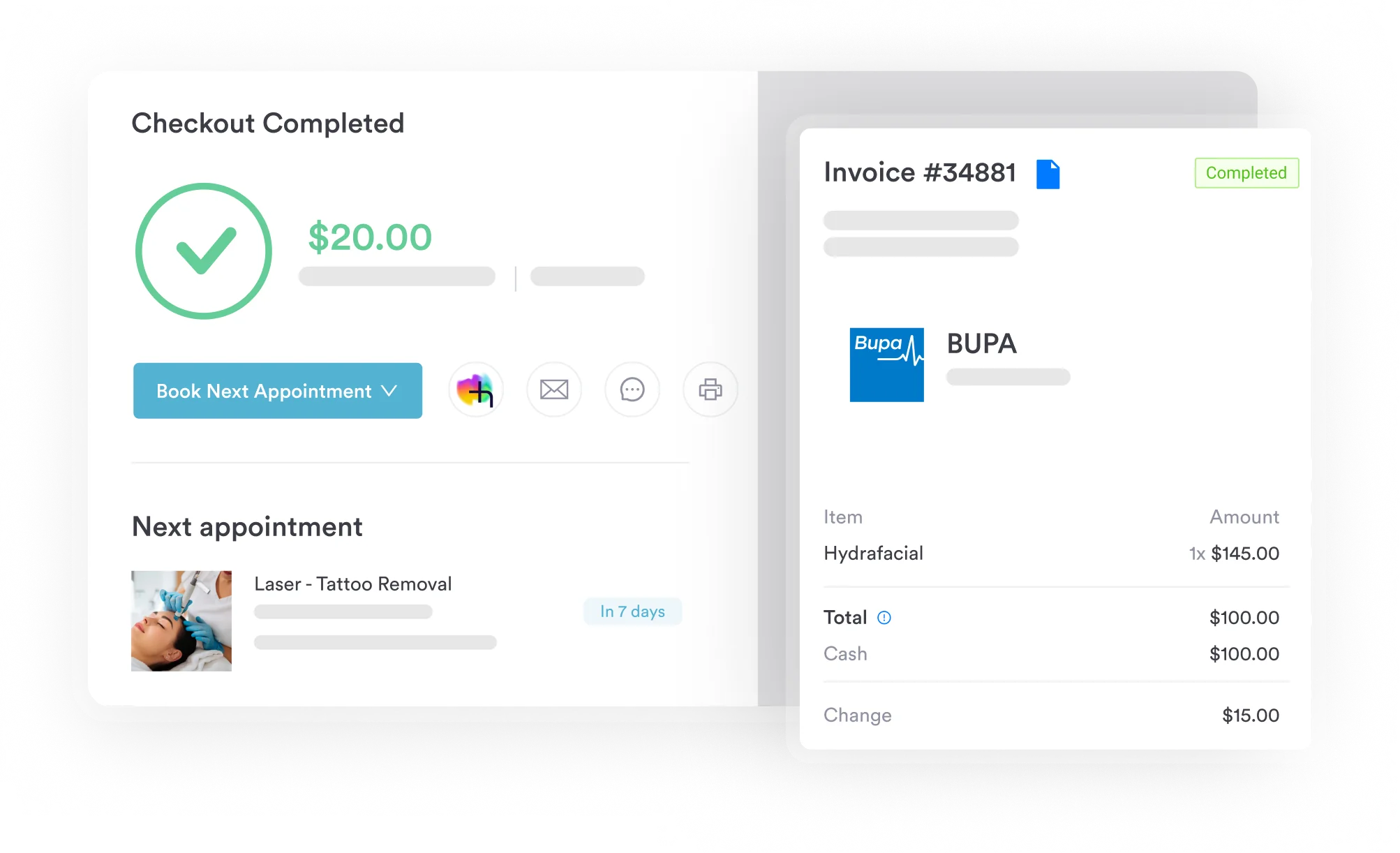
When a sepsis claim is denied, the ERA (835) data and its CARC code land back in the billing workflow for review and appeal. Your billing team sees the reason against the claim it belongs to, so the fix can start the same day.
Our Claim.MD clearinghouse guide explains how the connection reaches thousands of US payers, and the medical billing overview covers the full claim lifecycle.

Pabau connects to Claim.MD so your team can run real-time eligibility checks, submit CMS-1500/837P claims and match ERAs from one record. Denied claims come back into the same billing workflow, ready to work.

A41.9 is only as safe as the documentation behind it. Before you assign it, confirm the physician wrote “sepsis” and check the cultures for a named organism. Then look for organ dysfunction that calls for R65.20 or R65.21.
The trade-off is a little time now against money later. A compliant physician query costs a day, while a denied or downcoded sepsis claim can cost a DRG tier and a full appeal cycle.
To see how Pabau runs eligibility checks, claim submission and ERA matching for your sepsis claims, book a demo with our team.

Need a faster way to send claims to payers? Pabau’s Claim.MD clearinghouse guide explains how the integration checks eligibility and routes claims to thousands of US payers.
Struggling with denial tracking across code families? Understanding electronic remittance advice covers how ERA 835 data maps denial reasons back to specific claims.
Want to understand how DRGs affect reimbursement? Revenue cycle management explained covers MS-DRG grouping, the claim lifecycle and payment optimization for inpatient billing.
ICD-10 code A41.9 is the billable diagnosis code for sepsis, unspecified organism. It is assigned when a physician explicitly documents sepsis but does not identify the causative organism. It is valid for inpatient and outpatient HIPAA-covered transactions.
Yes, A41.9 is a billable and specific ICD-10-CM code valid for HIPAA-covered transactions. It carries an MCC (Major Complication or Comorbidity) designation, which affects DRG assignment when it appears as a secondary diagnosis.
Urosepsis does not map directly to A41.9. The physician must document “sepsis” explicitly for A41.9 to be assigned. If the documentation says “urosepsis” only, coders must query the physician to clarify whether sepsis is confirmed. If sepsis is confirmed, code A41.9 plus the UTI code; if not, code the UTI only.
Sepsis (A41.9) and bacteremia (R78.81) are mutually exclusive under ICD-10-CM and cannot be coded together. Bacteremia means bacteria are present in the blood without meeting the clinical criteria for sepsis. Sepsis requires explicit physician documentation of that term and represents a more severe systemic response.
Yes, A41.9 can be the principal diagnosis when sepsis is the condition chiefly responsible for the inpatient admission after study. Any underlying localizing infection (e.g. pneumonia, UTI) sequences as an additional code when sepsis is principal.
Severe sepsis requires A41.9 first, followed by R65.20 (without septic shock) or R65.21 (with septic shock), plus separate codes for each acute organ dysfunction present. Omitting the organ dysfunction codes is one of the most common denial triggers for sepsis claims.