



CCSD code G5100: Bypass of duodenum billing guide
CCSD code G5100 bills a bypass that leaves the duodenum in place CCSD code G5100...

Last Updated: Oct 16, 2026

CPT code 87086 describes a urine culture, bacterial; quantitative, colony count — a moderate-complexity lab test that requires a CLIA-certified facility.
Medicare covers 87086 under NCD 190.12 when a qualified provider orders it with a documented indication, such as suspected UTI or recurrent bacteriuria.
The most common billing errors involve missing ICD-10 linkage, thin medical necessity documentation, and upcoding to CPT 87088 before organism identification is complete.
Practice management software like Pabau pairs ICD-10 codes automatically and submits claims for lab codes such as 87086, cutting manual entry errors.
CPT code 87086 describes the laboratory procedure formally titled Culture, bacterial; quantitative, colony count, urine. The test grows bacteria from a urine specimen on culture media over 24 to 48 hours. It then counts the resulting colonies to quantify the bacterial load in colony-forming units per milliliter (CFU/mL). That colony count determines whether the growth is clinically significant. The threshold is typically 100,000 CFU/mL or higher for uncomplicated UTI, though clinical context can lower that bar.
CPT 87086 sits in the microbiology section of the CPT code set, which spans codes 87003 through 87999. The bacterial culture subrange begins at 87040. The code is maintained by the American Medical Association (AMA) CPT Editorial Panel and is one of the most-billed codes in clinical laboratory medicine.
CPT code 87086 is the correct code when the ordering provider requires a quantitative bacterial count from urine. That is distinct from a simple screening dipstick or a qualitative culture. The quantitative element is what drives the choice of 87086 over the other urinalysis codes. It measures CFU/mL rather than the presence or absence of organisms.
Clinical scenarios where 87086 is the appropriate code include:
The ordering provider must document the clinical indication clearly in the chart. Every lab order has to trace back to a clinical reason. Absent that documentation, the claim is vulnerable to a medical necessity denial under CMS coding requirements.
Order CPT 87086 specifically when you need a colony count. If a provider orders a urine culture without specifying quantitative, the lab may default to reporting growth as present or absent. That result does not support the 87086 descriptor. The order must request a quantitative culture with colony count to justify the code.
When the order and the lab report both describe a screen, the correct code is 87081, not 87086. The screening code covers a present-or-absent finding with no colony count.
CPT code 87086 is reimbursed under the Clinical Laboratory Fee Schedule (CLFS), not the Medicare Physician Fee Schedule (MPFS). The CLFS sets national payment rates for laboratory tests, adjusted annually by CMS. Geographic adjustment factors apply, so reimbursement varies by Medicare Administrative Contractor (MAC) jurisdiction.
For the current rate, check the CLFS file your MAC publishes each year. CMS also maintains a fee schedule lookup tool for its other payment schedules. The table below reflects the 2026 national payment amount range, which you should verify against your MAC before billing.
When CPT 87088 (identification of aerobic isolate) is billed alongside 87086, the combined reimbursement reflects both the culture and identification components. Track your electronic remittance advice (ERA/835 files) to reconcile payment against expected CLFS rates and catch underpayments early.
Medicare Part B covers CPT code 87086 when it meets the medical necessity criteria set out in NCD 190.12 (Urine Culture, Bacterial). The National Coverage Determination establishes the circumstances under which Medicare will pay. It is the primary policy document to reference when preparing an 87086 claim for a Medicare beneficiary.
Before billing, verify the patient’s coverage. That tells you whether they are under traditional Medicare, Medicare Advantage, or a supplemental plan with additional coverage criteria.
The full NCD 190.12 policy is published in the CMS Medicare Coverage Database. Review it directly before citing coverage criteria to a payer, as CMS updates NCDs periodically.
Every CPT 87086 claim must include a supporting ICD-10-CM diagnosis code that establishes medical necessity. Payers, including Medicare under NCD 190.12, cross-reference the diagnosis against covered indications. Our ICD-10-CM code reference covers the diagnosis codes you will pair with lab work most often. A claim submitted without an appropriate diagnosis code, or with one that falls outside covered indications, will deny however correctly 87086 itself is coded.
All ICD-10-CM codes in the table are valid for FY2026. N39.0 is the pairing you will reach for most, and its own reference page covers the sequencing rules. Verify any code’s active status against the CDC/NCHS ICD-10-CM web tool before including it on a claim.
Correct billing starts with the rules that govern how 87086 appears on a claim. The following apply across most payers, including Medicare. Always check your MAC’s local coverage determination (LCD) for additional payer-specific requirements.
CPT 87086 uses modifiers sparingly. The most relevant are:
Every 87086 claim needs supporting documentation before it leaves the practice. A clean claim gives the payer every element it needs to adjudicate on first pass, which avoids the rework cycle of denials and appeals. The required elements are:
Keep these elements in the patient record and accessible for a payer audit. CMS can request claim documentation going back up to seven years.
Urine culture billing rarely involves just one code. Knowing the adjacent codes, and when each is appropriate, prevents both undercoding and upcoding errors. The table below covers the most frequently confused or paired codes:
Presumptive identification does not always name the organism to species level. When the lab applies additional methods to reach that definitive identification, report CPT 87077 for each aerobic isolate.
Once the lab identifies the organism, antimicrobial susceptibility testing often follows. Report CPT 87186 for microdilution susceptibility studies, which are separately billable from the culture itself.
CPT 87088 is the code most often confused with 87086. The quantitative culture tells you how much bacteria is present. The identification step tells you which organism it is.
They describe different parts of the laboratory process and are billed separately when both are performed. Billing 87088 in place of 87086 before organism isolation is complete is a common coding error. The sequence below shows where each code attaches to the workup.
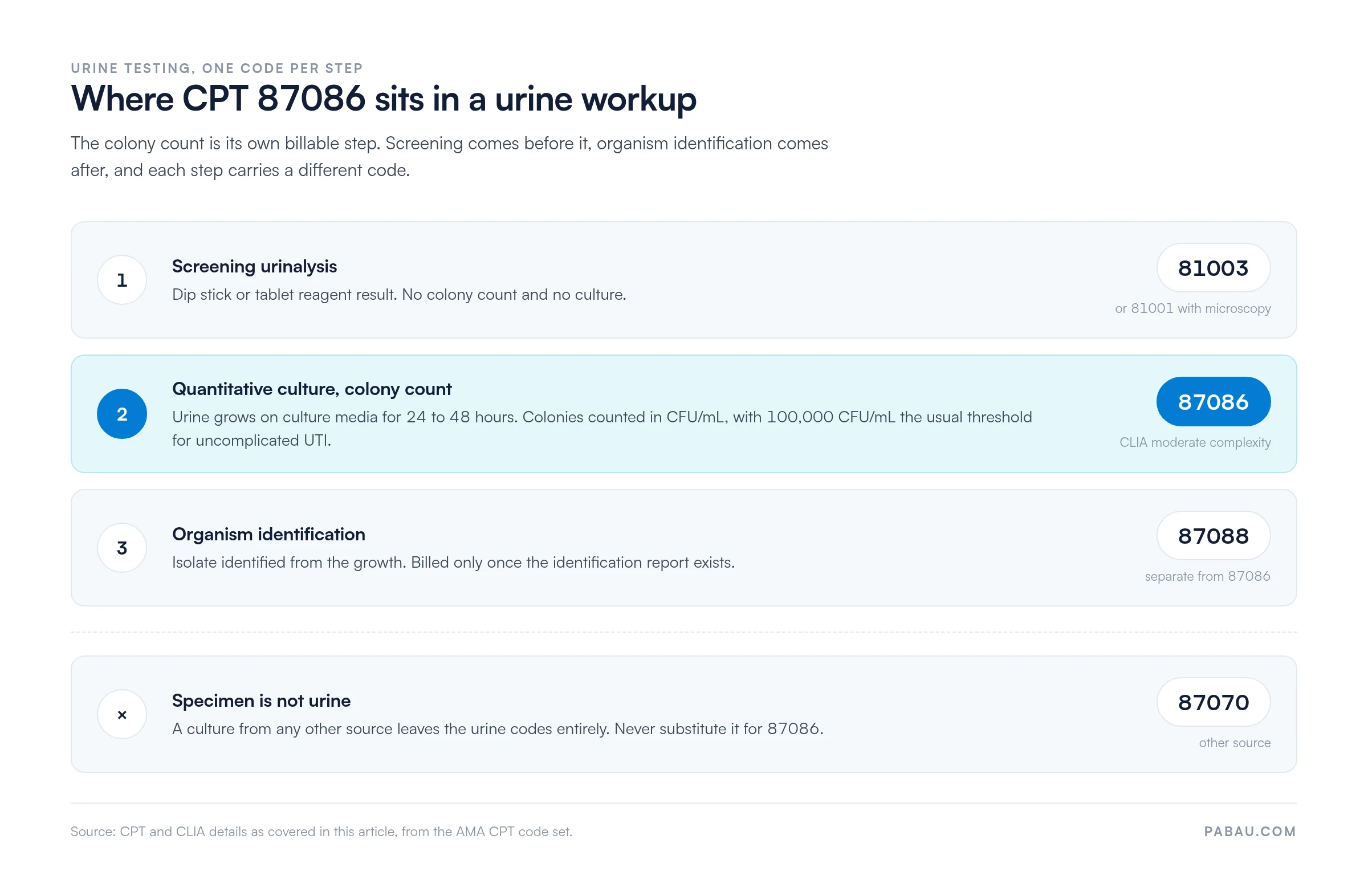
Denials on 87086 cluster around a handful of repeat mistakes. Each has a documentation or sequencing fix that stops it recurring, and the table below pairs them up.
Structured denial management catches these patterns before they compound. Tracking denial reason codes on 87086 claims over 90 days usually reveals which category dominates in a given practice or lab.
Manual lab billing for a code like 87086 tends to fail in the same three places:
Practice management software like Pabau closes each of those three points. Pabau’s claims software for labs automates code entry and links the diagnosis code at the point of order.
Completed claims route through our Claim.MD clearinghouse integration for electronic submission to over 4,000 US payers. Real-time eligibility checks run before submission, so coverage problems surface before they turn into denials.
For labs and outpatient practices billing high volumes of urine culture codes, that automation also builds a structured audit trail. Every order carries the ordering provider’s name, the clinical indication pulled from the record, the specimen collection date, and the linked ICD-10 code.
That is the documentation package payers request during an audit. Having it pre-assembled removes the retrospective chart review, and claim file submission becomes a single step rather than a multi-department handoff.
Practices tracking denial patterns can also use Pabau’s reporting to isolate 87086 denial rates by reason code. That shows whether the root cause is documentation, an ICD-10 mismatch, or an NCCI edit conflict, which makes coder training far more targeted. See how it works for your lab billing volume by booking a demo.

Pabau pairs diagnosis codes with procedure codes as the order is placed, and flags incomplete documentation before a claim goes out. Lab claims leave the practice complete, so fewer come back as denials.

87086 is not a hard code to get right. The descriptor is narrow, the coverage policy is published, and the denial patterns are few enough to cover with a handful of scrubbing rules.
Three failures account for most of the money lost on urine cultures. Transcription detaches the diagnosis code, the line item ships without one, or a QW modifier nobody removed triggers a rejection. Each of those is catchable before submission. Fix them at the point of order rather than at appeal.
If your lab runs regular UTI workups, the win sits in the workflow rather than in the code book. Book a demo to see how Pabau links diagnosis codes and scrubs lab claims before they leave the practice.

Need to understand how clean claims are built? Clean claim submission best practices covers the documentation and formatting steps that prevent first-pass rejections.
Want to reduce denial rates across your lab billing? Revenue cycle management fundamentals explains the end-to-end process from order to payment reconciliation.
Handling high claim volumes across multiple payers? Medical claims clearinghouse guide explains how clearinghouses route and validate claims before payer adjudication.
CPT code 87086 covers a urine culture, bacterial; quantitative, colony count. This is a moderate-complexity laboratory procedure. Urine is cultured on growth media and the resulting bacterial colonies are counted, reported as colony-forming units per milliliter (CFU/mL). The count shows whether the growth is clinically significant.
Yes. Medicare Part B covers CPT 87086 under National Coverage Determination (NCD) 190.12. The ordering provider must be qualified and must document a clinical indication, such as suspected or recurrent UTI. Routine asymptomatic screening in non-pregnant patients is generally not covered without individual medical necessity justification.
CPT 87086 covers the quantitative colony count from the urine culture. CPT 87088 covers identification of the specific bacterial isolate from that culture. They describe different steps of the lab process and are billed separately when both are performed. Billing 87088 before the organism identification is complete is a coding error.
The 2026 Medicare Clinical Laboratory Fee Schedule (CLFS) national rate for CPT 87086 is approximately $9-$11, subject to geographic adjustment by MAC jurisdiction. Verify the current rate against the CLFS file your MAC publishes, since CLFS rates are updated annually.
CPT 87086 and CPT 81003 (automated urinalysis) may be billed on the same date when both are separately ordered and medically necessary. However, NCCI edits may bundle them. Check the current National Correct Coding Initiative edit table for this pair and apply modifier 59 only when clinical documentation supports separate billing.
Modifier 91 applies when a repeat culture is medically necessary on the same day as a prior test. Modifier 59 applies when 87086 is billed alongside another code that triggers an NCCI edit and the services are distinct. Do not apply modifier QW, as CPT 87086 is not CLIA-waived and requires a certified moderate-complexity laboratory.
No, not without appropriate CLIA certification. CPT 87086 is a moderate-complexity test. Performing or billing it from a non-certified office setting is a compliance violation. The lab performing the culture must hold a valid CLIA certificate, and its certificate number must be on file with the payer.



