

HCPCS Code E0272: Foam rubber mattress billing guide
HCPCS Code E0272: official descriptor and code overview HCPCS Code E0272 is the ...

Last Updated: Nov 6, 2026
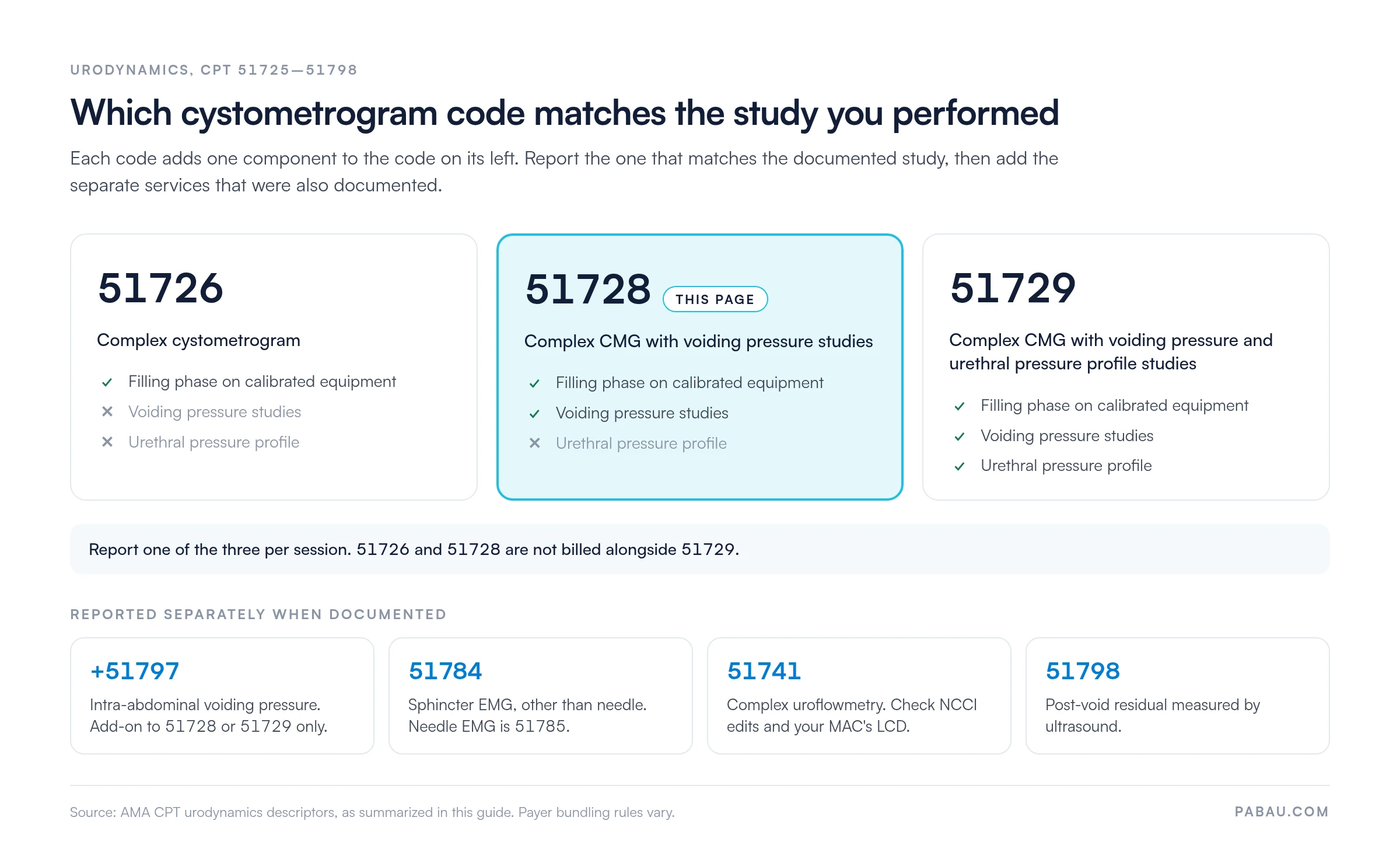
51728 is the CPT code for a complex cystometrogram (ie, calibrated electronic equipment) with voiding pressure studies (ie, bladder voiding pressure), any technique. It records detrusor pressure while the bladder fills and again while the patient voids.
It sits between 51726, the complex cystometrogram without voiding pressures, and 51729, which adds urethral pressure profile studies. Report 51728 when the study captures voiding pressures but no urethral pressure profile.
Let Pabau's smart automation suggest the right codes, reduce claim denials, and keep your practice compliant—effortlessly.
Automate repetitive tasks and focus on what matters most—your patients.
Reduce coding errors and ensure compliance with the latest regulations.
Clean claims, fewer denials, and faster reimbursements.
Powerful insights and reporting to help your practice thrive.
HIPAA compliant SOC 2 certified GDPR-compliant Trusted by 4,000+ clinics worldwide

CPT Code 51728 sits in the urodynamics subsection of the CPT Surgery section (51725-51798) and covers a complex cystometrogram with voiding pressure studies.
Never bill 51728 and 51729 together for the same session. 51729 adds urethral pressure profile studies and replaces 51728 when those are performed.
Add-on code +51797 reports intra-abdominal voiding pressure, and only alongside 51728 or 51729.
Medicare and most MACs require documented failed conservative treatment and a qualifying diagnosis before covering CPT Code 51728 under their LCD frameworks.
Practice software such as Pabau verifies eligibility, tracks prior authorizations and scrubs each claim for missing or invalid details before it reaches the payer.
The American Medical Association defines CPT Code 51728 as “Complex cystometrogram (ie, calibrated electronic equipment); with voiding pressure studies (ie, bladder voiding pressure), any technique.”
The key phrase is “voiding pressure studies.” This distinguishes 51728 from simpler urodynamic codes that capture only filling-phase pressures.
The American Medical Association maintains the CPT code set and publishes annual updates. CPT Code 51728 falls in the Surgery section, subsection Urinary System, Bladder, Urodynamics.
CPT Code 51728 covers both phases of urodynamic pressure measurement. The filling cystometrogram measures detrusor pressure as the bladder fills. The voiding pressure study measures bladder outlet and detrusor pressure during voiding. The procedure requires calibrated electronic equipment, physician supervision, and a written interpretation report.
Key distinction from 51726: Code 51726 is the complex cystometrogram without voiding pressure studies (simple CMG without calibrated equipment is 51725). If the clinician also captures voiding pressures, 51728 is correct. 51729 adds urethral pressure profile studies to complex CMG with voiding pressure studies, so use it when those are also performed. The diagram below shows how each code builds on the one before it.
Accurate documentation begins before the catheter is placed. Payers expect the medical record to show why conservative management failed and why invasive urodynamic testing was necessary. Without that narrative, an auditor has no basis for the medical necessity of the study.
The urodynamic code family shares overlapping clinical components, which makes selection errors common. The table below summarizes each code, what distinguishes it from 51728, and whether it can be billed in the same session.
Yes. 51741 is separately reportable when the uroflowmetry is documented as its own service. Code 51728 includes pressure measurements during voiding, but it does not include a standalone uroflowmetry recording. Some payers bundle the pair, so check NCCI edits and your MAC’s LCD before billing. Use modifier -59 or an X-modifier only where an edit requires it and a distinct service is documented.
No. CPT 51729 covers voiding pressure studies plus urethral pressure profile studies, while 51728 covers voiding pressure studies only. When 51729 is performed, it replaces 51728 for that session. Choose 51728 when no urethral pressure profile was done, and 51729 when both were. Billing both for the same encounter triggers an NCCI edit denial.
Before each urodynamic claim goes out, check the code combination in the AAPC CPT lookup tool. It shows whether the pair carries an NCCI bundling edit. The NCCI edit tables are updated quarterly, so a combination that was separately billable last year may now be bundled.
A diagnosis that the payer’s LCD does not list as a covered indication denies a CPT Code 51728 claim, however well the study was performed. The table below shows the diagnoses most commonly accepted by Medicare and commercial payers for pressure-flow urodynamic studies.
Always verify the specific ICD-10 codes accepted by your MAC’s active LCD before submitting. LCD-covered diagnoses vary by jurisdiction and are updated independently of the annual ICD-10-CM update cycle. For a patient in urinary retention, coded R33.9, the voiding phase matters most. Pressure-flow data helps separate outlet obstruction from a weak detrusor.
Medicare covers CPT Code 51728 when medical necessity criteria are met, as defined in each Medicare Administrative Contractor’s Local Coverage Determination for urodynamic studies. Coverage is not automatic. The clinical record must show a qualifying diagnosis. It must also show that less invasive management was tried and failed before urodynamic testing was ordered.
Each Medicare Administrative Contractor sets its own coverage and billing rules for urodynamic testing. Novitas Solutions, CGS Administrators, NGS Medicare and WPS Government Health Administrators are examples. Because LCD criteria differ by jurisdiction, a diagnosis that qualifies under one MAC may not qualify under another. Always access the active LCD for your specific MAC before submitting a claim.
Medicare fee-for-service does not currently require prior authorization for CPT Code 51728, but Medicare Advantage plans and many commercial payers do. Requirements vary significantly across payers and change frequently. Verify prior authorization status directly with the specific plan before scheduling the study.
A prior authorization request for 51728 should include:
Practices that use insurance eligibility verification workflows at the point of scheduling catch prior-auth requirements before the appointment date, not after the claim is denied.
Medicare reimbursement for CPT Code 51728 varies by geographic location. The 2026 Medicare Physician Fee Schedule (MPFS) values below are national figures at the 2026 conversion factor of $33.4009. CMS pays the global 51728 only in the office setting. When a physician performs the study in a facility, the physician bills the professional component (modifier -26) and the facility bills the technical component. Medicare then adjusts each payment by the Geographic Practice Cost Index (GPCI) for the practice’s locality. Use the FastRVU lookup tool for locality-adjusted rates.
These national figures come from the CMS 2026 national RVU file, before GPCI adjustment. GPCI adjustments, sequestration reductions, and annual MPFS updates all change the amount a practice receives. Verify current rates in the CMS Physician Fee Schedule lookup before making billing or staffing decisions.
Applying the correct modifier when billing CPT Code 51728 in a multi-code urodynamics session prevents both underpayment and denial. The table below covers the modifiers most relevant to urodynamic billing.
CMS distinguishes modifier -59 from the more specific X-modifiers (XE, XS, XP, XU). Some MACs and commercial payers prefer the X-modifiers to -59 when documenting a distinct service. Improper use of -59 to bypass valid NCCI edits is an identified OIG audit target. When in doubt, append -59 only when you have documented clinical evidence that the service was genuinely distinct and separate.
A urodynamic claim has to satisfy three requirements at once: documented failed conservative treatment, an LCD-compliant diagnosis, and physician supervision. Any one of them can deny the claim on its own. The table below maps the most common denial triggers to their root causes and fixes. Practices using systematic denial management workflows catch most of these before submission.
The National Correct Coding Initiative (NCCI) edit tables are published quarterly by CMS and govern which procedure code combinations trigger automatic bundling. For CPT Code 51728, the most common edit relationships involve the simpler urodynamic codes in the same family. See the AAPC Codify CPT lookup for current edit pairs alongside 51728. When an NCCI denial arrives, the denial codes in medical billing reference defines the CARC/RARC codes on it.
NCCI edit tables are updated quarterly. Verify the current edit status at the time of billing rather than relying on tables from a prior quarter.
A complete medical record is the most reliable denial prevention tool. This checklist reflects best-practice documentation standards aligned with CMS guidance and common MAC LCD requirements. It is not a guarantee of coverage, as payer-specific criteria vary.
Practices that capture this documentation at the point of service rarely have to reconstruct it after a denial arrives. The process of submitting a clean claim starts with documentation, not with the billing software.
Audit 10 consecutive CPT 51728 claims against this checklist every quarter. The item most often missing is the failed-conservative-treatment narrative, which the clinician knows but never charted. A templated field in the urodynamic order prompts the clinician to record it before the test is booked.
Accurate billing for CPT Code 51728 depends on three handoffs: clinical documentation, diagnosis code capture, and claim submission. When each one lives in a different system, errors creep in at every transfer. Pabau’s claims management software keeps all three in one patient record, so urology and pelvic health practices can catch errors before claims leave the practice.
Before the visit, eligibility verification runs through Claim.MD and confirms the patient’s coverage. Each prior authorization is stored as a case, and its code carries from the booking to the claim. Structured note templates give the failed-conservative-treatment narrative its own field instead of burying it in free text.
At submission, Pabau scrubs every claim for missing or invalid details before it leaves the practice. A claim the payer rejects is flagged as needing action, with the rejection reason attached. Your team corrects and resubmits it the same day, while bundling questions such as NCCI edits stay with your coder.

Pabau verifies eligibility before the visit, carries the prior authorization code from booking to claim, and scrubs every claim for missing or invalid details. Urology practices fix errors before submission instead of after a denial.

Coding 51728 correctly comes down to matching the code to what the tracing shows. Voiding pressures without a urethral pressure profile mean 51728. A urethral pressure profile on top means 51729, and a recorded intra-abdominal voiding pressure adds +51797.
Before you submit, confirm the diagnosis sits on your MAC’s LCD and the chart shows failed conservative treatment. The signed interpretation report belongs in the record too. A claim that clears those three checks leaves the payer no documentation reason to deny it.
Book a demo to see how Pabau keeps prior authorizations, study notes and claim checks for urodynamic billing in one record.

Billing EMG alongside the pressure-flow study? CPT code 51784 covers non-needle sphincter electromyography and when it is reported separately.
Want to understand how claim denials are classified and appealed? Denial codes in medical billing explains CARC and RARC codes that appear on urodynamic claim EOBs.
Measuring post-void residual in the same visit? CPT code 51798 explains how bladder ultrasound for residual urine is coded.
Looking for an overview of the full revenue cycle behind procedure billing? What is revenue cycle management covers the end-to-end process from eligibility check through payment posting.
CPT Code 51728 is the billing code for a complex cystometrogram with voiding pressure studies. This urodynamic procedure measures bladder pressure during both the filling and voiding phases using calibrated electronic equipment. It falls in the AMA CPT Surgery section under Urinary System, Bladder, Urodynamics, and carries a zero-day global period.
CPT 51729 adds urethral pressure profile studies to the complex cystometrogram with voiding pressure studies that 51728 describes. Never bill both in the same session. Select 51728 when no urethral pressure profile was performed, and 51729 when voiding pressures and a urethral pressure profile were both recorded.
Yes. 51741 is separately reportable when the uroflowmetry is documented as its own service. Some payers bundle it, so check NCCI edits and your MAC’s LCD before billing. Use modifier -59 or an X-modifier only where an edit requires it and a distinct service is documented.
Yes. Medicare Part B covers CPT Code 51728 when the medical necessity criteria in the performing MAC’s Local Coverage Determination are met. These typically require a qualifying ICD-10 diagnosis and documented failure of conservative management. Coverage criteria differ by MAC jurisdiction (Novitas, CGS, NGS, WPS), so verify the active LCD for your specific region before billing.
Commonly accepted diagnoses include N31.9 (neuromuscular dysfunction of bladder), N39.3 (stress incontinence), N39.41 (urge incontinence) and N39.46 (mixed incontinence). R33.9 (retention of urine, unspecified) and N40.1 (benign prostatic hyperplasia with lower urinary tract symptoms) are also common. Always verify the specific ICD-10 codes accepted under your MAC’s active LCD, as covered diagnoses vary by jurisdiction.
The most common reasons are undocumented conservative treatment, an ICD-10 code missing from the MAC’s active LCD, and an unsigned interpretation report. Missing prior authorization and NCCI edits from combining 51728 with 51726 or 51729 follow. Each has a straightforward fix when caught before submission.




