HCPCS code V2221: Lenticular bifocal lens billing guide
HCPCS code V2221 bills one lenticular bifocal lens at a time HCPCS code V2221 de...

Last Updated: Oct 19, 2026
51797 is the CPT add-on code for intra-abdominal voiding pressure studies (i.e., rectal, gastric, intraperitoneal), reported with a complex cystometrogram (51728 or 51729). A sensor, typically a rectal or vaginal catheter, records abdominal pressure so detrusor pressure can be separated from straining.
A pressure study done during the cystometrogram needs a primary of 51728 or 51729 on the same claim. Billed alone or with any other primary, the 51797 line denies. A clean claim also documents catheter placement, simultaneous pressure recording, and a qualifying ICD-10 diagnosis.
Let Pabau's smart automation suggest the right codes, reduce claim denials, and keep your practice compliant—effortlessly.
Automate repetitive tasks and focus on what matters most—your patients.
Reduce coding errors and ensure compliance with the latest regulations.
Clean claims, fewer denials, and faster reimbursements.
Powerful insights and reporting to help your practice thrive.
HIPAA compliant SOC 2 certified GDPR-compliant Trusted by 4,000+ clinics worldwide

CPT code 51797 is an add-on code reported only with 51728 or 51729, never on its own.
It records intra-abdominal pressure, typically through a rectal or vaginal catheter, alongside the bladder pressure the primary code captures.
Check the current CMS NCCI table before adding modifier 59, since a full urodynamic study normally reports several of these codes together.
Pabau, our practice management platform, sends urodynamic claims to thousands of US payers through its Claim.MD integration and matches ERA denials to each claim line.
CPT code 51797 is the add-on code for intra-abdominal voiding pressure studies. The American Medical Association publishes it as: Voiding pressure studies, intra-abdominal (i.e., rectal, gastric, intraperitoneal) (List separately in addition to code for primary procedure). The plus sign (+51797) marks it as an add-on, and it is reported only with a complex cystometrogram, 51728 or 51729.
The study places a pressure sensor, typically a rectal or vaginal catheter, to record abdominal pressure while the patient voids. Subtracting that reading from the bladder (intravesical) pressure recorded under the primary code gives detrusor pressure. That isolates the bladder muscle from straining, coughing, or a change in posture.
Because 51797 is a designated add-on, it never stands on a claim line by itself. The AMA parenthetical instruction lists two allowable primary codes. If neither appears on the same claim for the same date of service, the 51797 line denies.
Both primaries already include voiding pressure, which leads some billers to drop 51797 as a duplicate. The two measure different channels. 51728 and 51729 capture bladder pressure, while 51797 captures the intra-abdominal channel. AUGS lists +51797 with 51728 or 51729 in its full urodynamic code sets, so the pairing creates no conflict by design.
The chart below maps each channel to its code and shows which primaries the add-on can ride on. For a primer on how add-on codes fit a claim, see medical billing fundamentals.
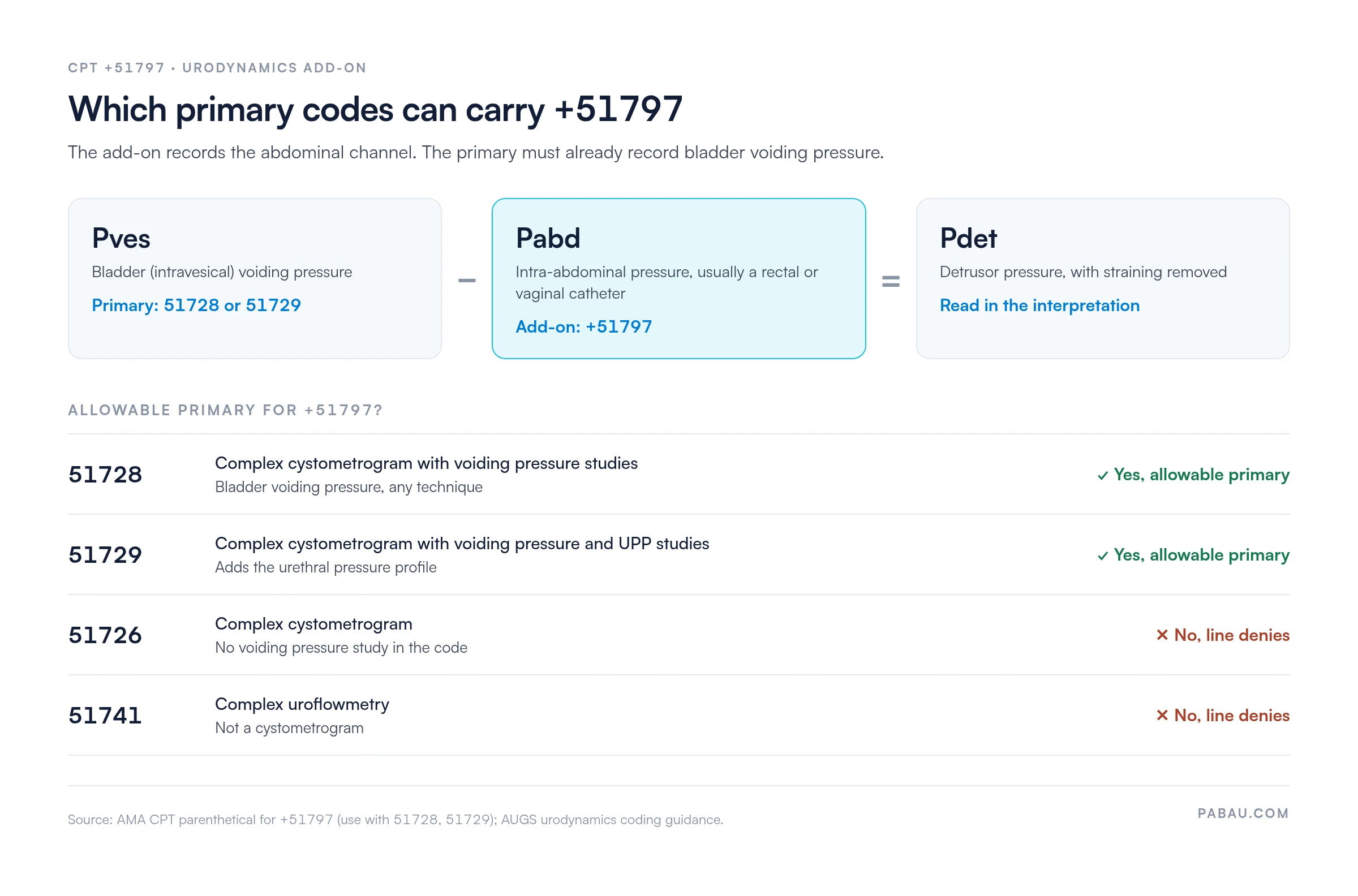
The procedure note is your main defense against a medical necessity denial. It should capture each of the following steps so the claim stands up to audit.
Each element belongs in the procedure note itself, not only in the billing system. A note that says only “urodynamics performed” next to a code selection is unlikely to survive MAC post-payment review.
Urodynamics coding errors usually come from mixing up which code captures each part of a multi-channel study. The table maps six neighboring codes against 51797, including which ones can serve as its primary.
Common mistake: billing 51797 with 51741 or 51726 as the only primary. Uroflowmetry is not a cystometrogram, and 51726 records no voiding pressure. Extra documentation won’t rescue that claim, because the AMA parenthetical lists only 51728 and 51729.
Medicare covers 51797 when a qualifying ICD-10 diagnosis and a signed physician order support medical necessity. Some MACs also require documented failed conservative management. Coverage rules come from each MAC, so check your MAC’s LCD and billing and coding article in the CMS Coverage Database before you submit.
Reimbursement changes with the year and your locality. Under the CMS Physician Fee Schedule, 51797 carries separate work, practice expense (PE), and malpractice RVUs. The schedule lists a facility and a non-facility PE value, so check both rather than assuming which is higher. Multiply the current-year total RVUs for your locality by the conversion factor that applies to you. Quote the calendar year whenever you share rates with staff, because they change every January.
Pull current-year RVU values for 51797 from the CMS PFS Look-Up Tool before each new calendar year. Non-facility rates apply when urodynamics is performed in your office. Facility rates apply in a hospital outpatient department or ambulatory surgery center.
These ICD-10 codes are typical indications for voiding pressure studies. Confirm each against your MAC’s LCD and its billing and coding article, because covered diagnoses change with the annual ICD-10-CM release.
Three modifiers come up most often with 51797, each tied to a different scenario. A wrong modifier draws as much payer attention as a missing one, because modifier misuse is a common audit flag.
Modifier 59 decision point: look up the pair in the current quarter’s CMS NCCI PTP edits before you append modifier 59. CMS updates these edits every quarter, so a pair or its modifier indicator can change. Checking the current table protects you in post-payment review.
Denials on 51797 fall into six repeatable patterns. Each has a specific fix in the documentation or the claim structure. For tracking these patterns across your urology practice, denial management workflows show which codes generate the most rejections.
Knowing the denial reason codes speeds up corrected claims. A CO-4 (modifier issue), CO-97 (included in another service), or CO-50 (not medically necessary) tells you which field to fix before you resubmit.
NCCI procedure-to-procedure (PTP) edits pair a column 1 code with a column 2 code that is normally included in it. Each pair carries a modifier indicator. An indicator of 0 means no modifier can bypass the edit, while 1 means a modifier may apply when the service was distinct.
A full urodynamic study often reports several codes on one date. AUGS lists 51741, 51729, 51784 or 51785, and +51797 together as a normal full study. So don’t assume a pair is bundled, and don’t append modifier 59 by habit. Look up each pair in the current CMS PTP table before you submit.
Where you run urodynamic testing decides which Medicare rate applies to 51797. The CMS Physician Fee Schedule publishes a facility and a non-facility practice expense (PE) value for the code.
Reporting POS 11 for a study performed in a hospital outpatient department is a billing error that leads to recoupment. Confirm the POS code matches where the service took place before you submit the claim.
Run every urodynamic claim through this checklist before submission. Each item maps to a denial pattern above. For a broader pre-submission framework, see the guide to submitting a clean claim.
The checklist also doubles as your audit file. Following billing compliance best practices across the 51725-51798 family lowers audit exposure as well as denial rates.
Flag urodynamic claims for a second review when the date of service carries three or more codes from 51725-51798. A quick check against the current NCCI table catches modifier errors before they reach the payer.
In many urology practices, a 51797 claim passes through several manual steps. A biller reads the study report, picks the primary, keys the add-on, and checks the NCCI table by hand. Each handoff is a chance to drop 51728 or attach 51797 to the wrong code.
Pabau, the practice management platform we build, keeps the study note and the claim in the same patient record. Its denial-reducing claims management runs real-time eligibility checks before the appointment. It then sends CMS-1500 claims through Claim.MD to thousands of US payers.
When the electronic remittance advice comes back, Pabau matches each payment or denial to its claim line. A denied 51797 line shows its reason code, so your biller can fix the primary or the modifier and resubmit.

Pabau checks eligibility before the study, sends CMS-1500 claims through Claim.MD, and matches ERA denials to each claim line. Your billers see which 51797 line was denied and why.

Bill +51797 whenever the study recorded abdominal pressure on its own channel alongside a 51728 or 51729. That channel is what turns bladder pressure into detrusor pressure, so the note should show it ran for the whole voiding phase.
Leave the add-on off when the primary was 51726 or 51741, however complete the tracing looks. And treat modifier 59 as a lookup in the current NCCI table each quarter, never as a habit.
Book a demo to see how Pabau keeps urodynamic claims, eligibility checks and ERA denials in one billing workflow.

Need to understand what happens after a claim is rejected? Denial management in healthcare covers how to build a systematic denial review workflow for multi-code specialties.
Want to verify eligibility before the urodynamics appointment? Insurance eligibility verification explains how real-time eligibility checks reduce same-day authorization surprises.
Curious how the 837P claim format carries urodynamic code data to payers? Understanding the 837 file breaks down the EDI transaction structure used for electronic claim submission.
CPT code 51797 covers intra-abdominal pressure measurement during voiding. The descriptor names rectal, gastric, or intraperitoneal sites, and the sensor is typically a rectal or vaginal catheter. Subtracting this reading from bladder pressure gives detrusor pressure, and the code is an add-on to 51728 or 51729.
CPT 51797 measures intra-abdominal voiding pressure as an add-on to 51728 or 51729. CPT 51798 measures post-void residual urine by ultrasound and is a standalone code. They assess different parts of bladder function and are reported separately.
Yes, Medicare covers CPT code 51797 when a qualifying ICD-10 diagnosis is documented and the MAC medical necessity criteria are met. Criteria vary by jurisdiction. Check your MAC LCD and billing and coding article in the CMS Coverage Database, and confirm the diagnosis is listed for the date of service.
Yes, 51728 and 51729 are the only primaries, and a primary must be on the same claim. Without one for the same date of service, the 51797 line denies. Other urodynamic codes such as 51726 and 51741 do not qualify as its primary.
Medicare payment for CPT 51797 comes from the RVUs in the annual CMS Physician Fee Schedule. They are multiplied by the conversion factor and adjusted for your locality. The schedule lists separate facility and non-facility rates, so use the one that matches your place of service. Pull current-year figures from the CMS PFS Look-Up Tool and cite the calendar year when you share them.
UDS CPT codes are the procedure codes in the AMA urodynamics subsection (51725-51798). They cover cystometrography, uroflowmetry, electromyography, voiding pressure studies, and post-void residual measurement. CPT code 51797 is the intra-abdominal (rectal, gastric, intraperitoneal) pressure add-on billed with 51728 or 51729.