N31.9 is the billable ICD-10-CM code for neuromuscular dysfunction of bladder, unspecified. It covers neurogenic bladder when the provider documents the condition but not its type, such as uninhibited, reflex or flaccid.
Claims for N31.9 are denied far more often for missing documentation than for the code itself. A missing urodynamic result, an unlinked neurological diagnosis or a mix-up with overactive bladder code N32.81 each drives a different denial.
Related Information
Chapter
N00-N99 Diseases of the genitourinary system
Category
N31 Neuromuscular dysfunction of bladder, not elsewhere classified
Group
N30-N39 Other diseases of the urinary system
Billable
Yes
Code also known as
Neurogenic bladder NOS
Save time. Improve accuracy. Get paid faster.
Automate coding with Pabau
Let Pabau's smart automation suggest the right codes, reduce claim denials, and keep your practice compliant—effortlessly.
Automate repetitive tasks and focus on what matters most—your patients.
Improve accuracy
Reduce coding errors and ensure compliance with the latest regulations.
Get paid faster
Clean claims, fewer denials, and faster reimbursements.
Grow with confidence
Powerful insights and reporting to help your practice thrive.
HIPAA compliant•SOC 2 certified•GDPR-compliant•Trusted by 4,000+ clinics worldwide
Key takeaways
N31.9 covers neurogenic bladder when the subtype (uninhibited, reflex or flaccid) isn’t documented, so use a more specific N31 code whenever the record supports one.
Best practice and payer edits expect the etiology code, such as MS, Parkinson’s or stroke sequelae, alongside N31.9.
N31.9 is supported by a documented neurological cause, while N32.81 covers an overactive bladder with no known neurological origin.
Bladder dysfunction due to a spinal cord lesion or cauda equina syndrome is excluded from N31 and coded to G95.89 or G83.4 instead.
Pabau submits claims through Claim.MD, runs eligibility checks and tracks ERAs, so your team can see denial patterns.
ICD-10 code N31.9 covers neurogenic bladder with no named subtype
ICD-10 code N31.9 is the billable code for neuromuscular dysfunction of bladder, unspecified. It sits in category N31 of the FY2027 ICD-10-CM Tabular List, with “neurogenic bladder dysfunction NOS” as its inclusion term. Use it when the provider documents neurogenic bladder but not whether it’s uninhibited, reflex or flaccid.
The code is active and billable in the current fiscal year. Here are the reference fields you’ll want in front of you before the claim goes out.
Field
Value
Code
N31.9
Official descriptor
Neuromuscular dysfunction of bladder, unspecified
Inclusion term
Neurogenic bladder dysfunction NOS
Code system
ICD-10-CM (Clinical Modification)
Billable
Yes, valid for claims in the FY2027 code set
ICD-10-CM chapter
Chapter 14: Diseases of the genitourinary system (N00-N99)
Code block
N30-N39: Other diseases of the urinary system
Parent category
N31: Neuromuscular dysfunction of bladder, not elsewhere classified
Valid 7th character
Not applicable
Gender edit
Not sex-specific
Age edit
None
Check the code against the current release in the CDC/NCHS ICD-10-CM web tool, which also shows any annual changes to the descriptor or notes.
What N31.9 covers, and where it stops
N31.9 covers neurological or neuromuscular bladder dysfunction when the type of dysfunction isn’t documented. That “unspecified” qualifier is the whole point. The record names a neurological cause, but nobody has said whether the pattern is uninhibited, reflex, flaccid or another recognized subtype.
In practice, that means voiding dysfunction from central or peripheral nervous system disease. Think detrusor overactivity with impaired contractility, an underactive detrusor, or a mixed picture the physician hasn’t fully characterized yet.
Neurogenic bladder, unspecified: The physician documents neurogenic bladder without naming the urodynamic pattern.
Neuromuscular dysfunction of bladder NOS: The note describes the dysfunction but gives no subtype to code it to.
Bladder dysfunction from brain or peripheral nerve disease: Multiple sclerosis, Parkinson’s disease, stroke or diabetic neuropathy, when the pattern is uncharacterized.
Where it stops matters just as much. Bladder dysfunction due to a spinal cord lesion or to cauda equina syndrome is excluded from the whole N31 category. It never lands on N31.9.
Section I.B.18 of the ICD-10-CM Official Guidelines covers the use of sign, symptom and unspecified codes. It allows an unspecified code when the record supports nothing more specific. Using N31.9 when the note documents an uninhibited pattern (N31.0) is undercoding. It may pass a claim edit, but it creates audit exposure.
Check the four specific N31 codes before you settle on N31.9
The N31 category groups neuromuscular bladder dysfunctions not classified elsewhere, and N31.9 is its residual “unspecified” code. Four more specific codes exist, so review the whole category before you default to it.
Code
Descriptor
Use when…
N31.0
Uninhibited neuropathic bladder, not elsewhere classified
Detrusor overactivity without voluntary inhibition, documented as uninhibited
N31.1
Reflex neuropathic bladder, not elsewhere classified
Voiding by reflex only, with no voluntary initiation
N31.2
Flaccid neuropathic bladder, not elsewhere classified
Atonic detrusor, overflow incontinence, lower motor neuron pattern
N31.8
Other neuromuscular dysfunction of bladder
A named subtype that doesn’t fit N31.0 to N31.2 but is specifically characterized
N31.9
Neuromuscular dysfunction of bladder, unspecified
Neurological cause documented, dysfunction type not characterized in the record
The practical rule is simple. If urodynamic results or the physician’s assessment call the dysfunction uninhibited, reflex or flaccid, use that subcode. If the note says “neurogenic bladder” and nothing more, and a query to the physician isn’t warranted, N31.9 is correct.
N31.9 notes: One Excludes1 list and one coding instruction
The N31 category carries two official notes that decide what belongs here and what gets coded elsewhere. Misreading them is a frequent source of coding errors and medical necessity denials.
Excludes1 (never code these with N31):
Cord bladder NOS (G95.89)
Neurogenic bladder due to cauda equina syndrome (G83.4)
Neuromuscular dysfunction due to spinal cord lesion (G95.89)
When the record ties the bladder problem to one of these, the G code replaces N31.9 rather than sitting beside it.
Use additional code:
Urinary incontinence (N39.3, N39.4-). Add a code for any associated incontinence the provider documents at the encounter.
Common causes behind neurogenic bladder ICD-10 coding
Best practice and payer edits expect the etiology code alongside N31.9. ICD-10-CM carries no code-first note at N31, so sequence the two by the reason for the encounter.
Spinal cord injury (SCI): Check the Excludes1 note first. Neuromuscular dysfunction due to a spinal cord lesion codes to G95.89, not N31.9, with the injury’s S-category sequela code alongside it. Payers often want both codes before they authorize clean intermittent catheterization (CIC) supplies.
Multiple sclerosis (MS), G35.-: Bladder dysfunction affects up to 80% of people with MS at some point. MS is now coded by subtype (G35.A to G35.D), so the bare G35 category won’t pass an edit.
Parkinson’s disease, G20.-: Detrusor overactivity is common. Code Parkinson’s to its full subcode (G20.A1 to G20.C), and confirm whether the urologist or neurologist is treating at each encounter.
Diabetic neuropathy, E08 to E13 with .40 or .49: Peripheral neuropathy from diabetes can produce a flaccid or underactive bladder. Code the diabetes with its neuropathic complication, then the N31 code for the bladder.
Stroke sequela, I69.-: Post-stroke bladder dysfunction is common in rehabilitation settings. Use the matching I69 sequela code alongside N31.9.
Brain or spinal cord tumor, C-category: When a mass compresses the pathways that control the bladder, code the tumor as the principal diagnosis. If the tumor is a spinal cord lesion, the Excludes1 note applies there too.
N31.9 vs N32.81 and other neighbors: Let the cause decide
The most common error in this space is swapping overactive bladder code N32.81 and N31.9. N31.9 is supported by a documented neurological cause. N32.81 covers an overactive bladder with no neurological origin identified.
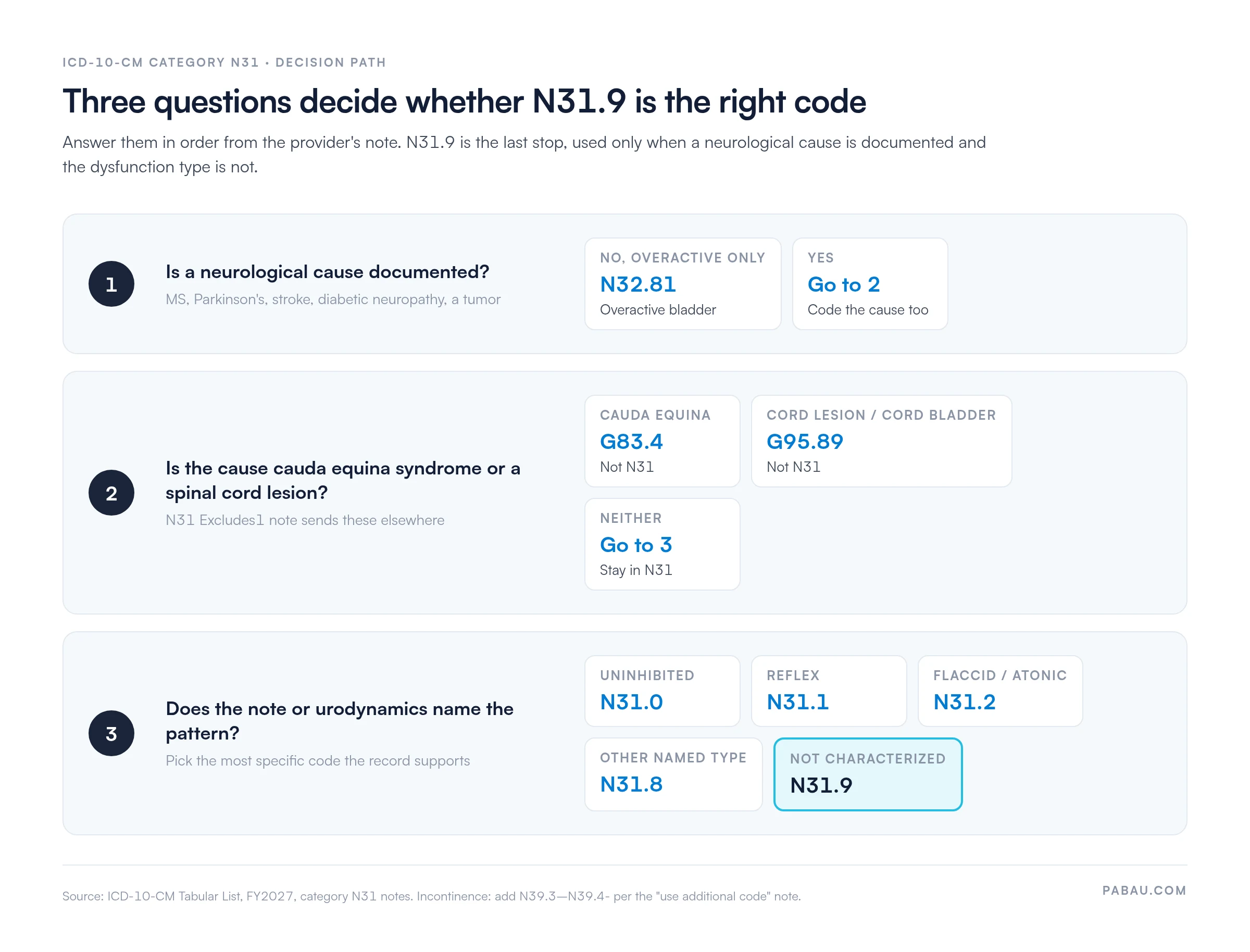
Three questions, asked in order, settle which code the record supports.
N31.9 is the last stop on the path, after the Excludes1 check and every named subtype. Rules are taken from the FY2027 ICD-10-CM Tabular List notes for category N31.
Neurological cause documented and the pattern recorded as uninhibited
No, use N31.0 instead of N31.9 when the type is specified
N31.2
Flaccid neuropathic bladder
Atonic or underactive detrusor, lower motor neuron pattern documented
No, use N31.2 instead of N31.9 when the flaccid pattern is documented
N32.81
Overactive bladder
No neurological cause identified, functional overactivity only
No Excludes note links them. Code both only when each is independently documented.
N39.3
Stress incontinence (female) (male)
Incontinence is the main complaint, and the mechanism is stress, not neurological
Yes, the N31 “use additional code” note covers associated incontinence
G83.4
Cauda equina syndrome
Use G83.4 when cauda equina syndrome is documented
No, Excludes1 applies
The cause-first framing is your fastest audit safeguard. If a neurological diagnosis drives the bladder problem, you’re in the N31 family. If the chart says the bladder is overactive with no neurological explanation, you’re at N32.81.
Documentation that holds up on an N31.9 audit
Thin documentation causes more N31.9 denials than any coding choice. Payers reviewing these claims want the record to show three things:
A documented neurological condition.
A bladder dysfunction the provider links to that condition.
Evidence that the dysfunction type couldn’t be characterized more specifically.
Miss one and the claim is exposed.
The CMS ICD-10 coding resources page publishes the annual Official Guidelines. Read Section I.B.18 and the Chapter 14 guidance before coding complex neurogenic bladder encounters. Medical billing compliance for N31.9 claims starts in the note, before anyone assigns a code.
Urodynamic testing and diagnostic workup
Urodynamic studies are the main diagnostic support for neurogenic bladder coding. A cystometrogram (CMG) showing detrusor overactivity or underactivity gives the reviewer half the evidence chain. Add a post-void residual and a history of neurological disease, and the chain is complete.
Cystometrogram (CMG/urodynamics): Documents detrusor pressure, compliance and sensation, and helps separate neurological from functional causes.
Post-void residual (PVR): Measured by ultrasound or catheterization. An elevated PVR supports detrusor underactivity, consistent with a flaccid neurogenic bladder.
Electromyography (EMG) of the pelvic floor: Separates detrusor sphincter dyssynergia from pure detrusor dysfunction.
Neurological assessment: The physician’s note should state the neurological diagnosis and its link to the bladder findings. “Bladder dysfunction secondary to multiple sclerosis” is the pattern that supports N31.9.
Prior imaging or neurological workup: The urology note should reference any brain or spine MRI that supports the neurological diagnosis.
Pro Tip
Flag encounters where urodynamics are ordered but the results aren’t back. Until the findings and the physician’s interpretation are in the chart, code the visit with symptom codes. R39.12 (poor urinary stream) and R39.19 (other difficulties with micturition) are typical. N31.9 coded before the neurological link is documented won’t hold up on audit.
How an N31.9 claim moves from visit to payment
Here’s the path a typical N31.9 claim takes, and where each step tends to go wrong.
The visit. The provider documents the neurological cause, the bladder findings and the link between them. A missing link here comes back later as a documentation denial.
Coding. The coder works the three-question path and adds the etiology code and any incontinence code. If urodynamics name a pattern the note doesn’t, the coder queries the provider.
Authorization. For urodynamics, Botox, sacral neuromodulation or catheter supplies, the team confirms prior authorization and records the number before the service date.
Claim build. Each CPT or HCPCS line points to the diagnosis that supports it. Urodynamic lines point to N31.9, and the etiology code sits on the claim beside it.
Scrub and submit. The clearinghouse checks format and payer rules, and a rejection comes back before the payer ever adjudicates the claim.
Adjudication and remittance. The payer pays or denies with a CARC on the electronic remittance advice (ERA). Your team reads the code and routes the denial to the right fix.
Steps 1 and 3 both happen before the claim exists, so a resubmission can’t fix what goes wrong there. That’s why the checklist further down starts with them.
CPT codes billed with N31.9 and the supplies that ride along
A clean N31.9 claim depends on pairing the right procedure codes with the diagnosis. Payers run medical necessity edits that check the ICD-10 diagnosis against each CPT line. These are the CPT codes most often billed with N31.9 in urology and rehabilitation settings.
CPT code
Description
Notes
51736
Simple uroflowmetry
Often the first urodynamic test, and a natural fit for N31.9 workup visits
51741
Complex uroflowmetry
With calibration and interpretation. Helps separate obstruction from neurogenic voiding dysfunction.
51726
Complex cystometrogram (CMG)
The main urodynamic study for neurogenic bladder, and the one most often billed with N31.9
51772
Urethral pressure profile
Identifies sphincter insufficiency or dyssynergia alongside neurogenic dysfunction
51798
Post-void residual by ultrasound
A common monitoring code, often billed at follow-up visits for patients on CIC
51703
Insertion of temporary indwelling bladder catheter; complicated (51702 is the simple version)
For complicated insertions, such as altered anatomy or a fractured catheter or balloon. Document clinical necessity when paired with N31.9.
99213-99215
Established patient office visits
Ongoing management visits, with N31.9 as primary and the etiology code as secondary
HCPCS codes A4351 and A4352 cover intermittent urinary catheters, often billed with N31.9 for patients on CIC. They’re supply codes, not procedure codes. Medicare no longer uses a certificate of medical necessity for them. It wants a standing written order, medical records that document the need, and quantities within the LCD L33803 limits.
Use the AAPC Codify ICD-10-CM lookup to check N31.9 against specific procedure codes and each payer’s medical necessity rules.
Prior authorization for N31.9 procedures varies by payer
Prior authorization (PA) rules for procedures paired with N31.9 vary by payer and change often. No universal rule applies, but a few procedure types reliably trigger PA across commercial plans and Medicare Advantage.
Complex urodynamic studies (51726, 51772): Many commercial payers want PA for multichannel urodynamics, especially for outpatient neurology or rehabilitation patients. Submit the neurological diagnosis alongside N31.9 to establish medical necessity.
Botulinum toxin injection into the detrusor (CPT 52287): Almost always needs PA. Payers usually want documented failure of anticholinergic or beta-3 agonist therapy, with at least one dated medication trial and its outcome in the record.
Sacral neuromodulation (CPT 64561 or 64581 for lead placement, 64590 for pulse generator insertion): A high-cost procedure. Nearly every commercial payer and Medicare Advantage plan requires PA for it. Documented conservative therapy is mandatory.
Intermittent catheter supplies (HCPCS A4351, A4352): Original Medicare needs a standing order, documented need and quantities within LCD L33803. MACs set LCDs for Original Medicare only, so check each Medicare Advantage plan’s own policy.
Send the PA request with the neurological etiology code, the relevant urodynamic findings and any conservative therapies already tried. Insurance eligibility verification at scheduling flags payer-specific PA rules before the procedure date, not after the denial.
N31.9 denials follow six patterns, and each has a fix
N31.9 denials are predictable once you read the claim adjustment reason code (CARC) on each one. Denial management for these claims means fixing the documentation before resubmission, not re-billing the same claim. Our guide to medical billing denial codes explains each CARC in full.
Denial reason
Common CARC
Fix
Insufficient documentation of neurological etiology
CARC 50
Add the neurological diagnosis code (a G35.- or G20.- subcode, or an I69 sequela code) to the claim. Make sure the physician’s note links the two conditions explicitly.
Code specificity, more specific code required
CARC 16 or 146 (payers vary)
Review the physician’s documentation for the dysfunction type. Query the physician if urodynamic results support N31.0 or N31.2.
Missing or failed prior authorization
CARC 15, 197
Submit PA before the procedure, with the etiology code, urodynamic results and prior therapy documentation.
N31.9 and N32.81 billed without separate documentation
CARC 11
Confirm both conditions were independently documented and evaluated at that encounter, each with its own clinical rationale in the note.
Medical necessity not established for urodynamics
CARC 50
Check the LCD for urodynamic testing in your MAC jurisdiction, or the plan’s own policy. Document necessity in the ordering note, citing the neurological diagnosis.
Diagnosis code does not support procedure
CARC 11
Check that each CPT line points to a supporting diagnosis before submission. Add the etiology code when the payer’s policy asks for a neurological diagnosis.
CARC meanings are standard, but which code a payer attaches to a given problem varies, so treat the column as a starting point.
Pro Tip
Run a quarterly audit of N31.9 claims by denial reason code. If CARC 16 (missing information) or CARC 50 (medical necessity) keeps appearing, the issue sits upstream in documentation. The note isn’t capturing enough for the coder to pick a specific N31 subcode, or for the payer to confirm medical necessity. Fix the note template before you resubmit.
Before you submit an N31.9 claim: A quick checklist
Run through this list before the claim leaves your practice. It applies the general clean claim checks to N31.9.
The provider’s note names the neurological cause and links it to the bladder findings.
No urodynamic report names a pattern that points to N31.0, N31.1, N31.2 or N31.8.
The cause isn’t a spinal cord lesion or cauda equina syndrome, which code to G95.89 or G83.4.
The etiology code is on the claim at its full length, never a bare category like G35 or G20.
Any documented incontinence has its own N39.3 or N39.4- code.
Each CPT and HCPCS line points to the diagnosis that supports it.
Prior authorization is approved and its number is on the claim where the payer requires it.
Eligibility is verified for the date of service.
Common N31.9 coding mistakes that trip up claims
The same handful of mistakes turns up again and again in N31.9 audits.
Coding N31.9 for bladder dysfunction after a spinal cord injury. The Excludes1 note sends dysfunction due to a spinal cord lesion to G95.89. Read the note before you pick an N31 code.
Billing the bare MS or Parkinson’s category. G35 and G20 now expand to subcodes, so the three-character code fails as invalid.
Leaving N31.9 in place after urodynamics come back. Once a study names the pattern, update the diagnosis on the next claim.
Dropping the incontinence code. The “use additional code” note asks for it whenever incontinence is documented.
Resubmitting a denial unchanged. A CARC 50 or 11 denial needs a documentation or pointer fix before the claim goes back out.
How Pabau keeps N31.9 claims and authorizations in one place
In many practices, an N31.9 denial surfaces weeks after the visit. By then the urodynamic report, the authorization number and the provider’s note sit in three different places.
Pabau, the practice management platform we build, keeps them on one patient record. Its claims management software submits US claims through Claim.MD to thousands of payers, runs eligibility checks and tracks ERAs. Your team can spot denial patterns by payer and fix the cause instead of resubmitting blind.
Prior authorizations live on the patient’s case too. Pabau tracks the authorization code, dates and sessions, and warns the team when one is missing. That gives staff time to chase it before a urodynamic study or Botox session is billed.
Pabau’s claims tools send claims and track remittances from the patient record, so an N31.9 denial shows up while the visit is still fresh.
Keep N31.9 claims and authorizations together
Pabau submits claims through Claim.MD, runs eligibility checks and tracks ERAs, so your team spots denial patterns early. Authorization codes, dates and sessions sit on the patient’s case.
N31.9 is a sound, billable code when the record does its job. Get the note to name the neurological cause and link it to the bladder. Then let the three-question path choose between N31.9, a specific N31 code and a G code.
If you change one habit, make it the check at step 2. Spinal cord lesion and cauda equina cases don’t belong in N31 at all. They’re easy to miss when “neurogenic bladder” is the only phrase in the note. The trade-off is a few extra minutes per claim against weeks of denial rework.
Book a demo to see how Pabau keeps claims, eligibility checks and authorizations for neurogenic bladder patients on one record.
Continue your research
Need a denial management framework for urology claims?Denial management in healthcare covers CARC-based workflows for reducing repeat denials across diagnosis code categories.
Looking for clean claim submission best practices?Clean claim essentials outlines the pre-submission checklist that reduces first-pass rejection rates for complex ICD-10 pairings.
Want to understand how clearinghouses process N31.9 claims?Claim.MD clearinghouse guide explains how payer-specific edits are applied before claims reach the adjudication queue.
Frequently asked questions
Can N31.9 support a claim for intermittent catheter supplies?
Yes. N31.9 is a common diagnosis on A4351 and A4352 claims for patients on clean intermittent catheterization. For Medicare, the supplier also needs a standing order and records showing the need, with quantities inside LCD L33803 limits.
Is neurogenic bladder from MS coded N31.9 or a G35 code?
Usually both. The G35.- subcode identifies the multiple sclerosis, and N31.9 or a more specific N31 code describes the bladder dysfunction. Sequence them by the reason for the encounter.
Does every N31.9 claim need a urodynamic study result?
No. ICD-10-CM lets you assign N31.9 from the provider’s documented diagnosis. Some payers do want urodynamic findings before they approve procedures such as Botox injection into the bladder or sacral neuromodulation.
How do you code neurogenic bowel and bladder together?
Code them separately. Neurogenic bowel is K59.2, and the bladder side is N31.9 or a specific N31 code. Add the code for the underlying neurological condition as well.
What was the ICD-9 code for neurogenic bladder?
It was 596.54, neurogenic bladder NOS. It maps to N31.9 in ICD-10-CM, and you’ll still see it in older records and crosswalk tables.