

HCPCS Code Q4185: Cellesta flowable amnion billing guide
HCPCS Code Q4185: definition and official descriptor HCPCS Code Q4185 is the Lev...

Last Updated: Nov 20, 2026
54640 is the CPT code for orchiopexy through an inguinal or scrotal approach. It covers bringing a palpable undescended testis down and fixing it in the scrotum.
The procedure is usually performed in children, but the code has no age limit. An inguinal hernia repaired in the same session is reported separately with a code from 49495–49525. An intra-abdominal testis takes CPT 54650 for the open abdominal approach, single or staged, or CPT 54692 when the surgeon brings it down laparoscopically.
Let Pabau's smart automation suggest the right codes, reduce claim denials, and keep your practice compliant—effortlessly.
Automate repetitive tasks and focus on what matters most—your patients.
Reduce coding errors and ensure compliance with the latest regulations.
Clean claims, fewer denials, and faster reimbursements.
Powerful insights and reporting to help your practice thrive.
HIPAA compliant SOC 2 certified GDPR-compliant Trusted by 4,000+ clinics worldwide

CPT Code 54640 covers orchiopexy through an inguinal or scrotal approach for a palpable undescended testis. Laparoscopic orchiopexy of an intra-abdominal testis takes 54692 instead.
An inguinal hernia repaired in the same session is reported separately with a code from 49495–49525, with modifier 51 on the hernia code.
The code carries a 90-day global surgical period, so routine postoperative E&M visits are bundled into the surgical fee.
Bilateral same-day orchiopexy bills with modifier 50, or with RT and LT on two lines for payers that require it. Check each payer before submitting.
A specific Q53 diagnosis, such as Q53.112 or Q53.212, establishes medical necessity, while unspecified Q53.9 raises audit risk.
Pabau’s claims management software tracks claim status and flags denied claims for rework in the dashboard.
CPT Code 54640 describes orchiopexy through an inguinal or scrotal approach for a palpable undescended testis in the inguinal canal or at the internal ring. The American Medical Association, which maintains the CPT code set, places it in the Male Genital System section (54000–55899). The official descriptor reads: Orchiopexy, inguinal or scrotal approach. Penile repairs share that section, including the angulation correction billed under CPT code 54360.
Older references add “with or without hernia repair” to this descriptor, which leads coders to treat a same-session hernia repair as bundled. Current CPT guidance says otherwise. When an inguinal hernia is repaired in the same session, report 54640 and the appropriate hernia code from 49495–49525. Modifier 51 goes on the hernia code. The table below summarizes the classification data.
Orchiopexy under CPT Code 54640 is an open surgical procedure. It is usually performed in children, although the code carries no age limit. Coders need the operative steps because the operative report must show these elements to hold up in a payer audit.
The operative note must document each of these steps. It should state the approach, confirm the testis was palpable before surgery, and name the structures divided and the fixation method. A note that misses any of these invites a medical necessity denial.
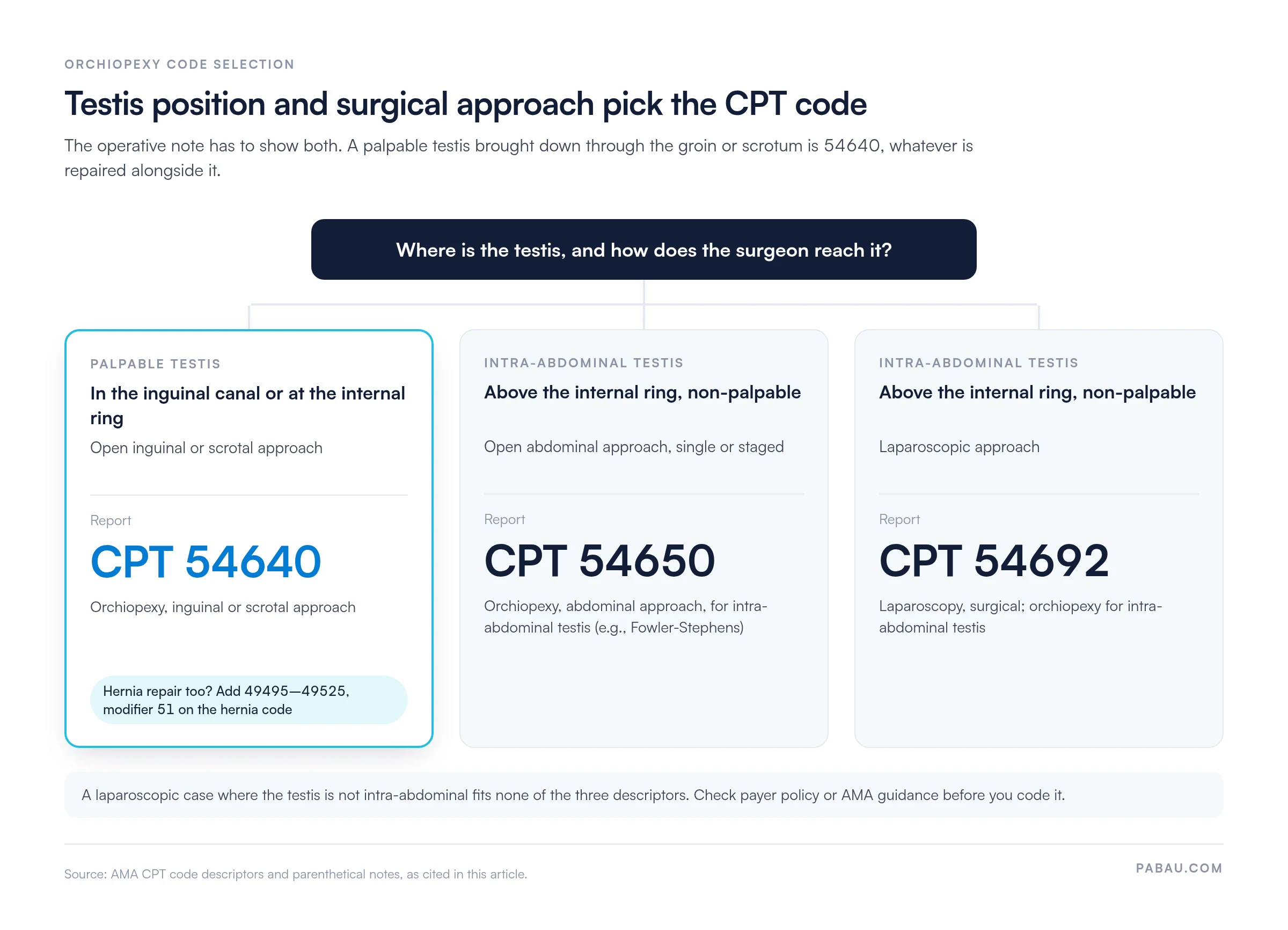
The orchiopexy codes cover three distinct clinical scenarios, separated by testis position and surgical approach. Picking the wrong one is a common cause of denials for this procedure. The deciding question is where the testis sits and how the surgeon reaches it.
The most common orchiopexy mis-coding is billing 54640 when the operative report documents a non-palpable or intra-abdominal testis. CPT 54640 requires an inguinal or scrotal approach, which fits only a palpable testis reachable through a groin or scrotal incision. When the testis sits above the internal ring and the surgeon opens the abdomen, CPT 54650 is the correct code.
Payers and auditors compare the testis position in the pre-operative notes and imaging with the code submitted. If the notes say “non-palpable” but 54640 is billed, expect a denial or an overpayment recovery request.
CPT 54692 covers laparoscopic orchiopexy for an intra-abdominal testis. If the operative report describes laparoscopic ports and visualization for an intra-abdominal testis, 54692 is the correct code. Billing 54640 for that case is a code-approach mismatch and a known payer audit trigger. A laparoscopic case where the testis is not intra-abdominal fits neither descriptor, so check payer policy or AMA guidance before you code it. The diagram below puts the three codes side by side.
ICD-10 Q53 codes establish medical necessity for orchiopexy. Payers expect a valid Q53 code on every 54640 claim, and an unspecified or mismatched diagnosis is one of the most common causes of denial. The table below lists the codes you will use most and when to pick a more specific one.
Use the most specific ICD-10 code the documentation supports. The ICD-10-CM guidelines call for coding the documented detail, and many commercial payers reject Q53.9 on a claim that also carries modifier RT or LT.
Modifier selection is where most billing errors occur on CPT 54640 claims. The table below covers the modifiers most often applied to this code.
Bilateral billing note: Medicare and most Medicaid programs accept modifier 50 on a single line for bilateral orchiopexy and pay 150% of the allowable. Many commercial payers require two separate line items instead, with modifier RT on the first and LT on the second. Submitting modifier 50 to a payer that expects two lines leads to a denial or underpayment. Check each payer’s bilateral billing requirement before submitting.
CPT Code 54640 carries a 90-day global surgical period set by CMS. The global package covers the day before surgery, the day of surgery and the 90 days that follow it. Routine postoperative care related to the orchiopexy in that window is bundled into the surgical fee. That includes follow-up visits to check wound healing and testis position.
Four scenarios allow separate billing within the global period:
Documentation for any separately billed service in the global period must show why it falls outside the bundled postoperative care. A missing explanation is the most common reason E&M claims with modifier 24 are denied.
Medicare payment for CPT Code 54640 comes from the CMS Physician Fee Schedule, which uses the resource-based relative value scale (RBRVS). The CMS Physician Fee Schedule lookup tool gives current payment rates by locality. Practices that submit through the Claim.MD clearinghouse can reach thousands of US insurance payers and run real-time eligibility checks before surgery.
The breakdown below shows the 2026 CMS PFS values. Each component is adjusted by its locality’s geographic practice cost index (GPCI), and the sum is multiplied by the conversion factor. Use the FastRVU 2026 lookup tool to check current values and location-adjusted rates for your practice ZIP code.
These national values change with each annual PFS update. CMS publishes the final rule RVU tables each November for the following calendar year. Check the current year’s CMS PFS data before using them in compensation benchmarking or contract negotiations.
Run your 54640 claims through the CMS PFS lookup before contract negotiations with commercial payers. Many commercial contracts are set as a percentage of Medicare. Knowing the current facility total RVU and conversion factor gives you an accurate floor for fee schedule offers. Geographic adjustment can move the base rate by 20% or more between markets.
Prior authorization requirements for CPT 54640 vary by payer type and state. Run insurance eligibility verification at scheduling to confirm whether authorization is needed before the surgery date. Requirements generally break down as follows.
The operative report for CPT Code 54640 must address several specific elements to show the code matches the work performed. A thorough note also protects against post-payment audit. When preparing the superbill, confirm each of the following is captured in the operative record.
The goal of submitting a clean claim for 54640 is an operative note where the approach, testis position, structures addressed, and laterality are unambiguous. A payer reviewer reading the note should reach the same code without calling the provider’s office.
An inguinal hernia repaired alongside the orchiopexy is reported separately. The AMA’s CPT note for 54640 directs coders to report 54640 and the appropriate inguinal hernia repair code from 49495–49525. Modifier 51 goes on the hernia code. Beyond that pair, the National Correct Coding Initiative (NCCI) decides what else can be billed on the same date. A grasp of medical billing fundamentals helps here, because NCCI bundling drives most same-day rejections.
NCCI edit pairs change quarterly. Check the bundling status of 55040 with 54640 against the current NCCI table before submitting. CMS publishes the updated tables on its NCCI edits page. Check the version date before relying on any third-party summary of bundling edits.
Most denials on CPT 54640 claims fall into five categories, and each one points to its own appeal path. Claims management software that tracks claim status and flags denied claims for rework shows which category keeps recurring in a pediatric urology practice.
Before submitting a bilateral 54640 claim, check the payer’s recent ERA remittance codes. Look for CO-4 (incorrect code for the service billed) or CO-16 (claim lacks information needed for adjudication). CO-4 on a bilateral claim usually means the payer requires LT/RT two-line billing rather than modifier 50. Update the payer’s billing profile in your system before the next submission.
Many urology practices still track surgical claims in a spreadsheet and learn about a denial only when the remittance arrives. By then, the global period is running and the operative note is weeks old.
In Pabau, the practice management platform we build, the claim goes out as a CMS-1500 through Claim.MD after an eligibility check. The prior authorization code, dates and sessions sit on the patient’s case, and Pabau warns the team when one is missing.
Once a claim is submitted, Pabau tracks its status and flags denied claims for rework in the dashboard. ERA remittances come back into the same system. Your coder sees the denial reason beside the claim and can fix a modifier or diagnosis before resubmitting.

Pabau sends claims through Claim.MD, tracks each claim’s status, and flags denied claims for rework. Your team stops chasing surgical claims by spreadsheet.

Most 54640 claim problems start before the claim is built. When the operative note names the approach and confirms a palpable testis, the code choice defends itself in an audit.
Report a same-session hernia repair on its own line with modifier 51, and pick the Q53 code that matches the documented testis location. Then check each payer’s rule before choosing modifier 50 or RT/LT. A denial that still comes back usually points to one field you can fix.
Pabau tracks claim status and flags denied claims for rework in the dashboard. Your team sees at a glance which 54640 claims need a second look. Book a demo to see how it handles surgical claims for pediatric urology practices.

Need a clearinghouse for CPT 54640 submissions? Pabau’s Claim.MD clearinghouse guide explains how surgical claims reach thousands of US insurance payers, with real-time eligibility checks and ERA tracking.
Confused by remittance denial codes on your 54640 claims? Electronic remittance advice explained breaks down how to read ERA files and act on CARC codes from payer responses.
Want to see how the 11.79 RVUs turn into payment? What is an RVU walks through work, practice expense and malpractice RVUs and how the conversion factor applies.
Is prior authorization holding up your orchiopexy schedule? The prior authorization process covers what payers ask for and how to keep requests moving before the surgery date.
Want to understand the full revenue cycle behind surgical billing? What is revenue cycle management covers the end-to-end workflow from claim creation to payment posting for surgical specialties.
CPT Code 54640 covers orchiopexy through an inguinal or scrotal approach, bringing a palpable undescended testis into the scrotum and fixing it there. An inguinal hernia repaired in the same session is reported separately with a code from 49495–49525, with modifier 51 on the hernia code. Bilateral same-day orchiopexy takes modifier 50, or two RT/LT lines, depending on the payer.
CPT 54640 is for a palpable testis brought down through a groin or scrotal incision. CPT 54650 is for an intra-abdominal testis reached through an open abdominal approach, such as a Fowler-Stephens procedure. If the pre-operative notes say non-palpable, or imaging places the testis above the internal ring, 54640 is the wrong code.
CPT 54640 covers open orchiopexy through an inguinal or scrotal approach. CPT 54692 covers laparoscopic orchiopexy for an intra-abdominal testis. A laparoscopic case where the testis is not intra-abdominal fits neither descriptor, so check payer policy or AMA guidance before coding it.
Yes for Medicare and most Medicaid programs, which accept modifier 50 on a single line item at 150% of the allowable. Many commercial payers require two separate line items instead, with modifier RT on the first and LT on the second. Check the payer’s bilateral billing rule before submitting to avoid a denial or underpayment.
CPT Code 54640 carries a 90-day global surgical period. It covers the day before surgery, the day of surgery and the 90 days that follow, with routine postoperative care bundled into the surgical fee. Use modifier 24 for an unrelated E&M visit and 78 for a complication that needs a return to the OR. Use 79 for an unrelated procedure and 58 for a planned staged procedure.
Medicare pays CPT 54640 from a 2026 total of 11.79 RVUs, multiplied by the 2026 conversion factor of about $33.40. That gives a national base rate of about $393.80 before geographic adjustment. Payment varies by locality, so check the CMS Physician Fee Schedule lookup tool before using the figure in contract negotiations.
ICD-10 Q53 codes establish medical necessity for CPT 54640. For unilateral cases, use Q53.112 (unilateral inguinal testis), or Q53.10 if the location is unspecified. For bilateral cases, use Q53.212 (bilateral inguinal testes) or Q53.20. Avoid Q53.9 when the note says whether one or both sides are affected, as many payers reject it alongside an RT or LT modifier.
Five causes account for most denials. The first is a laparoscopic orchiopexy of an intra-abdominal testis billed as 54640 instead of 54692. The second is a missing laterality modifier, or one that contradicts the operative note. The third is a diagnosis that does not fit a palpable testis, and the fourth is missing prior authorization. The fifth is a postoperative E&M visit billed without modifier 24.





