HCPCS code T2043: Hospice continuous home care billing guide
HCPCS code T2043 pays for hospice crisis care by the hour HCPCS code T2043 is th...

Last Updated: Oct 7, 2026
51784 is the CPT code for electromyography studies (EMG) of anal or urethral sphincter, other than needle, any technique. It sits in the 51725-51798 urodynamic procedures range and is reported once per session.
The non-needle electrode is what separates 51784 from CPT 51785, the needle EMG code, and payers audit that split closely. Most denials trace back to one of two misses. Either a same-day evaluation and management (E/M) visit lacks modifier 25, or the note doesn't name the electrode type.
Let Pabau's smart automation suggest the right codes, reduce claim denials, and keep your practice compliant—effortlessly.
Automate repetitive tasks and focus on what matters most—your patients.
Reduce coding errors and ensure compliance with the latest regulations.
Clean claims, fewer denials, and faster reimbursements.
Powerful insights and reporting to help your practice thrive.
HIPAA compliant SOC 2 certified GDPR-compliant Trusted by 4,000+ clinics worldwide

CPT Code 51784 describes EMG of the anal or urethral sphincter using non-needle electrodes. Needle electrodes are reported with CPT 51785 instead.
Billing 51784 on the same date as an E/M code requires modifier 25 on the E/M, because the NCCI edit bundles them without it.
Medicare covers 51784 for urinary incontinence, neurogenic bladder, and pelvic floor dysfunction, and the note must name the specific indication.
Medicare doesn’t expect this test to be billed more than twice in a patient’s lifetime, so check the history before booking a repeat study.
Pabau’s claims management software supports urodynamics coding workflows, including modifier assignment and ICD-10 diagnosis pointer mapping.
CPT Code 51784 describes electromyography of the anal or urethral sphincter using non-needle electrodes, in the code set maintained by the American Medical Association. It sits in the 51725-51798 range, which the AMA titles Urodynamic Procedures on the Bladder.
Nerve conduction studies and muscle EMG serve neurological diagnosis. 51784 instead evaluates sphincter function in patients with pelvic floor dysfunction, incontinence, or voiding disorders.
The code covers performing the study and interpreting the results when surface or wick electrodes sit on or near the external anal or urethral sphincter. It’s reported once per session, however many electrodes are placed or sphincter sites evaluated. Reporting it twice in one encounter is a billing error and triggers an unbundling flag.
The sole clinical distinction between 51784 and 51785 is electrode type. CPT 51784 requires non-needle electrodes, such as surface patches or wick electrodes placed externally. CPT 51785 requires needle electrodes inserted into the sphincter muscle.
Payers apply NCCI edits to both codes. Billing them together on the same date is a bundling violation unless modifier 59 (distinct procedural service) applies and the documentation supports it.
CPT 51784 rarely stands alone. Most urodynamic study (UDS) encounters involve several codes from the 51725-51798 range billed together. Knowing which combinations are routine, and which trigger NCCI edits, prevents both under-billing and claim rejections.
The National Correct Coding Initiative (NCCI) bundles CPT 51784 and CPT 51785 with evaluation and management (E/M) codes in Column 2 relationships. When a urologist or urogynecologist performs an E/M service on the same date as a urodynamic EMG, the E/M requires modifier 25.
The modifier shows the visit was a significant, separately identifiable service. Good medical billing compliance means applying modifier 25 at the encounter, not adding it after a denial.
NCCI edits are updated quarterly. The column relationships here reflect the 2026 policy manual, so verify them against the current CMS NCCI table before submitting claims. The four checks below put the electrode, modifier and diagnosis decisions in the order a coder meets them.
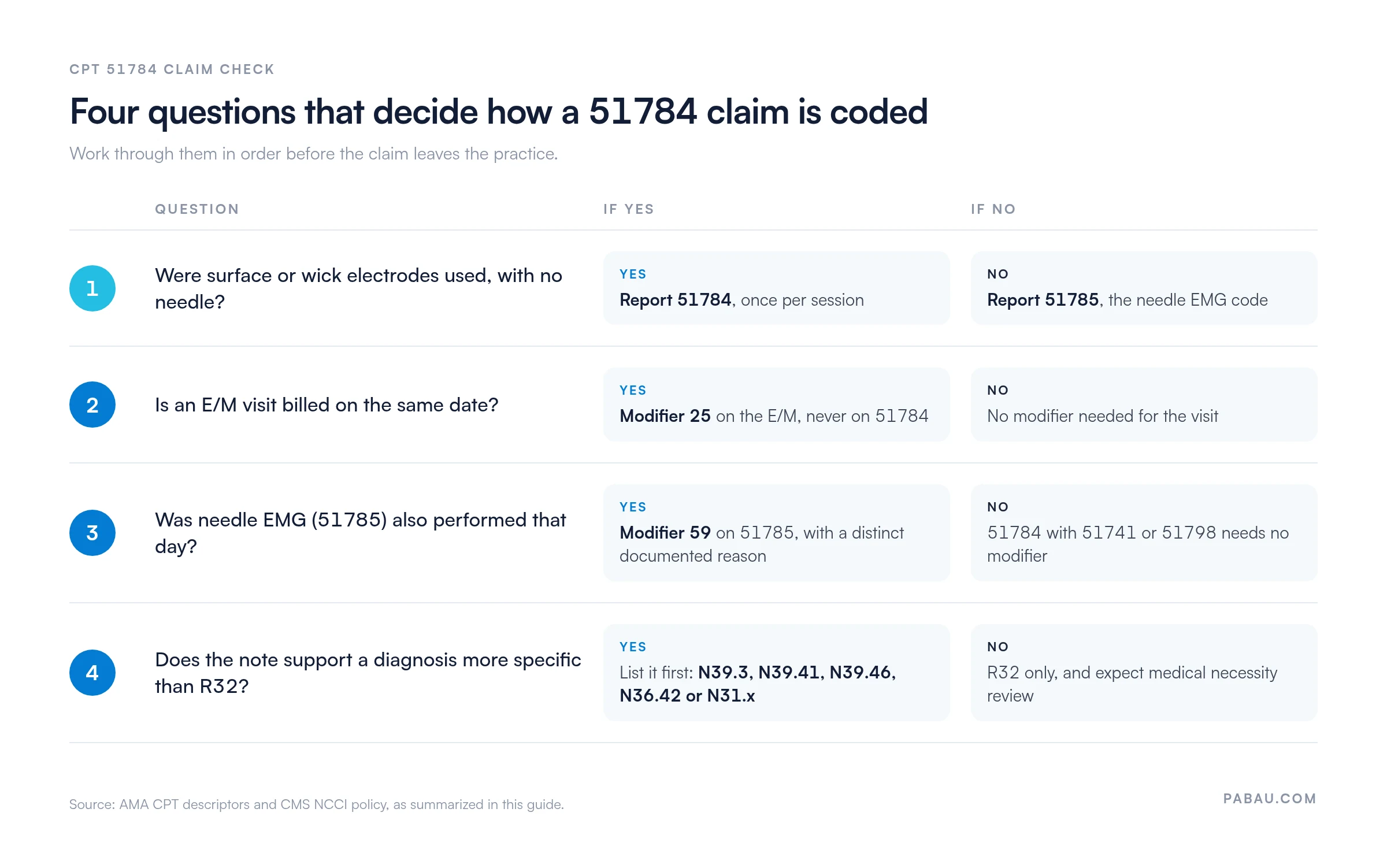
Run an NCCI edit scrub as part of your pre-submission workflow. Flag any 51784 claim that also contains an E/M code and confirm modifier 25 is present before the claim leaves your practice management system.
CMS addresses coverage for pelvic floor EMG studies in Medicare Coverage Database Article A57595, the billing and coding article for pelvic floor dysfunction. Coverage isn’t automatic. The claim must link 51784 to a covered diagnosis, and the clinical note must show medical necessity for the specific indication.
Practices specializing in urogynecology should read it alongside any local coverage determinations (LCDs) their Medicare Administrative Contractor (MAC) issues. An LCD can be more restrictive than the article.
Covered indications under the CMS article include:
Non-covered indications typically include routine screening without documented symptoms and repeat studies outside payer-specified intervals. Studies that only monitor biofeedback therapy, with no separately documented clinical indication, are excluded too.
Article A57595 also sets a lifetime limit: Medicare wouldn’t expect this test to be billed more than twice for the same patient. Check the patient’s history before booking a repeat study. Prior authorization requirements vary by commercial payer, so confirm them before scheduling.
Every 51784 claim is only as strong as the documentation behind it. Payers review these notes closely because pelvic floor EMG is a relatively high-value study with known abuse patterns. The note has to hold up in a retrospective audit.
Minimum required elements in the clinical note:
Correct claim submission for 51784 follows a consistent sequence, and a skipped step is where billing staff introduce errors. Clean claim submission for urodynamic codes depends on every field being populated correctly before the claim leaves the practice.
The 2026 Medicare Physician Fee Schedule (MPFS) rates below are national unadjusted figures. Your payment varies by geographic practice cost index (GPCI) and by setting, facility (hospital or ASC) or non-facility (office).
Use the CMS Physician Fee Schedule lookup tool for locality-adjusted rates. The FastRVU 2026 RVU lookup breaks out work, practice expense, and malpractice RVU values.
Commercial payer rates vary significantly. Some payers use a percentage of Medicare, while others negotiate rates independently. Always check payer-specific fee schedules before quoting reimbursement internally.
Use the PCC free 2026 RVU calculator to apply your locality’s conversion factor and GPCI adjustments. Because 51784 carries the same practice expense RVU in both settings, office and facility payments come out the same.
These figures are approximations based on the 2026 MPFS conversion factor. Verify them against the CMS tool for your MAC jurisdiction before building fee schedules.
A covered diagnosis code is what lets the payer adjudicate 51784 as a covered service. Of the full ICD-10-CM code set, the codes below are the most widely accepted diagnosis pointers for pelvic floor EMG.
List the most specific applicable code first on the claim. Listing R32 when a more specific code applies is a leading cause of medical necessity denials.
Most 51784 denials fall into four categories. Understanding each one helps billing staff build both a prevention protocol and a targeted appeal. Good denial management workflows for urodynamics codes flag these patterns before claims are submitted, not after the remittance arrives.
Track 51784 denials by reason code for 90 days. If more than 20% of denials are for missing modifier 25, the fix sits upstream. Build a modifier 25 prompt into your scheduling template when an E/M and urodynamics are booked together.
Without an integrated system, billing staff check modifiers by hand, then rekey each 51784 claim into a separate clearinghouse portal. Each handoff is another chance to drop modifier 25 or attach the wrong diagnosis pointer.
Pabau, the practice management platform we build, sends CMS-1500 and 837P claims through its Claim.MD clearinghouse integration. That connection reaches thousands of US payers and supports real-time eligibility verification, ERA/835 remittance processing, and secondary claims. Built-in CPT and ICD-10 catalogs validate 51784 and its diagnosis codes before the claim reaches adjudication.
Pabau’s urology claims management software handles modifier assignment, diagnosis pointer mapping, and denial tracking in one workflow. Your team spends less time rekeying claims and chasing avoidable 51784 denials.
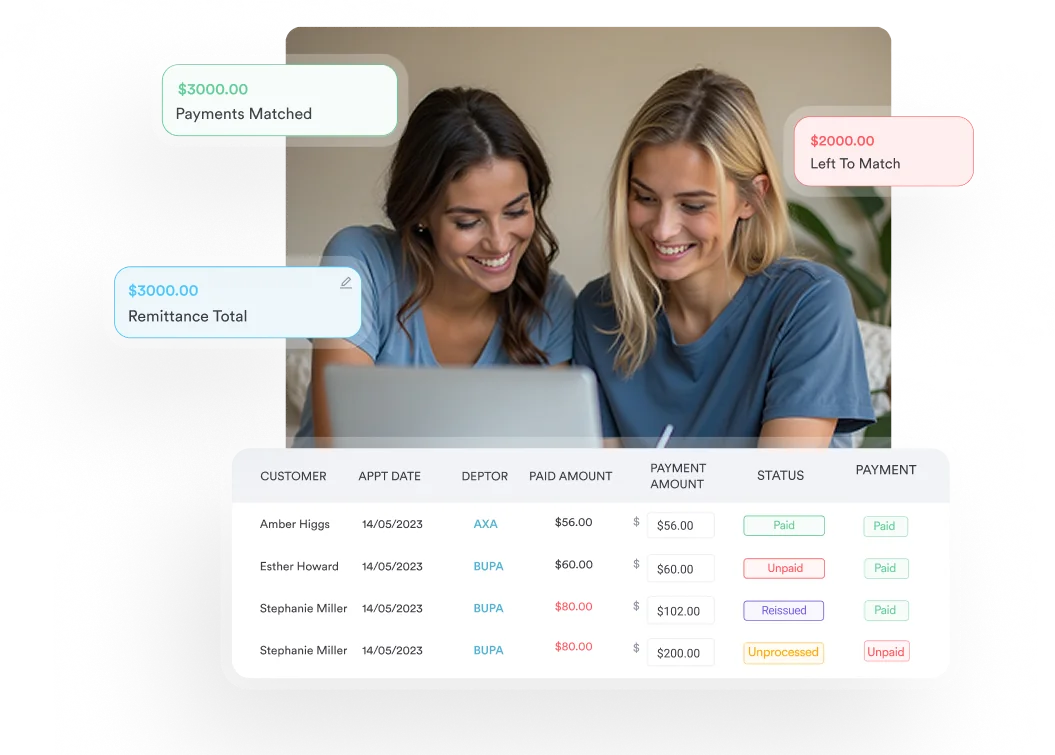

Pabau’s claims management tools help urology and urogynecology practices assign modifiers correctly and map ICD-10 diagnosis pointers. They also track 51784 claims through to payment without manual chasing.

CPT Code 51784 rewards discipline in the note far more than skill at appeal. Get the electrode type, the modifier 25 decision and the lead diagnosis right at the encounter. Then the claim leaves a payer little to question.
The trade-off is a little extra work for the clinician, who records the electrode type and writes a separate interpretation. That costs far less than reworking a denied claim weeks later. Before your next urodynamics session, check that your note templates prompt for each of those fields.
Book a demo to see how Pabau flags missing modifiers and diagnosis pointers on urodynamics claims before they leave your practice.

Need to verify denial codes on rejected urodynamics claims? Denial codes in medical billing explains the most common CARC codes and how to read them on your ERA.
Want to understand how the clearinghouse processes 837P claims? 837 file formats and EDI submission covers the transaction set structure for professional claims.
Looking to verify a patient’s insurance before scheduling urodynamics? Insurance eligibility verification walks through real-time eligibility checks and what to confirm before the appointment.
CPT Code 51784 is the procedure code for EMG of the anal or urethral sphincter using non-needle (surface or wick) electrodes. It’s performed as part of a urodynamic study and sits in the 51725-51798 urodynamic procedures range. Clinicians use it to evaluate pelvic floor muscle function in patients with incontinence, neurogenic bladder, or pelvic floor dysfunction.
Modifier 25 is required on the E/M code. The NCCI bundles 51784 with E/M codes. Without modifier 25, the payer will typically pay the procedure and deny or reduce the visit. The E/M note must document a significant service, separately identifiable from the decision to perform the EMG.
CPT 51784 uses non-needle (surface or wick) electrodes, while CPT 51785 uses needle electrodes inserted into the sphincter muscle. Both codes cover EMG of the anal or urethral sphincter, and electrode type is the defining clinical and billing distinction. Billing both on the same date requires modifier 59 on 51785 and a documented, clinically distinct purpose for each.
NCCI edits bundle 51784 with E/M codes, which need modifier 25 on the E/M code. They also bundle 51784 with 51785, which needs modifier 59 when both are performed on the same date. No NCCI edit exists between 51784 and 51741 or 51798, so those pairs need no bypass modifier. NCCI tables are updated quarterly, so verify the current version before submitting.
Yes. CPT 51798 (ultrasonic measurement of post-void residual) and CPT 51784 are routinely billed together on the same date as part of a complete urodynamic study. No NCCI bundling edit applies between them. Check your MAC’s LCD, or the commercial payer’s policy, for frequency limits on same-day co-billing.
The four most common denial reasons are a missing modifier 25 on a same-day E/M and weak medical necessity documentation. The other two are a note that doesn’t call the electrode non-needle, and 51785 billed the same day without modifier 59.