

CCSD code G5100: Bypass of duodenum billing guide
CCSD code G5100 bills a bypass that leaves the duodenum in place CCSD code G5100...

Last Updated: Oct 16, 2026
51729 is the CPT code for a complex cystometrogram that includes both voiding pressure studies and urethral pressure profile studies in the same session. Complex means the study uses calibrated electronic equipment, and both components are required, measured by any technique.
It is the most comprehensive code in the 51725-51729 cystometrogram family. Without the urethral pressure profile, the study codes to 51728. Without the voiding pressure study, it codes to 51727. Never report 51726 alongside 51727, 51728 or 51729 for the same session.
Let Pabau's smart automation suggest the right codes, reduce claim denials, and keep your practice compliant—effortlessly.
Automate repetitive tasks and focus on what matters most—your patients.
Reduce coding errors and ensure compliance with the latest regulations.
Clean claims, fewer denials, and faster reimbursements.
Powerful insights and reporting to help your practice thrive.
HIPAA compliant SOC 2 certified GDPR-compliant Trusted by 4,000+ clinics worldwide

CPT code 51729 reports a complex cystometrogram with voiding pressure studies and urethral pressure profile studies. All three components are required in the same session.
Voiding pressure only codes to 51728, a urethral pressure profile only codes to 51727, and both together code to 51729. Never bill 51726 alongside any of them for the same session.
CPT code 51729 carries a professional and a technical component. Practices that own their urodynamics equipment can bill both under the same code.
Sphincter EMG (51784) and post-void residual ultrasound (51798) may be separately billable alongside 51729 when performed and documented, subject to current NCCI edits.
Pabau’s claims management software routes urodynamic claims through Claim.MD for electronic submission, real-time eligibility checks and ERA posting.
The American Medical Association (AMA) descriptor for CPT code 51729 opens with “Complex cystometrogram (ie, calibrated electronic equipment)”. It then requires “voiding pressure studies (ie, bladder voiding pressure)” and “urethral pressure profile studies (ie, urethral closure pressure profile), any technique”.
The CMS short descriptor is “Cystometrogram w/vp&up”, which flags the two components that define the code: voiding pressure (vp) and urethral pressure profile (up).
In plain clinical terms, the session must include three components for the code to apply:
The code applies in any setting with a calibrated electronic urodynamics system. That includes office-based urodynamics suites, ambulatory surgical centers, and hospital outpatient departments. Place of service affects reimbursement rates but not code selection.
Knowing what is bundled into 51729 prevents two common billing errors. One is unbundling components that 51729 already includes. The other is missing separately billable services.
The National Correct Coding Initiative (NCCI) edits are updated quarterly. Bundling rules for companion codes can change between fiscal years. Check the current pair in the CMS NCCI edit files before billing any companion code with 51729.
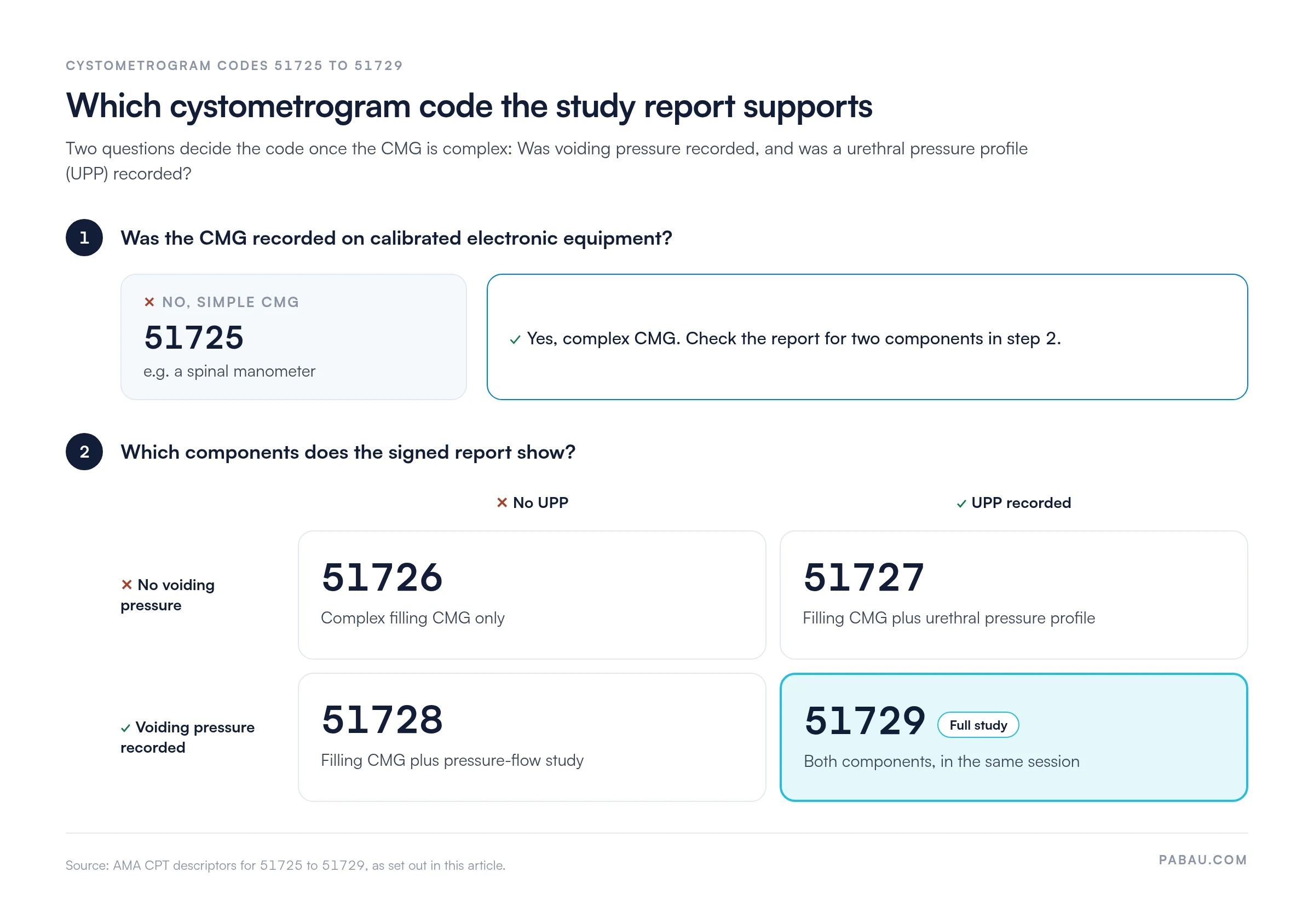
The 51725-51729 cystometrogram family starts with one question: Was the CMG simple or complex? Codes 51726 through 51729 are all complex CMG codes. They separate on two further questions: Was a voiding pressure study performed, and was a urethral pressure profile performed? The most common miscoding reports 51729 when only one of the two was recorded.
Decision rule: Start with the equipment. A CMG recorded on calibrated electronic equipment is complex. A study on non-calibrated equipment, such as a spinal manometer, is simple and codes to 51725.
Then check the report for the two components, as the grid below maps them. Voiding pressure only codes to 51728, a urethral pressure profile only codes to 51727, and both code to 51729. A complex CMG with neither codes to 51726.
A full urodynamic study session often captures data beyond what 51729 covers. Four codes are regularly billed alongside it, each requiring its own documentation and subject to separate NCCI edit review. Check every companion code against the AAPC’s CPT code lookup to confirm current bundling status before submission.
When Modifier 59 is needed to unbundle a companion code, the procedure note must document the service as distinct. That means a different anatomical site, a different instrument, or a service not ordinarily encountered in the primary procedure. CMS auditors apply heightened scrutiny to Modifier 59 usage on urodynamic claims.
Run your urodynamic study billing through an NCCI edit checker before submitting any claim that includes both CPT code 51729 and a companion code. Edits update quarterly, and a pair that was separately billable last year may now be bundled. Document the edit-check date in your billing file as a compliance record.
Insufficient documentation is one of the most frequent reasons payers deny CPT code 51729 claims. The report must contain specific data elements, not just a narrative summary. A clean claim submission for urodynamics starts with a complete study report that meets these requirements:
The interpretation note is the element most commonly missing or deficient. A tracing printout without a physician-signed narrative does not meet medical necessity documentation standards for Medicare or most commercial payers. Refer to the medical billing compliance framework for documentation best practices across procedure-based specialties.
Medicare reimburses CPT code 51729 under the Medicare Physician Fee Schedule (MPFS), which CMS updates annually. Rates vary by geographic locality and by place of service. Non-facility (office-based) rates are higher than facility rates for hospital outpatient or ambulatory surgical center (ASC) settings. In the office, the practice bears the equipment and supply costs.
Always use the CMS Physician Fee Schedule lookup tool to retrieve the current locality-adjusted rates for your ZIP code. Rates change each January 1.
The code carries both a professional component (26) and a technical component (TC). Practices that own their urodynamics equipment and employ the interpreting physician can bill globally (no modifier) for the full payment. When the interpreting physician does not own the equipment, split billing applies. The interpreting physician bills 51729-26, and the facility bills 51729-TC.
Medicare does not require prior authorization for CPT code 51729, but many commercial payers do. Medical necessity criteria vary by payer and are governed by LCDs for Medicare or clinical policy bulletins for commercial plans. Verify requirements with each payer before scheduling the study.
Most LCD policies require documentation of at least one of the following before urodynamics is considered medically necessary:
LCD criteria differ by MAC jurisdiction. Consult your specific MAC’s LCD for urodynamic services before treating medical necessity as universal. When a properly documented study is denied for medical necessity, check it against the LCD criteria before you re-code the claim.
Pairing CPT code 51729 with the correct ICD-10-CM diagnosis code is essential for establishing medical necessity on the claim. The diagnosis must reflect the documented clinical finding, not the planned procedure. Common pairings:
Avoid using unspecified urinary incontinence (R32) when a more specific code is documented. Specificity reduces the risk of a medical necessity denial and simplifies appeals if a claim is challenged. The diagnosis must appear in the physician’s note for the encounter, not just on the claim form.
Denials on CPT code 51729 fall into four categories, each with its own prevention step. Strong denial management in healthcare starts with knowing which denial type you are dealing with before routing the appeal.
Understanding medical billing denial codes helps billing staff identify the root cause faster. A CO-4 denial (inconsistent modifier) on a 51784 companion code is a different appeal pathway than a CO-50 denial (medical necessity not established). Sorting denial codes into categories at intake cuts rework time significantly.
Build a CPT 51729 denial tracker by category (bundling, medical necessity, authorization, documentation) and review it monthly. Bundling denials cluster around the quarterly NCCI updates in January, April, July and October. Catching a pattern early means you can update workflows before the denial volume compounds across an entire quarter.
Nurse practitioners (NPs) and physician assistants (PAs) can perform urodynamic studies. Under Medicare, the billing rules depend on how the service is furnished and documented. Scope-of-practice and supervision requirements vary by state. Always verify your state board’s requirements alongside the federal rules below.
Independent billing: Under Medicare, NPs and PAs may bill CPT code 51729 in their own name at 85% of the physician fee schedule. They must be enrolled in Medicare, practice within their state scope of practice, and sign their own interpretation note. The claim is submitted under the NP’s or PA’s NPI.
Incident-to billing: An NP or PA may bill urodynamics at 100% of the physician fee schedule under incident-to rules when four conditions are met:
Incident-to billing requires the supervising physician’s NPI on the claim.
Technical component: When the practice owns the urodynamics equipment, the technical component (TC) can be billed independently of the professional component. An NP or PA can perform and document the study while the supervising physician provides and bills the professional component (26). When both components are submitted together, the result is a global bill.
Commercial payers vary widely on NP and PA billing for urodynamics. Some require physician billing for any invasive urodynamic procedure regardless of state scope laws. Verify with each payer’s provider manual. In a multi-provider practice, record on each claim who performed the study and whose NPI bills it.
Most 51729 billing errors start before the claim is built. The coder sees pressure-flow tracings in the report and picks 51729, even though no urethral pressure profile was recorded. The claim then goes out with a companion code that a quarterly NCCI update has since bundled.
Pabau, the practice management platform we build, includes claims management software that keeps the study appointment, invoice and claim in one record. Claim.MD checks eligibility before the study, and claim status tracking flags denied claims for rework. Run NCCI edit checks in a separate edit checker before submission.
Electronic remittance advice (ERA) posting closes the loop once the payer responds. Your billing team works from one record instead of a spreadsheet and a clearinghouse portal.
Pabau’s Claim.MD clearinghouse integration submits urodynamic claims electronically to thousands of US payers. The eligibility response arrives before the patient does, so a lapsed policy surfaces before the study rather than after the denial.
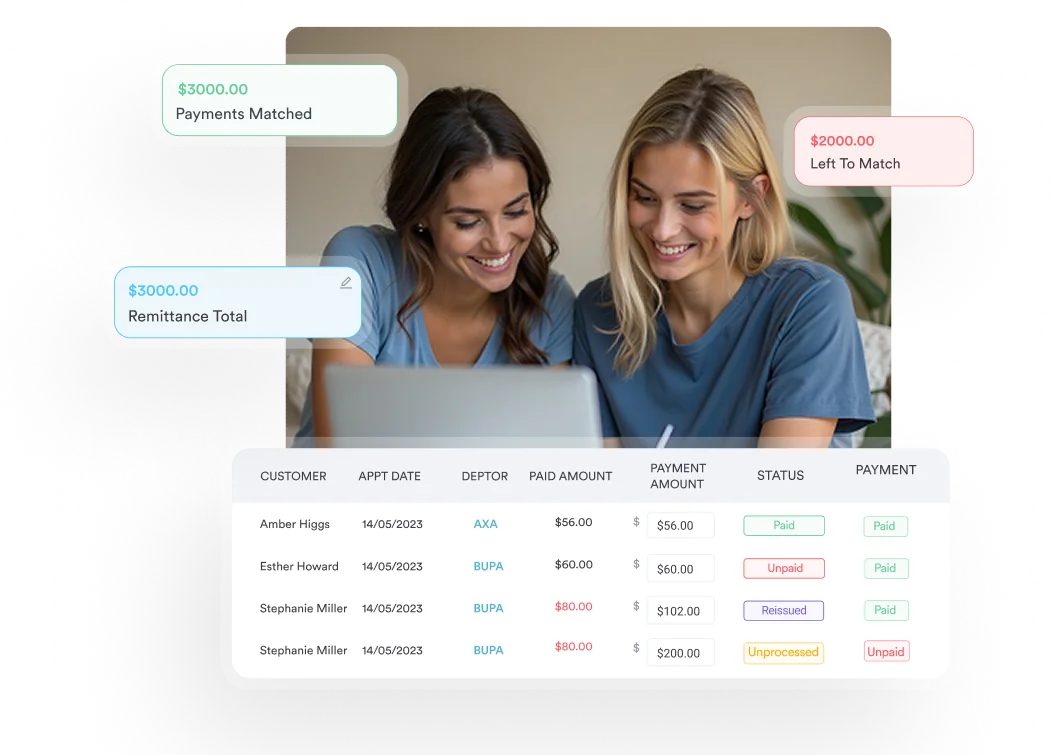

Pabau’s claims management handles clearinghouse submission, real-time eligibility checks, and ERA posting for urology and urogynecology practices. Your team spends less time on rework and more time on patients.

CPT code 51729 rests on what the signed study report shows. The code needs a complex CMG, a voiding pressure study and a urethral pressure profile, all recorded in the same session. Drop one component and the correct code drops with it, to 51728 or 51727.
So code each study from its signed report. Before the claim leaves, confirm the report holds both the pressure-flow data and the urethral closure pressures. That one check prevents the downcode and the audit exposure that follow a 51729 billed on partial data.
Pabau’s medical billing workflows, backed by the Claim.MD clearinghouse, handle electronic submission, real-time eligibility checks, and ERA posting for urology and urogynecology practices. To see how Pabau manages urodynamic claims from scheduling through payment, book a demo.

Need to understand how claims flow from encounter to payment? What is revenue cycle management explains the end-to-end process urology practices use to turn a study into collected revenue.
Want a structured guide to submitting cleaner electronic claims? 837 file submission guide covers the EDI format Medicare and commercial payers require for procedure-based claims.
Looking for a credentialing and payer enrollment walkthrough? Getting credentialed with insurance companies covers the enrollment steps NPs and PAs need before billing urodynamics independently.
Billing a post-void residual scan in the same session? CPT code 51798 covers the documentation that keeps the bladder scan separately payable.
Coding the sling procedure that follows the study? CPT code 57288 explains how to report a sling operation for stress incontinence.
CPT code 51729 reports a complex cystometrogram with voiding pressure studies and urethral pressure profile studies, by any technique. Both components are required in the same session. It is the most comprehensive code in the 51725-51729 cystometrogram family. It applies when calibrated electronic equipment records bladder pressure through filling and voiding, and the urethral closure pressure profile is measured too.
Both codes describe a complex CMG with voiding pressure studies. The difference is the urethral pressure profile: 51729 requires one, and 51728 does not include one. If the report shows pressure-flow data but no urethral closure pressure profile, bill 51728. If it shows both, bill 51729, and never bill 51728 alongside it for the same session.
Medicare rates for CPT 51729 are locality-adjusted and updated each January 1. The non-facility rate (office-based global bill) is higher than the facility rate because it includes the practice expense component for equipment ownership. Use the CMS Physician Fee Schedule lookup tool at cms.gov to retrieve the current national and locality rates for your ZIP code. If you use a third-party tool, check the publication year first.
CPT code 51729 is the UDS (urodynamic study) code for a full study. That means a complex CMG with voiding pressure studies and a urethral pressure profile. If no urethral pressure profile was performed, the study codes to 51728 instead. A session may also include companion codes 51784 (EMG), 51798 (post-void residual ultrasound) and 51741 (uroflowmetry), billed separately when documented. The combination varies by clinical indication and payer policy.
Medicare does not require prior authorization for CPT 51729, but many commercial payers do. Requirements vary by health plan and are not universal. Check the patient’s plan for a prior authorization requirement before scheduling. A missing authorization is one of the most preventable denial causes for urodynamic procedures.
Yes, in many cases. Sphincter EMG (CPT 51784) is generally separately billable alongside CPT 51729 when performed and documented with its own interpretation note. However, NCCI edit status for this pair is reviewed quarterly. Verify current edit status before billing both codes, and apply Modifier 59 only when the payer’s policy and your documentation support it.



