CCSD Code B2710: Radical mastectomy including block dissection
CCSD Code B2710: Definition and clinical scope CCSD Code B2710 is the UK private...

Last Updated: Nov 13, 2026
52630 is the CPT code for transurethral resection; residual or regrowth of obstructive prostate tissue including control of postoperative bleeding, complete.
The code applies only to repeat resections. The patient has already had a primary TURP, typically billed as CPT 52601, and now has recurrent obstruction from remaining or regrown tissue. Three errors are common causes of avoidable denials on this code. Coders confuse it with 52601, miss the prior-procedure documentation, or pick the wrong modifier inside a global period.
Let Pabau's smart automation suggest the right codes, reduce claim denials, and keep your practice compliant—effortlessly.
Automate repetitive tasks and focus on what matters most—your patients.
Reduce coding errors and ensure compliance with the latest regulations.
Clean claims, fewer denials, and faster reimbursements.
Powerful insights and reporting to help your practice thrive.
HIPAA compliant SOC 2 certified GDPR-compliant Trusted by 4,000+ clinics worldwide

CPT 52630 covers a repeat transurethral resection of residual or regrown prostate tissue, never an initial resection.
The record must document a prior TURP, and a missing prior-procedure record is a frequent audit trigger.
Inside a prior 52601’s 90-day global, use modifier 78 for an unplanned return to the OR and modifier 58 for a planned staged repeat.
52630 carries its own 90-day global period, so related care in that window is bundled into the surgical payment.
N40.1, BPH with lower urinary tract symptoms, is the diagnosis most often paired with 52630.
CPT code 52630 reports a repeat transurethral resection of residual or regrown obstructive prostate tissue, including control of postoperative bleeding. The AMA’s CPT Editorial Panel maintains the code set and its official descriptor. It reads: Transurethral resection; residual or regrowth of obstructive prostate tissue including control of postoperative bleeding, complete. The code sits in the Surgery section, Urinary System subsection, within the 52400-52700 vesical neck and prostate range.
Three elements set 52630 apart from other urological resection codes. The procedure is a repeat resection, it targets residual or regrown obstructive tissue, and it bundles bleeding control. An operative note missing any one of them leaves the claim exposed at audit.
Note: RVU values and Medicare payment amounts change each calendar year. Always verify current figures in the CMS Physician Fee Schedule search tool before submitting claims or producing fee schedules.
CPT code 52630 applies when a patient who already had a complete TURP returns with symptoms caused by residual or regrown prostate tissue. The first procedure is typically billed as CPT 52601. Benign prostatic hyperplasia (BPH) is the most common underlying diagnosis. Prostate tissue can regrow, so symptoms often return months or years after the first procedure.
The chart must establish four things before 52630 is coded:
The typical patient is an older man with BPH, often on Medicare, presenting 2 to 7 years after their original TURP. Some patients return sooner when residual tissue was left intentionally at the first operation due to bleeding risk or incomplete visualization.
Audit the patient’s prior surgical history before coding. Say the chart shows a 52601 within the last several years. If the new op note describes re-resection of obstructive tissue, 52630 is the correct code. If no prior TURP is documented anywhere in the record, 52601 applies regardless of the clinical narrative.
The descriptor bundles several services into a single reportable unit. Billing them separately on the same operative session triggers National Correct Coding Initiative (NCCI) bundling edits and is a common denial cause.
Included (not separately billable on the same day):
Separately reportable (when documented as distinct services):
The choice between 52601 and 52630 turns on one question: Has the patient had a prior complete TURP? CPT 52601 is for a complete initial resection. CPT 52630 is for a repeat resection of residual or regrown tissue. Payers audit prior-procedure history, so a swap rarely goes unnoticed. A 52601 billed for a patient whose record already shows one triggers a medical-necessity review or a denial.
Coders working in urology encounter several codes alongside CPT Code 52630. Knowing which are mutually exclusive and which may be reported together prevents bundling denials.
Consult the current AAPC Codify CPT lookup and the NCCI Policy Manual chapter on urological endoscopy before billing 52630 alongside any same-session code. When a repeat procedure uses laser vaporization rather than loop resection, review 52648 before you code it.
Medical necessity for CPT Code 52630 requires a supporting ICD-10-CM diagnosis that reflects the clinical indication. Medicare and most commercial payers expect at least one of the following on the claim.
Some Medicare Administrative Contractors (MACs) have issued Local Coverage Determinations (LCDs) for TURP procedures that specify minimum AUA symptom score thresholds or urodynamic criteria. Check the relevant MAC LCD for your practice’s jurisdiction before submitting.
Medicare is the dominant payer for CPT 52630 given the demographic profile of BPH patients. Payment starts from the Relative Value Units assigned to the code, multiplied by the annual conversion factor. Geographic practice cost indices (GPCI) then adjust it by location.
Use FastRVU’s RVU lookup tool or the CMS Physician Fee Schedule search to retrieve current-year RVUs. Pull the work, practice expense (facility and non-facility), malpractice and total values for the year you bill.
Key reimbursement concepts for 52630 billers:
Routing 52630 through a Claim.MD clearinghouse lets format errors surface before the payer sees the claim. That check matters most on high-RVU urology procedures, where a rejected claim delays a large payment.
CPT 52630 carries a 90-day global surgical period. Services related to the repeat TURP are bundled into the 52630 payment for 90 days after the procedure. They cannot be billed separately without a modifier that justifies the unbundling.
The more critical question for urology billers is what happens when 52630 is itself performed during the global period of a prior 52601. That is the scenario that generates most modifier confusion.
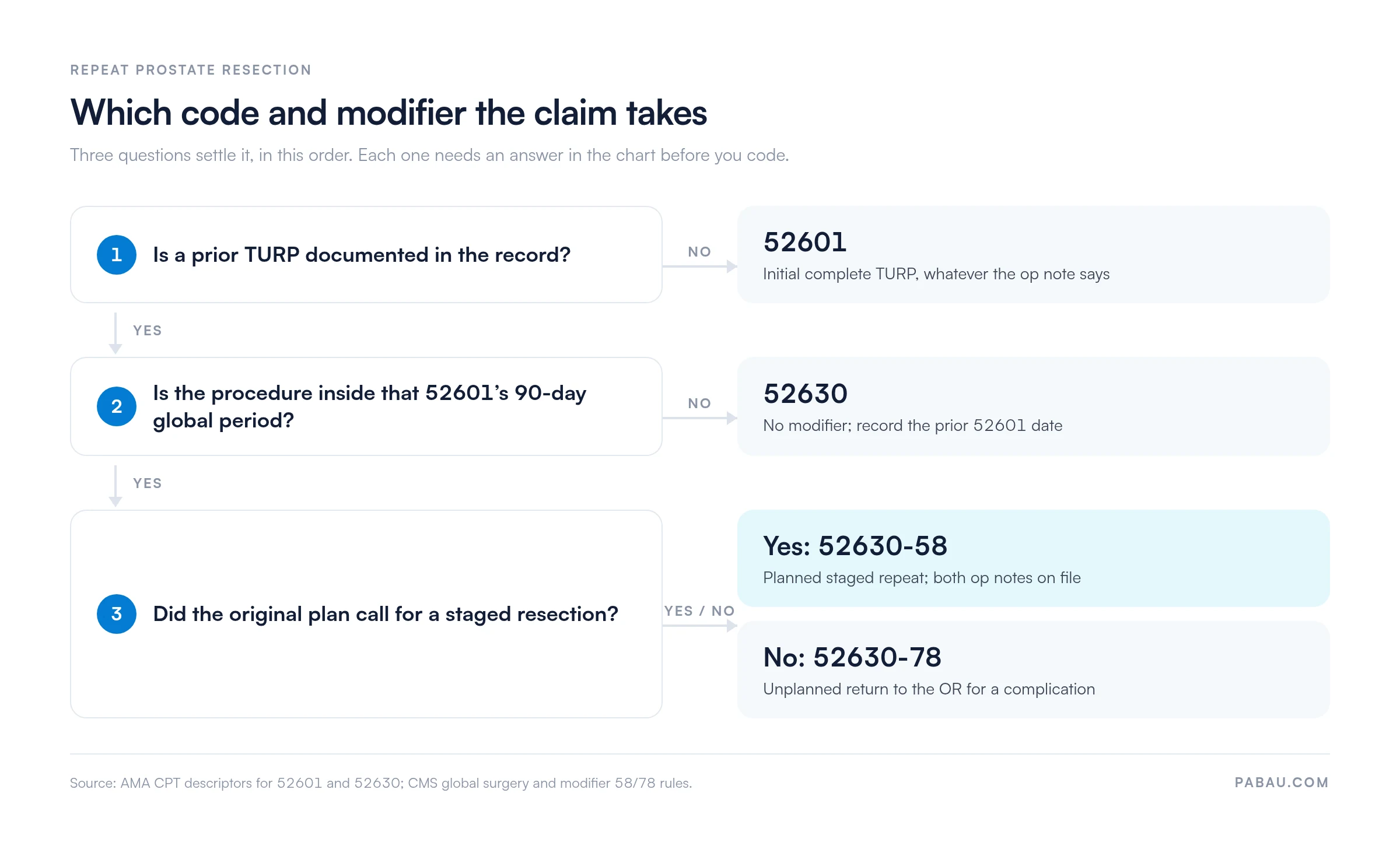
Practical decision rule: A patient still inside the 52601 global window who returns to the OR urgently for bleeding or acute obstruction takes Modifier 78. If the original operative plan stated the resection would be completed in two stages, that is Modifier 58. If the global period has fully elapsed, no modifier is needed on the 52630 itself. The flow below puts the three questions in the order a coder should answer them.
Incomplete documentation causes many first-submission failures on 52630, and it raises audit risk too. The operative report must show why this patient needed a repeat resection rather than an initial one.
A clean claim submission for 52630 requires the operative record to contain all of the following elements:
Missing prior-TURP documentation is a frequent trigger for audits and denials on this code. Build a pre-billing checklist that flags charts where the operative note references a “re-do” or “repeat” TURP but no prior procedure record is attached.
Review every 52630 claim before submission. Confirm the prior 52601 date and code are in the chart, and check that the op note names residual or regrown tissue. Then match the modifier to the global period status. Three minutes of review prevents weeks of appeals.
Understanding where 52630 claims fail helps urology billing teams fix root causes rather than chase individual appeals. Denial management workflows for surgical codes like 52630 work best when sorted by denial type. Claims management software can then track those patterns across the 52xxx code range.
Review denial codes in medical billing to map payer-specific CARC codes back to these root causes and streamline your appeals workflow.
Medicare Part B generally does not require prior authorization for CPT 52630, treating it as a covered surgical benefit when medical necessity is documented. That said, the MAC for your region may have issued a Local Coverage Determination governing which symptom scores or urodynamic thresholds must be met. Check the relevant MAC LCD before scheduling to confirm the chart meets stated criteria.
Commercial payers take a different approach. Most major carriers require prior authorization for repeat TURP procedures, and many specify:
Effective prior-auth management feeds directly into the broader revenue cycle management flow for urology practices. Submit the authorization request with the full clinical documentation package, not just the required fields. Payers scrutinize repeat surgical procedures more heavily than first-time ones.
Many 52630 denials trace back to the chart. The prior 52601 date is missing, the global-period modifier is wrong, or the diagnosis is vague. Billers often find out only when the payer sends the claim back.
Pabau, the practice management and billing platform we build, keeps operative notes, procedure history and claims on one patient record. In the US, its claims tools connect to Claim.MD to submit claims to thousands of US payers, check eligibility and post ERA remittances.
Your coder sees the earlier 52601 date before choosing a modifier, and a returned claim lands back on the record it came from. That shortens the trip from denial to corrected resubmission.
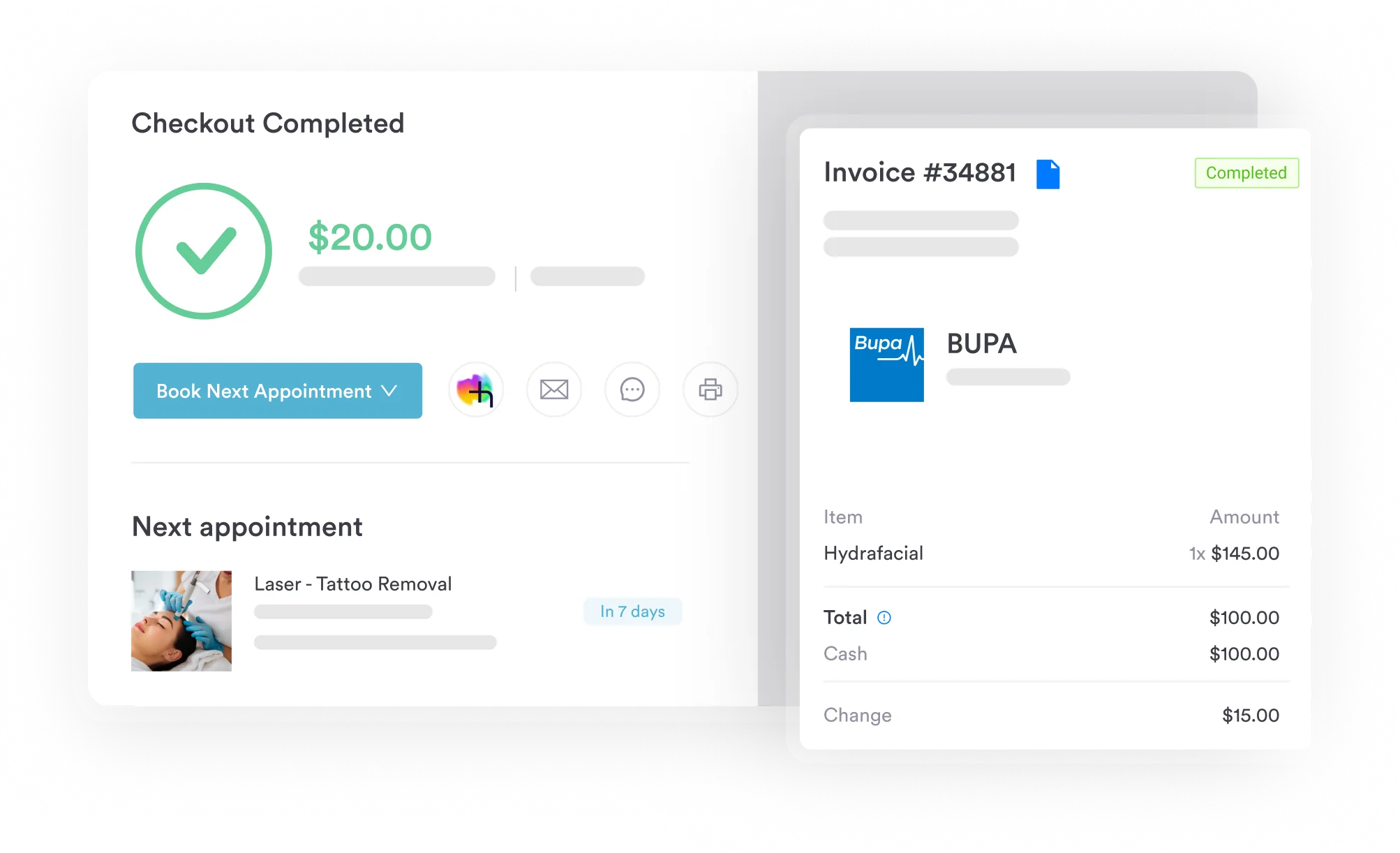

Pabau integrates with Claim.MD to handle CPT claim submission, real-time eligibility checks, and ERA posting for urology practices. See how it works for your team.

Code 52630 only when the chart proves a prior TURP, then let the 52601 global window decide the modifier. Settled in that order, a repeat resection reaches the payer with the code, modifier and history in agreement.
The cost is a few minutes before submission, spent pulling outside operative records and checking dates. A denied 90-day-global surgical claim takes far longer to rework than that check takes to run.
Pabau’s Claim.MD connection submits claims to thousands of US payers and posts remittances back to the patient record. Book a demo to see how Pabau handles repeat surgical claims for urology practices.

Need to track denial patterns across your urology claims? Denial management in healthcare outlines how to categorize, track, and resolve claim denials systematically.
Submitting 837P claims electronically? 837 file format for medical claims explains the EDI transaction set structure used for professional claim submission.
Want to verify eligibility before the procedure date? Insurance eligibility verification covers how real-time payer checks reduce same-day authorization surprises on surgical cases.
CPT code 52630 includes endoscopic access, resection of residual or regrown obstructive prostate tissue, intraoperative bleeding control, and routine catheter placement. Routine same-session diagnostic cystoscopy (CPT 52000) is bundled and not separately billable per NCCI edits.
CPT 52601 is for a complete initial TURP with no prior prostate resection history. CPT 52630 is for a repeat TURP after a prior 52601, when residual or regrown obstructive tissue remains. The two codes are mutually exclusive on the same date and cannot be billed together.
CPT 52630 carries a 90-day global surgical period. Related services within those 90 days are bundled into the base payment. They cannot be billed separately without a modifier that justifies the unbundling.
Yes. The official AMA descriptor explicitly states “including control of postoperative bleeding, complete.” Billing a separate hemostasis code for intraoperative bleeding control during the same operative session will trigger a bundling denial under NCCI edits.
Code 52630 when the operative note confirms a prior TURP history and the current resection targets residual or regrown tissue. Code 52601 when the operative note documents a first-time, complete prostate resection with no prior TURP history. Prior-procedure documentation in the chart is the controlling factor.