HCPCS Code E0272: Foam rubber mattress billing guide
HCPCS Code E0272: official descriptor and code overview HCPCS Code E0272 is the ...

Last Updated: Nov 6, 2026
27524 is the CPT code for open treatment of patellar fracture, with internal fixation and/or partial or total patellectomy and/or repair of retinaculum.
The code applies whenever the surgeon incises the skin to reach the patella. Tension band wiring, partial patellectomy with retinacular repair and total patellectomy without hardware all map to 27524. Closed treatment is reported with 27520 instead. A missing laterality modifier (LT/RT) and an operative report that omits which descriptor components were performed are frequent denial triggers.
Let Pabau's smart automation suggest the right codes, reduce claim denials, and keep your practice compliant—effortlessly.
Automate repetitive tasks and focus on what matters most—your patients.
Reduce coding errors and ensure compliance with the latest regulations.
Clean claims, fewer denials, and faster reimbursements.
Powerful insights and reporting to help your practice thrive.
HIPAA compliant SOC 2 certified GDPR-compliant Trusted by 4,000+ clinics worldwide

CPT Code 27524 covers open (surgical) treatment of patellar fracture, which separates it from 27520, the only closed-treatment patellar fracture code.
The 90-day global period bundles all routine post-op visits, so billing standard follow-up separately within that window triggers denials.
A missing laterality modifier (LT/RT) and an operative report that omits which descriptor components were performed are frequent denial triggers.
Pabau’s claims management software works with the Claim.MD clearinghouse to help catch missing modifiers and code mismatches before submission.
CPT Code 27524 has an official descriptor set by the American Medical Association.
It reads: “Open treatment of patellar fracture, with internal fixation and/or partial or total patellectomy and/or repair of retinaculum.” The “and/or” construction means the code covers any combination of those three components. Fixation alone, patellectomy alone, or either one with retinacular repair is still reported once as 27524. What separates it from the closed treatment code 27520 is that the surgeon opens the fracture site.
Open treatment of patellar fracture begins with the patient supine under general or spinal anesthesia. The surgeon makes a midline or parapatellar incision over the kneecap and directly inspects the fracture pattern before choosing a fixation strategy. That choice drives what the operative report must document for 27524.
Fluoroscopy confirms reduction and hardware position intraoperatively. Intraoperative fluoroscopy (CPT 76000) is generally bundled into 27524 under NCCI edits. Verify the current edit table before billing it separately.
The 90-day global surgical package for 27524 bundles most routine post-operative care. The table shows which services are included and which can be billed separately with the right modifier.
Choosing the right code from the patellar fracture family depends on whether the fracture site was surgically exposed. CPT 27520 is the only closed-treatment code for a patellar fracture, and the next code in the family is 27524. The table below shows the distinctions coders check in the operative report before assigning a code.
Check the operative report for the phrase ‘surgical approach’ or ‘incision over the patella.’ If neither phrase appears and the note describes reduction only, the correct code is 27520, not 27524. Upcoding to the open treatment code when the approach was closed constitutes improper billing.
Patellar fracture diagnosis codes fall under ICD-10-CM subcategory S82.0. Every code requires a laterality character and a 7th-character extension reflecting the encounter type. Getting the 7th character wrong is a frequent denial trigger. Use the CDC ICD-10-CM tabular list to verify the full code set for each operative scenario.
7th character rules: Use “A” for the initial encounter when the fracture is closed and the surgeon performs definitive open treatment. Use “B” for an open type I or II fracture, and “C” for an open type IIIA, IIIB or IIIC fracture. A closed displaced transverse fracture of the right patella, a pattern that often goes to ORIF, is reported as S82.031A.
Follow-up visits, hardware checks and physical therapy use the subsequent-encounter characters (D through S). A surgery claim that carries a “D” character signals that treatment is already in progress, so payers reject it.
The 90-day global period for CPT Code 27524 means that all routine post-operative care through day 90 is bundled into the surgical fee. The timeline below shows the three billing windows around the surgery, and the modifier that unlocks each separate charge.
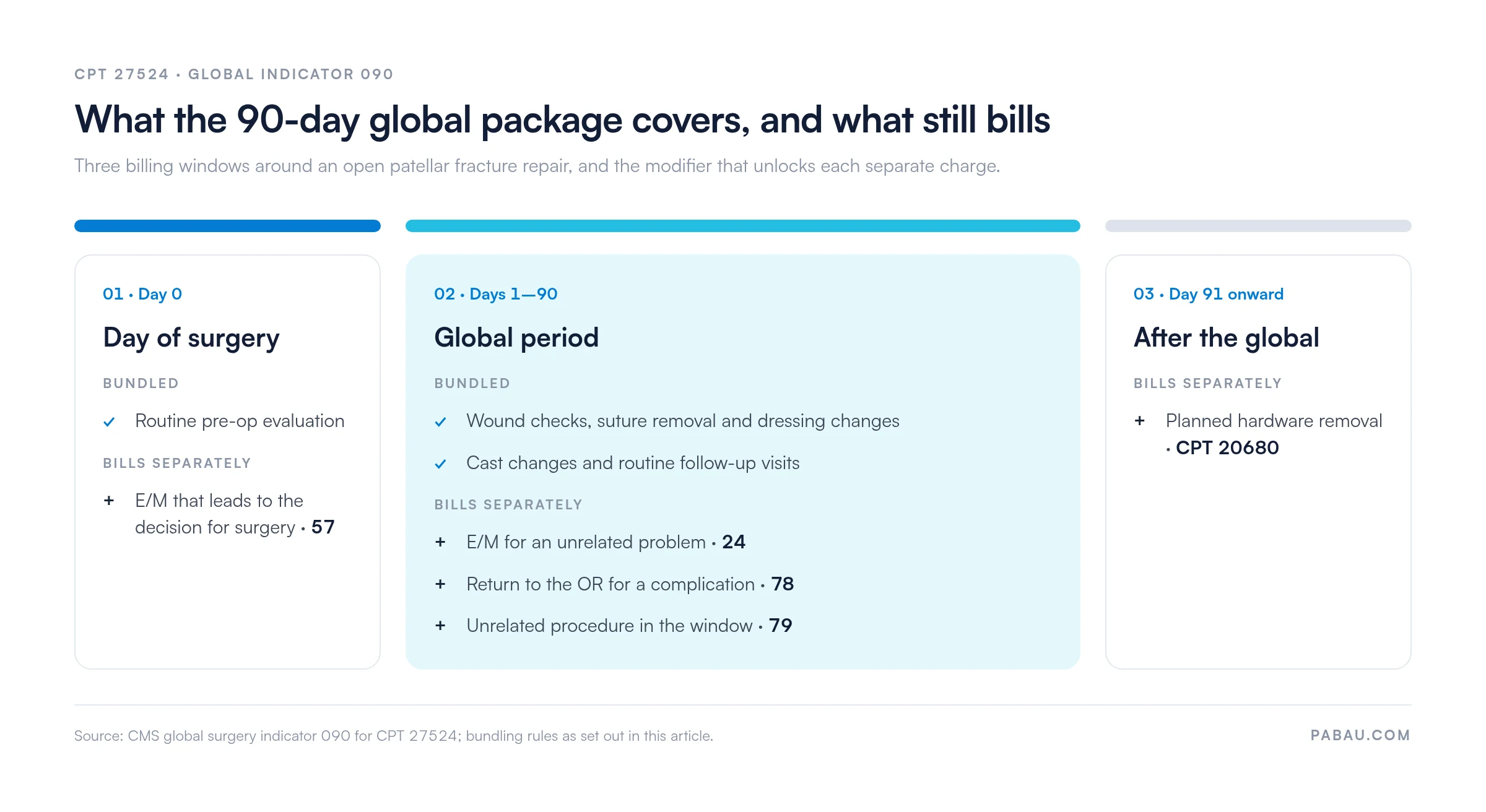
Medicare pays CPT Code 27524 under a 090 global period, so one fee covers the surgery and 90 days of routine post-operative care. PayerPrice lists the 2026 national Medicare non-facility rate at $705.09, before geographic adjustment.
Each MAC region adjusts that figure with its geographic practice cost index (GPCI). Use the CMS Physician Fee Schedule Look-Up Tool to pull the current RVUs and the facility and non-facility rates for your locality.
Rates change each January when CMS publishes the final physician fee schedule rule. Never quote a Medicare rate to a patient or payer without pulling the current locality-adjusted amount from the CMS look-up tool.
Payers audit 27524 claims against the operative report. A note that simply states “ORIF patella” gives a reviewer grounds to downcode or deny. It needs the fracture pattern, approach, fixation method, and any additional procedures. The operative report is the most important document in a clean claim package for 27524.
Modifier selection for 27524 claims determines whether a claim pays, pays reduced, or denies outright. The following modifiers appear most frequently on patellar ORIF claims.
Prior authorization requirements for CPT Code 27524 vary by payer and cannot be generalized. Medicare generally does not require prior authorization for medically necessary fracture ORIF, but commercial insurers frequently do. Verify requirements with each specific plan before scheduling. Strong revenue cycle management processes include checking prior auth at patient registration, not at the time of billing.
For trauma presentations where surgery proceeds emergently, document ’emergent surgical intervention required due to fracture pattern and neurovascular risk’ in the pre-op note. This language protects against post-surgical authorization denial and supports the claim if the payer requests records.
Denied 27524 claims usually trace back to a short list of fixable problems. Effective denial management workflows should track these triggers by payer so patterns can be addressed at the source. For a complete reference on denial codes in medical billing, cross-reference your CARC codes against the specific 27524 scenarios below.
Without a pre-submission check, a missing LT/RT modifier or a wrong 7th character usually surfaces only when the denial comes back. Each one costs a corrected claim, a resubmission and another wait for payment.
Pabau’s claims management software lets practice teams build pre-submission scrubbing rules and flag claims with missing modifiers before they reach the payer. The same tools track denial trends across CPT codes, including 27524.
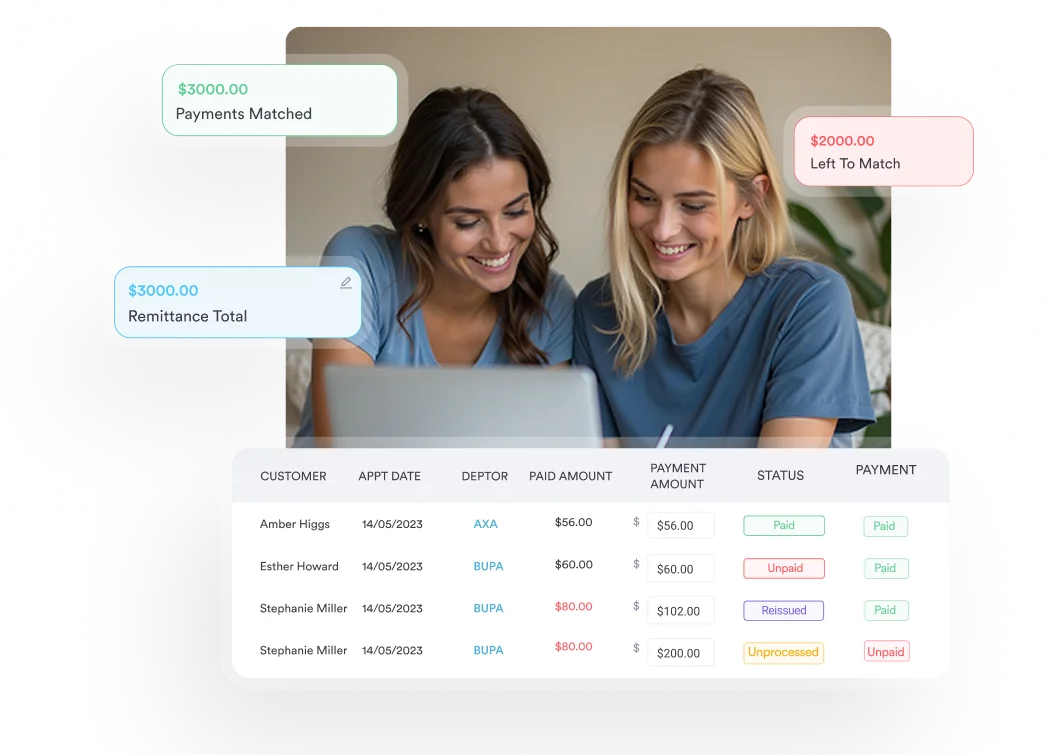
Claims then go out through the Claim.MD clearinghouse integration, and claim status comes back into the same system. The billing team sees which 27524 claims are pending, paid or denied without logging into a separate portal.

Pabau integrates with Claim.MD to validate CPT and ICD-10 codes before submission, flag missing modifiers, and track claim status across your orthopedic cases.

CPT Code 27524 is straightforward to assign once the operative report confirms an open approach. Denials come from the paperwork around it. The usual culprits are a missing LT/RT modifier, a wrong 7th character, or a note that never names the components performed.
Check those three items on every 27524 claim before submission, not after the first denial. Fixing the operative note template once costs less than reworking each rejected claim. Book a demo to see how Pabau checks orthopedic claims from the encounter through to payment.

Need a clearinghouse for orthopedic claim submissions? Pabau’s Claim.MD clearinghouse integration explains how electronic claim validation works for US practices billing CPT codes.
Want to understand the full 837 claim submission process? Electronic 837 claim files covers the EDI transaction set used to submit CPT 27524 and other surgical claims to payers.
Getting ERA data back after claim adjudication? Electronic remittance advice (ERA) explains how to read 835 remittance files and match payments to your 27524 submissions.
CPT Code 27524 is the procedure code for open surgical treatment of a patellar (kneecap) fracture. It covers internal fixation, partial or total patellectomy, and retinacular repair, individually or in combination. It applies whenever the surgeon makes an incision to access and treat the fracture directly, which separates it from the closed treatment code 27520.
CPT 27520 covers closed treatment of a patellar fracture without manipulation, and it is the only closed-treatment code in the family. The skin is never incised. CPT 27524 requires a surgical incision to access the fracture site. If the operative report does not describe a skin incision over or around the patella, 27524 cannot be assigned.
Patellar fracture diagnosis codes fall under ICD-10-CM subcategory S82.0. Subcodes specify the fracture type (transverse S82.03_, comminuted S82.04_, osteochondral S82.01_, unspecified S82.00_) and laterality (1 = right, 2 = left). At the initial surgical encounter, the 7th character is “A” for a closed fracture. An open fracture takes “B” or “C”, depending on its Gustilo type. Subsequent encounter characters (D through S) are used for follow-up visits, not for the surgery itself.
CPT 27524 carries a 90-day global period (CMS indicator “090”). Routine post-operative visits, dressing changes, and cast management within 90 days of surgery are bundled into the surgical fee. Services outside the global package, such as treatment of a new unrelated condition, require modifier 24. A complication requiring return to the OR during the global period is billed with modifier 78.
Yes, assistant surgeon billing is potentially payable for CPT 27524, but payability varies by payer. Medicare assigns an assistant surgeon indicator of “1” to this code, meaning payment may be allowed when medical necessity is documented. Use modifier 80 for a qualified assistant surgeon or modifier 82 when a qualified resident was unavailable at a teaching facility. Always verify with the specific payer before assuming coverage.
The operative report must document the fracture pattern and displacement, the surgical approach, and the fixation method and hardware. It also records any retinacular repair or patellectomy, plus the post-operative stability check. Note intraoperative fluoroscopy too, although CPT 76000 is generally bundled under NCCI edits. Missing any component that is included in the code descriptor gives payers grounds to downcode or deny the claim.